
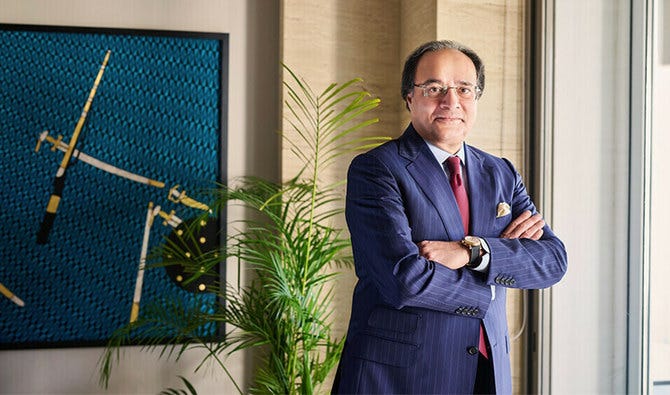
Who Is Finance Minister Muhammad Aurangzeb?
Pakistan's finance minister ran the country's largest bank HBL for six years. The numbers he left behind tell a different story than the one he tells about himself.
Tariq Hussain runs a hardware stall on Shahrah-e-Faisal, Karachi. He opened an HBL current account in 2009 because the branch was close and the name felt like a guarantee. He has never changed banks. In 2022, when he went to renew a small trade loan he had been taking for years, the bank told him the process had changed. More forms. More documentation. A longer wait. He eventually got it, three months later, at a rate he could barely absorb. He did not know that, in the same year, the bank’s CEO was earning Rs 352 million annually in salary and perquisites. He did not know that the bank his account sat inside had posted record profits and still paid its shareholders a dividend thirty percent lower than what it had paid a decade earlier. He did not know any of this. He just knew the loan took longer and cost more.
Aurangzeb ran HBL from I.I. Chundrigar Road, and it is from there that his record must be read. He is now Pakistan’s finance minister, the man who meets IMF missions first, who sets the country’s fiscal course, who tells the poor that the pain of austerity is temporary. Before Q-block, he ran the largest bank in Pakistan for six years. The record from those six years deserves a forensic reading, not a ceremonial one.
The inheritance and the mandate
When Aurangzeb walked into HBL in April 2018, the bank was in genuine crisis. The New York State Department of Financial Services had, the year before, found that HBL’s New York branch had systematically violated US sanctions and anti-money-laundering rules for years. The consent order that followed was damning in its specificity: a “good guy list” that gave favoured clients exemptions from due diligence checks, wire transactions where counterparty names had been stripped before transmission, accounts servicing individuals and entities linked to terrorism and to sanctioned jurisdictions including Iran. The branch was ordered closed. The fine: 225 million dollars. At the time, the largest civil penalty ever imposed on a Pakistani bank.
The conduct that earned that fine predated Aurangzeb entirely. Nobody disputes this. The question is what he did with the institution once he had it. The Aga Khan Fund for Economic Development, HBL’s controlling shareholder, was explicit about the mandate: rebuild compliance, restore correspondent banking relationships, modernize the franchise, install discipline. Aurangzeb had the profile for it. Thirty years in international banking, the JPMorgan name, ABN AMRO, RBS, a Wharton MBA. He was not a local hire with local entanglements. He was an outsider, presented as a corrective force.
He was also, by 2023, earning Rs 352 million a year from HBL in salary and perquisites, a figure disclosed in the bank’s 2023 annual report, making him one of the five highest-paid bank CEOs in Pakistan. The question is not whether he was paid. The question is what the institution he was paid to run actually delivered for everyone else.
What the numbers say
There is a particular kind of institutional dishonesty that lives inside good headline numbers. HBL’s absolute profits rose under Aurangzeb. Profit before tax went from a shock low in the DFS aftermath to Rs 113.6 billion in 2023, up 47 percent year on year. Record profits. The press releases said so. The CEO’s LinkedIn posts said so. The investor calls said so.
Headline profits are not the same as capital productivity. A bank the size of HBL, holding trillions in assets and deposits, is expected to generate returns. The forensic question is not whether profits grew. It is whether the bank used its capital and franchise efficiently. On that question, HBL’s own published KPI tables deliver a verdict that the press releases do not advertise.
HBL’s “Progress at a Glance” tables, published in its annual reports and cross-referenceable in the 2025 consolidated disclosure, show the following. In the pre-Aurangzeb years of 2013 to 2016, the bank’s return on equity sat in the high teens, touching 20.2 percent in one year, averaging around 18.8 percent over the period. Return on assets ran between 1.4 and 1.8 percent. Cost-to-income ratios stayed in the mid-40s. Non-funded income, the fees and commissions that measure how much of the bank’s revenue came from real economic activity rather than from simply holding government paper and collecting spread, contributed between 25 and 32 percent of gross revenue. Cash dividends per share averaged Rs 12.
Run the same calculation across the 2018 to 2024 Aurangzeb years. Return on equity averaged approximately 14 percent, roughly 4.7 percentage points lower. Return on assets averaged around 0.8 percent, nearly half the pre-2018 level. The cost-to-income ratio, which captures how many rupees the bank spends to earn one rupee of income, rose to an average of 62.5 percent. Non-funded income as a share of gross revenue fell to approximately 21 percent. Cash dividends per share dropped to an average of Rs 8.4, roughly 30 percent below the pre-2018 baseline.
These are not speculative figures. They are drawn from HBL’s own published KPI tables, the same documents HBL uses to present its performance to shareholders and regulators, calculated from the “Growth at a Glance” tables covering 2013 to 2018 and 2019 to 2024. Across 2020 to 2024, return on equity ranged between 12.7 and 18.5 percent, with most years clustered around 14 to 17 percent. Cost-to-income across the same period ranged between 56.8 and 58.8 percent. Non-funded income to gross revenue sat between 19 and 22 percent for most of those years, touching the mid-20s only in 2024. That single-year jump, the year Aurangzeb departed, is the most telling data point of all.
The cost machine
Costs are where negligence hides. Not in the dramatic line items, the fines and write-offs that appear in footnotes, but in the slow structural bloat that never quite gets explained and never quite comes down.
HBL’s cost-to-income ratio moved from a 42 to 49 percent range across 2013 to 2016 to 76.2 percent in 2018, the year Aurangzeb took charge. That single-year spike carries a partial explanation: the DFS fine, remediation costs, restructuring charges, the consolidation of a microfinance subsidiary. These are real and documented. But by 2019 and 2020 the ratio had not returned to pre-crisis norms. It settled into the high 50s and stayed there. The 2022 annual report notes that total administrative expense reached Rs 124.8 billion, citing unprecedented inflation as the primary driver. In 2023’s half-year results, administrative expenses were up 30 percent year on year, described in investor materials as driven by inflation and continued digital investment. The 2025 results show cost-to-income finally beginning to compress, the first year of material improvement, the year after Aurangzeb’s departure.
Every management team inherits cost structures. Not every cost is controllable. Inflation in Pakistan between 2021 and 2024 was genuinely severe. These are real constraints. Forensic analysis does not ask whether costs rose. It asks whether the rate of cost growth was proportionate to the revenue being generated, and whether management made choices that compounded or contained the problem.
On this question, the comparison with peers is devastating. In the same years in which HBL’s cost-to-income ratio sat in the high 50s to low 60s, United Bank Limited was operating at approximately 37.6 percent. Meezan Bank, a franchise built from scratch with no inherited branch network of HBL’s scale, was at 25.3 percent. These are not aberrations. They represent sustained, structurally different choices about how to run a bank. HBL has a far larger legacy infrastructure than Meezan, and the comparison has limits. But UBL operates a broadly similar conventional franchise. A gap of 18 to 20 percentage points in cost-to-income between HBL and UBL, sustained across years, is not explained by inflation or by the DFS remediation. It is a management signature.
The question a forensic accountant asks at this point is: where, precisely, did the extra expense go? HBL’s digital transformation was its flagship narrative. Konnect, the branchless banking platform. The mobile app. Data centres. Aurangzeb, in every public forum, spoke the language of technology-led efficiency. Yet the cost-to-income ratio did not move in the direction technology-led efficiency is supposed to produce. In the half-year results to June 2023, administrative expenses alone were Rs 56.6 billion, up 30 percent on the same period the previous year. Inflation and digital infrastructure was the explanation. There is nothing inherently dishonest about that explanation. But it raises a question the annual reports do not answer: how much of the digital spend produced lasting productivity, and how much was absorbed by vendors, consultants, and project costs that left no permanent efficiency in the balance sheet?
Without access to HBL’s internal procurement records, vendor contracts, and project-by-project cost accounting, this question cannot be answered from the outside. That is the limit of forensic analysis on public data. It can locate the anomaly. It cannot, on its own, trace the rupee. That work requires regulators, auditors, or a parliamentary inquiry with subpoena power.
The carry trade that wasn’t called a carry trade
Pakistan’s banking sector has a long-standing structural problem: its largest institutions prefer to park depositors’ money in government securities rather than lend it into the economy. The returns are guaranteed, the credit risk is zero, and the management effort is minimal. Critics call it lazy banking. The State Bank of Pakistan has at various points tried to force higher private-sector lending through instruments like the Advances-to-Deposit Ratio levy. The debate about whether Pakistani banks genuinely develop the private sector or simply extract rent from the sovereign debt pile is as old as the sector itself.
HBL under Aurangzeb was a full participant in this dynamic. The evidence is in the non-funded income numbers. Non-funded income, the fees, commissions, trade finance revenues, and advisory income that come from actually doing things for customers and businesses rather than simply carrying government paper, is the cleanest measure of whether a bank is creating economic value or extracting it.
In the pre-2018 years, HBL’s non-funded income contributed between 25 and 32 percent of gross revenue. Across 2020 to 2023 under Aurangzeb, that figure sat between 19 and 22 percent. Funded income, the spread earned from holding government securities and other interest-bearing assets, was doing the work. In Pakistan’s high-interest-rate environment between 2022 and 2024, with the State Bank’s policy rate running above 20 percent, this was a lucrative posture. Government T-bills and PIBs were yielding extraordinary returns. Every bank in Pakistan was benefiting from this. But HBL, which marketed itself as Pakistan’s digital bank, Pakistan’s trade bank, Pakistan’s SME champion, was simultaneously running a balance sheet increasingly dependent on government paper for its income.
The advance-to-deposit ratio tells the same story. HBL’s ADR in 2024 stood at 55.7 percent, up from 44.9 percent in 2023, an improvement that arrived in the post-transition year. For most of Aurangzeb’s tenure, the ratio had been lower, meaning more deposits sitting in government securities and less flowing into private-sector lending. Meezan’s ADR in comparable periods was higher. UBL’s was higher. The bank that claimed to be transforming Pakistan’s financial landscape was, by one of the clearest measures available, putting less of depositors’ money to work in the actual economy than its competitors.
None of this is illegal. Holding government securities is a legitimate, regulated activity for commercial banks. But there is a meaningful gap between what HBL said it was doing and what the fee income numbers show it was actually doing. When you are being paid Rs 352 million a year to lead a digital transformation and the non-funded income share of your bank falls to 19 percent, the transformation narrative requires scrutiny.
Shareholders who waited
The shareholders of HBL are not an abstract category. They include the Aga Khan Fund for Economic Development, yes, but also Pakistani mutual funds, institutional investors, and thousands of retail shareholders who put money into a listed bank and expected it to be governed in their interest.
By any reasonable standard of shareholder governance, the Aurangzeb years underdelivered. Cash dividends per share averaged Rs 8.4 across 2018 to 2024 against a pre-2018 baseline of Rs 12. In 2022, a year of record profits, HBL declared a total cash dividend of Rs 6.75 per share. UBL, operating with a structurally cheaper cost base, paid Rs 44 per share in 2024. HBL paid Rs 16.25. This is not a function of different profit scales in any simple way. It reflects a different view of what shareholders are owed, and a payout ratio that persistently lagged what the profit trajectory could have supported.
HBL’s share price traded at or below book value for extended periods during Aurangzeb’s tenure. When a bank’s shares trade below book value, the market is telling management that it does not believe the bank is using its capital well enough to justify its stated net asset value. This is a judgment, not a fact. But it is the market’s collective forensic assessment, and for much of Aurangzeb’s time at HBL, that assessment was negative. Only as profits compounded in the very last years of his tenure, and then surged again immediately after his departure, did the discount close. By March 2024, the same month he became finance minister, HBL’s stock had begun a recovery that would take market capitalisation from Rs 162.6 billion in 2023 to Rs 255.9 billion in 2024, a 57 percent increase in one year. The recovery came when the franchise changed hands.
The question of management compensation against this backdrop is the standard governance question: when you are paid Rs 352 million a year to run an institution, what are the shareholders receiving in return? The answer, across 2018 to 2024, is a dividend that averaged 30 percent below the pre-2018 level and a share price that spent years in discount territory. The numbers do not prove bad faith. They document misalignment.
A litigation shadow that never lifted
Beyond the numbers there are the courts. The 225-million-dollar DFS fine was the past’s debt. Aurangzeb inherited it and paid it. The legal entanglement did not end with the New York branch closure. It mutated.
Beginning in 2020, HBL found itself named as the primary defendant in a series of US civil lawsuits filed under the Justice Against Sponsors of Terrorism Act. The consolidated proceedings, centred on King v. Habib Bank Limited, had grown to more than 410 plaintiffs by early 2026, families of Americans killed in terrorist attacks in Afghanistan between 2010 and 2019. Their claim was specific: that HBL had provided banking services, accounts, and financial infrastructure to al-Qaeda, the Haqqani Network, and associated organisations, facilitating the movement of funds that financed attacks in which their relatives died. Federal court records show the case was still being actively contested as of January 8, 2026.
These are civil proceedings. The standard of proof is different from criminal law. In September 2022, the presiding judge dismissed primary liability claims, finding that none of the alleged banking services were themselves acts of international terrorism, but allowed secondary liability theories to proceed, finding that the allegations that HBL took deliberate steps to help customers evade international sanctions regimes were sufficient to show that HBL joined in a conspiracy to commit the attacks. HBL called the allegations meritless and said it would contest them fully and vigorously. Aurangzeb is not a named defendant. This must be stated clearly, because the line between institutional liability and personal liability is real and matters.
The timeline deserves attention regardless. The conduct alleged in the King v. HBL suits runs from 2010 to 2019. Aurangzeb took charge in April 2018. The conduct period and his tenure overlap by more than a year. The specific accounts and transactions at the centre of the suits, routed through HBL’s international network and its now-closed New York presence, were not all historical artifacts by the time he arrived. Whether HBL’s risk and compliance remediation under his leadership was sufficient, whether the new KYC and transaction monitoring systems he installed were genuinely effective, and whether the bank’s exposure to entities later identified as terrorism-linked was meaningfully reduced during his tenure, these are questions the civil proceedings will eventually explore at the institutional level.
What is documentable from public records is the cost: legal fees, provisioning uncertainty, the reputational discount. A bank carrying active terrorism-related civil liability in US federal court is carrying a risk that depresses correspondent banking relationships, limits international expansion, and keeps a portion of every year’s resources dedicated to litigation management. These costs fed directly into the cost-to-income ratio that would not come down. The elevated cost base was not only about inflation and digital investment. It was also about the institutional price of unresolved legal risk.
The franchise that bounced back
The sharpest piece of evidence against the Aurangzeb years is not a number from his tenure. It is a number from the year after.
In 2024, the first year under new management, HBL’s non-funded income as a share of gross revenue jumped from 19.2 percent to 28.2 percent. A single-year increase of nine percentage points. Cash dividends per share rose from Rs 9.75 to Rs 16.25, a 66.7 percent increase in one year. Market value per share moved from Rs 110.8 to Rs 174.5. Market capitalisation went from Rs 162.6 billion to Rs 255.9 billion. The advances-to-deposit ratio rose from 44.9 percent to 55.7 percent. HBL posted a full-year profit before tax of Rs 120 billion in 2024. Every metric that had looked chronic improved sharply, quickly, and simultaneously, without any change in macroeconomic conditions that would explain the shift.
This is the forensic finding that is hardest to explain away. When a bank’s performance degrades over six years and then recovers sharply in the year a new management team takes over, the most parsimonious explanation is that the earlier management was not extracting the franchise’s potential. The degradation was not structural. It was not the economy. It was not the regulatory environment. The franchise responded immediately to different leadership.
Aurangzeb’s defenders will say the 2024 recovery was built on the foundations his work laid: the digital infrastructure, the compliance rebuild, the balance sheet stabilisation. These arguments exist and are not entirely without merit. But they do not explain why the specific metrics he presided over for six consecutive years without material improvement improved the moment he left. A digital investment thesis would predict gradual improvement. What the numbers show is a step change, coinciding precisely with a leadership transition. That is what the data says. Reading it differently requires a reason.
From Chundrigar Road to Q-block
In March 2024, Shehbaz Sharif’s coalition government handed Muhammad Aurangzeb the finance ministry. He renounced his Dutch passport, filed for a technocrat Senate seat from Punjab, was elected in April, and began meeting IMF missions as Pakistan’s chief economic steward. The narrative was the same as 2018: here is the internationally credentialled professional who will impose discipline on a dysfunctional system.
Two years in, the record at the finance ministry carries the same signature visible at HBL. The IMF programme is on track, in the sense that tranches have been released and targets technically met. Inflation has fallen sharply from its 2023 peaks. The government has cited improvements in the debt-to-GDP ratio. On the headline numbers, the story looks manageable.
But tax collection has repeatedly undershot targets. The FBR faced a shortfall of Rs 1.2 trillion against its original target of Rs 12.97 trillion for fiscal year 2024-25, despite the imposition of Rs 1.3 trillion in additional taxes. The board ultimately collected Rs 11.74 trillion after two downward revisions. The actual fiscal deficit for FY2024-25 came in at Rs 6.17 trillion, or 5.38 percent of GDP. Total public debt rose from Rs 71.2 trillion in June 2024 to Rs 80.5 trillion in June 2025, driven mainly by higher interest payments. In the first quarter of fiscal year 2025-26, the revenue shortfall continued: FBR collected Rs 2.89 trillion against a target of Rs 3.08 trillion, a gap of Rs 198 billion. The finance ministry’s own fiscal policy statement admitted that the government spent Rs 3.1 trillion over and above the 3.5 percent federal fiscal deficit limit set by Parliament.
In November 2025, the IMF published a Governance and Corruption Diagnostic Assessment of Pakistan. The exercise had been triggered in part by a Rs 448 million discrepancy in budget figures that had surfaced during a routine IMF mission. The findings were unambiguous: persistent and widespread corruption risks embedded in a heavily state-dominated economy, complex regulatory environments, weak institutional capacities, and influential elite networks steering key economic sectors to their advantage. The report’s publication was made a prior condition for the release of a 1.2-billion-dollar tranche under Pakistan’s ongoing programme. Aurangzeb called the findings a catalyst for long-overdue reforms. His ministry said the government had itself requested and facilitated the assessment.
The IMF accepting that framing is one measure of what Aurangzeb is genuinely good at. He has survived. In Pakistan’s current political economy, survival is a real achievement, and managing the IMF relationship has required competence. But the headline stabilisation sits alongside a debt load that grew by Rs 9.3 trillion in a single year, a tax base that failed to expand despite Rs 1.3 trillion in new levies, and a governance diagnostic that required a corruption discrepancy to trigger. The method is familiar: headline figures cited in defence, structural questions deflected, a narrative of competence maintained while the operational metrics of the institution under management point in a different direction.
The forensic record
Muhammad Aurangzeb has not been charged with any crime in Pakistan or abroad. No regulatory authority has found him personally culpable for anything. The civil suits in New York are directed at Habib Bank Limited as an institution, not at him as an individual. These distinctions are real and they matter.
What the forensic record documents is different. HBL’s own published annual report data across 2018 to 2024, drawn from the bank’s KPI tables, shows returns on assets averaging nearly half the pre-2018 baseline, returns on equity averaging 4.7 percentage points below the preceding period, a cost-to-income ratio rising from a pre-2018 average of 46 percent to 62.5 percent, non-funded income falling from 27.7 percent of gross revenue to 21.2 percent, and cash dividends per share averaging 30 percent below the pre-2018 level. And then, in the single year after his departure, virtually every one of those metrics improved sharply and simultaneously. The franchise responded immediately to different leadership.
Running underneath all of it: the litigation in US federal courts, still active as of January 2026, the number of plaintiffs grown to over 410. Its costs, direct and indirect, fed a cost structure that would not come down under his management.
The question Pakistan must ask is whether this is the profile of a man who should now be managing the country’s finances. The answer will not come from this article. It will come from the parliamentary scrutiny that, in Pakistan’s current political economy, is rarely applied with anything like the rigour these numbers deserve.
Tariq Hussain, the hardware stall owner on Shahrah-e-Faisal, does not follow parliamentary hearings. He watches whether his loan application gets processed and whether the economy he trades in is getting better or worse. He has watched the price of a single Gold Leaf cigarette sold by the vendor next to him go up and up. He does not know that the finance minister managing this economy once ran a bank that spent six years returning less than its cost of capital to shareholders while paying its CEO Rs 352 million a year, and that the country’s largest financial institution responded to his departure by immediately delivering for shareholders what he had told them, for six years, was not yet possible. He deserves to know.
Sources
HBL Annual Reports, 2013–2024. “Growth at a Glance” and “Progress at a Glance” KPI tables. Habib Bank Limited, Karachi.
HBL Annual Report, 2023. CEO remuneration disclosure: total salary and perquisites of Rs 352 million. Habib Bank Limited, Karachi.
HBL Full Year Results Announcement, year ended December 31, 2024. Profit before tax Rs 120.3 billion, 6 percent higher than 2023. hbl.com/news-and-media, February 2025. Confirmed by Profit by Pakistan Today, February 20, 2025.
New York State Department of Financial Services. Consent Order in the Matter of Habib Bank Limited, New York Branch. August 2017.
King v. Habib Bank Limited, No. 1:20-cv-04322 (S.D.N.Y.). Filed June 2020. Last known filing: January 8, 2026. United States District Court, Southern District of New York.
Schofield, Lorna G. Order on Motion to Dismiss, King v. Habib Bank Limited. September 28, 2022. Southern District of New York.
International Monetary Fund. Pakistan: Technical Assistance Report — Governance and Corruption Diagnostic Assessment. Technical Assistance Reports 2025/098. Washington D.C.: IMF, November 2025.
International Monetary Fund. Pakistan: IMF Country Report No. 25/109. Washington D.C.: IMF, 2025.
Ministry of Finance, Government of Pakistan. Fiscal Policy Statement FY2024-25: Summary of Consolidated Federal and Provincial Fiscal Operations July–June 2024-25. Islamabad: Finance Division, 2025.
“Pakistan’s budget deficit at 5.4% of GDP; primary surplus climbs to 2.4% in FY25.” Business Recorder, August 5, 2025.
“HBL faces liability in terror financing case in US, bank says will ‘vigorously’ contest allegations.” Dawn, September 29, 2022.
“Finance czar vows to lift tax take to 11% of GDP despite shortfall.” The Express Tribune, October 3, 2025.
“’So far, so good’: Aurangzeb says talks with IMF headed in right direction.” Dawn, October 2, 2025.
“Talks with IMF progressing ‘positively’: FinMin Aurangzeb.” Geo.tv, October 1, 2025.
“Pakistani govt initiated IMF’s governance and corruption report: Aurangzeb.” Business Recorder, December 2, 2025.
“Islamabad says IMF diagnostic and corruption report ‘catalyst’ for reforms.” Arab News PK, November 30, 2025.
“IMF considers lowering FBR’s tax collection target amid revenue shortfall.” Profit by Pakistan Today, March 6, 2025.
“Muhammad Aurangzeb takes oath to lead finance team after quitting HBL.” Profit by Pakistan Today, March 11, 2024.
“CEO of Pakistan’s Largest Bank Picked to Lead Country Out of Economic Crisis.” Reuters, March 11, 2024.
Meezan Bank Annual Report, 2024. Karachi.
United Bank Limited Annual Report, 2024. Karachi.


