
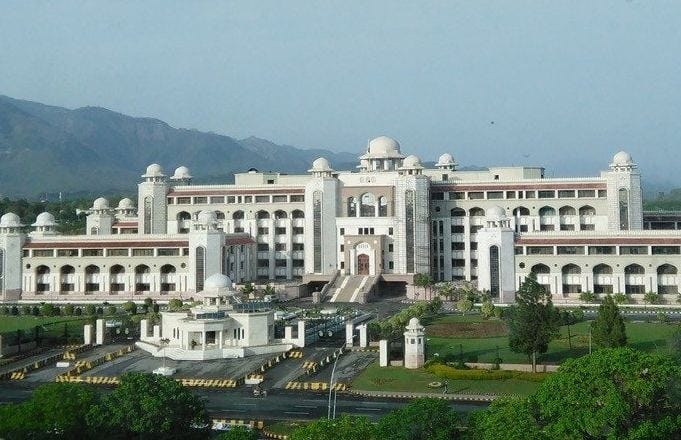
The federal government presented a Rs 17.573 trillion budget for the 2025-26 fiscal year in June. Provincial governments unveiled their own spending blueprints simultaneously. Together, these documents tell a story that the government itself has written in allocation percentages and rupee denominations. That story is not about scarcity. It is about choice.
The Federal Picture
When Finance Minister Muhammad Aurangzeb stood in the National Assembly to present the budget on June 10, 2025, the numbers revealed a government operating within clear priorities. Of Rs 17.573 trillion in federal expenditure, debt servicing claimed Rs 8.2 trillion, or 47 percent. Defense received Rs 2.55 trillion, a 20 percent increase from the previous year amid regional tensions. These are substantial commitments that the state considered essential.
The same state allocated Rs 32 billion for healthcare across the entire country of 240 million people. That equals approximately Rs 133 per person annually. For education, the allocation was Rs 113 billion, or Rs 471 per person per year. For context, the Public Sector Development Program received Rs 1 trillion, of which Rs 328 billion went to transport infrastructure alone.
Meanwhile, 27 mothers die every day from preventable pregnancy-related complications. The World Health Organization confirmed this figure in April 2025. These are not theoretical deaths. They are 9,800 mothers per year, each one preventable with adequate healthcare access. Add 675 newborns dying daily from preventable causes, and the arithmetic of mortality reaches 246,300 per year. Another 190,000 stillbirths occur annually. These are the human consequences of the budgetary choice.
What Allocation Actually Looked Like at the Provincial Level
Punjab, the nation’s largest and most populous province, presented a Rs 5.335 trillion budget in June. This was the largest provincial budget ever tabled. The development allocation reached Rs 1.24 trillion, representing a 47 percent increase from the previous year. The Finance Minister, Mujtaba Shuja ur Rehman, oversaw what appeared on paper to be significant investment in the province.
That investment manifested in specific projects. Electric buses for urban transport received Rs 45.9 billion across seven cities. The “Apni Chhat Apna Ghar” housing scheme for the elite got Rs 50 billion. Urban “beautification” infrastructure, including overhead wire burial, canal tiling, and market renovations under the “Beautiful Punjab” initiative, consumed Rs 25 billion. In February 2026, the Punjab Government acquired a 2019-manufactured Gulfstream GVII-G500 aircraft for VIP transport. Feasibility studies for Air Punjab and high-speed rail took Rs 1 billion and Rs 2 billion respectively, with eventual total costs projected at Rs 10 billion and Rs 250 billion.
Healthcare in Punjab tells a different story. The department struggled with a 47 percent vacancy rate for medical specialists. Of 2,098 sanctioned positions for specialists, approximately 1,000 remained unfilled. The Tribune reported in December 2025 that a recent recruitment drive resulted in only 200 of 304 appointed candidates actually accepting positions. The reason was straightforward: Punjab paid 21 percent less than federal government doctors. Working conditions at facilities were described as “strenuous” with “limited resources.”
The state decided to outsource health services to private contractors who could hire at lower cost without providing government employment benefits. This decision appeared in December 2025 reporting.
Meanwhile, pregnant women in Punjab’s hospitals occupied beds in ratios of two to three per bed. At Holy Family Hospital in Rawalpindi, surgery wait times extended from three to six months. The Mother and Child Hospital, a 500-bed facility built at a cost of Rs 7 billion, had been abandoned for 15 years and fallen into vandalism. Yet the budget for Punjab’s healthcare, when added to development allocations in health, still did not reach the scale of urban transport, housing, or beautification projects.
The provincial government allocations by sector showed the hierarchy clearly. Infrastructure development for urban centers consumed the largest share. Education received Rs 363 billion for the entire province plus Rs 5 billion designated as an “education emergency.” This emergency designation itself conveyed a message: education appeared to require emergency interventions rather than structural adequacy.
Balochistan and the Structural Dependency Pattern
Balochistan, the least developed province, presented a Rs 1.028 trillion budget in 2025-26. Of this amount, 78 percent came from federal transfers. The province was, structurally, 78 percent dependent on the federal government for its revenue. This dependency shaped what was possible and what remained deferred.
The federal Public Sector Development Program allocated Rs 205.99 billion specifically to Balochistan and adjacent federal territories, representing 67.97 percent of the total PSDP divided among Balochistan, the federation, and AJK combined. This capital went to specific infrastructure: Gwadar Airport received Rs 54.98 billion, with the project 77.7 percent complete. The N-25 highway dualization project consumed Rs 240 billion. Eight Safe City surveillance projects across urban centers took Rs 18.5 billion.
The official budget documents themselves acknowledged governance deficits. “Severe governance deficits including corruption, weak financial oversight, ghost employees, and misallocated funds” were noted in assessments of provincial capacity. The health sector budget of Rs 87.4 billion was apportioned as Rs 71 billion for operations and Rs 16.4 billion for development. Of the purported development spending, Rs 16.4 billion was allocated to “reopen” 164 non-functional health centers. These were not new facilities. These were previously closed centers being counted as fresh development initiatives.
Khyber Pakhtunkhwa and Fragmentation
Khyber Pakhtunkhwa announced a Rs 2.119 trillion budget surplus. The province had recently transitioned leadership, with Ali Amin Gandapur resigning as Chief Minister on October 9, 2025, and being replaced by Sohail Afridi. The new government’s budget contained 2,159 development schemes, of which 810 were newly proposed and 1,349 were ongoing. Road projects dominated the development portfolio with 221 schemes.
The fragmentation of development spending across hundreds of small projects was itself a structural issue. Education received Rs 363 billion in regular budget plus Rs 5 billion designated as an emergency measure. Health absorbed spending across 93 new schemes and 89 ongoing schemes. Foreign-funded development programs contributed Rs 177.52 billion across 50 projects from multilateral institutions like the World Bank and Asian Development Bank.
This fragmentation meant that money was spread thin across numerous initiatives. Individual projects suffered from execution delays, partial completion, and diffused impact. The issue was not absence of funds but their dispersion across too many competing priorities without adequate concentration in any single sector.
Sindh and the Mega-Project Priority
Sindh’s Chief Minister Syed Murad Ali Shah presented a Rs 3.451 trillion budget. The development program was reduced to Rs 520 billion due to anticipated federal transfer shortfalls. Within this constrained envelope, mega-projects in Karachi received Rs 21 billion, a 1,400 percent increase from the previous year’s Rs 1.38 billion. This increase reflected a clear reallocation of scarce provincial capital toward flagship infrastructure.
The flagship projects were concrete: Shahrah-e-Bhutto Expressway at Rs 54.7 billion, Nabisar Vajihar Water Works at Rs 69 billion, Ghotki Kandhkot Bridge at Rs 30.4 billion, and NED Technology Park at Rs 25 billion. Karachi’s Safe City surveillance system received Rs 6.6 billion for phase one.
Urban transport expanded with 50 electric buses launched, with plans for 500 total buses. This was concrete, visible infrastructure that served urban constituencies directly.
For the entire province’s health sector, spending reached Rs 336.46 billion, equivalent to Rs 5,600 per capita for Sindh’s 60 million population. Education received Rs 523.73 billion, or Rs 8,700 per capita. Both were higher than federal allocations per capita, reflecting provincial mobilization of resources. Yet the provincial capacity was constrained by federal transfer shortfalls, meaning the province was doing more with the share allocated to it by the federal structure.
The Death and Deficit Data
In April 2025, the WHO released figures for maternal and newborn mortality. The maternal mortality ratio stood at 155 deaths per 100,000 live births in 2024, according to WHO estimates, though the Pakistan Maternal Mortality Survey released by UNFPA in September 2025 cited 186 deaths per 100,000 as the latest figure from their exclusive national survey. Punjab performed best among provinces at 157 per 100,000 live births. Balochistan performed worst at 298 per 100,000. This meant that a woman in Balochistan had nearly double the risk of dying in childbirth compared to one in Punjab.
Infant mortality nationally was 54.66 per 1,000 live births in 2024, an increase from the prior year. Neonatal mortality stood at 37.6 per 1,000 live births. In raw numbers, 27 mothers died every day, and 675 newborns died every day. These were the figures that the budget allocations produced in human terms.
Children’s malnutrition remained endemic. Stunting affected 37.6 percent of children under five nationally. The WHO Global Nutrition Report noted that Pakistan remained well above the regional average for Asia of 21.8 percent. Nearly 10 million Pakistani children suffered from stunting, meaning chronic undernutrition affecting their linear growth and cognitive development. Anemia affected 62 percent of children under five and 41.3 percent of women aged 15-49 years.
On education, recent data from January 2026 confirmed that approximately 20 million children remained out of school, down from previous estimates of 25.3 million due to updated 2023 census data. This represented 28 percent of the school-age population. In Punjab, the out-of-school rate held steady at 21 percent, showing no progress since the last survey. In Sindh, the rate improved from 42 percent to 39 percent. In Balochistan, 75 percent of girls were out of school. Government education spending had fallen to 0.8 percent of GDP, down from 2 percent in 2018. Save the Children noted in June 2025 that this constituted a new low despite education having been declared a national emergency.
Within Punjab, over 3,000 government school buildings were declared structurally unsafe during the 2025 monsoon season, creating hazards for students and teachers. The education department had failed to initiate timely repairs despite repeated assessments.
The Doctor Migration Crisis
In February 2026, just this month, Gallup Pakistan released analysis of Bureau of Emigration data showing that 3,800 to 4,000 doctors emigrated from Pakistan in 2025. This was the highest annual figure ever recorded and represented a sharp increase from previous decades when departures had remained in the hundreds. The national healthcare system was simultaneously underfunded and hemorrhaging trained professionals to overseas migration.
This was not coincidental. Doctors moved to countries where compensation, working conditions, and resources met basic professional standards. They left a system where 47 percent of specialist positions remained vacant, where facilities lacked basic equipment, where pregnant women shared beds, and where surgery wait times extended for months. The budget allocations that prioritized infrastructure over healthcare were thus doubly consequential: they restricted the resources available and contributed to conditions that drove the remaining qualified professionals abroad.
Food Insecurity: The Other Crisis
The Household Integrated Economic Survey released in January 2026, covering the period from September 2024 through June 2025, documented a parallel crisis emerging in food security. Nearly 25 percent of households now faced moderate to severe food insecurity, driven by prolonged inflation and weak economic growth. In Punjab, food insecurity jumped from 14.4 percent to 22.6 percent, with severe food insecurity nearly doubling. Balochistan faced the most severe situation, with food insecurity affecting over 30 percent of households.
This context transformed the health and nutrition statistics from abstract figures into lived crisis. Children were stunted not merely from inadequate healthcare access but because their families lacked food security. Mothers died not only from absence of skilled birth attendants but from maternal malnutrition, with 42 percent of pregnant women experiencing anemia. The budget allocations for healthcare and education existed within an ecosystem where a quarter to a third of households faced food insecurity.
Conclusion
Budgets are not natural phenomena. They do not reflect scarcity so much as priority. Pakistan’s federal government had Rs 17.573 trillion to distribute. The provincial governments had additional trillions. The allocation pattern showed what was deemed priority and what was relegated to insufficient and emergency designations.
Defense spending increased 20 percent. Debt servicing consumed 47 percent of the federal budget. Transport infrastructure for urban centers received Rs 328 billion from the Public Sector Development Program alone. Housing schemes for elites, urban beautification, and technology parks were funded at scale. These were not unimportant projects. They reflected real government decision-making.
Simultaneously, healthcare spending was Rs 32 billion federally, less than the cost of proposed government airlines or high-speed rail feasibility studies. Specialist positions in Punjab went unfilled because the government chose not to pay competitive salaries. Educational infrastructure deteriorated to structural unsafety because Rs 363 billion was insufficient to maintain 3,000-plus school buildings in one province.
The government did not lack resources. It lacked the choice to allocate them to these sectors at the scale required. That choice reflected what constituencies mattered in budgetary terms and what human needs could be deferred, fragmented across emergency designations and insufficient allocations, or outsourced to private providers.
Every mother who dies in childbirth, every child whose linear growth is stunted, every student studying in a structurally unsafe classroom—these represent the consequences of the budgetary choice already made. The government’s money tells the truth about its priorities. In that truth lies the explanation for why mothers still die in childbirth, why children remain out of school, and why villages lack basic medical care. Not because these problems are unsolvable. But because solving them was not the priority the budget reflected.
References
Federal Budget 2025-26: Ministry of Finance, Government of Pakistan (June 10, 2025)
Provincial Budgets: Official government announcements June 2025
Maternal Mortality: WHO Pakistan, April 2025; UNFPA Pakistan Maternal Mortality Survey, September 2025
Doctor Migration: Gallup Pakistan analysis of Bureau of Emigration data, February 2026
Health Sector Vacancies: The Tribune, December 30, 2025
Education Statistics: HIES 2024-25 (January 2026); Save the Children, June 2025; UNICEF Pakistan
Nutrition Data: Global Nutrition Report, 2024; UNICEF Pakistan; WHO data
Food Security: HIES 2024-25, January 2026


