
What Pakistan Was Supposed to Be
Open war with Afghanistan. Bombs over Kabul. And inside Pakistan's own cities, the slow erasure of every value the country was created to protect.
There is a particular kind of grief that comes from watching something you love destroy itself. Not from outside, not from an enemy’s hand, but from within, through choices made by people who were trusted with its care. Anyone who has spent real time in Pakistan, who has felt the generosity of its people, the depth of its cultural memory, the extraordinary human reserves of a civilization that survived everything colonialism threw at it and still produced poets and mathematicians and saints and farmers who understand the land the way their grandparents did, knows that grief. It is not the grief of a critic. It is the grief of someone who knows what this country was supposed to be and watches, every day, the distance between that promise and this reality grow wider.
Pakistan was not supposed to be bombing Afghanistan.
Afghanistan was not supposed to be launching retaliatory operations across the Durand Line and declaring war on its neighbor.
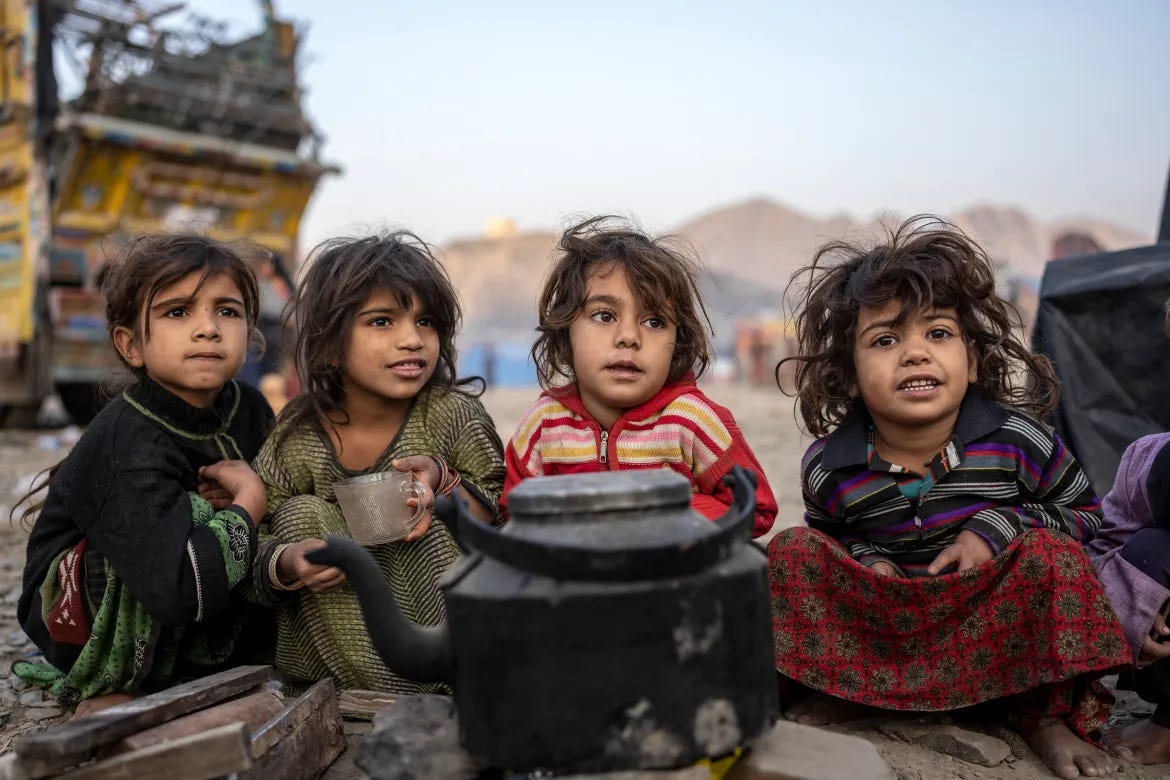
And yet here we are, on the morning of February 27, 2026, with Kabul struck by Pakistani Air Force jets for the first time since the British left the subcontinent, with Taliban ground forces operating against Pakistani military positions along the border, with a Pakistani Defense Minister on X declaring open war, with the UN Secretary-General calling for restraint that neither side is inclined to exercise, with children on both sides of a line their great-grandparents never accepted paying for decisions made in offices they will never enter.
This piece is not against Pakistan. It is not against Afghanistan. It is written in grief for both, and in the conviction that the force doing the most sustained damage to Pakistan is not the Taliban, not the TTP, not India, not any enemy that can be bombed. It is the slow, accelerating erasure of the values Pakistan was built to embody, by a ruling class that imported its civilization from somewhere else, by a manufactured extremism that filled the vacuum that ruling class created, and by seventy years of choosing every available distraction over the one necessary work: building the state that was actually promised.
Let the documented record stand without reduction on either side, because this argument cannot be made honestly without it.
The Tehreek-e-Taliban Pakistan is not a fabrication of Rawalpindi’s communications directorate. It is a real organization with a documented record of mass violence inside Pakistan. More than 1,200 Pakistanis, soldiers and civilians, died in TTP attacks in 2025 alone, double the number recorded in 2021 when the Afghan Taliban reclaimed Kabul. On February 6, 2026, a suicide bomber walked into a mosque in Islamabad’s diplomatic enclave during Ramadan and killed 31 worshippers at Friday prayers. Eleven soldiers and a child were killed in a checkpoint attack in Bajaur days later. These are not statistics. They are people who had names and families and plans for the week after they died.
The Afghan Taliban government in Kabul has, since August 2021, consistently treated the TTP as Pakistan’s internal matter. Taliban Interior Minister Sirajuddin Haqqani stated this publicly and explicitly. TTP commanders have operated from Afghan territory with a degree of freedom that the Afghan government has had neither the capacity nor, in significant cases, the political will to curtail. The networks of ideological kinship, family connection, and organizational overlap between the Afghan Taliban and the TTP are not a clean separation between two distinct entities. They are a tangle that the Afghan government has used as cover for inaction while Pakistani civilians and soldiers bled.
On February 22, Pakistan launched airstrikes in Nangarhar and Paktika provinces. On February 26, Pakistani jets struck again. On the same day, the Taliban launched what its spokesman Zabihullah Mujahid described as large-scale offensive operations against Pakistani military positions along the Durand Line, claiming 55 Pakistani soldiers killed and 19 army posts seized. Pakistan denied the figures and struck Kabul, Kandahar, and Paktia. By February 27, Pakistan’s Defense Minister Khawaja Asif had declared open war.
Both governments made choices that brought them here. Both governments are responsible for those choices. Both governments are failing the people they claim to protect.
That is the foundation. Now comes the question the foundation does not answer: how did two Muslim nations, neighbors across a shared civilization, arrive at open war in the month of Ramadan? And who, beyond the populations being killed, benefits from the answer remaining buried?
Pakistan was not created as a secular state. It was not created as a theocracy. This distinction, which Pakistani liberals and Pakistani Islamists collapse in opposite directions for their own political purposes, is the foundation of everything that has gone wrong.
Muhammad Ali Jinnah’s vision, articulated most precisely in his address to the constituent assembly on August 11, 1947, was of a Muslim homeland that embodied the genuine ethical framework of Islam. In that vision, non-Muslims would be equal citizens. Justice would be the organizing principle of the state. He understood what any serious student of Islamic history understands: that authentic Islamic governance at its height produced pluralism, not persecution, because the Islamic civilization that built the great centers of learning from Cordoba to Samarkand was built on the accommodation of human difference under the rule of law and the accountability of power to divine ethics.
That vision held, imperfectly and incompletely, for approximately a decade. Then the demolition began. Through constitutional amendments, through military coups, through the institutional inheritance of British colonial structures that never actually departed, and then through the 1980s, when Zia ul-Haq received CIA money and Saudi ideology and built a manufactured sectarianism out of Deobandi madrassa networks and called it Islam. And alongside all of this, running in parallel as its mirror image, the Westernized secular elite that has governed the civilian face of the Pakistani state ever since, whose actual values, formation, and cultural allegiances have no authentic connection to the 240 million people they claim to lead.
Pakistan today is being consumed by both corruptions simultaneously. The extremist bombs a mosque during Ramadan and calls it jihad. The ruling class pours imported whiskey at a private party in Defence Housing Authority and calls that governance. Authentic Islam, the actual founding premise of the country, the tradition that built universities and produced philosophers and organized commerce across continents, is buried under both. And the country that was created precisely to protect an Islamic civilizational identity cannot defend that identity because the people running it do not live inside it.
Drive through Defence Housing Authority in Karachi on a Friday morning. The brunch cafes are full by ten. Cold brew coffee, imported menus, tables of young women in the particular aesthetic that Pakistani Instagram has made its signature. Conversations in English, with Urdu dropped in for irony. The men at adjacent tables discuss property in Dubai, schooling options in London, immigration pathways to Canada or Australia. On the walls, sometimes, a framed Quranic verse. It sits beside a menu listing the weekend cocktail specials, because the kitchen knows its clientele and the clientele knows exactly what it wants.
This is not a moral prosecution of individuals. It is a structural diagnosis of a class.
Drive forty minutes north into Orangi Town. Or into Landhi. Or take the bus that DHA residents do not take into Lyari. The mosque is the center of community life because the state never built anything else there. The madrassa substitutes for the school the government did not fund. The local religious scholar is often the most educated person in the neighborhood because the educational pipeline that sends DHA children to Lahore Grammar School and then to London does not extend into those streets. The people there are Muslim not as a cultural identity performance but as the actual organizing framework of daily life, family structure, ethical reasoning, and social obligation.
These two Pakistans share a flag, a passport, and a national anthem. They do not share a civilization.
The ruling class, and here the term covers the military’s senior officer corps, the civilian bureaucracy, the major political dynasties, the corporate elite, and the urban professional class that staffs these institutions, was formed outside the country it governs. This is a documented educational and social history, not a rhetorical device. Pakistan’s institutional leadership has for three generations been produced by a specific pipeline: elite schools modeled on the British curriculum, undergraduate degrees at British or American universities, postgraduate formation at those same institutions or at the World Bank and IMF and the policy ecosystem around them, followed by return to Pakistan to occupy positions of governance.
The formation that occurs in those institutions is not neutral. It is the formation of Western liberal modernity, with its specific assumptions about the separation of religion from public life, the primacy of individual rights as defined in post-Enlightenment European philosophy, and the definition of progress as movement toward Western metrics. A Pakistani civil servant who spent three years at the London School of Economics returns to Islamabad having absorbed a framework for understanding the world that was designed in London. He governs with that framework. His children go through the same pipeline. The governing class reproduces itself across generations through institutions that have no organic connection to the civilization being governed.
The normalization of alcohol culture in Pakistan’s elite social spaces is not a secret. Private parties in Karachi, Lahore, and Islamabad operate openly with full bars. The entire support infrastructure around this, the suppliers, the event managers, the private venues, operates on the understood basis that enforcement is a function of class. A Muslim from a working-class neighborhood found with alcohol faces arrest. A senior official at a private party in DHA faces nothing, because the police that would arrest the first person would not pass through the gate of the second person’s home.
This is primarily not a legal observation. It is a civilizational one. The Islamic Republic of Pakistan applies its Islamic identity selectively by class. The Republic is Islamic for the poor and optional for the powerful. That arrangement communicates clearly to every Pakistani who can see it, and they can all see it, that the state’s Islamic identity is performance rather than commitment. And when the state’s Islamic identity becomes a performance, it loses its authority to speak for Islam. When the state loses that authority, others claim it. The TTP claims it. Every radicalized formation in Pakistani history has claimed it by pointing at exactly this contradiction.
The educational pipeline makes the fracture generational. Pakistan’s elite sends its children to schools teaching the British curriculum. Those children navigate Western political philosophy with reasonable confidence. The same children may know almost nothing about Al-Ghazali’s ethical framework for governance, Ibn Khaldun’s analysis of how civilizations collapse, the intellectual history of Islamic jurisprudence, or the administrative achievements of the Mughal state. This is not a curriculum accident. It is a class reproduction system. The elite reproduces itself through institutions that produce the values, networks, and credentials required to occupy elite positions. Those institutions are Western. The networks run through London and Washington. They do not run through Lahore’s inner city or the shrine cities of Sindh.
A governing class whose formation is disconnected from the people it governs cannot produce legitimate authority. It can only produce force. And a state that governs through force rather than consent eventually produces the conditions for the very violence that force was supposed to prevent.
Zia ul-Haq’s Islamization in the 1980s looked like the opposite of this problem. It was the same problem in different clothing.
Zia did not build an Islamic state. He built a control mechanism dressed in Islamic language, funded by CIA money in service of the anti-Soviet Afghan war and by Saudi Arabia in service of its own ideological export agenda. The proliferation of Deobandi madrassas under Zia was an intelligence and geopolitical project before it was a religious one. The blasphemy laws Zia codified were not derived from classical Islamic jurisprudence, which has a sophisticated and contested tradition of legal reasoning on such matters developed over fourteen centuries. They were political instruments designed to suppress dissent by making dissent synonymous with apostasy. The sectarian militias that emerged from Zia’s madrassa networks, the organizational ancestors of the groups now attacking Pakistani mosques and soldiers, were created under state supervision and then escaped state control.
What Zia built with American money and Saudi ideology destroyed what it claimed to protect. It destroyed it because it was not authentic. A religious identity manufactured for political and geopolitical purposes is not a religious identity. It is a tool. Tools get picked up by whoever can use them.
The specific tool that Zia’s project exported into Afghanistan, the Afghan Taliban in its original formation, was picked up by the TTP, which read the same texts, emerged from the same madrassa networks, and turned the same ideology against the Pakistani state that nurtured it. Khawaja Asif acknowledged this when CNN asked him directly in November 2025 whether the current violence was the definition of blowback. He said: “Yeah, I think so.”
The blowback is documented, acknowledged by its architects, and ongoing. Bombing Afghanistan does not address blowback. It extends the cycle that produced it.
Pakistan’s financial dependency on Gulf states is the mechanism through which the secular ruling class is maintained in place and the authentic Islamic governance question is kept permanently off the table.
When Pakistan needs a bailout, it goes to Riyadh or Abu Dhabi. The money arrives. The conditions are rarely stated in public terms but are understood by every Pakistani finance minister who has made that journey. Those conditions are about alignment: the assurance that Pakistan’s governing class will remain a class that Gulf states can work with. Not too independent in its foreign policy. Not too democratically responsive to its own population. Not too rooted in an Islamic intellectual tradition that would challenge Gulf theological and political hegemony.
The UAE’s pattern across the Muslim world makes this logic visible. In Egypt, it backed a military coup that removed a government with an Islamic political orientation and installed a secular-military government that imprisoned tens of thousands. In Libya, it funded a military strongman against an internationally recognized government. In Tunisia, it backed the trajectory that ended democratic governance entirely. The consistent principle across all these cases is the suppression of Muslim-majority political self-determination in favor of secular-technocratic governments that are financially dependent on Gulf states and politically aligned with Western preferences.
Pakistan is the largest possible version of that pattern. A country of 240 million Muslims with nuclear weapons, with a significant scientific and technical community, with a geostrategic position at the intersection of Central Asia, South Asia, China, and the Arabian Sea, that built genuine Islamic governance rooted in its own founding values rather than external dependency, would be the most consequential independent Muslim state since the fall of the Ottoman Empire. That possibility is precisely what the current arrangement is designed to foreclose.
The most efficient foreclosure mechanism is not military force. A nuclear state cannot be destroyed from outside. It is internal fragmentation: ethnic tensions kept activated, sectarian violence kept smoldering, the civil-military relationship permanently destabilized, the economy in chronic crisis through debt structures that require austerity that generates public rage that gets channeled away from the people responsible for it. And when all of that proves insufficient, a hot border.
A Pakistan at open war with Afghanistan has no political bandwidth for the domestic reckoning its people are demanding. Every week that war coverage dominates Pakistani media is a week that the questions about who actually runs the country, under what legitimate authority, in service of whose interests, go unasked. The war with Afghanistan is useful to Pakistan’s ruling class in exactly that proportion.
Afghanistan is not Pakistan’s enemy. That sentence needs to stand alone because it is the most important one in this piece, and it needs to stand alongside an equally direct one: the Afghan Taliban government has made choices that put Pakistani lives at risk, and those choices carry real responsibility.
Both are true. Holding both is the only honest position available.
The TTP’s use of Afghan territory is not contested by serious analysts. Pakistani soldiers dying at Bajaur checkpoints and Pakistani worshippers dying in Islamabad mosques are dying partly because of choices made in Kabul. The Afghan Taliban’s insistence that the TTP is Pakistan’s internal matter, while TTP commanders operate from Afghan soil and cross the border to kill, is a position that fails every standard of neighborly obligation and Islamic ethics simultaneously. The Afghan government’s inability or unwillingness to act is a genuine grievance of the Pakistani state and the Pakistani people, and deserves to be named as such without apology.
At the same time, the context that produced this moment does not disappear because the moment is urgent. Pakistan’s intelligence apparatus cultivated the Afghan Taliban for three decades as a strategic asset. Pakistan’s military celebrated when Kabul fell in August 2021. The TTP networks that now kill Pakistani soldiers are the ideological and organizational descendants of the networks Pakistan built, trained, and exported into Afghan territory across the 1980s and 1990s with American and Saudi support. Khawaja Asif said it himself. This is blowback. Naming it is not anti-Pakistan. It is the minimum requirement of honest analysis.
Pakistan and Afghanistan share more than a disputed border. They share Pashtun tribes whose families were divided by a line drawn in 1893 by a British colonial administrator who spent six weeks in Kabul negotiating a sphere-of-influence demarcation that Afghanistan has never formally accepted. They share Sufi shrines that pilgrims visit from both sides regardless of what the border posts say. They share the experience of having their civilizational identity disrupted by the same external forces across the same historical period. The people dying on both sides of the Durand Line in February 2026 are Muslim. Many are Pashtun. Many are poor. None of them drew the line.
Both governments are failing them. Both governments are making choices that serve institutional and external interests over the interests of the people they govern. Both populations are paying the price.
The Islamic ethical tradition that both governments claim as their source of legitimacy does not permit this war.
The Prophet Muhammad’s (PBUH) instructions to his commanders before battle are some of the earliest documented rules of engagement in military history: do not kill women, do not kill children, do not destroy places of worship, do not harm those who have surrendered, do not devastate the livelihoods of the innocent. These are not obscure theological footnotes. They are foundational principles that predate the Geneva Conventions by thirteen centuries and express the same truth: there are limits to what power may do to human beings even in war, because every human being carries a dignity that no military objective can override.
A TTP bomber who kills worshippers in an Islamabad mosque violates those limits. A Taliban government that shelters fighters who cross a border to kill Pakistani soldiers violates those limits. None of these violations become permissible because the other side committed the previous one. That is not how Islamic ethics works. That is not how any serious ethics works.
The twisted practice of Islam visible in the security doctrines of both states, the Islam of strategic depth and suicide bombing and airstrikes on sleeping families, has nothing to do with the faith that built the University of al-Qarawiyyin in Fez in 859 CE, that produced Ibn Khaldun’s sociology of civilizational collapse, that organized Avicenna’s medical canon, that administered the Mughal state with a sophistication that British colonialism dismantled and then attributed to its own presence. That civilization was built on learning, legal reasoning, trade, the accommodation of difference, and the accountability of power to divine ethics. What has been constructed in the security apparatuses of both countries across the past forty years, using American money and Saudi ideology and Pakistani institutional manipulation and Afghan Taliban governance, is a disfigurement of that tradition.
Pakistan’s urban secular elite contributed to this disfigurement by abandoning the Islamic public sphere to forces it did not understand and chose not to engage. Their secularism was not Jinnah’s principled pluralism. It was the secularism of a class that wanted to remain culturally Western while governing a population it had no authentic relationship with. That abandonment created the vacuum. The vacuum was filled. The consequences are now visible in every direction simultaneously: in the brunch cafes of DHA and the TTP recruiters in the same country, in the bombs falling on Kabul and the retaliatory Taliban operations along the Durand Line, in a Ramadan that should be a month of reflection and has become a month of open war.
This war will not solve Pakistan’s TTP problem. The record is unambiguous on this. Seven rounds of Pakistani airstrikes on Afghan territory over two years produced no measurable reduction in TTP attacks inside Pakistan. The attacks increased. The bombs fell again. Afghanistan then declared war back. Each civilian funeral in Nangarhar is a recruitment event for the next generation. Each Pakistani soldier killed in a retaliatory Taliban operation produces a family that will carry that loss for generations. The Pakistani military knows the limits of this approach. Every serious counterinsurgency analysis written in the past century contains the same observation. Killing civilians accelerates the insurgency it claims to suppress.
What this war will do is accelerate Pakistan’s internal crisis by consuming resources, political attention, and institutional energy that cannot be spared. Pakistan in February 2026 is simultaneously managing open war with Afghanistan, ongoing TTP operations across its northwestern territory, severe economic crisis in which debt servicing consumes the majority of government revenue, a political crisis in which its most popular leader sits imprisoned in Rawalpindi, a judicial crisis, an information crisis in which large portions of the internet are blocked, and a social crisis visible in every gap between the country’s stated Islamic values and the class arrangement that actually governs it.
Under these accumulated pressures, declaring open war is not strategy. It is the action of a leadership class that has exhausted every other tool for managing its own legitimacy deficit.
Pakistan was created as a homeland for Muslims and a guarantee of equal rights for all, because those two commitments are not in tension within authentic Islamic ethics. They are the same commitment expressed in two directions. A state organized around Islamic justice does not persecute its minorities. A state organized around Islamic values, as understood by its own best intellectual and spiritual traditions rather than by Zia’s CIA-funded sectarianism or DHA’s imported lifestyle culture, does not produce a secular governing elite on one side and TTP recruiters on the other. It produces something neither of those represents: a Muslim civilization that takes its own founding seriously.
That Pakistan has never been fully built. The reasons it has not are structural, documented, and connected directly to the forces that benefit from it remaining unbuilt.
The people of Pakistan are not waiting for permission to be who they are. They are 240 million Muslims whose faith is not a political position to be managed between secular elites and manufactured extremists. It is a civilizational identity that has survived everything thrown at it. They recite Iqbal and Bulleh Shah and Rumi in the same breath. Their shrines are full on every Thursday night with people who come to connect with something larger than the IMF report and the Defense Minister’s declaration of open war. Their capacity for patience has been extraordinary. Their demand for a state that actually reflects their values is legitimate and long overdue.
Afghanistan deserves a government that honors its own people, that discharges its obligations to its neighbors as Islamic ethics requires, that builds rather than arms. Pakistan deserves a governing class that was formed inside the civilization it governs, that can speak to its population with the authority of shared values rather than the authority of institutional force and Gulf-backed financial leverage.
The bombs falling across the Durand Line right now are falling because the work of building that Pakistan has not been done. Because the governing class cannot do it, having been formed in institutions that do not know the question exists. Because the vacuum left by that failure has been filled, across seventy years, by forces that are destroying from below what the secular elite is destroying from above.
What Pakistan was supposed to be is still possible. It has never been built. That is the real emergency. That is the real war.
Everything happening on the Durand Line is a consequence of failing to fight it.


https://mirrorsfortheprince.substack.com/p/towards-the-ideal-islamic-government?r=v623r&utm_medium=ios
The people of Pakistan do not support this war. They do not want to attack their brotherly neighbors.
Knowing Pakistanis, one can say with a fair degree of certainty, that the vast majority of Pakistanis do not support this military attack on Afghanistan by Pakistan’s military junta.
Pakistanis have nothing against Afghanistan or its people. They have so much in common with the people of Afghanistan.
They consider Afghans, their brotherly neighbors, as one of their own.
The majority of the people of Pakistan have no desire to attack Afghanistan, their next door neighbors, or to fight with their fellow Muslims, much less fight them in the sacred month of Ramadan, when all hostilities are forbidden by God.
Don’t the military rulers know, that :
Fighting in the sacred month of Ramadan is forbidden in Islam?
It is HARAM!
Stop it!
Stop this violation of God’s clear Commandments!
Instead of attacking Afghanistan shouldn’t the ruling military junta be attacking the real problems besetting the nation?
Don’t Pakistan’s rulers realize that Pakistan has far more pressing problems of its own that demand the rulers’ immediate and undivided attention and the nation’s full resources :
The problems such as providing:
• Food.
• Healthcare.
• Education.
• The Rule of Law
• Opportunities to earn one’s livelihood,
• Restoration of Democracy
Or may be these uncalled for, unnecessary aggression and armed hostilities have been provoked to deflect people’s attention from the nation’s real, more pressing, problems -- that are becoming a matter of life and death for most ordinary citizens of Pakistan.
This war does not have the support of the people of Pakistan.
It is against God’s clear Commandments.
Fighting in Ramadan is HARAM.
Stop this madness.
Stop this sacrilege in the sacred month of Ramadan.