
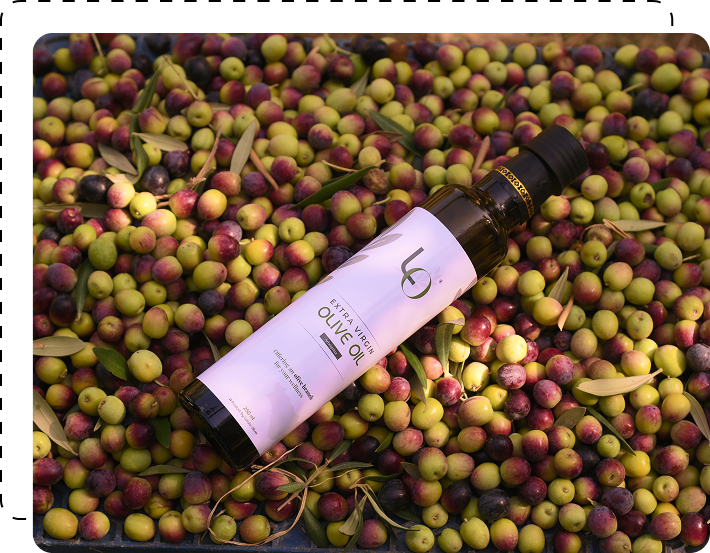
The Grove at the Edge of Everything
A farmer in Loralai, a bottle of olive oil, and Pakistan’s oldest, quietest argument with its own neglect.
The olive tree does not need much. It survives drought. It stabilises eroded soil. It asks for cool winters and long summers and good drainage, and it takes five years before it gives you anything worth selling, and then it gives for a thousand years. Abdul Jabbar has known this for long enough that the knowledge has settled into something like patience. His thirty acres in Loralai district sit in the highland country of northern Balochistan, where the elevation pushes past a thousand meters and the soil drains the way it should and the winters are cold enough to put the Arbequina olive under the particular stress that concentrates its oil. Last season those thirty acres gave him more than 9,000 liters. In May 2025, the judges at the New York International Olive Oil Competition tasted it without knowing where it came from, and they gave it a Silver Award among more than 1,200 entries from Spain, Italy, the United States, Croatia, and Greece.
No Pakistani brand had ever placed. No South Asian brand had placed either.
The oil is smooth and fruity, with notes of green apple, almond, and fresh herbs. The acidity is low. The judges scored it on those qualities alone. They did not know it came from a province that the Pakistani state has spent decades treating as a security problem, a resource deposit, and — when it suits the occasion — a symbol of national unity it has never bothered to build.
Balochistan has been growing wild olives for longer than Pakistan has existed. In the Sherani district of Zhob division, wild olive forests cover more than 41,000 hectares. The Forest Department estimates the oldest trees at between 1,500 and 7,000 years old. For most of that history the trees were used as fodder and fuel. Communities cut them because they had no other source of heat in winter and no alternative source of income to replace what the forest gave them. The trees survived. The poverty did not lift.
The Italian government planted the first cultivated orchards in Balochistan at Loralai and Khuzdar in 1988. For nearly two decades, those orchards were an experiment nobody scaled. In 2007, the federal agriculture ministry began what Habibullah Kakar, deputy director of Agriculture Research in Loralai, describes as the first of three distinct phases: experimental planting across Loralai, Zhob, and Sherani, climate and soil assessment, variety testing. In the second phase, from 2013 to 2018, the government distributed free saplings to thousands of farmers and introduced grafting on the wild Sherani trees. By the third phase, running from 2019 to 2024, the infrastructure had arrived: drip irrigation systems, cold storage, seventeen new varieties introduced through research institutes, and 2.46 million seedlings distributed across the province. The Italian organisation CIHEAM-Bari provided continuous technical support throughout.
The numbers that came out of this are striking only because the baseline was so low. Until 2017, olive trees covered 200 acres of Balochistan. By 2023 and 2024, the area had reached 8,000 acres, yielding 2,500 tonnes of olive fruit worth more than two billion rupees. In Loralai district alone, more than a million trees of Spanish and Italian varieties have been planted. This year’s crop from the district produced 62,000 liters of oil.
The quality, it turns out, is not merely adequate. In most Pakistani provinces, 100 kilograms of olive fruit yields between 10 and 16 liters of oil. In Loralai, the same weight yields 22 to 28 liters, approaching world-standard extraction rates. The soil, the elevation, and the specific temperature range of Loralai’s highland valleys do something the warmer, wetter lowlands cannot replicate. Farmer Rafiullah, who cultivates olives in the district, puts it plainly: the plant starts bearing fruit in the first year here, the oil is of high quality, and it sells for between three thousand and thirty-five hundred rupees a liter. Abdul Samad, another Loralai farmer, switched to olives after his apple orchard became unviable in the region’s tightening water conditions. He grows two hundred olive plants now. His neighbor Ahsan Ullah, from Kenobi village, abandoned almond farming and planted five hundred olive trees. In Sherani, Abdul Qayyum grafted Spanish and Italian varieties onto the ancient wild trees on his five hectares of natural forest. His grove now yields three to four thousand liters of oil a year and brings him more than a million rupees annually.
None of this made international news. The province that produces it has been in international news, reliably, for enforced disappearances, military operations, gas royalties disputed and withheld, and a insurgency the state alternately describes as foreign-sponsored and then as internally resolved and then as foreign-sponsored again.
Shaukat Rasool did not come from farming. He built Khaity Technologies, an AI-powered agriculture platform he launched in 2021 with the stated intention of putting digital tools into the hands of Pakistani farmers. The company runs sixty people and operates orchards across more than forty hectares in Balochistan alongside farms on the Pothohar Plateau near Chakri in Rawalpindi. He chose Loralai specifically, after research into which terrain and climate would give the Arbequina and Coratina varieties the best chance. The dry, temperate climate, the long sunlight hours, the elevation. He chose it the way you choose a place when you believe the land will do the work, if you give it the conditions it needs.
The brand he built around that conviction, Loralai Olives, carries ISO 9001, ISO 22000, HACCP, and Halal certifications. It uses the government extraction plant in Loralai, which has a capacity of 600 kilograms per hour and processes fruit within six to eight hours of harvest. For extra virgin olive oil, the window between harvest and mill determines everything: the shorter the gap, the lower the acidity, the cleaner the flavor. Rasool already knows where the silver ends and the gold begins. “Maybe we can win gold,” he told Arab News, “if we bring down our milling time to three to four hours.” This year he extracted ten tonnes. He is targeting twenty-five to thirty next year.
The scale of Pakistan’s import dependency gives his arithmetic a particular weight. The country spends approximately 4.5 billion dollars annually importing edible oil, mostly palm and soya bean. Through the first four months of 2025, that import bill had surged by 140 percent to 3.2 billion dollars. Rasool told Arab News that Pakistan had the potential to export two billion dollars’ worth of olive oil annually if the sector developed as it should. That is a long arc from thirty acres in Loralai, but the direction of travel is not unclear.
The competition in New York does not give a single overall prize. It gives gold and silver awards to the oils that meet its quality threshold in blind evaluation. The bottle from Abdul Jabbar’s grove met it. The judges recorded what they tasted: smooth, fruity, green apple, almond, fresh herbs. They noted the quality of the extraction. They assigned it a silver, and that silver put Pakistan on a list that previously included only the established Mediterranean producing nations and a handful of newer entrants from California, Chile, and Australia.
Dr. Khair Muhammad Kakar, former head of the Pakistan Oilseed Department and a technical member of the Chief Minister’s Inspection Team, confirmed what the result implied: the extra virgin olive oil produced in Balochistan meets international standards. This is not, in the context of what Balochistan normally receives from official confirmation, a trivial thing. The province’s farmers have been cultivating these trees for nearly two decades on the basis of agronomic potential alone, without cold chains, without export infrastructure, without reliable market access, without the branding ecosystem that Italian and Spanish producers have built across generations.
Pakistan’s National Olive Council was established in November 2025, after the New York win, to coordinate production, marketing, and export strategy. The government’s Olive Cultivation Initiative, running since 2012, has supported more than 85 olive-related startups and is now in a phase of building the commercial infrastructure that the cultivation phase presupposed. Three thousand tractors are being provided to olive farmers across Balochistan at a fifty percent subsidy. The Crop Reporting Services is developing a 150 million rupee software platform for digital farmer support.
The architecture of the scale-up exists, at least on paper. The extraction bottleneck remains real: three plants in Loralai, capacity 600 kilograms per hour each, is thin for a district producing 62,000 liters in a single season. The cold chain that would let Balochistan oil compete in Tokyo or Dubai at premium prices does not yet exist. Rasool’s target of three-to-four-hour milling requires a private plant inside or adjacent to the farm, not a shared government facility six hours down the road.
These are solvable problems, assuming the investment arrives before the enthusiasm recedes. Pakistan’s institutional memory for agricultural initiatives that flourished briefly and then stalled is long and unencouraging.
What Abdul Jabbar’s silver medal established, in the meantime, is a fact that cannot be argued with: the oil from his thirty acres in Loralai is world-class. The judges in New York said so, blind, without provenance, without politics. The tree does not need the state to be good. Whether the state can build what the tree deserves is the question Loralai is now living inside.


