
Tirah Valley: Echoes of Endless War in Pakistan’s Forgotten Mountains
Evacuation Orders and the Haunting Revival of the War on Terror
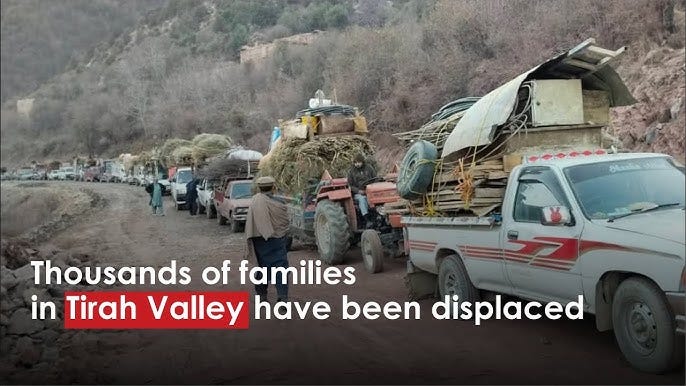
The Pakistan Army issued evacuation orders on January 16 and 17, 2026, giving residents of Tirah Valley until January 25 to abandon their homes in advance of a major military operation. The directive affects between 20,000 and 37,000 households across this remote corner of Khyber Pakhtunkhwa, displacing an estimated 100,000 people from mountain villages that straddle the Afghan border. Officials frame the operation as necessary counterterrorism, targeting remnants of Tehrik-i-Taliban Pakistan and Lashkar-e-Islam entrenched in the valley’s forests and gorges. The reality unfolding on the ground tells a more complex and disturbing story, one that resurrects the worst patterns of Pakistan’s two-decade War on Terror.
Families began their exodus in early January, trudging through winter cold toward overcrowded camps in Peshawar and the Bara tehsil. The federal government pledged compensation packages: 250,000 rupees per household after biometric registration, monthly stipends of 50,000 rupees through April, and payouts reaching three million rupees for homes destroyed in the coming assault. The Khyber Pakhtunkhwa provincial government allocated four billion rupees for displacement relief. Yet beneath these bureaucratic assurances lies a humanitarian crisis gathering force. Registration centers strain under demand, aid distribution falters, and displaced families endure freezing nights in inadequate shelters. Children miss school, the elderly lack medical care, and food supplies run short.
Tirah Valley has suffered this cycle before. The strategic corridor, spanning roughly 100 kilometers along the Afghan frontier, became a militant sanctuary following the 2001 U.S. invasion of Afghanistan. Al-Qaeda operatives fleeing American forces crossed into Pakistan’s tribal areas, finding refuge in Tirah’s dense forests and mountain redoubts. By 2007, Mangal Bagh’s Lashkar-e-Islam had established control, later forging alliances with the Pakistani Taliban. The Pakistan Army launched Operation Rah-e-Shahadat in April 2013, displacing approximately 11,000 families through aerial bombardment and ground assaults. Residents returned a year later to find army checkpoints and partially rebuilt villages, but militants filtered back across porous borders.
Subsequent operations followed in grim succession. Khyber-1 in 2014 unleashed airstrikes that killed 21 militants in coordinated raids. Khyber-2, running from March through June 2015, saw ground forces battle through rugged terrain at significant cost. Khyber-4 in 2017 targeted Jamaat-ul-Ahrar positions in the Rajgal area. These campaigns formed part of the broader Zarb-e-Azb operation that displaced millions across the Federally Administered Tribal Areas in 2014, providing temporary security to Peshawar but failing to eliminate the underlying militant networks. Fighters retreated to safe havens in Afghanistan’s Nangarhar and Kunar provinces, regrouping and recruiting.
The Afghan Taliban’s return to power in August 2021 dramatically altered this equation. TTP operatives gained renewed confidence and cross-border mobility, launching attacks from Afghan territory with varying degrees of tacit approval from Kabul’s new rulers. Explosions in Tirah Valley in September 2025 killed 30 people in what officials attributed to TTP operations. The Islamic State’s Khorasan Province maintains a presence as well, adding another layer to an already complex insurgent landscape. The January 2026 offensive represents the army’s response to this resurgence, the 23rd major military operation in Tirah since 2001 by some counts.
Chief Minister Sohail Afridi of Khyber Pakhtunkhwa, himself a Pashtun from the region, toured displacement camps on January 16, visibly angry at what he termed the federal government’s “closed-door policy” that excluded provincial input. He expanded registration points to schools and marketplaces, deploying additional staff to process the influx. Yet even as his administration released billions in aid, Afridi condemned the operation as politically motivated, arguing that 22 previous military sweeps had failed to bring lasting peace. His Pakistan Tehreek-e-Insaf party, in opposition at the federal level, sees the timing as suspect, targeting PTI strongholds under the guise of counterterrorism.
Other political voices echo this skepticism. Mahmood Khan Achakzai, a prominent Pashtun nationalist leader, characterized the forced evacuation as state terrorism against civilians. Provincial opposition figures warn that heavy-handed tactics will fuel rather than suppress militancy, repeating mistakes from the height of the War on Terror when drone strikes and indiscriminate operations drove recruitment to extremist groups. Videos circulating on social media show protesters with tape over their mouths, women describing fully furnished homes left behind, families crammed into trucks as winter weather worsens. The symbolism resonates: Pashtuns silenced, displaced, caught between militant violence and state force.
The strategic calculus driving the operation extends beyond simple counterterrorism. Tirah Valley contains deposits of chrome, marble, and other minerals that have long attracted both official and illicit interest. The terrain itself holds military value, commanding approaches to Peshawar and controlling smuggling routes used for everything from timber to weapons. Critics charge that resource extraction and political control factor as heavily as security concerns in the army’s planning. The pattern observed across Pakistan’s former tribal areas suggests operations often serve multiple agendas: securing territory, establishing permanent military presence, accessing economic assets, and demonstrating federal authority over restive populations.
The humanitarian toll mounts beyond official tallies. Displacement camps become pressure cookers of poverty and desperation, breeding grounds for the very radicalization the operations purport to combat. Young men watching mothers beg for rations and sisters suffer in squalid conditions become susceptible to militant recruitment. The 2013 Tirah operation illustrated this dynamic: many who fled as refugees returned to find their communities fractured, their livelihoods destroyed, their resentment toward the state deepened. Army checkpoints and surveillance reinforced the sense of occupation rather than protection. When militants eventually returned, they found willing ears among the aggrieved.
International context frames Pakistan’s predicament. The U.S. War on Terror funneled billions in military aid to Islamabad throughout the 2000s and 2010s, underwriting operations that displaced millions and killed thousands, yet failed to achieve strategic victory. American drone strikes, often launched with Pakistani complicity, generated cycles of revenge that sustained insurgencies. The withdrawal from Afghanistan in 2021 eliminated neither the militants nor the cross-border dynamics that enable their survival. Pakistan now confronts the legacy of those policies without significant American backing, fighting an insurgency partly of its own making.
The border with Afghanistan remains the core unresolved issue. The Durand Line, imposed by British colonial authorities in 1893, bisects Pashtun tribes and has never been accepted as legitimate by Kabul. Militants exploit this, moving between countries, drawing on kinship networks and shared ethnic identity. Pakistan accuses Afghanistan’s Taliban government of harboring TTP; Kabul denies the charge while refusing to recognize the border itself. No amount of military force within Pakistan can seal this frontier or eliminate sanctuaries beyond it. Yet operations like the current Tirah offensive proceed as though borders are impermeable and enemies can be definitively eliminated.
Provincial authorities project that displaced families might return after April 2026, once the military operation concludes. History suggests otherwise. Previous operations stretched far longer than initially announced, reconstruction lagged years behind promised timelines, and returnees discovered their homes occupied by army installations or razed to rubble. Compensation payments, when they arrived, rarely covered actual losses. Trust between security forces and local populations eroded to the point where basic intelligence gathering became impossible, leaving the army blind to genuine militant activity while harassing civilians at checkpoints.
The January 2026 Tirah evacuation thus represents not an anomaly but a predictable recurrence of failed strategy. Twenty-three operations across two decades have produced neither military victory nor political reconciliation. Each sweep generates its own backlash, feeds its own resistance, justifies its own sequel. The machinery of counterinsurgency, built on American models and sustained by institutional inertia, grinds forward regardless of outcomes. Generals tout body counts and territory cleared; militants melt away and reappear; civilians pay the price in displacement, death, and despair.
As families huddle in January cold, waiting for bombs to fall on abandoned villages, the question becomes not whether this operation will succeed, but how long before the next one becomes necessary. Tirah Valley’s mountains have witnessed empires rise and fall for millennia. The Pakistani state’s current offensive will join that long history of transient conquest and enduring resistance, another chapter in a war that neither side can win but both seem unable to end.


