
Three Million Children
Baluchistan's Education Minister cannot count the province's missing students. A civic-tech organization with undisclosed foreign funding arrived in May 2026 to map the gap.
Three million children are not in school in Baluchistan. That number was disclosed by the Baluchistan Education Minister herself, Raheela Hameed Khan Durrani, standing at a government-convened event, reading from her own ministry’s figures. She called it the province’s biggest challenge. Then she said something that did not make headlines anywhere: her ministry does not have current data to measure the dropout rate. The systems to count the missing children do not exist.
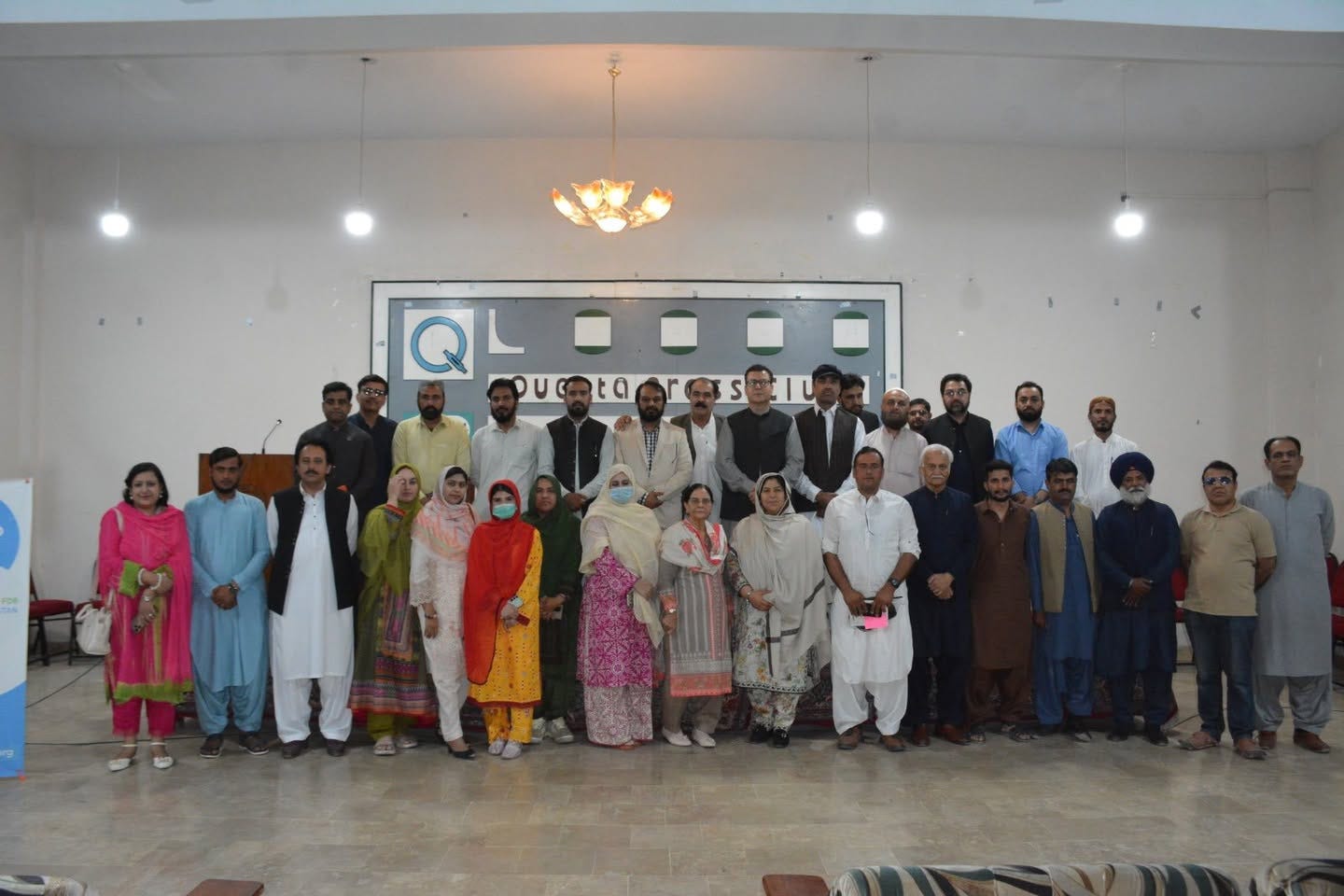
This is not a reporting gap in the ordinary sense. A government that cannot measure its own dropout rate cannot be held accountable for it. The metric that goes untracked cannot fall. The target that is not recorded cannot be missed, and cannot be presented to a court, a parliament, or an international body as evidence of dereliction. Durrani said this at a government organized event, disclosed it into a microphone, and the government she represents went on operating. The admission carried no consequence because accountability was never the arrangement. Three million children in a province of fourteen million people, and the ministry responsible for educating them cannot tell you, with any precision, where they went. Into that counted and uncountable absence, in the first week of May 2026, a civic-technology organisation arrived in Quetta to build an alliance.
The Guftugu
What came out of the room was a formation called the Quetta EdTech Alliance. Code for Pakistan committed to mapping all active education initiatives across the province, identifying models that work, and convening a follow-up session to move from conversation to implementation. Khunsa Khawar of Code for Pakistan told the room: “Quetta is not behind; it has been held back.” A participant from the National Party Women’s sector, Shazia Ahmed, asked the question that should have been the room’s only question: “Our children can use apps, but the question is, can they build one?”
It is the right question, and what came back from the room was not an answer but a process commitment: a mapping exercise, a follow-up convening, a framework for identifying what works. The Alliance’s stated mandate is to build what Code for Pakistan calls an ecosystem. It does not commit to who will own what is built, or who will control the platform on which children in Kech and Mastung and Gwadar will one day, if the Alliance proceeds as planned, encounter their first structured lesson. Shazia Ahmed’s question sat in the room. It found no respondent. The session produced a name, a mandate, and a date for the next meeting.
What Was Not Said in the Room
The Baluchistan government’s budget for the financial year 2025-26 allocated Rs 28 billion to early childhood and primary education. In the same budget document, Rs 18 billion was allocated to safe city surveillance infrastructure across eight cities. No one in the Quetta Press Club on May 5 cited that ratio. No one explained what it means when a government spends nearly two-thirds of its primary school budget on cameras pointed at its own people.
The safe city infrastructure in Baluchistan is not municipal traffic management. It is biometric data collection, high-definition surveillance towers, and integrated command systems deployed in a province with an active and ongoing counterinsurgency operation. The cameras watching Quetta’s streets are not watching for stolen motorcycles. What the budget calls public safety infrastructure, the families of the disappeared call the architecture of the last record, the surveillance log that places a person at a specific street corner before they are taken and not returned. The Rs 18 billion is not a security budget. It is a political budget. The Rs 28 billion for education is not an education budget in any functional sense. The two numbers, placed next to each other in a government document, are a policy statement. Nobody in the room discussed them together.
The per-child spending figures appear reasonable precisely because the denominator, children actually enrolled in school, is catastrophically small. The math is technically correct and morally catastrophic. The money is not going to children. The formula is the confession written in arithmetic.
In rural Baluchistan, only one in five households with school-age children reports that all their children attend school. Not one in five children. One in five households. Entire families, entire villages, entire districts operating outside the formal education system, not because the geography is impossible, not because the culture is hostile to learning, but because the infrastructure was never built, the teachers were never posted, the schools were constructed on paper and left to collapse in the heat while the salaries attached to them continued to be drawn. Ghost schools are not an anomaly of poor record-keeping. They are a revenue stream. The ghost school is the product; education is the alibi. The teacher on a ghost school’s payroll does not disappear. He exists, draws his salary, and votes. The children he was hired to teach do not exist in any government database. They are the three million.
Raheela Hameed Khan Durrani knows this. She said it. In 2025 she stood at a podium and named the problem and disclosed the data gap in the same breath, and then the government she serves allocated more money to watch its citizens than to teach them. The statement was performance. The budget was policy.
The Organization in the Room
Code for Pakistan describes itself as building technology solutions for social good. It has been operating in Pakistan for over a decade, partnering with government departments and advocating for civic-tech integration across provinces. Its website lists annual reports. The reports are not downloadable. The donor list is not published. The financial statements are not accessible to the public. What the website does display, prominently, is a grid of institutional logos: government agencies, international foundations, technology corporations. The logos are not accompanied by grant amounts, project scopes, or terms of engagement. A visitor to the site can see who Code for Pakistan has been associated with; they cannot see what any of those associations cost or produced.
Code for Pakistan is not a small local NGO. It is a member of Code for All, an international network of civic-technology organizations whose founding members and primary institutional backers originate in the United States, Germany, Australia, and the Netherlands. The network’s architecture, its language, its model of “fellowship” and “civic innovation,” traces directly to Code for America, a San Francisco-based nonprofit funded by Silicon Valley foundations and the American philanthropic establishment. Code for All operates across more than thirty countries. The model is consistent: partner with government, deploy technology, build civic infrastructure. The funding behind the model does not follow the same route in every country, and the terms under which local organisations join the network are not publicly disclosed by the network or its members.
In 2020, Code for Pakistan was identified as a grantee of the National Endowment for Democracy. NED is a Washington-based private foundation that receives its funding directly from the United States Congress. It was established in 1983. Its founding rationale, stated publicly by its own leadership, was to do through open, civil-society channels what had previously required covert methods. Allen Weinstein, one of NED’s founders, said in 1991 that a lot of what NED does today was done covertly twenty-five years ago by the CIA. He did not say this as a confession. He said it as a mark of progress: the work had been brought into the open. NED publishes its grants in annual reports available on its website. It funds organizations in countries the United States government considers strategically significant. Pakistan is among them, and has been for decades. This is the public record.
Code for Pakistan received NED funding in 2020. Whether that relationship continues in 2026 is unknown. Code for Pakistan does not disclose its funders. The absence of disclosure places its community partners, its Alliance members, its Guftugu participants in an asymmetric position: they are asked to lend their names and institutional credibility to an alliance built partly on infrastructure they cannot trace. In Baluchistan, where every foreign-linked conversation is surveilled, where every civil society organization operates under the permanent suspicion of the state’s intelligence apparatus, an organization that will not name its funders is not protecting its partners. It is asking them to carry a risk it will not document. That asymmetry is not incidental. It is the structure of the arrangement.
The Ecosystem
The Quetta EdTech Alliance will, if it proceeds, map Baluchistan’s education landscape. It will identify what works and what does not. It will build, in Code for Pakistan’s language, an ecosystem.
An ecosystem is not neutral. An ecosystem has architects. It has species that thrive and species that do not. The curriculum that arrives on a tablet in a village in Mastung was designed somewhere. The platform that hosts the learning was built by someone. The framework that defines what constitutes a “good” educational outcome for a Baluch child in 2026 was written in a language, and that language has a geography. When a child in Khuzdar encounters mathematics through a platform developed for populations with stable electricity, reliable connectivity, and a different relationship to institutional authority, she is not simply learning mathematics. She is learning inside a framework of assumptions about what she is learning for, what she might become, and what the correct relationship between a learner and an institution looks like, assumptions that were not built with her in mind and were not built by anyone she has ever met.
Platform dependency, once established, is structural. Once a province’s educational delivery is built on foreign-owned or foreign-affiliated infrastructure, the cost of moving off it becomes prohibitive. The curriculum cannot easily be localized once it has been standardized across a network. The data the platform collects about children’s learning patterns, their pace, their gaps, their trajectories, does not remain in Mastung. It goes to a server. Where that server is, who reads the data, under what terms it was collected, and what happens to it when the grant cycle ends are questions that were not on the Guftugu’s agenda. They were not in the Alliance’s founding mandate. They are, for the organization that convened the room, administrative details to be worked out later. For the families whose children will be on those platforms, they are not administrative.
Pakistan’s own Education Minister, at the federal level, admitted in 2025 that out-of-school children nationally had dropped from 30 percent to 8 percent. The Baluchistan figures tell a different story, and the Baluchistan figures are the minister’s own. There is no reconciliation offered between these numbers. There is no explanation of the methodology gap, no acknowledgement that the federal figure may reflect school enrollment, not attendance, not learning, not completion. There is, instead, a civic-tech organization with undisclosed foreign network affiliations arriving to map the discrepancy, funded by sources it will not name, building an alliance in a province where the state has spent seventy years ensuring the discrepancy exists.
Shazia Ahmed asked whether Baluch children can build the app, not just use it. The answer depends entirely on who owns the curriculum, who controls the platform, who defines the learning outcome, and who decides when the mapping exercise is complete and the ecosystem is handed over. None of those questions were on the agenda. The agenda was dialogue. The agenda was the ecosystem. The agenda was, as it always is in rooms like this, a beginning, and what is never specified in rooms like this is who gets to decide when the beginning ends and the arrangement becomes permanent.
The Architecture of the Absence
There is a particular kind of governance failure that does not announce itself as failure. It announces itself as a challenge. As a priority. As the biggest problem we face, spoken from a podium, into a microphone, at an event organized by the government responsible for the problem. It is the failure that has already made peace with itself. It has named the wound and decided that naming it is the work. It holds press conferences about the dropout rate. It forms alliances. It invites civic-tech organizations from outside the province, outside the country’s network of institutional trust, to come and map the gap. The gap does not close. The conferences continue.
Three million children not in school, and the government cannot count them with precision. The surveillance budget for 2025-26 was Rs 18 billion. The primary education budget was Rs 28 billion. The ghost schools draw salary. The civic-tech organization that came to map the problem does not publish its funders. The network it belongs to was built in San Francisco. The foundation that funded it in 2020 was created to do through civil society what previously required other methods. The province where all of this is taking place has been under military operation, in one declared or undeclared form or another, for most of its existence as a Pakistani administrative unit. A literate, numerate, civically informed Baluch population that understands its constitutional rights and its land rights and its resource rights is not a population that is easily governed through the current arrangement. The question of whether the arrangement prefers it uneducated is not answered anywhere in any government document. It does not need to be. The budget answers it.
All of it is in the public record, across Pakistani press, US government grant databases, Baluchistan budget documents, and the organization’s own published materials. It sits in plain language in documents that nobody was expected to read together. The architecture of the absence is not a conspiracy requiring concealment. It is a set of institutional arrangements, each individually defensible, that together produce the same result: a Balcch child who does not read, does not code, does not know her constitutional rights, and does not know who decided that for her.
The question the evidence raises and cannot yet answer: when the state has spent decades ensuring a population cannot read, and an organization with undisclosed foreign funding arrives to teach them on a platform, inside a curriculum, within an ecosystem built somewhere else, who owns what those children learn to think, and what happens when the answer is not Baluchistan.


