
Thirty Days: How Pakistan's Borrowed Energy Economy Meets America's War on Iran
The Iran War Is Disrupting Pakistan's Energy Supply
The lights went out first in the power-loom streets of Faisalabad, then in a Karachi katchi abadi where a cheap Chinese fan froze above a child’s bed, and finally in the control room of a small textile mill in Lahore where the owner watched the gas pressure fall on a borrowed computer he could no longer afford to upgrade. In each place the explanation was the same: Pakistan’s energy system depends on imported fuel paid for with money it does not have, and the Iran-US-Israel war is turning that dependence into a noose.
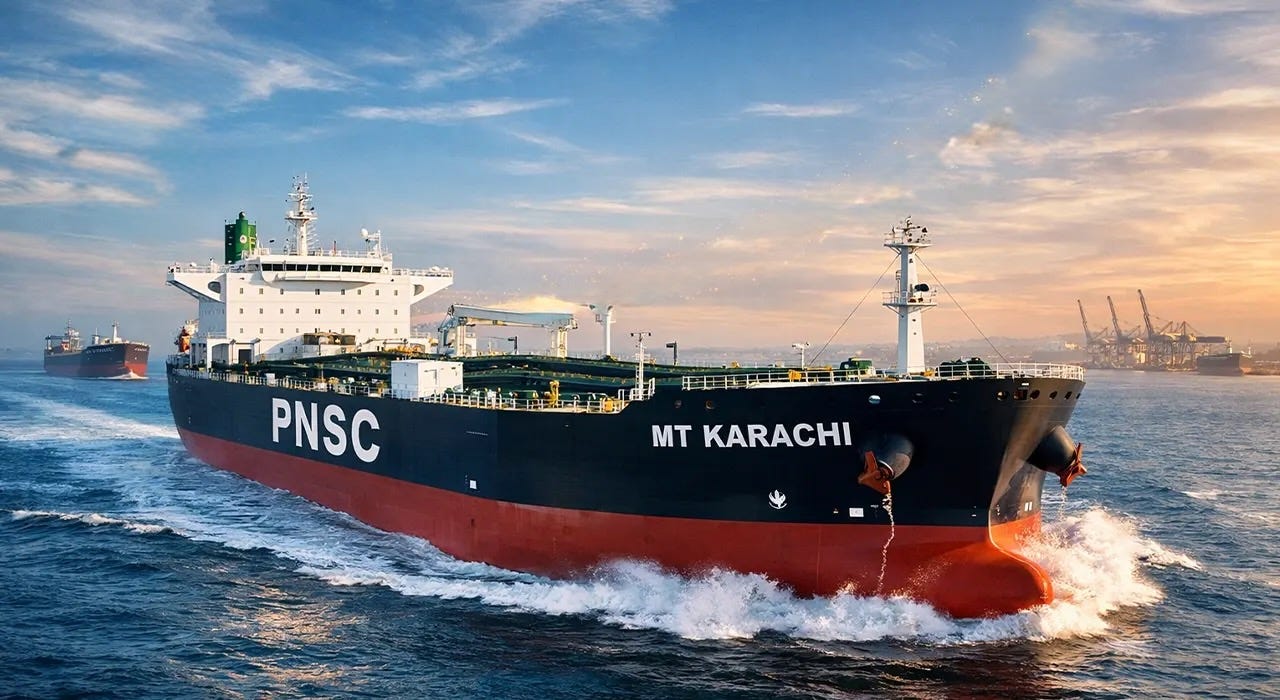
Somewhere near the mouth of the Strait of Hormuz, a vessel named for that city of twenty million people sits at anchor, going nowhere. The MT Karachi, operated by the Pakistan National Shipping Corporation, is carrying the fuel those twenty million people need. A second PNSC tanker is stranded alongside it. A third cargo, mid-loading when American and Israeli aircraft struck Iran on February 28, will not sail under any condition the insurance market is currently willing to cover.
In Islamabad, a second emergency meeting has been convened. Petroleum Minister Ali Pervaiz Malik sits across from Finance Minister Muhammad Aurangzeb. The agenda is simple and terrible: what does Pakistan have, how long will it last, and what happens when it runs out.
The answer, according to officials who attended, is approximately thirty days of petrol and high-speed diesel. After that, the government will need to buy from a spot market where prices are already climbing toward $100 a barrel, using foreign exchange reserves that Pakistan has been borrowing to accumulate, to pay for fuel it cannot produce itself, to keep running an economy already on life support from the International Monetary Fund.
On February 28, 2026, the United States and Israel launched Operation Epic Fury, a coordinated campaign of airstrikes against Iran’s military infrastructure, nuclear sites, and political leadership. Among those killed in the opening hours was Supreme Leader Ali Khamenei. Iran responded with missile barrages against Israeli cities and against American military bases in the Gulf, hitting infrastructure in the UAE, Qatar, and Bahrain. The Islamic Revolutionary Guard Corps issued warnings via international distress frequencies that any vessel attempting to pass through the Strait of Hormuz would be set ablaze. By March 1, tanker traffic through the strait had fallen by 86 percent compared to the 2026 average. By March 2, an IRGC senior official declared the strait formally closed. By March 3, no tanker broadcasting automatic identification signals could be detected inside the waterway.
This is the chokepoint on which Pakistan’s survival depends.
The Strait of Hormuz is a passage twenty-one miles wide at its narrowest point, threading between the Iranian coastline and Oman. Through it flows approximately 20 percent of the world’s daily oil supply, roughly 20 million barrels a day, along with 20 percent of global liquefied natural gas exports, almost all of it originating from Qatar. When it closes, the world feels the disruption. When it closes, Pakistan faces a structural catastrophe that has nothing accidental about it.
This war, moreover, did not arrive in isolation. Houthi attacks on Red Sea shipping since late 2023 had already forced dozens of tanker operators to reroute around the Cape of Good Hope, pushing shipping costs on affected routes up by 40 to 60 percent and adding a two-to-four-dollar per barrel risk premium to oil reaching Asian ports. For every country in the region that depends on Gulf crude and Gulf LNG, the shipping corridor had already become more expensive, slower, and more dangerous before the first American aircraft crossed into Iranian airspace in 2026. Pakistan was absorbing those costs throughout. Now the corridor itself is gone.
Pakistan imports approximately 300,000 barrels of crude oil per day against domestic production of around 70,000 barrels per day, a figure that has been declining for years as indigenous reserves exhaust themselves. The national oil company, OGDCL, predicted that domestic oil reserves would be depleted by approximately 2025. That prediction was accurate. Pakistan meets roughly 70 percent of its petrol consumption through imports. Its refineries depend almost entirely on crude arriving by sea from Gulf sources.
That crude comes primarily from the Abu Dhabi National Oil Company. The LNG that fuels Pakistan’s power generation comes from Qatar, which supplies 99 percent of the country’s imported gas. The diesel that keeps the trucks running and the generators going comes significantly from Kuwait. All of it moves through the Strait of Hormuz. All of it has stopped.
Fossil fuels account for 88 percent of Pakistan’s total energy consumption, with gas and oil together contributing 71 percent of that total. Domestic gas production is declining as reserves deplete, which means reliance on imported LNG was already rising before the first American bomb fell on Tehran. Pakistan signed two long-term LNG supply agreements with QatarEnergy: a fifteen-year contract at a price slope of 13.37 percent of Brent crude, and a ten-year contract at 10.2 percent of Brent. A third fifteen-year agreement with ENI runs until 2032. These contracts carry take-or-pay clauses that obligate Pakistan to accept the cargo or pay for it regardless of whether domestic demand exists. The cumulative burden of these Qatari agreements alone amounts to approximately $5.6 billion. As recently as late 2025, Islamabad was attempting to defer 177 LNG cargoes scheduled for delivery between 2025 and 2031, seeking to divert 24 of the 2026 parcels back to the open market because domestic demand had collapsed and the government could not afford to pay.
And now QatarEnergy has halted production entirely. Iranian drones struck the Ras Laffan Industrial City and the Mesaieed Industrial City on Monday. Qatar’s state energy firm confirmed it had ceased LNG output at both facilities. Daily freight rates for LNG tankers jumped more than 40 percent on that news alone. Anne-Sophie Corbeau of Columbia University’s Center on Global Energy Policy made the assessment plainly: there is no spare LNG capacity anywhere in the world. This disruption is massive. It will impact everyone who imports LNG.
Pakistan is one of those importers. Unlike Japan, which holds strategic reserves and imported 116 LNG cargoes in fiscal year 2025. Unlike China, which has accumulated roughly one billion barrels of oil in storage. Unlike South Korea or the European Union, which have months of emergency reserves built over decades of deliberate energy security planning. Pakistan, which went to the IMF for the twenty-fourth time in 2024 and is currently operating under a $7 billion, 37-month Extended Fund Facility with conditions attached to every tranche, does not have strategic reserves. It has thirty days of petrol. It has a war on its western border. It has a broken strait and ships that will not move.
The energy relationship between Pakistan and the Gulf has always been managed dependency, not partnership. Saudi Arabia does not simply sell Pakistan oil. It extends deferred payment facilities, oil purchased on credit, the bill to be settled later on terms that invariably tighten whenever Pakistan’s geopolitical compliance is required. In February 2025, Islamabad signed an agreement with the Saudi Fund for Development to defer $1.2 billion of oil import payments for one year, a facility the prime minister’s office framed explicitly as a mechanism for “stable supply” while easing short-term fiscal pressure. The UAE extended a $2 billion debt payment deadline as recently as January 2026. These arrangements are what keep Pakistan’s lights on. They are also what keep Pakistan in line.
The current moment tests every dimension of that relationship simultaneously. The UAE, whose Jebel Ali port temporarily suspended operations as Iranian strikes hit Gulf infrastructure, is itself managing an emergency. The Ras Tanura refinery in Saudi Arabia and the Ras Laffan LNG facility in Qatar have both faced direct strike disruption. The Gulf states cannot extend Pakistan credit on favorable terms while Iranian missiles are hitting their own infrastructure. And even if they were willing, the oil and LNG would still need to move through a strait the IRGC has declared closed.
Pakistan’s foreign exchange reserves, rebuilt with extraordinary effort under IMF supervision from their catastrophic lows of 2022 and 2023, when they briefly fell below $4.5 billion and covered less than a month of imports, now face a new stress test that no fiscal discipline can address. Buying oil on the spot market at $100 a barrel, if it can be found, against a budget baseline of $75, destroys every assumption the current IMF programme rests on. The rupee will fall. Import costs will rise. Energy tariffs, already pushed to politically destabilizing levels as an IMF condition, will face further upward pressure. And the circular debt lodged inside the power sector, which reached 2.396 trillion rupees by March 2025, the accumulated product of high generation costs, theft, line losses, and governments that refused to charge consumers what the fuel actually cost, will expand again.
The structural mathematics are merciless. Each dollar added to the oil price by war, sanctions, or shipping disruption passes straight through into higher gas and electricity tariffs or deeper circular debt, because Pakistan’s state has promised the IMF that it will stop absorbing those shocks through untargeted subsidies. Under the 37-month Extended Fund Facility, and under the parallel IMF Resilience and Sustainability Facility which introduced climate-related levies on petrol and diesel, Islamabad committed to restoring cost recovery in the power sector and phasing out untargeted subsidies. When Brent climbs on Houthi attacks or conflict in the Gulf, Pakistan pays at the port, through LNG and oil contracts indexed to global benchmarks it does not control, and again at home, through tariff hikes imposed on a population that cannot absorb more.
There is a bitter geography to Pakistan’s exposure. The country shares a 909-kilometer border with Iran. For decades, the two governments negotiated the Iran-Pakistan gas pipeline, designed to carry 750 million cubic feet of gas per day from Iranian fields directly to Pakistani cities, with no tanker required, no Strait of Hormuz, no spot market exposure. Tehran spent approximately $2 billion constructing its section. The pipeline was designed to lower Pakistan’s domestic gas prices structurally and permanently.
Instead, successive Pakistani governments invoked American sanctions and issued a force majeure notice, suspending their construction obligations while Iran disputed the legal basis of the claim. Islamabad now pays American law firms to prepare for international arbitration over a project that was meant to end the energy dependency it currently cannot escape. Iranian and Pakistani sources have put the potential penalties for Pakistan’s non-completion at up to $18 billion. In late 2024 and early 2025, Pakistan’s petroleum minister publicly discussed seeking a US sanctions waiver from the Trump administration. The waiver was not granted. The current wave of American and Israeli strikes on Iran makes any such relief not merely unlikely but geopolitically incoherent.
The Iran-Pakistan pipeline would not resolve today’s emergency. The construction is incomplete and operationalizing it would require time that the current crisis does not provide. But its absence, enforced by sanctions compliance across multiple Pakistani governments, is the clearest available illustration of how Pakistan’s structural vulnerability was built and then locked in place. The country was prevented from using the one alternative that geography offered, and is now dependent entirely on the same Gulf corridor that American military action has severed.
Pakistan’s officials say they have approximately thirty days of petrol and high-speed diesel. That figure requires honest scrutiny.
Thirty days assumes current consumption rates. When fuel scarcity becomes visible, consumption patterns change: people hoard, informal market prices surge, industrial users front-load wherever they can, and official reserve figures detach from behavioral reality. The psychological emergency is not thirty days away. It is already underway.
Beyond the immediate stockpile, the supply picture is structurally deteriorating. The two PNSC tankers stranded near Hormuz represent specific and irreplaceable volumes of crude that Pakistan’s refineries were scheduled to receive. The refinery intake shortfall will hit domestic diesel production within days of any extended closure. Pakistan meets roughly 70 percent of its diesel needs through local refining, but that local refining requires crude to process. No crude arriving means domestic diesel output falling regardless of what the official reserve figures state.
Islamabad is investigating rerouting crude through Saudi Arabia’s Petroline pipeline, which bypasses the Strait and exports from the Red Sea terminal at Yanbu. The combined bypass capacity available from Saudi and UAE pipelines is estimated at approximately 2.6 million barrels per day. Japan, South Korea, India, and China are simultaneously making the same calculation and arriving at the same destination with far larger dollar reserves and far more powerful bilateral leverage. Pakistan, which was already trying to defer LNG cargoes it contractually owed payment for, will be bidding for scarce alternative supply against governments that hold a billion barrels of strategic reserves and credit lines that do not depend on IMF approval.
The LNG situation is more immediately critical than the oil situation. Pakistan’s power generation depends significantly on regasified LNG. With QatarEnergy having halted production and the global LNG market already running without spare capacity, Pakistan faces a power generation crisis layered directly on top of its transport fuel crisis. Load shedding, which Pakistani households and factories endured as a structural feature of daily life until the most recent brief stabilization, will return with the force of everything that has been deferred. Industrial production will fall. The textile export sector, which generates the foreign exchange Pakistan needs to service its import bills, will be struck in a moment when foreign exchange is already the binding constraint on every other problem the government faces.
The energy crisis does not arrive alone. While the Strait closes and the MT Karachi sits stranded, Pakistan is simultaneously conducting military operations against Afghanistan. Pakistani forces launched strikes against Taliban military facilities in Kabul and Kandahar earlier this year in response to cross-border militant activity, including a major suicide bombing in Islamabad attributed to Afghan-based networks. The confrontation has escalated into what analysts now characterize as an open inter-state conflict, with Pakistani air strikes met by Taliban counter-fire along a border that has never been stable.
Military operations consume fuel. Aircraft burn jet fuel. Armored vehicles run on diesel. Generator-dependent forward bases require continuous supply. The military machine conducting operations on the western border draws on the same reserves that the civilian economy needs to function. Pakistan has been living inside a compounding crisis for years: political instability, military-civilian governance dysfunction, an economy kept solvent by external borrowing, an energy system built on imported fuel purchased with borrowed dollars, a security environment in which threats arrive from multiple directions simultaneously. The Iran-US-Israel war has not created a new crisis. It has stripped away the last buffer between the structural vulnerability that existed and the emergency it was always threatening to become.
Pakistan’s 37-month Extended Fund Facility, approved in September 2024, was designed to stabilize an economy that had narrowly avoided sovereign default. Its conditions included energy tariff increases that pushed electricity prices to levels triggering industrial shutdowns and household distress. Its external financing assumptions rested on the annual rollover of bilateral deposits from China, Saudi Arabia, and the UAE, an architecture of borrowed stability that Islamabad had been requesting be re-profiled across three to five years because even annual rollovers exceeded the government’s capacity to manage.
None of those assumptions accounted for a Gulf war. The IMF programme has no mechanism for external supply shocks of the current scale. If Pakistan needs to purchase oil on the spot market at prices 30 to 40 percent above the programme’s baseline, the fiscal framework built into the EFF collapses. The government either absorbs the cost, blowing its deficit targets and triggering an immediate IMF review, or passes the cost to consumers through further tariff and price increases, which the political environment cannot sustain and which risk the civil instability that has attended every previous energy price shock in Pakistan’s recent history.
There is a third option, which is what Pakistani governments have historically chosen when squeezed between IMF conditionality and political reality: they defer, they partially subsidize, they allow arrears to accumulate in the circular debt mechanism, and they present the IMF with a fait accompli while promising reforms that do not materialize. This option is available. It accumulates the cost rather than resolving it. And the cost, at current energy price levels with the Strait closed and QatarEnergy dark, is accumulating faster than any previous cycle required.
If the Strait of Hormuz remains effectively closed for two weeks, Pakistan’s thirty-day petrol reserves will be significantly drawn down without replacement. Rationing will become operationally necessary even if the government resists announcing it formally. Diesel shortages will affect freight transport. Agricultural operations across Punjab and Sindh depend on diesel-powered tube wells for irrigation. Power load-shedding will extend. Industrial output will fall. The IMF programme’s growth projections for fiscal year 2025-26, already downgraded after years of near-contraction, will not be met.
If the closure extends to one month, Pakistan will need to approach the spot market for refined fuel at crisis prices, competing against the entire Asian import complex, while simultaneously seeking emergency financing from bilateral partners whose own economies are under strain from the same war. The options narrow substantially and the sequencing matters: by the time Pakistan has exhausted its reserves, the window for orderly negotiation will have closed.
If a ceasefire stabilizes the region and tanker traffic resumes within two to three weeks, which Oxford Economics considers the most probable scenario, Pakistan will have experienced severe disruption without crossing into a new category of structural failure. Prices will remain elevated. The fiscal pressure will persist. But the supply emergency will have a resolution date.
What this crisis does regardless of how quickly it ends is confirm the depth and intractability of Pakistan’s structural energy position. Domestic oil reserves are effectively exhausted. Domestic gas production is declining. LNG imports depend entirely on Qatari production moving through a strait that an adversarial military can close within hours. The alternative supply route that geography provided, the Iran-Pakistan pipeline, was blocked by American sanctions compliance and is now the subject of international arbitration with an $18 billion penalty claim attached to it.
For three decades, successive Pakistani governments managed this structural exposure through bilateral credit arrangements, IMF borrowing, and deferred reckoning. The fuel arrived, the lights stayed on intermittently, and the underlying fragility was addressed through the language of reform while the reform did not occur. The war in Iran has ended that deferral. The thirty days of petrol are not a policy failure in the ordinary sense. They are the consequence of a foreign policy posture, an economic model, and an energy strategy built on three assumptions: that Gulf supply routes would remain stable, that American wars would not directly sever Pakistan’s supply lines, and that the borrowing would be refinanced before the bill came due.
All three assumptions have failed simultaneously.
The bill is due.
The MT Karachi is still anchored near the strait, sitting in waters the IRGC has declared closed, carrying fuel for twenty million people who are not yet aware of what runs out first: the patience of international creditors, the diesel in the generators, or the political capacity of a government that has already exhausted most of its options and is now waiting, like everyone else, to see whether the Americans and Iranians can stop the war before Pakistan’s lights go out.


