
Thirteen Thousand Homes
What the Capital Development Authority calls encroachment, half a million people call home.
The Capital Development Authority has spent six months dismantling a settlement older than Islamabad itself. Ninety-five percent of displaced families will receive no compensation. Twenty-five kilometres away, the Punjab government is flooding farming villages to build a dam for a city that is simultaneously clearing its poor for a smart-city skyline modelled on Shanghai. This is what development looks like in the twin cities in the spring of 2026.
Part I: Thirteen Thousand Homes
The man at the glass case near Rimsha Colony has been in that spot since 2012. His family was moved there by the government that year, after blasphemy-related violence in Mehrabad made their previous home uninhabitable. He set up the shop, built a small extension to the house, enrolled his children in the neighbourhood school. Last month, he was told the colony will be cleared.
He is not named in any official statement about the Islamabad Smart City project. He does not appear in Interior Minister Mohsin Naqvi’s January 2026 remarks at the Shanghai Urban Planning Headquarters, where the minister described a vision of Islamabad developed “on the same model” as one of the world’s fastest-growing megacities. His family was displaced by religious violence in 2012 and is being displaced by urban development in 2026. The category changes. The displacement does not.
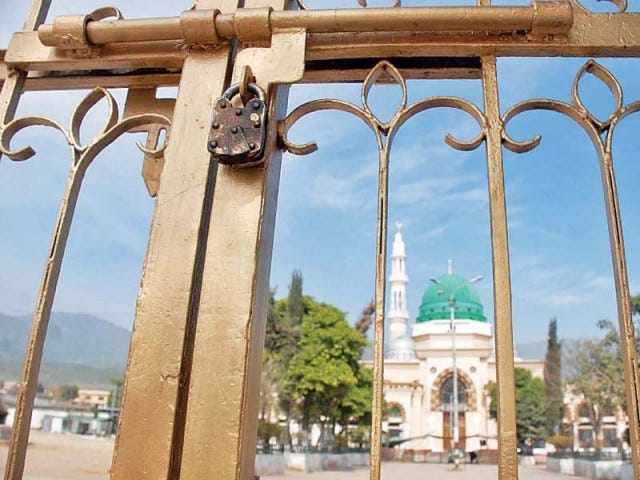
The village of Noor Pur Shahan sits behind the President’s House and the Parliament building, at the foot of the Margalla Hills, roughly twelve kilometres from Zero Point. Mughal Emperor Aurangzeb built the silver-mirrored shrine at its centre in the seventeenth century, in honour of Syed Abdul Latif Shah Kazmi, the Sufi saint known as Bari Imam, who settled in this area around 1617 and died here in 1705. The village that grew around that shrine has existed in some form since before the British arrived, before Pakistan was created, before Islamabad was a city planned on a drawing board in the early 1960s. One resident told local reporters that the people of Noor Pur Shahan had lived in the area for nearly 500 years, from the period when it was known as Chorpur, a place of bandits and trade caravans crossing toward Central Asia, through the Mughal era, through British rule, through Partition, and into a Pakistan that eventually built its capital around them without ever deciding what to do with them.
The founding of Islamabad as a planned capital city in 1961 required the acquisition of large tracts of land across what is now the Capital Territory. Tens of thousands of kanals were acquired in those early years, and the communities that had occupied that land were, in many cases, relocated to adjacent areas or issued temporary occupancy permits on portions of the acquired land while the planned city grew around them. The planned sectors, designed for government employees and the administrative class, offered no formal housing to the workers those sectors required: the construction labourers, the domestic servants, the sanitation staff, the cooks and drivers and cleaners who are the invisible infrastructure of any capital city. Katchi abadis, informal settlements, grew to fill that gap, from the 1970s onward, as low-wage migrants and relocated residents built homes in the spaces the master plan had left unspecified.
Noor Pur Shahan sits within this longer history but with older, semi-rural roots. CDA documents acknowledge its age while classifying it as an encroachment. The authority holds that the land was acquired decades ago, that temporary occupancy permits issued to some residents over subsequent years created no long-term legal claim, and that current residents are trespassers, some of whom received cash or land compensation at the time of original acquisition. An Islamabad Metropolitan Corporation official told Arab News that landowners whose land was acquired were offered one hundred kanal plots for every four kanal taken, plus cash for built structures, and that permits issued later conveyed no ownership rights.
The legal record supports neither side cleanly. Some families hold older land documents or unresolved compensation claims. Others hold permits the authority now calls temporary. Many hold nothing. This ambiguity is not accidental. It is the accumulated product of decades in which the state created informal settlements by relocating people, issued permits it now classifies as temporary, never built the affordable housing that would have made those permits irrelevant, and then returned, at intervals, to call the result an encroachment. When the authority decided to clear the land this time, the ambiguity resolved in one direction only, which is the direction it always resolves.
In the six months before April 2026, the CDA demolished approximately 13,000 homes in Noor Pur Shahan across ten neighbourhoods. The Express Tribune reported the second phase: fourteen more localities targeted, including Dori Bagh, Opara Shehar, Kathian, Bona Mohalla, Shamdan, Mohalla Las, Kamalpur, Mandiala, Ratta Hotar, and Bonian Khattian, affecting an estimated 15,320 additional homes. CDA has stated that the entire area has been incorporated into a new federal government project, that the land around the shrine will be cleared entirely, and that it will be converted into open spaces, including playgrounds.
The operations have not been orderly. When CDA machinery arrived in Noori Bagh Mohallah, between 400 and 500 residents, including women and children, came out of their homes and stood in front of the bulldozers. The machinery paused. Police arrived with riot control units. Residents pelted stones. Police responded with tear gas and batons. Two CDA vehicles were set on fire. At least eight police officers and dozens of villagers were injured. Reporting from Dawn, Pakistan Today, and other Islamabad outlets confirmed that by late evening much of Noori Bagh Mohallah had been levelled, with around 1,000 security personnel deployed across the locality and roads from Margalla Road, Third Avenue, and the Diplomatic Enclave sealed. Searches were conducted in nearby areas. Dozens were detained.
After the clashes, CDA Assistant Director Enforcement Zafar Shah filed an FIR at the Secretariat Police Station against 250 residents, including charges under anti-terrorism laws. The FIR alleged that armed locals had resisted the demolition team, attacked enforcement officers, and set government vehicles on fire. Police launched raids to arrest those named. The Express Tribune had already reported that loudspeaker warnings were broadcast across Noor Pur Shahan explicitly threatening that any protest would result in terrorism charges and the arrest of entire families. Residents said the demolitions began without adequate time to remove household belongings. In several instances, CDA officials reportedly pulled items out of structures before the bulldozers arrived. Debris buried what remained.
Pir Adil Gilani, former mayor of Islamabad, had his ancestral home demolished at approximately 4:30 in the morning on a Sunday. He described the property as spread over four kanals, inhabited by three generations of his family, the graves of his grandfather, his father, and his great-grandfather all on that land. The Islamabad High Court had issued a stay order protecting the property. The demolition proceeded regardless. Family members spent the following Sunday digging through rubble for whatever could be recovered.
“This is our ancestral land spanning three centuries,” Gilani told reporters. “This is a cruelty against not only me but the entire community.”
Faisal, Nadir, and Haji Saleh, named in the same Express Tribune report, said what their own words carry better than any commentary: their grandfathers built these homes. How can they simply leave?
The Express Tribune reported that approximately 95 percent of affected families in Bari Imam will receive no compensation from the current operation.
Ninety-five percent. The government called its Smart City project a milestone.
Part II: The City That Clears Its Workers
Islamabad has a population of 2,363,863, according to the 7th Digital Census of 2023. Approximately 448,000 of those people live in katchi abadis, informal settlements scattered across the capital, according to a mapping study released by the Awami Workers Party at the Haq-i-Rehaish, Right to Housing, conference in April 2026. That is roughly one in five Islamabad residents. The CDA officially recognises ten of the city’s 63 informal settlements as legal. The remaining 53, housing the bulk of those 448,000 people, are classified as illegal encroachments on state land. The CDA’s Katchi Abadi Cell, the body within the authority responsible for surveying and categorising those settlements, has not released a completed population survey in thirty years. The authority is operating, when it operates on data at all, on figures from 2001, three censuses ago, before the city’s population more than doubled.
A city whose urban planning authority has not completed a census of its own informal population in thirty years is not making urban planning decisions on the basis of data. The AWP’s Aasim Sajjad Akhtar named the operative logic at the Federal Constitutional Court hearing on the katchi abadi case on April 16, 2026: Islamabad is increasingly governed by unaccountable bureaucrats who prioritise high-value real estate for the elite over the rights of the labourers who built the city.
Those labourers are not an abstraction. Dawn noted in an editorial in December 2025 that Muslim Colony residents had for years been the drivers, gardeners, cooks, and cleaners sustaining the offices and homes of Islamabad’s ruling class. They are never security risks, the editorial observed. It is their labour that explains the palatial lifestyles of the capital’s elite. The same description applies to Noor Pur Shahan, to Allama Iqbal Colony, to Rimsha Colony. These communities are domestically employed in the planned sectors. They clean the ministries, drive the ministers, cook for the officials. Their physical presence in the capital is economically necessary. Their legal presence, in the authority’s classification, is not.
Allama Iqbal Colony in G-7 is a predominantly Christian working-class neighbourhood that has existed for 25 years, most of its residents employed as janitors, sanitation workers, and labourers for the government offices it serves. Rimsha Colony carries the same profile. The man at the glass case near Rimsha Colony, displaced from Mehrabad in 2012 by blasphemy violence and relocated by the government to his current position, is facing a third displacement, this time by the development vision that also cleared the original Mehrabad. The HRCP and its coalition specifically noted in March 2026 that Christian communities face heightened vulnerability in the current drive, and that women and children across all affected settlements are at particular risk of displacement, loss of schooling, and loss of access to healthcare. These are not secondary consequences of the demolitions. They are the primary experience of the people inside them.
The Human Rights Watch 2024 report on abusive forced evictions in Pakistan documented a consistent sequence across Karachi, Lahore, and Islamabad that maps precisely onto the Bari Imam operations: minimal consultation with affected communities, short or deliberately unclear notice periods, overwhelming police presence, no compensation or resettlement before demolition, and the systematic use of anti-encroachment and anti-terrorism framing to delegitimise the act of resistance. Residents in Bari Imam were told, via loudspeakers, that protest would result in terrorism charges. The FIR against 250 residents included anti-terrorism provisions. The HRW report notes that this framing, standard across Pakistan’s eviction drives, serves a specific function: it strips the category of “resident” from those being displaced and replaces it with “encroacher” or “agitator,” which makes the violence of the operation legally legible and the humanity of those receiving it politically invisible.
Islamabad High Court issued a stay against demolitions in Muslim Colony in December 2025. The demolitions continued. The Supreme Court issued a stay order against summary evictions of katchi abadis in 2015, after the clearance of the I-11 settlement left 20,000 people homeless. At the April 16, 2026 Federal Constitutional Court hearing, AWP’s Aasim Sajjad Akhtar stated that the case had been pending for ten years, during which the CDA had continued demolishing homes intermittently and was now conducting the largest single anti-encroachment drive in the capital’s recent history. The court ordered CDA to formulate a comprehensive katchi abadi policy within four weeks. CDA operations in Noor Pur Shahan continued on the same day the order was issued.
Now consider what the government is building while it clears the workers who built the city. Interior Minister Mohsin Naqvi visited the Shanghai Urban Planning Headquarters in January 2026. He was briefed through videos, architectural models, and interactive displays on Shanghai’s integrated land use, municipal governance, and digital infrastructure. “Shanghai’s exemplary development is worthy of imitation by every major city,” he said. “We want to develop Islamabad on the same model, and will take immediate steps to benefit from Shanghai’s rapid growth experience.” In April 2026, Naqvi chaired a meeting at Islamabad’s Safe City Headquarters and directed officials to complete Phase Two of the Capital Smart City project by May 30. Officials reported that 75 percent of the work was already done, including extensive fibre-optic installation and an upgraded surveillance system integrated into a central command and control structure. From January 1, 2026, vehicles without an M-tag have been barred from entering Islamabad, the first element of the new traffic regulation architecture. In separate television appearances, Naqvi described plans for a skyline behind the Prime Minister’s House that would be “almost a mixture of Shanghai and Manhattan.”
Shanghai cleared millions of residents from its historic shikumen neighbourhoods to build its current skyline. That process took decades and involved state investment in replacement housing at scale. The displacement it caused to working-class communities with deep roots in central districts has been extensively documented and contested. Naqvi’s public statements have focused on Shanghai’s integrated governance and digital infrastructure. What Shanghai built for the people it displaced has not appeared in his remarks.
The cleared land around the Bari Imam shrine, per CDA officials, will become open spaces and playgrounds. The 15,320 homes targeted in the second phase, added to the 13,000 already demolished, will yield land incorporated into a new federal government project whose master plan has not been published. No resettlement sites within Islamabad have been identified or announced for those displaced. In February 2026, CDA held a board meeting at which it approved the ICT Urban Katchi Abadi Regulations 2025, a framework designed, in its stated language, to promote sustainable and organised urban development by bringing informal settlements into the formal net. The regulations exist on paper. The demolitions exist on the ground. Both are current.
The surveillance cameras of the Capital Smart City will, when Phase Two completes on May 30, cover the roads those displaced workers travel to reach the planned sectors where their labour is still required. The traffic management system will regulate their commute from wherever they have been pushed. The integrated monitoring infrastructure will log their movements. The M-tag system will track vehicles at the city’s entry points. They will not appear in the architectural models shown to visiting ministers in Shanghai. They will appear, if at all, in the FIR filed by CDA Assistant Director Enforcement Zafar Shah, under anti-terrorism provisions, against 250 of their neighbours who stood in front of bulldozers at dawn in Noori Bagh Mohallah.
The CDA also, in March 2026, engaged Qatari investors to boost Islamabad’s hospitality sector. The two conversations, Qatari investors and demolished homes, are happening simultaneously in the same administrative apparatus.
Part III: Displaced
Twenty-five kilometres from the Bari Imam shrine, in the Pothohar hills near the Kahuta-Rawat industrial triangle, the villages of Dadhocha, Bharwala, Khanpur, Dhadhar Najaar, and Mohra Wains have been acquired for a water reservoir.
The Dadhocha Dam was proposed in 2001. For nearly two decades it remained unbuilt, a project that moved through feasibility approvals, court proceedings, and the occasional ministerial announcement without reaching a shovel in the ground. During that period the Supreme Court took suo-motu notice of Rawalpindi’s worsening water crisis. Malik Riaz Hussain, chairman of Bahria Town, briefly offered to finance the dam himself provided the government’s bureaucracy did not interfere. The Punjab government assured the court it could build the dam on its own. In October 2020, the construction contract was awarded to the Frontier Works Organisation, the engineering and commercial wing of the Pakistan Army, at a cost of Rs 6.4 billion for construction, excluding land acquisition. Total project cost revised by ECNEC approval in 2025 stands at approximately Rs 14 billion. When complete, the dam will supply 35 million gallons of water per day to Rawalpindi.
The dam sits adjacent to DHA Phase 6 and DHA Valley.
For the construction of the Dadhocha Dam, 16,194 kanals of land have been acquired across Rawalpindi and Kalar Syedan under the Land Acquisition Act of 1894, the same colonial law that governs land acquisition across Pakistan. Over 400 households, approximately 4,000 people, across five or more villages stand to lose their homes, their agricultural land, and in some cases the graves of their ancestors.
In February 2024, Punjab Chief Minister Maryam Nawaz visited the dam site and directed completion by November 2025. She ordered that no injustice be done to anyone. She instructed that a model village be built for approximately 200 displaced households, allowing them to resettle close to their native areas. She said the dam was being built at the cost of Rs 12 billion and that it would meet a major chunk of Rawalpindi’s water demand. The Punjab chief secretary and the Rawalpindi commissioner were praised for their efforts in getting the project commenced. In July 2025, flooding inundated Bharwala, Mohra Faizullah, and Khanpur as the dam was still under construction, destroying belongings worth millions and prompting hundreds of residents to block the Rawat-Kallar Syedan Road in protest. A court issued a stay order and demanded a report from the district administration. The model village has not been built. The compensation being offered to affected families remains the central grievance.
An affected resident of the Dadhocha Dam villages, who asked not to be named for safety reasons, described the situation to us: “Punjab government is taking away all we have: homes, fields, meadow, graves of our ancestors, basic amenities such as road, water. In return, all they had to do was to build a model village for about 200 homes and resettle us there close to our native areas. But local government isn’t helping much in that way. Imagine the compensation being offered for lands is Rs 17,000 per marla for lands adjacent to DHA. You cannot eat one proper dinner with four friends with that money in a decent restaurant these days, and that is the price being offered to us for lands we have tilled over many generations.”
In September 2023, the Supreme Court ordered the Commissioner Rawalpindi to determine compensation for Dadhocha Dam land afresh, at assessed market value, including the potential value of the land and the escalation in prices over time. The order was explicit. Some landowners were paid following that order. The source’s testimony suggests the assessment has not been uniformly applied, and that compensation rates for remaining affected families have not reflected the market value of land adjacent to one of Rawalpindi’s most commercially active military-run real estate developments.
“CM Punjab visited the location a year ago and passed orders that no injustice should be done to anyone,” the resident said. “But no one seems to heed to it, or news are not getting to her.”
The resident then described a second strand of the dispute. Outside the formally acquired dam area, but surrounded on multiple sides by DHA Phase 6, sits approximately 82 kanals of ancestral land containing a family graveyard. This land had been subject to illegal occupation. On January 6, 2026, revenue officials and local administration officers cleared that illegal occupation, demarcated the land, and formally handed it back to its owners. Days later, DHA demolished the demarcation markings and reasserted its claim, arguing that it had already sold property files for this land to buyers, and that it therefore could not return the land to the people who owned it before DHA sold it.
The Lahore High Court had previously declared DHA’s acquisition of adjoining land in the same area null and void. DHA continued to occupy it. Lok Sujag confirmed in 2021 that despite the court ruling, DHA had not vacated the land. Residents at the time told Lok Sujag that a thousand families had been affected by the dam project across multiple villages, and that demands for a settlement had been met with an assistant commissioner who told them the matter was “out of his hands.” What happened on January 6, 2026, if the account given to us is accurate, represents something beyond the original occupation: a revenue department acted on a legal restoration, handed land back to its owners, and was overruled within days by an institution with greater institutional leverage than the revenue department. We could not independently verify the specific sequence of events from a second source. DHA’s occupation of land in the Dadhocha area in defiance of court orders is documented in Lok Sujag’s reporting and confirmed by the Lahore High Court’s own rulings.
The argument attributed to DHA, as the resident characterised it, is this: we sold something that was not ours to sell, and the fact of those sales now prevents us from returning it to you. The residents of Barwala and the adjacent villages described this logic to us as the same logic by which their ancestors’ graves end up inside a housing scheme’s boundary. The graveyard is outside the acquired area. DHA is inside the boundary. The revenue department handed the land back. DHA took it again.
This has happened before in the Dadhocha area. What is new, in the January 2026 episode, is that a government agency acted to restore the land, and was overruled within the same week.
Across the Rawalpindi Expressway, the Rawalpindi Development Authority is also conducting demolitions. Its targets are different from CDA’s and from the Punjab government’s dam projects, and the difference is instructive. In 2024 and into 2026, RDA moved against illegal private housing schemes on Chakri Road and elsewhere, including Abdullah City, Avalon City, Blue World City, and Al-Imran Homes, demolishing their main gates, site offices, boundary walls, billboards, and road infrastructure. RDA’s stated rationale: protecting citizens from fraudulent developers who sell plots in schemes operating without regulatory approval. In March 2026, RDA launched enforcement action across Rawalpindi, Taxila, Gujar Khan, Kallar Syedan, and Kahuta against developers operating without planning approval, deviating from layout plans, and misleading buyers. The DG RDA described the goal as curbing exploitation.
The distinction is worth stating plainly, not editorially but structurally. RDA demolishes the gates and offices of developers who sell land they do not own, to protect buyers from fraud. CDA demolishes the homes of residents who have lived on land for generations, in service of a federal project whose master plan has not been published. Punjab’s dam authority displaces farming villages for water infrastructure that will serve the twin cities, offering compensation that falls below what the Supreme Court ordered three years ago. All three exercises proceed under the same legal vocabulary: state land, illegal structures, anti-encroachment. The law is identical. The people on the receiving end are not. In one version of the enforcement regime, the state protects ordinary citizens from predatory developers. In the other, it becomes the predatory developer.
What Islamabad and Rawalpindi are producing together, in the spring of 2026, is a coordinated clearance of the poor from multiple directions simultaneously. In Noor Pur Shahan, 13,000 homes are gone and 15,320 more are targeted, with no resettlement plan and no compensation for 95 percent of those displaced, for a federal project whose cleared land will become, officially, playgrounds. In Allama Iqbal Colony and Rimsha Colony and Muslim Colony, working-class communities of 20 and 25 years are cleared while stay orders remain on the books and the FCC issues new orders requiring a policy within four weeks. In the hills near Kahuta and Rawat, farming families are removed for infrastructure that will supply water to the twin cities, offered compensation that falls below what the Supreme Court itself ordered three years ago, with a model village promised in February 2024 and still unbuilt, and ancestral graveyards distributed between acquired land and a military housing scheme’s boundary.
The CDA’s Katchi Abadi Cell has not completed a population survey of Islamabad’s informal settlements in thirty years. They are operating on 2001 data in a city of 2.36 million where nearly half a million people live in communities the authority classifies as illegal. Thirty years of missing data is not a bureaucratic oversight. It is a deliberate production of ignorance: a state that does not count the people it plans to displace does not have to account for them when the machinery arrives.
The Human Rights Commission of Pakistan and its coalition, the AWP, the National Commission for Justice and Peace, the All-Pakistan Alliance for Katchi Abadis, and Aurat March Islamabad have collectively and repeatedly stated what a rights-compatible response would require: an immediate moratorium on all demolitions in informal settlements, formal recognition and regularisation of long-standing communities wherever possible, malikana huqooq for long-term residents under constitutional housing protections, fair compensation and nearby resettlement where displacement cannot be avoided, legal action against officials who bypass existing court orders, a transparent national framework governing informal settlements with full community consultation, and the completion of the population survey the CDA’s own Katchi Abadi Cell has owed for three decades. These demands have been in writing since 2015. Since April 16, 2026, the Federal Constitutional Court has given CDA four weeks to produce a policy. The demolitions continued on the same day the order was issued.
The Awami Workers Party held its Haq-i-Rehaish conference in April 2026 and released the mapping study that challenged CDA’s data, documented the 448,000 katchi abadi residents operating outside the official record, and called for the housing right embedded in Article 9 of the Constitution to be operationalised. Conference participants issued a formal set of demands: immediate moratorium, malikana huqooq, fair compensation, legal accountability for officials defying court orders. These are not new demands. The CDA has been receiving them since 2015 and has regularised ten settlements in that time.
Bari Imam, the saint for whom the shrine is named and maintained, settled in Noor Pur Shahan in the early seventeenth century to teach the people of that isolated and difficult place about peace, harmony, and the obligations of those with power toward those without it. The Government of Pakistan maintains his shrine. The Government of Pakistan has demolished the village that grew around it and will convert the land into playgrounds.
The shrine remains. Everyone else must leave.
The man from Rimsha Colony whose family was displaced by blasphemy violence in 2012 and is now displaced by development in 2026 is not a data anomaly. He is the data. The man in the Dadhocha hills who was offered Rs 17,000 per marla for land adjacent to DHA, whose graveyard was handed back by a revenue officer and taken again within the week, is not an exceptional case. He is the documented norm.
The question that the evidence raises and cannot yet answer is whether the Federal Constitutional Court’s four-week deadline, issued on April 16, 2026, will produce a policy that governs the next demolition drive, or whether it will join the 2015 Supreme Court stay order and the December 2025 Islamabad High Court order and the CM Punjab’s February 2024 instruction that no injustice be done, in the archive of protections that exist in writing while the clearances continue in the mornings.


