
The Women of Chak 123
Pakistan pays its poorest women Rs6,000 a quarter to survive. The system collecting that payment had been looting them for years. On March 16, it killed eight of them.
Dunya News printed this on March 16, 2026:
ملبے تلے دب کر 50سالہ شہناز بی بی، 40سالہ مریم بی بی، 35سالہ بختاور بی بی، 50سالہ انور مائی، 45سالہ چرخی مائی عرف گوگی، 49سالہ پروین بی بی اور زلیخا بی بی دم توڑ گئیں۔
Buried under the rubble and died: Shahnaz Bibi, 50. Maryam Bibi, 40. Bakhtawar Bibi, 35. Anwar Mai, 50. Charkhi Mai, known as Gogi, 45. Parveen Bibi, 49. And Zulaikha Bibi, whose age the report did not give.
An eighth woman died as the night continued. Her name has not appeared in any published account.
This sentence, in Urdu, in a single Pakistani news broadcast, is the entirety of what the public record contains about who these women were. No ages appeared in AP’s wire report. No names appeared in Dawn’s English edition, The Express Tribune, The Washington Post, or any English-language outlet that filed within seventy-two hours of the collapse at Sajjad Kirana Store in Chak 123/P, Rahim Yar Khan. The officials who responded were named at length. The BISP chairperson was named and quoted. The deputy commissioner was named. The district police officer was named. The rescue operation supervisor was named. Shahnaz Bibi, fifty years old, was not named in English. Charkhi Mai, who was forty-five and whose family called her Gogi, was not named in English.
The British numbered the settlements they carved out of the Cholistan desert fringe when the canal engineers opened the Lower Chenab and Sidhnai irrigation schemes at the end of the nineteenth century. They did not give the villages names. They gave them grid coordinates. Chak 1. Chak 2. Chak 3. Each chak was a unit of canal-irrigated agricultural settlement, its tenancies divided by the acre, its tenants assigned by caste and community according to what the colonial land revenue administration had determined each community was suited to grow. The numbering ran into the hundreds. The chaks were not meant to have histories, only outputs: acreage under cotton, yield per acre, revenue per tenancy. No subsequent government gave them anything to replace the numbers with.
Chak 123/P is in Union Council 114, Rahim Yar Khan district. It sits in the agricultural belt where the canal water that made the desert farmable also created the conditions for the feudal land concentration that has kept this district poor across six generations of Pakistani statehood. The poverty headcount in Rahim Yar Khan is 44.15 percent. In 2004 and 2005, before BISP existed, the poverty rate here was 56.2 percent. The number has moved. The arrangement has not.
The Benazir Income Support Programme pays its registered beneficiaries Rs6,000 per quarter. This is what Shahnaz Bibi and Maryam Bibi and Bakhtawar Bibi and Anwar Mai and Gogi and Parveen Bibi and Zulaikha Bibi came to Sajjad Kirana Store to collect on the morning of March 16. The third installment of the year. The Eid payment, timed specifically by BISP to reach the poorest households before Eid-ul-Fitr. Six thousand rupees. At current exchange rates, approximately $21. For a household assessed by the National Socioeconomic Registry as falling below the poverty threshold in a district where 44 percent of the population is below that threshold, Rs6,000 every three months is not supplementary income. It is the flour calculation for the end of Ramadan, the cloth for the children’s Eid clothes, the credit at the kirana that has been accumulating since January. It is the reason you put on your dupatta before nine in the morning and walk to the designated shop, even if the designated shop is crowded and someone tells you to go upstairs.
Around a hundred women made that calculation and walked to Sajjad Kirana Store.
The word kirana covers a specific kind of Pakistani commercial existence. The neighbourhood grocery that sells in the quantities poor households can actually afford, which is not the wholesale quantity but the daily quantity. Flour by the two-kilo bag. Oil by the quarter-litre. Single cigarettes from a jar on the counter for people who cannot afford the pack. A kirana in a rural chak of southern Punjab typically occupies one room, sometimes with a small storeroom attached, sometimes with a raised first floor used for storage. The counter is wood. The lighting is a single bulb. The credit extended to regular customers is unwritten and understood.
Sajjad Kirana Store had been designated as a BISP payment point. The designation did not require an inspection of the premises. It required a biometric fingerprint device, supplied through a private app official connected to one of BISP’s six partner banks, and a contractual arrangement under which the shopkeeper would facilitate quarterly payments in exchange for a fee. What it did not produce, at any point, is a safety standard for the physical premises. No floor load assessment. No occupancy limit. No structural certification. A private shopkeeper’s building became a government welfare distribution point by contractual designation alone, and the state’s obligation to the women collecting payments inside it ended at the designation.
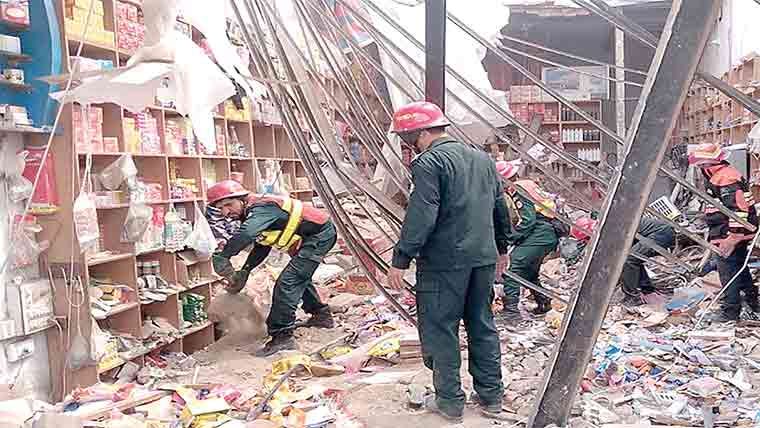
When the ground floor of Sajjad Kirana Store filled that morning, the shopkeeper directed some women upstairs. The first floor was there: a room above the shop, the kind of supplementary space a kirana owner uses for storage. Its roof was supported by a girder and a T-iron structure. The Additional Deputy Commissioner General’s inquiry, completed within twenty-four hours as directed by the district administration, found this and named it. A girder and a T-iron structure. Not built for crowds. Not inspected. Not required to be inspected.
At approximately 10:39 in the morning, the roof came down.
Shahnaz Bibi was fifty. She had been alive long enough to see BISP created, reformed, renamed, and administered under four governments. She had been assessed and enrolled and assigned a quarterly payment and a payment point and she walked to that payment point and was killed there.
Maryam Bibi was forty. She was in the middle of her life.
Bakhtawar Bibi was thirty-five. She was, by the standards of women in Rahim Yar Khan’s rural chaks, where early marriage and early childbearing are the norm documented by every development survey of this district, almost certainly a mother of children who needed Eid clothes.
Anwar Mai was fifty.
Charkhi Mai was forty-five. Her family called her Gogi. This is the single biographical fact that the Dunya News report added to her name, and it is the detail that makes her more present in the record than any of the others, because a nickname is given by people who love you, and it follows you across your life, and it is how you are known in the house and the lane and the neighbourhood, and it is a fact that no official survey, no poverty scorecard, no BISP beneficiary number carries. The National Socioeconomic Registry knew Charkhi Mai’s poverty score. It did not know she was called Gogi.
Parveen Bibi was forty-nine.
Zulaikha Bibi. No age given.
An eighth woman died that night. Her name has not been published anywhere in the record this piece was able to locate.
More than eighty others were injured. They were taken to Sheikh Zayed Hospital with broken legs, fractured arms, and head wounds. Their names are not in any published account.
Three years before the roof came down, a reporter for Dawn’s Rahim Yar Khan bureau published an investigation that every official statement made after March 16 must be read against. The investigation appeared in print on February 5, 2023. It documented, specifically and by name, how BISP beneficiaries in this district were being systematically defrauded by the retailer network through which they collected their payments.
The figures were precise. At the time of the investigation, Rahim Yar Khan district had 209 designated BISP payment retailers. Liaqatpur had 50. Khanpur had 60. Rahim Yar Khan city had 52. Sadiqabad had 47. Each retailer operated through a private app official, a representative of the partner bank. The investigation noted clearly that these officials were neither employees of the bank nor authorised by the bank to conduct any business on its behalf. A senior bank official confirmed this on record, anonymously. The app official’s fee, which each retailer paid quarterly to keep the biometric device operational, ran between Rs150,000 and Rs200,000. The retailer recovered this cost directly from the women at the counter. Between Rs500 and Rs1,500 was deducted from each beneficiary’s Rs6,000. She received what remained. She received this every quarter, from the programme that described itself as income support, from the device at the designated payment point, which could not be used without unlocking it through a private contractor who was not authorised to be there.
That investigation ran in Dawn. It named Rahim Yar Khan. It named the tehsil counts. It named the fee structure. It named the per-beneficiary deduction range. A senior bank official confirmed the arrangement was operating outside any regulatory framework.
Nothing happened.
In July 2025, The Diplomat published a national investigation into the same system at scale. BISP’s most recent audit had found Rs141 billion in financial irregularities in a single fiscal year. One source described what happens to retailers who refuse to participate in the quarterly fee arrangement: they are threatened with criminal charges, their biometric devices confiscated, their payment point designation revoked. Participation in the extraction is, by design, mandatory. Above the retailers, BISP district monitoring officials collect Rs40,000 to Rs100,000 per retailer per quarter. Above them, law enforcement officials and public administration figures receive regular distributions. The chain is institutional, not incidental. It is not a few bad actors in an otherwise sound system. It is the system.
Shahnaz Bibi, Maryam Bibi, Bakhtawar Bibi, Anwar Mai, Gogi, Parveen Bibi, and Zulaikha Bibi walked into this arrangement every quarter. They stood at the counter and placed their fingers on the biometric reader and collected what remained of Rs6,000 after the overhead had been recovered. They did this in the summer installment and the autumn installment and the winter installment and on the morning of March 16, when the Eid installment came and the shop filled past capacity and the shopkeeper told some of them to go upstairs and the girder and T-iron structure gave way.
The state was not absent from Sajjad Kirana Store on the morning of March 16. It had been present every quarter, collecting its share.
Police registered a case at Airport Police Station before the day ended. DPO Irfan Samo confirmed that five individuals had been named, including the private device agent attached to the store. Deputy Commissioner Zahir Anwar Jappa visited Sheikh Zayed Hospital and declared an emergency. Commissioner Musarrat Jabeen of Bahawalpur Division arrived at the hospital and confirmed an investigation had been launched. Punjab Chief Minister Maryam Nawaz Sharif conveyed condolences and directed the DC to submit a report. President Asif Ali Zardari expressed sorrow and directed the BISP chairperson to travel to the district immediately.
Senator Rubina Khalid flew to Rahim Yar Khan. She visited Sheikh Zayed Hospital. She announced Rs1 million in compensation for the family of each woman killed and Rs300,000 for each of the injured. She issued a notice to the partner bank for negligence and announced a fine.
Her first public statement, issued before the inquiry had completed its work, was this: banks are responsible for cash disbursement, not BISP.
The inquiry completed its work the following day. It found the building structurally inadequate. It submitted its report. Senator Khalid’s statement was not revised.
The Rs141 billion in irregularities found in BISP’s audit covers fiscal years your office administered. The 2023 Dawn investigation that named your programme’s retailer network in Rahim Yar Khan, by tehsil count and quarterly fee structure and per-beneficiary deduction range, ran while you held this post. The retail-agent model, in which private contractors with no employment relationship to any government body became the financial and physical interface between Pakistan’s largest welfare programme and 9.6 million beneficiary families, operating in uninspected premises with no safety obligation, answerable to no authority except the threat of criminal charges if they declined to participate in the extraction: this is not a system you inherited without warning. It was documented and published in a national newspaper and named this specific district before March 16.
The five men named in the police case are at the absolute floor of the hierarchy your audit identified. The device agent is in custody. The partner bank has been fined. No statement from your office, the Punjab government, or the federal government has announced that BISP’s 209 payment points in Rahim Yar Khan will be inspected for structural safety before the next disbursement. No statement has addressed whether a minimum premises standard will be required before a kirana is designated as a welfare payment point. No statement has addressed the quarterly concentration model itself: the arrangement under which the district’s poorest women are directed, four times a year on a fixed schedule, to informal, unregulated, privately owned buildings to collect cash in conditions the state neither monitors nor controls.
The compensation has been announced. The inquiry report is filed. You have returned to Islamabad. The next quarterly disbursement is four months away, and the 208 remaining payment points in this district have not been inspected, because nothing in any statement from any level of government suggests they will be.
The women injured at Sajjad Kirana Store on March 16 were taken to Sheikh Zayed Hospital.
The hospital is named after Sheikh Zayed bin Sultan Al Nahyan, the late ruler of the United Arab Emirates. The international airport serving Rahim Yar Khan is named Sheikh Zayed International Airport. The medical complex at the centre of the city is named the Sheikh Zayed Medical Complex. There are roads bearing Emirati names in the district. There are palaces staffed year-round by hundreds of local employees who receive regular salaries in years when the UAE royal family does not visit. As recently as December 2024, UAE President Sheikh Mohamed bin Zayed Al Nahyan met Pakistani Prime Minister Shehbaz Sharif at the Sheikh Zayed Palace in Rahim Yar Khan. Pakistani foreign policy officials have described the hunting privileges extended to UAE royals in the Cholistan desert each season as a cornerstone of Middle East relations.
The poverty headcount in Rahim Yar Khan is 44.15 percent.
BISP offered Rs1 million for each woman killed collecting her Eid payment. At current exchange rates, approximately $3,500. The government described this as compensation.
Bakhtawar Bibi was thirty-five years old. Each quarter she collected her payment, Rs500 to Rs1,500 was deducted by the retailer recovering his overhead from the device agent above him. Over years of quarterly payments, the extraction accumulated. The state knew she was poor enough for the transfer. The system it built to deliver the transfer collected from her on the way.
The Rs1 million offered for her death is, at current exchange rates, the largest sum her household will almost certainly have ever received from the state. This is also a kind of accounting.
Every English-language outlet that filed the story on March 16 constructed the same piece: casualty count in the headline, official response in the body, Senator Khalid’s visit as the closing note of institutional concern. The officials were named and quoted. The rescue operation was described. The compensation was noted. In not one of these accounts did a reporter travel to Chak 123/P Tibba, or knock on a door in Union Council 114, or ask the name of a woman who had been standing in the shop that morning and walked out alive.
This is not a failure of individual journalists. It is the accumulated weight of how the English-language press in Pakistan relates to the beneficiary class. BISP stories appear in the English press when BISP makes announcements: when its chairperson visits, when its audit figures are released. The women who collect the payments appear as data points in coverage of the programme’s reach and as casualty counts when something goes wrong. The Dawn Rahim Yar Khan bureau investigation from 2023 was the exception: a district correspondent who had sources on the ground and knew precisely what to ask. That story ran. It named this district. It produced no English-language follow-up that sought out the women being deducted from.
Dunya News, reporting in Urdu on the day of the collapse, named Shahnaz Bibi, Maryam Bibi, Bakhtawar Bibi, Anwar Mai, Charkhi Mai, Parveen Bibi, and Zulaikha Bibi. It gave their ages. It gave Charkhi Mai her nickname. This information was available to any English-language journalist or editor who looked. Nobody looked.
Zamir Niazi spent his career documenting Pakistan’s architecture of press silence, and he understood that the most durable censorship is not the dramatic raid on the printing press or the journalist taken in the night. It is the thousand institutional assumptions that produce the same silence without requiring any single act of suppression. Nobody instructed the English-language press to leave these women nameless. Nobody needed to.
The inquiry found one faulty building. It examined one kirana, one T-iron roof, one union council in one tehsil of one district. The device agent from that kirana is in custody. The partner bank connected to that kirana has been fined. Sajjad Kirana Store is closed.
What the record cannot answer, because no government statement has addressed it and no journalist has asked it in print, is whether anyone in BISP or the Punjab government or the federal administration has walked into any of the remaining 208 payment points in this district and looked at the ceiling.
The fourth quarterly disbursement of the year will be distributed before the autumn. The women of the chaks will walk to their designated payment point, as they have done every quarter, and stand in whatever space is available, and place their fingers on the biometric reader, and collect what remains of Rs6,000 after the overhead has been recovered. The state will know their poverty scores. It will not know the load-bearing capacity of the roof above them.
In Dunya News, Charkhi Mai was named as Charkhi Mai, and then her family’s name for her was placed beside it in the record, separated by the Arabic word for alias. She was forty-five years old and she was called Gogi and she came to Sajjad Kirana Store on a Monday morning in Ramadan to collect twenty-one American dollars’ worth of welfare and she is buried under the rubble of a sentence that no English newspaper printed, in a language the people who built the system that killed her do not read, in a district where the next quarterly payment is already scheduled and the 208 remaining payment points have not been inspected and her name, and all the names beside hers in that sentence, are waiting for someone to carry them further than the Urdu press could reach.


