The Villages Under DHA's Lake
Farming families in Rawalpindi were displaced from land their ancestors held for 200 years. The compensation offered was Rs 17,000 per marla.

Begin with what is not in the record.
A Geo News camera team visited the villages of Bharwala, Khanpur, and Mohra Faiz several months before the demolitions. They filmed the houses, the fields, the ancestral graveyard. The documentary has not been broadcast. The villages no longer exist. The displaced families were informally permitted to return and harvest the crops they had already sown before the debris was cleared. After the harvest, the last visible signs of human habitation were removed.
Correspondents for major national newspapers based in Rawalpindi say, without hesitation, that they cannot name DHA in their reporting on the Dadhocha Dam displacement. The Weekly Pindi Post, an Urdu weekly, ran the story about the 87-kanal ancestral land dispute that no national outlet would publish. A handwritten petition from affected residents, documenting their land parcel by parcel against specific khasra numbers, went to the Assistant Commissioner’s office and reached no national editorial desk.
What Was Hidden in the Dam’s Own File

The Dadhocha Dam was proposed in 2001 to solve Rawalpindi’s water crisis. The project stalled for years, delayed by funding gaps and, as the Express Tribune’s Rawalpindi correspondent noted in his original clipping, political reasons. The original cost estimate appears in different sources as either Rs 200 crore or Rs 7 billion, a discrepancy that itself reflects how long the project drifted without fixed parameters. The revised total project cost as of April 2026 is Rs 52,730 million. The Frontier Works Organization holds the construction contract awarded in 2020.
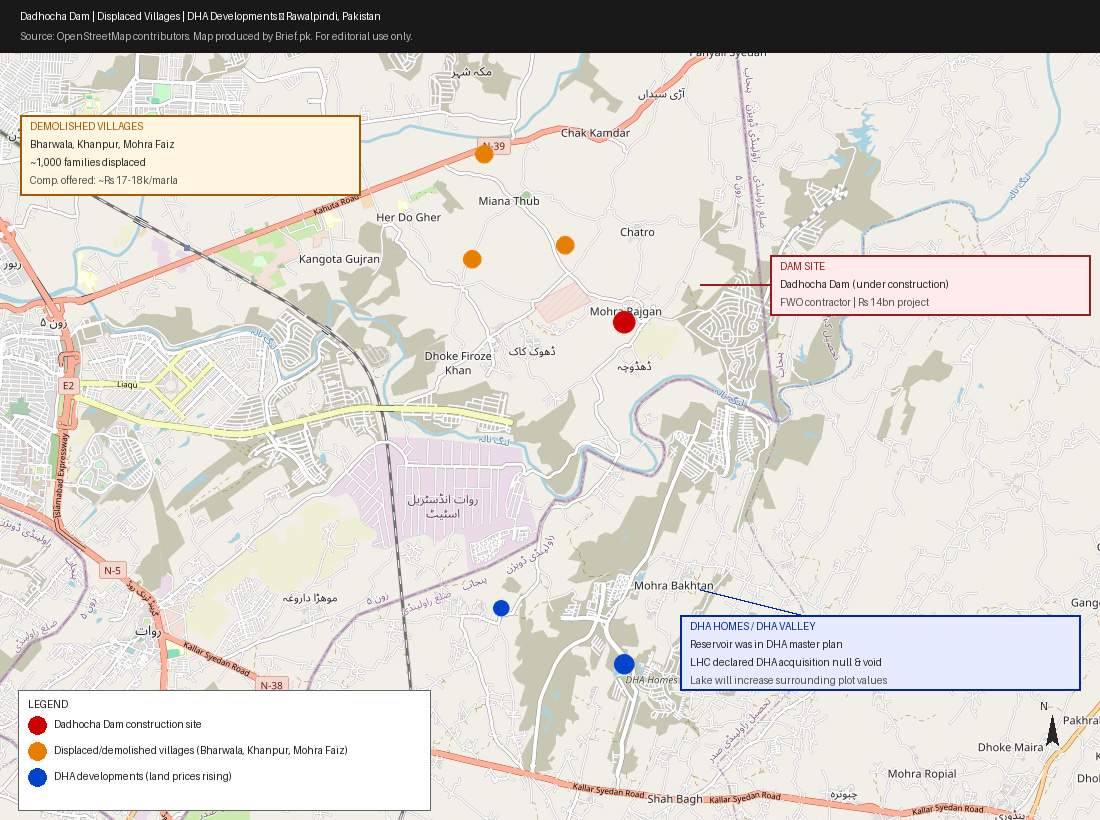
The Defense Housing Authority acquired approximately 18,000 kanals of land in Bharwala, Dadhocha, and surrounding villages in the 2000s to develop DHA Valley. The Lahore High Court declared that acquisition null and void. DHA continued to occupy the land. In the same period, DHA incorporated the dam’s reservoir location into DHA Valley’s master plan, designating the future lake as an amenity for its luxury residential development.
In 2010, a retired Lieutenant Colonel, Tariq Kamal, filed a petition before the Supreme Court alleging that DHA and others were actively developing residential plots on a site the state had reserved for a public dam. A two-judge bench headed by Justice Jawwad S Khawaja took up the case. During proceedings the bench asked directly: how could DHA’s Vice President, General Hamyum Aziz, lobby the Punjab Chief Minister to relocate a water reservoir meant for millions of Rawalpindi’s residents to a different site? The Punjab government responded by submitting a report confirming the dam would be built at its original location, Site Number 1, which the report itself confirmed falls within DHA Valley’s master plan. Punjab committed publicly to resisting all pressure to change the site.
This is the context no major Rawalpindi bureau will put in print. DHA tried to move a public dam to protect a private real estate development. A serving General made that request to the Chief Minister. A retired army officer had to file a Supreme Court petition to stop it. The Punjab government’s own submission confirmed that the dam site was already in DHA’s master plan. That submission is on the public record. It has not been widely reported.
The dam is now being built at that original site. The Frontier Works Organisation, the Pakistan Army’s engineering and commercial wing, holds the construction contract awarded in October 2020. When complete, the reservoir will supply 35 million gallons of water per day to Rawalpindi and sit as a lake at the centre of DHA Valley, DHA Phase 7, and DHA Homes. FWO builds the infrastructure. DHA gains the lake view. No conflict of interest has been declared by any party.
What the Families Were Paid
Seven villages along Ling Nullah fall within the dam’s reservoir area, housing approximately 1,000 families. Bharwala alone contains around 250 households. An affected source was precise about what displacement means at this economic level: “Our connection with lands was not merely emotional. Hundreds of people’s lives depended on food they could grow and cattle they could graze on these lands. These are not big farmers. Each family owns a few kanals of tillable land, if at all.” The loss of those kanals and the shared meadows eliminates both shelter and food production in a single administrative action. When it is done, the dam will ease the Kant-Pasni water shortage that has worsened in Rawalpindi for decades. The families who paid for that ease with their land will not be among those who benefit from it.
The compensation offered runs at approximately Rs 17,000 to Rs 18,000 per marla for land adjacent to DHA developments. An affected resident, speaking to brief on condition of anonymity, described the figure directly: “You cannot eat one proper dinner with five friends in a reasonable outlet in Rawalpindi with that money. And that is the price being offered to us for lands we have tilled over many generations.”
In September 2023, the Supreme Court ordered the Commissioner Rawalpindi to redetermine compensation at assessed market value, including the potential value of the land and the escalation in prices over time. The order came after years of residents arguing in court and to journalists that what was being offered bore no relationship to market value. A resident of Bharwala, speaking to Lok Sujag in 2021, put it plainly: “Our village has all the facilities that DHA Valley has. Water, electricity, gas, schools. Why can’t we get the same price for our land that a DHA plot gets?”
The comparison is exact. DHA had paid these same villagers approximately Rs 96,000 per kanal when acquiring their land in the 2000s for DHA Valley, the acquisition the Lahore High Court later voided. The Punjab government’s dam acquisition rate today is Rs 90,000 per kanal, lower in nominal terms than what DHA paid for the same land more than a decade ago, before DHA Phase 6, DHA Valley, and DHA Homes were developed and operating in the surrounding area. A widow from Bharwala told Lok Sujag the money offered would not cover six months of rent for a one-room house in Rawalpindi.
The villagers’ demand has been consistent in every petition and every conversation: use DHA Valley’s illegally held land to resettle us. Hundreds of kanals of open land, some of it under DHA development, sit within sight of where the villages stood. The Lahore High Court already voided DHA’s acquisition of that land. The court-ordered solution and the people who need it occupy the same postcode. Neither has moved toward the other.
What Happened on the Ground
An operation to demolish houses and shops was led by Assistant Commissioner Hakim Khan, targeting four settlements in the reservoir area. He issued five-day eviction notices and set a deadline of November 6 to 8.
Residents, including women and children, blocked the bulldozers by lying down in front of the machines. Before the operation was halted that day, the team had partially demolished two widows’ homes, one poultry shed, four shops, and sections of boundary walls and roadside sheds belonging to eight households. When the operation suspended, AC Hakim Khan made his position clear: “No excuses will be accepted. Anyone who resists will face the law. Next week we will clear the entire area and use bulldozers. Shift your belongings and vacate the area yourselves.”
Two residents, whose names brief withholds for safety, told Express correspondent Qaiser Shirazi they would not be evicted by force, but were not against the dam. “Our demand, which has been upheld by the High Court and Supreme Court, is that we be paid market compensation for our lands and century-old trees. Our ancestors have lived here for 200 years. Do not offer us half or three-quarters of the price.” They asked for 40 days to vacate once a genuine agreement was reached. The government’s offer at the time was Rs 0.7 to 1 million per unit, against land the residents valued at Rs 2 million.
The Commissioner stated publicly that all affected people had been assisted and funds disbursed. The informal permission for families to return and harvest pre-sown crops before the debris clearance, confirmed to brief by an affected source, was not a formal resettlement mechanism. It was administrative acknowledgment that families had been removed before they could complete their agricultural season.
The 87 Kanals and the Graveyard
Outside the formally acquired dam area, surrounded on multiple sides by DHA Phase 6, sits approximately 87 kanals and 16 marlas of ancestral land containing a family graveyard. The primary khasra reference for the disputed plots is number 683, with additional plots documented in a formal handwritten petition submitted by affected families to the Assistant Commissioner, recording each parcel by khasra number and requesting legal restoration. The Weekly Pindi Post, in its January 16-29, 2026 edition, ran the story under the headline in Urdu: Dadhocha Dam: Mutasareen Ki Jaddi Zameen Wapis Dilanay Kay Liye Pesh Raft, Progress to Restore Affected People’s Ancestral Land. No national publication followed. For readers who want to verify the geography themselves, the source provided these Google Earth search terms: Dadhocha Dam site, Barwala graveyard, DHA Phase 7, DHA Valley. The spatial relationship between the reservoir, the graveyard, and the DHA developments is visible from above.
On January 6, 2026, revenue officials and local administration officers cleared the illegal occupation of this land, demarcated the boundaries, and handed the property back to its owners. Within days, the demarcation markings were demolished. DHA reasserted its claim. Their argument: DHA had sold property files for this land to buyers and could not return it to the people from whom it had not been legally purchased. Lok Sujag documented in 2021 that DHA was still occupying the same area despite the LHC ruling voiding the original acquisition. The January 6 sequence goes beyond that original occupation: a government revenue department acted on a legal restoration, handed the land back, and was overruled within the same week.
An affected resident described the logic to brief: “It is like I sell your house without buying it from you and then claim that giving it back to you will hurt my client.”
The Structural Arrangement Nobody Declares
FWO, established in 1966 as the Pakistan Army’s engineering division, builds infrastructure across Pakistan on commercial contracts from federal and provincial governments. It built the Karakoram Highway. It holds the Dadhocha Dam contract at a declared construction cost of Rs 6.4 billion, excluding land acquisition.
DHA, the army’s real estate division, operates luxury housing developments in every major Pakistani city. DHA Valley and DHA Homes are active developments in the Rawalpindi area. The Lahore High Court voided DHA’s 18,000-kanal acquisition in the Bharwala and Dadhocha villages. DHA kept the land. Parts of the land now being submerged by the reservoir also belonged to DHA, acquired in recent years. DHA will absorb that loss. An affected source described to brief what happens next: “Any loss DHA may suffer will be more than compensated by this windfall. The prices of land will skyrocket.” The reservoir being built by FWO will create a water feature at the centre of DHA’s surrounding developments. What lakes do to land values in premium Pakistani real estate does not require analysis. It requires only observing who owns the land around this one and who was paid Rs 17,000 per marla to put the water there.
A school teacher from Bharwala, identified here only by profession for safety, told Lok Sujag in 2021: “We are ready to accept the construction of the dam in the national interest, but we fear that it will be used as a precursor to the development of luxurious housing schemes for army officers.” He spoke before he had access to the Supreme Court petition, the LHC rulings, or the DHA master plan documentation. The facts he feared were already in the public record when he said it.
A village elder from Khanpur, whose name is withheld, told the same reporter: “I weep at night when I think about leaving this place.” Another elder said: “We will not leave this place. We are ready to die for it.”
They left.
A widow in Bharwala, sole caretaker of four daughters, one of them disabled, described the only security she had before the demolition: “I am living under my own roof.” She was asked where she would go. She said: nowhere.
What the Government Promised
When Punjab Chief Minister Maryam Nawaz visited the dam site in February 2024, she directed completion by November 2025, ordered additional machinery deployed, and gave two further instructions: no injustice should be done to anyone, and a model village should be built for approximately 200 displaced households near their native areas. The November 2025 deadline was missed. The project cost by then had already exceeded the figure cited at her visit. The model village has not been built.
An affected source told brief: “CM Punjab visited the location a year ago and passed orders that no injustice should be done to anyone. But no one seems to heed to it, or news are not getting to her.”
What the Reservoir Is Becoming
On April 20, 2026, Commissioner Rawalpindi Division Aamir Rafiq visited the dam site. He announced that all required land had been formally acquired and all affected residents had vacated the area. He directed an immediate feasibility study for hydropower generation from the dam, with Rs 20 million allocated for the purpose. He instructed WASA to prepare a study and PC-I within the current financial year for laying a 25-kilometre water supply pipeline from the dam to Rawalpindi city. Once the study is complete, Section 4 of the Land Acquisition Act will be imposed on the pipeline route and additional land acquired accordingly.
He also announced plans to develop the dam as a major recreational destination for the district. The reservoir will feature a European-style recreational park. Boating and scooting will be introduced on the water. The site will be developed as a habitat for migratory birds arriving from Siberia during winter.
The revised total project cost is Rs 52,730 million.
The farmers of Bharwala, Khanpur, and Mohra Faiz were paid Rs 17,000 to Rs 18,000 per marla.
The Silence
In Pakistan, certain institutions do not get named in certain stories. Not because a law prohibits it. Not because a regulator sends a notice. Because every journalist who has worked in Rawalpindi long enough knows what happens when you name them. The knowledge does not need to be written down or transmitted from editor to reporter. It is already present before the story reaches the desk. It is the air of the newsroom.
Geo News sent a team. They filmed the villages. The footage exists. The broadcast does not.
Correspondents for major national newspapers confirmed to brief that they cannot name DHA in this story. The Weekly Pindi Post, an Urdu weekly distributed in Rawalpindi, ran the one print account that named the full situation. Its circulation is local. Its readership is limited. It did what the national press would not, and the national press did not follow.
A handwritten petition from the affected families, documenting their land plot by plot using khasra numbers, went to the Assistant Commissioner. It did not reach a national desk. A Supreme Court petition, filed in 2010, laid out the entire DHA-dam relationship in legal proceedings that are publicly accessible. It did not produce a single national investigative report. A Lahore High Court ruling declared DHA’s 18,000-kanal acquisition in these villages null and void. The land remained in DHA’s possession. No newspaper pursued why.
The villages of Bharwala, Khanpur, and Mohra Faiz have been demolished. The reservoir is filling. On April 20, 2026, the Commissioner announced the site will become a European-style recreational park with boating facilities and a winter habitat for migratory birds from Siberia. He said all affected residents had vacated the area. The model village CM Maryam Nawaz ordered in February 2024 has not been built. The families were informally allowed to harvest the crops they had already sown before the debris was cleared.
An affected resident told brief: “CM Punjab visited the location a year ago and passed orders that no injustice should be done to anyone. But no one seems to heed to it, or news are not getting to her.”
The news is getting to her now.
The question that remains open is straightforward: the Lahore High Court declared DHA’s acquisition of 18,000 kanals in this area null and void. That land is still in DHA’s possession. Hundreds of kanals of it sit within sight of where these villages stood. The families’ demand, consistent across every petition and every conversation, is that this illegally held land be used to build the model village they were promised. The court order is there. The land is there. The families are there, displaced and waiting. What is not there is a government willing to enforce one against the other.
Note on sourcing and safety: All names of ordinary residents and affected villagers have been withheld at brief’s editorial discretion. Named individuals, including Assistant Commissioner Hakim Khan, Commissioner Rawalpindi Aamir Rafiq, DHA Vice President General Hamyum Aziz, and retired Lt Colonel Tariq Kamal, are identified by virtue of their institutional roles in the public record. The handwritten petition, khasra documentation, and Weekly Pindi Post clipping are on file with brief.
Sources: Express Tribune (Qaiser Shirazi, Rawalpindi; multi-utility project report, April 20, 2026), Weekly Pindi Post, Lok Sujag (Umar Farooq, 2021), Dawn (August 2015; September 2023), The Nation (August 2015), Engineering Review, High Asia Herald, direct testimony from affected resident (name withheld at source’s request)