
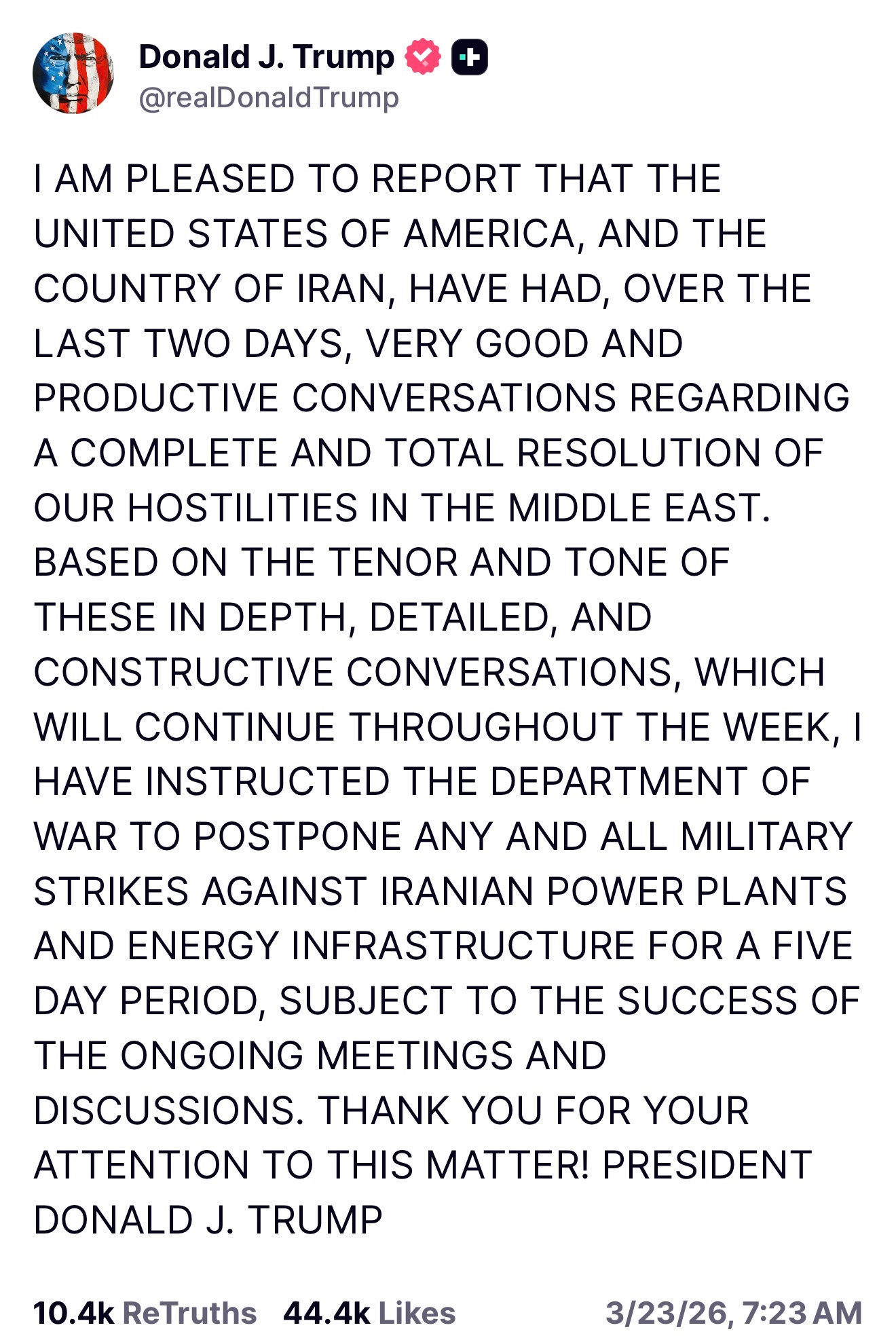
On Sunday, Trump posted to Truth Social that he had held “very good and productive” conversations with Iran to end the war. Before US markets opened on Monday, the S&P 500 added approximately $2 trillion in value. Oil prices fell from their peak. Iran’s parliament speaker Mohammad Bagher Ghalibaf then went on record to call the reports of negotiations “fake news” and accused Washington of attempting to “manipulate financial and oil markets and escape the quagmire in which the US and Israel are trapped.” Iran’s Foreign Ministry spokesperson Esmaeil Baghaei told IRNA that Iran had received messages from “certain friendly states” conveying Washington’s interest in negotiations but denied that any direct talks had taken place. Pakistan had by then been named as the proposed venue. The sequence matters: the market moved before a single party confirmed the talks were real.
That is the diplomatic environment in which Field Marshal Asim Munir telephoned Donald Trump on Sunday and Pakistan’s Foreign Office spokesperson Tahir Andrabi told Dawn that “if the parties desire, Islamabad is always willing to host talks.”
Pakistan’s push for the Islamabad venue is being reported in its domestic press as a demonstration of proactive leadership and balanced foreign policy. That framing does not survive contact with the actual record. There are three concrete reasons Pakistan is positioning itself as mediator, and they are each about Pakistani survival.
The first is the economy. Pakistan imports more than 80 percent of its oil. Between July 2025 and February 2026, oil imports totalled $10.71 billion. On March 6, Deputy Prime Minister Ishaq Dar, Finance Minister Muhammad Aurangzeb, and Petroleum Minister Ali Pervez Malik stood at a press conference and announced a Rs.55-per-litre increase in petrol and diesel, the single largest fuel hike in the country’s history. Petrol moved to Rs.321.17. Diesel to Rs.335.86. The IMF had instructed the government to pass rising costs on to consumers and refuse subsidies. The government complied. That announcement came eight days after the war started, when oil was already below its current level of $111 per barrel.
Pakistan sourced 99 percent of its LNG from Qatar last year. Iran struck Qatari energy infrastructure early in the conflict. QatarEnergy declared force majeure. Pakistan has received no LNG since day three of the war. LNG accounts for roughly a quarter of Pakistan’s electricity generation. The government has shifted from fortnightly to weekly fuel price reviews, which is how you administer a price that is moving faster than your institutions can track. Former State Bank of Pakistan chief Murtaza Syed stated the trajectory on March 21: at $100 per barrel sustained through 2026, the rupee depreciates 10 to 20 percent, inflation rises 6 to 8 additional percentage points, GDP growth falls 2 to 3 points, and the IMF program, designed under different assumptions, offers no flexibility. Pakistan’s GDP per capita has been stagnant for a decade. There is nothing to absorb this with.
The second reason is the Saudi defense pact. Pakistan signed a Strategic Mutual Defence Agreement with Riyadh in September 2025. The agreement treats an attack on one signatory as an attack on both. Iran has struck Saudi targets. The pact is now live. Security columnist Baqir Sajjad, former Pakistan fellow at the Wilson Center, told NPR that there is a sense at the official level that Pakistan would have to commit to the Saudi war “if it gets bad.” Defense Minister Khawaja Asif ruled out military participation in any campaign against Iran. The government is simultaneously expressing “full solidarity and support” for Saudi Arabia and engaging Tehran through backchannel diplomacy. Foreign Minister Ishaq Dar told parliament he had reminded Tehran of the defense agreement with Riyadh, which he described as a signal that Saudi soil would not be used to attack Iran, a communication aimed at keeping Iran from striking Riyadh directly. It worked, so far. The arrangement is a wire act. A mediating Pakistan is an active diplomatic actor, not a treaty-bound military combatant. The mediation offer is, in part, a mechanism for staying out of the war.
The third reason is internal. An estimated 15 to 20 percent of Pakistan’s population is Shia. When Khamenei was killed on February 28, protests erupted across the country. On March 1, protesters attempted to storm the US Consulate in Karachi. US Marine security guards opened fire. At least ten people were killed and more than sixty injured. At least 23 protesters died in clashes across Pakistan in the first week of the war, with a three-day curfew imposed in Gilgit-Baltistan. On March 20, Munir met Shia clerics in Rawalpindi and warned that “violence in Pakistan, based on incidents taking place in another country, will not be tolerated.” He is managing a domestic sectarian pressure that every additional week of war makes harder to contain. A Pakistan that ends the war is a Pakistan that does not face that pressure indefinitely.
Chatham House analyst Sanam Vakil was direct on Monday: “I don’t take this as any signal the war is coming to an end.” People briefed on the matter described the diplomatic activity as “very early-stage messaging” rather than a formal process. The contacts are indirect, passing through Turkey, Egypt, and Pakistan. Iran has not confirmed any direct engagement. Trump walked back his threat to bomb Iran’s power plants, citing productive negotiations. Oil prices dropped. The S&P recovered. That sequence does not require a peace process. It requires a pause long enough to calm the markets.
Trump’s approach, as Georgetown University professor Mehran Kamrava described it to Al Jazeera, follows a consistent pattern: sustained military and economic pressure to force Tehran to negotiate on US terms, a strategy that has not yet succeeded. Israel’s Yedioth Ahronoth reported, citing an unnamed government official, that Washington has set April 9 as a target date for ending the war, timed to Trump’s planned visit to Israel for Independence Day. Iran’s conditions for ending the war, stated by an Iranian official to Press TV on Monday, included guarantees against future military action, closure of all US military bases in the Gulf, full reparations from Washington and Tel Aviv, an end to conflicts involving Iran-aligned groups, and a new legal framework governing the Strait of Hormuz. Those are not the opening positions of a side preparing to concede.
Pakistan is not shaping any of this. It is providing a room, a channel, and a degree of regional legitimacy to a process whose terms are being set entirely by Washington and Tehran. Munir’s call to Trump gives Pakistan the credit line of a facilitator. The army chief who called Trump is the same army chief who signed the Saudi defense pact and is managing the Afghanistan war simultaneously. He is juggling five fires. The Islamabad talks, if they happen, are one of the ways he keeps all five from merging.
The Iran-Pakistan gas pipeline was completed on the Iranian side more than a decade ago. Pakistan never built its portion. The construction was stopped under American sanctions pressure. Every year since, Pakistan has paid in LNG import costs what it could have avoided in pipeline gas. The war has concentrated that cost into four weeks. Whatever framework emerges from any negotiations must create conditions under which Pakistan can revisit the pipeline without triggering secondary sanctions that destroy its financial system. That is the Pakistani economic interest that is conspicuously absent from the public diplomatic record. Munir has positioning capital right now. Whether that capital is being used to extract a concrete commitment from Washington on the pipeline question is not on record.
Energy analyst Amer Zafar Durrani, former World Bank official, told Al Jazeera that the government’s austerity measures leave the fundamental problem untouched. “Transport dominates petroleum consumption,” he said. “Roughly 80 percent of petroleum products are used in transport, meaning the country’s oil dependence is fundamentally a mobility problem.” The four-day work week and school closures do not fix an economy built on imported fuel. They are the government administering symptoms while hoping the underlying cause resolves before the next price review.
At Taftan, where 100 to 150 LPG bowsers crossed daily before February 28 and now 15 to 25 cross on a good day, a 50-kilogram LPG cylinder has risen from Rs.12,000 to Rs.16,000. The Quetta Chamber of Commerce puts 95 percent of Pakistan-Iran trade as currently halted. Its president Muhammad Ayoub Miryani said more people will fall below the poverty line. Eid al-Fitr is days away. LPG sellers in Quetta say they have stock until then.
A pause is not a settlement. If the Islamabad talks produce a pause, oil markets calm, and then the war resumes a month later, Pakistan’s position will be worse than it is now. It will have extended diplomatic capital on a process that failed, its IMF program will be under more stress than it was in March, and the Saudi defense pact will still be live. A settlement produces different conditions: the Strait reopens, QatarEnergy’s force majeure lifts, the rupee stabilizes, and Pakistan has a window to address the structural exposure the war made visible.
Pakistan in 2015 declined a Saudi request to join the Yemen coalition following a parliamentary resolution to remain neutral. It can decline again. But in 2015 it did not have a signed mutual defense agreement that explicitly treats an attack on Saudi Arabia as an attack on Pakistan. The legal and political position is materially different. The mediation push is Islamabad’s way of remaining useful without becoming a combatant, of remaining in the room with both parties without being formally on either side. Whether that position holds depends on how long the war continues and whether Saudi Arabia formally invokes the agreement.
Pakistan needs this war to end. That is not a diplomatic position. It is an economic condition and a security calculation and a domestic political necessity, all at once. The Islamabad offer is not Pakistan seizing an opportunity. It is Pakistan running out of options.


