
The Ventriloquist’s Bridge
How Washington Bought Pakistan’s Voice - The USA-Iran-Israel Pakistan Mediated Negotiations
Iran completed its side of the gas pipeline in 2014. Pakistan has not broken ground on its side in eleven years. The 780-kilometre route from the South Pars field to Gwadar sits partly surveyed, partly cleared, and entirely unbuilt. The reason is a single word: Washington. The United States told Pakistan to stop, and Pakistan stopped. Iran threatened $18 billion in international arbitration. Pakistan told Tehran it wanted an out-of-court settlement to scrap the project entirely, unless the US granted a sanctions waiver, which Washington declined. As of January 2026, one month before US and Israeli forces struck Iran and killed its Supreme Leader, Pakistan was formally exploring how to exit a thirty-year commitment to a neighbour it cannot afford to anger.
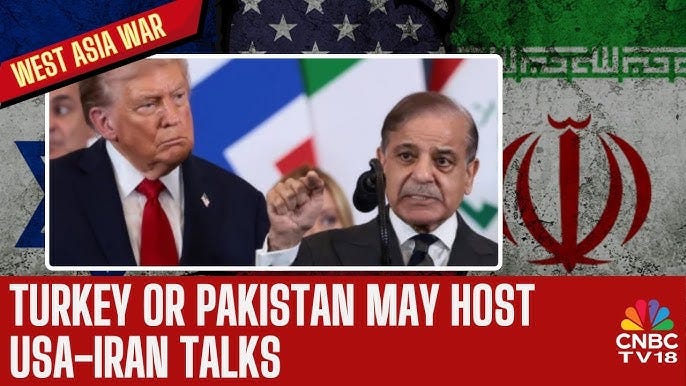
In March 2026, that same Pakistan is the channel through which Washington is sending its 15-point ceasefire framework to Tehran.
Both facts are true. Neither cancels the other. Held together, they describe a country structurally incapable of building a gas pipeline to Iran for eleven years because Washington would not permit it, now being praised internationally for its diplomatic courage in bridging the two sides. The bridge was always Washington’s. Pakistan is the architecture.
The transaction record is specific and worth reading in sequence.
On June 18, 2025, Field Marshal Asim Munir had lunch at the White House. It was the first time an American president had received Pakistan’s army chief for a private meeting. White House press secretary Anna Kelly confirmed, before the meeting took place, that Trump would receive Munir “after he called for the president to be nominated for the Nobel Peace Prize.” The Nobel nomination was the price of entry. Two days later, the Government of Pakistan formally posted the nomination on X: “decisive diplomatic intervention and pivotal leadership.” Trump told reporters afterward that Munir “was extremely influential in stopping it from the Pakistan side,” referring to the India-Pakistan ceasefire of May 2025.
On January 14, 2026, Zachary Witkoff flew to Islamabad. His father, Steve Witkoff, is Trump’s special envoy to the Middle East, the man who later confirmed to the US cabinet that Washington had presented a 15-point ceasefire framework to Iran through Pakistan. The son is co-founder and CEO of SC Financial Technologies, an entity associated with World Liberty Financial, the Trump family’s cryptocurrency venture. The Trump Organization owns 60 percent of World Liberty Financial and is entitled to 75 percent of all revenue from coin sales. Pakistan’s Finance Minister signed the memorandum of understanding in the presence of Prime Minister Shehbaz Sharif, Deputy Prime Minister Ishaq Dar, and Field Marshal Asim Munir. The ISPR issued a statement saying Munir had emphasised Pakistan’s “commitment to economic stability and investor confidence.” In the photographs, Munir and Zachary Witkoff are shaking hands in Rawalpindi.
On February 19, 2026, nine days before the US and Israel struck Iran, Steve Witkoff brokered a second deal: a memorandum of understanding between the US General Services Administration and Pakistan’s Ministry of Finance to jointly redevelop the Roosevelt Hotel, a 22-story, 1,025-room landmark on Madison Avenue in Manhattan, owned by Pakistan International Airlines since 2000. Real estate analysts estimate the site is worth at least $1 billion. Pakistan owes the IMF $7 billion. The Roosevelt Hotel MoU was described in a statement from Pakistan’s Finance Division as “negotiated and stewarded” by Steve Witkoff. The GSA offered a single sentence: “This agreement embodies the Trump Administration’s dedication to diplomacy and our nation’s economic prosperity.”
The sequence matters because the sequence is the argument. Pakistan did not become Washington’s channel after the Iran war started. The channel was constructed across twelve months, transaction by transaction, each denominated in a currency Islamabad needs: real estate access, cryptocurrency legitimacy, White House proximity, IMF goodwill. By the time Munir and Trump spoke by phone in late March 2026, a call confirmed by the White House, the relationship was already architecturally complete. The phone call was not the beginning. It was the activation.
This is how the CIA-ISI permanent structure has always operated. Adrian Levy’s documented institutional history of the ISI describes the relationship between Langley and ISI as “a permanent structure that continues to exist beneath the state.” When Trump, in his first term, publicly threatened to end the relationship with Pakistan, the covert conversations between the two agencies continued without interruption. The public statement was theatre. The structure was not. Between 1983 and 1987, the ISI funnelled 75,000 tonnes of US military equipment to the Afghan mujahideen. CIA director William Casey visited Islamabad repeatedly, observing training operations personally. ISI was the main conduit. When the Soviets withdrew, the US abandoned Afghanistan and left Pakistan to manage the wreckage: the refugee flows, the guns, the Taliban, and the thirty years of domestic blowback that followed.
Pakistan knows what it is in this relationship. It has chosen, again, to be useful.
The current mediation is the same structure in upgraded form. Washington and Tehran have not had formal diplomatic relations since 1979. They cannot be seen talking directly. Pakistan carries the message, as Yahya Khan’s government carried Kissinger’s messages to Beijing in 1971 and provided the corridor through which Nixon’s China opening became possible. The Yahya Khan parallel holds in one more direction: Khan was managing that diplomatic channel while East Pakistan was being massacred. The geopolitical service and the domestic atrocity ran simultaneously, managed by the same institution.
The domestic cost of the current mediation falls on specific people in specific places.
In Karachi, pump prices jumped 20 percent in a single week in early March: Rs1.15 per litre for petrol, Rs1.20 for diesel, the largest fuel price increase in the country’s recorded history. This followed the partial closure of the Strait of Hormuz, which Iran announced after the February 28 strikes. Pakistan imports more than 80 percent of its oil needs from the Gulf. Between July 2025 and February 2026, its oil import bill stood at $10.71 billion. With oil above $100 a barrel, that arithmetic is not survivable at the current pace.
In Turbat, Gwadar, Panjgur, Chagai, Washuk, and Mashkail, the border districts of Balochistan that run along the frontier with Iran, between 60 and 70 percent of petrol pumps closed in the first weeks of the war. These districts do not draw fuel from the national supply grid in the ordinary sense. They run on Iranian oil crossing at Makran, Rakhshan, and Chagai. Gwadar itself, Pakistan’s flagship port and the anchor of CPEC, receives its electricity from Iran. That supply is now disrupted. The port that China built, the port that Pakistan uses to anchor sovereignty arguments at every IMF negotiation, is running low on power during a war that Pakistan is telling the world it is working to end.
The IP pipeline would have delivered 750 million cubic feet of Iranian gas per day to Pakistan, more than seven LNG cargoes per month, had Islamabad built it. Iran completed its side in 2014. Pakistan’s former petroleum minister said, in plain language: “We cannot bear American sanctions.” That sentence is the fullest summary of Pakistan’s strategic position in the public record. It was said before Pakistan became Washington’s ceasefire courier to the same country.
On March 1, ten people were shot dead outside the US Consulate on Mai Kolachi Road in Karachi. US Marine security guards opened fire. The crowd was Shia. They had come to protest the killing of Ayatollah Khamenei, done by American bombs two days earlier. By nightfall, 22 were dead across the country: eight in Skardu, ten at the consulate gates, two in Islamabad. Curfews followed in Gilgit-Baltistan. The government announced a four-day workweek for federal employees and closed schools through the end of March.
The ISPR issued no statement about the dead at the consulate gates.
A 28-year-old woman named Syed Nayab Zehra told a reporter in Islamabad that she had brought her family to the demonstrations: “We want to show the world that, don’t take us Shia lightly.” She was speaking to Iran. She was also speaking to her own government. Pakistan is home to the second-largest Shia community on earth, between 15 and 20 percent of a population over 250 million. The government that manages this community nominated Donald Trump for the Nobel Peace Prize in June 2025, signed a cryptocurrency MoU with Trump’s family firm in January 2026, put a $1 billion Manhattan hotel into a deal stewarded by the man who would carry the US ceasefire framework to Tehran, and then asked its Shia citizens to grieve quietly while Munir arranged the diplomatic architecture.
The Interior Minister asked for calm. The Chief Minister of Sindh called the deaths “extremely tragic.” No inquiry has produced anything.
The timing question is the one no press briefing addresses. Pakistan’s government officials have said publicly that their mediation role followed “weeks of quiet diplomacy” that preceded the formal offer to host talks. The strikes on Iran began February 28. The quiet diplomacy, by Pakistan’s own account, began before February 28. The Roosevelt Hotel MoU was signed February 19. The World Liberty crypto MoU was signed January 14. The Nobel nomination was posted June 2025 and the White House meeting was granted explicitly on its basis.
The channel was being constructed while Washington was planning the operation. The bombs and the bridge were built together.
Pakistan’s former law minister Ahmad Irfan Aslam described the operating condition with a precision no official statement has matched: Pakistan relies on the US “for everything from economic bailouts to its security.” There is no ambiguity in that sentence. It is not analysis. It is the ledger Pakistan works from.
Iran is not deceived. Foreign Minister Araghchi said explicitly that there are no negotiations with the United States, only messages through mediators, “which does not mean negotiations.” Iran’s five counter-conditions, delivered through Pakistan in response to Washington’s 15 points, include war reparations, the right to exercise sovereignty over the Strait of Hormuz, and a guarantee against future war. These are not the conditions of a country in dialogue. They are the conditions of a country reading a ceasefire proposal delivered by a postman and responding in kind.
What GHQ extracts from this arrangement is also specific and worth naming.
Pakistan’s role as Washington’s Iran channel has produced: the White House meeting Munir could not have secured through any other mechanism; Rubio’s public praise for Pakistan’s “willingness to play a role as mediator”; Trump’s reposting of Sharif’s offer to host talks, amplifying it to 90 million followers; the Roosevelt Hotel deal, which Pakistan had been unable to close with JLL, Morgan Stanley, or any private consortium for two years; the World Liberty MoU, which positions Pakistan as a sovereign early adopter of a Trump-family financial product at a moment when proximity to the Trump business network functions as diplomatic currency; and the structural rehabilitation of GHQ’s international standing after two decades of being described in Washington as a duplicitous partner running a double game in Afghanistan.
Pakistan is not mediating. It is performing the function it has performed since 1979: holding a corridor open for a power that requires plausible distance from its own diplomacy. Every previous time Pakistan held that corridor, it paid long after the Americans left. The Afghan corridor produced thirty years of blowback through Pakistani bodies. The blowback from this one is already legible: a 28-year-old woman in Islamabad whose government is not with her, ten people shot at a consulate gate whose deaths produced no ISPR statement, pump prices in Gwadar jumping 20 percent in a week while the port runs on borrowed power from a country that Washington has been bombing.
The IP pipeline sits unbuilt in Balochistan. Iran’s side has been ready for eleven years. When this war ends, Washington will call it a diplomatic success. Pakistan will count what it owes. The people in Turbat and Gwadar will still be waiting for gas.


