
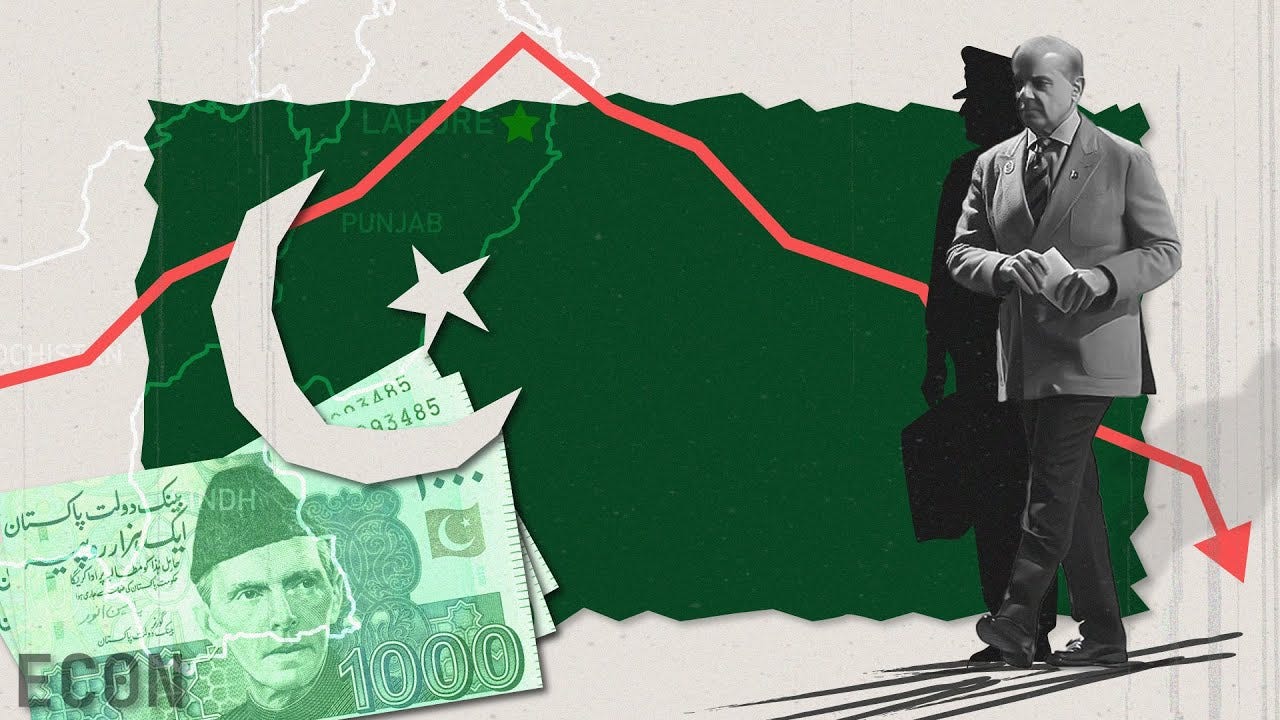
The Unravelling of a Republic
How Pakistan’s Predatory Elites Murdered the Economy and Shredded the Constitution
Pakistan’s economy today resembles a system in advanced decay: the growth engine has stalled, the state’s financial plumbing is corroded, and the labor market is absorbing the social and political shock of what can reasonably be called the slow death of the post‑independence economic model. This is not a single‑year crisis but the cumulative result of decades of structural neglect, elite capture, constitutional erosion and serial policy failure that have hollowed out both the economy and the institutions meant to safeguard it. The result is a country of more than 250 million people trapped between anaemic growth, rising public debt, vanishing formal jobs and a fraying social contract.
For much of its history, Pakistan relied on a consumption‑ and import‑led growth model underwritten by foreign aid, remittances and repeated bailouts rather than by domestic productivity and investment. Growth spurts were typically fueled by cheap credit, subsidized energy and an overvalued currency that made imports attractive to urban consumers and politically connected businesses. Each time the external account buckled under the weight of an unsustainable import bill, Islamabad turned to bilateral partners or the International Monetary Fund to plug the gap, promising reforms that were rarely carried through once immediate pressure eased. Over time, this stop‑go pattern produced shorter and weaker booms, longer and more painful busts, and an economy locked into a low‑growth, high‑vulnerability equilibrium.
The structural weaknesses are now well documented. Domestic savings remain among the lowest in comparable developing economies, leaving the country perpetually dependent on foreign borrowing to finance investment and even basic consumption. Public debt has climbed to levels where servicing it consumes an enormous share of government revenues, crowding out spending on development, health and education. State‑owned enterprises continue to bleed cash, energy pricing remains distorted, and the tax system leans heavily on indirect levies that punish the formal sector while leaving large swathes of wealth essentially untouched. In this environment, private investment is timid, often speculative and skewed toward real estate or rent‑seeking rather than productivity‑enhancing activities.
What makes the current conjuncture particularly grave is that economic decay is intertwined with constitutional erosion. The “constitutional death of Pakistan” is not a rhetorical flourish but a description of the way in which the spirit of the constitution has been steadily hollowed out by repeated extra‑constitutional interventions, manipulated electoral processes and the marginalization of parliament. When executives rule through ordinances, when elected governments are fragile and easily displaced, and when key decisions on security, foreign policy and even economic direction are taken outside the formal democratic arena, budgeting and economic planning cease to be genuinely representative exercises. The constitution may remain in force on paper, but the checks, balances and accountability that give it life are severely weakened.
This constitutional decay has direct economic effects. Investors, whether domestic or foreign, factor political stability and rule of law into their decisions. Frequent changes of government, abrupt policy reversals and the ever‑present shadow of non‑elected power centers create an environment of uncertainty that discourages long‑term commitments. Tax amnesties appear and disappear, contracts are renegotiated or ignored, and regulations are enforced selectively. Ordinary citizens see little reason to comply faithfully with a system they experience as arbitrary and unfair, resulting in widespread informality and tax evasion. In this sense, the erosion of constitutional governance and the rise of a “managed” democracy feed directly into the weakening of the economic base.
The crisis of audit integrity is another critical strand in this story of institutional collapse. External partners have increasingly voiced concern over Pakistan’s weak audit controls and the limited independence and capacity of oversight bodies meant to scrutinize public spending. When the state cannot credibly demonstrate where money goes, whether it achieves its stated purpose, and who is held accountable when it does not, trust erodes at every level. Parliament cannot exercise meaningful oversight, citizens cannot track whether taxes and tariffs translate into services, and lenders insist on ever tighter conditionality to compensate for their lack of confidence in domestic institutions. Instead of being a neutral guardian of public money, the audit framework is seen as vulnerable to political manipulation and bureaucratic capture.
This compromised audit and accountability ecosystem allows a shadow fiscal universe to thrive. Off‑budget spending, opaque subsidies, guarantees to loss‑making enterprises and poorly monitored development projects proliferate. While headline deficits and debt numbers tell part of the story, a significant share of fiscal risk lies in these hidden or under‑reported obligations. Every attempt at fiscal consolidation is thus undermined by leakages and contingent liabilities that surface only when they can no longer be rolled over or disguised. Under such conditions, even earnest reformers face an uphill battle: the numbers they work with are incomplete, and the vested interests defending the status quo are deeply entrenched within the state itself.
The labor market is where this macro‑level decay becomes tangible for ordinary Pakistanis. After years of delayed and patchy data, recent surveys and anecdotal evidence point to rising open unemployment, especially among the youth, alongside a surge in underemployment and informal work. A demographic profile that should have been a dividend, a large, young population is turning into a liability as the economy fails to create enough decent, formal jobs. Many young people find themselves either locked out of the labor market or trapped in precarious gig work, daily wage labor or low‑productivity services that offer little security, benefits or upward mobility.
Structural shifts in employment that could have signaled successful transformation are occurring under adverse conditions. Labor is moving out of agriculture, but the manufacturing base remains too narrow and energy‑intensive to absorb it effectively, while the expansion in services is heavily tilted toward small‑scale, informal and low‑wage activities. High energy prices, erratic taxation, weak contract enforcement and chronic uncertainty discourage firms from investing in labor‑intensive, export‑oriented production. At the same time, inflation bouts, currency depreciation and regressive taxation erode real wages, deepening working poverty even among those who are nominally employed. This is not simply a cyclical downturn but a labor market under systemic stress.
Layered on top of these structural and institutional problems are powerful external and environmental shocks. Pakistan sits on the front line of climate vulnerability; repeated floods and extreme weather events have destroyed crops, displaced communities and damaged infrastructure worth billions of dollars. These disasters strain already weak public finances, disrupt supply chains and intensify food and energy insecurity. In the absence of robust social protection and climate‑resilient infrastructure, each event pushes more households into poverty and further undermines the productive capacity of key sectors like agriculture and textiles. Climate risk thus amplifies existing economic fragilities and reinforces the cycle of dependence on external relief and borrowing.
Corruption and elite capture further deepen the crisis. Studies and reports have increasingly highlighted how a small coalition of political, military and business elites disproportionately benefits from subsidies, tax exemptions, cheap credit and regulatory privileges, effectively extracting rents equivalent to several percentage points of GDP each year. These arrangements are often justified in the name of national security, strategic sectors or short‑term stabilization but, in practice, they harden inequality and sap the state’s capacity to invest in broad‑based development. When citizens see that some groups are systematically above the law, the legitimacy of both the constitution and the market economy is corroded.
Putting these threads together, the “death of the Pakistan economy” is best understood as the exhaustion of a model built on four pillars: debt‑fueled consumption, external bailouts, constitutional weakness and institutionalized inequality. The growth model can no longer deliver sufficient expansion to accommodate the population; the fiscal system cannot raise and spend resources accountably; the constitutional order cannot reliably channel citizen preferences into policy; and the labor market cannot translate human potential into productive employment. Each IMF program, each friendly deposit and each emergency package therefore acts more like life support than a cure, postponing rather than resolving the underlying disease.
Yet to describe this as a terminal condition is also to acknowledge the possibility of rebirth but only if the political will exists to confront foundational questions. Any credible path forward would have to begin with restoring constitutional governance in substance, not just form: empowering parliament, ensuring the independence of the judiciary within its proper bounds, and clearly subordinating all institutions to the civilian democratic order. This must be paired with a ruthless clean‑up of public finance: strengthening the autonomy and capacity of audit institutions, publishing transparent, timely fiscal data, and dismantling the network of exemptions and off‑budget commitments that shelter elite interests.
On the economic side, Pakistan needs to pivot from a consumption‑ and import‑led pattern to a strategy centred on investment, exports and productivity, particularly in sectors that can absorb large numbers of workers. That implies stable and competitive energy pricing, predictable tax policy, serious improvements in logistics and contract enforcement, and a relentless focus on human capital through education and skills. Labor policy must move from seeing workers as a cost to be contained toward recognizing them as the central engine of growth, with formalization, social protection and collective bargaining as tools to boost both equity and efficiency.
None of this will be quick or easy. It will demand redistributing costs and benefits within society, challenging long‑standing privileges and accepting that genuine reform may initially depress headline growth even as it lays the groundwork for a more resilient and inclusive economy. The alternative, however, is to continue along the current trajectory: living through a prolonged constitutional and economic death in slow motion, marked by recurring crises, rising disillusionment and a steady hollowing‑out of the state. In that sense, recognising the death of the old model is not an exercise in despair but the necessary first step toward imagining and building something better


