
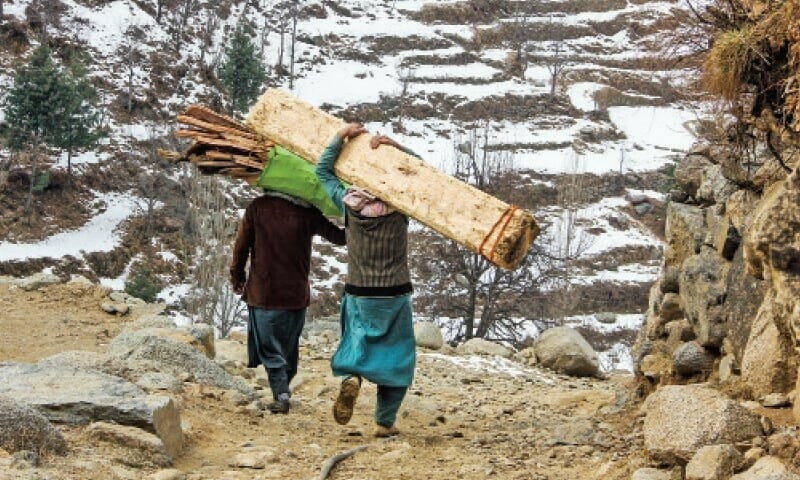
The Timber Mafia of Khyber Pakhtunkhwa
In Arandu Gol, a government document put the army on record. The forest inventory settled the rest.
In August 2021, the Khyber Pakhtunkhwa cabinet, chaired by Chief Minister Mahmood Khan, approved Rs525 million for the transportation of 1.494 million cubic feet of illegally logged timber out of Arandu Gol in Lower Chitral. The forest department’s cabinet summary justifying the operation used a specific phrase. It stated that the district administration and Pakistan Army were ready to provide “atmosphere congenial for forceful seizure and departmental salvage of illegally harvested timber.” On the strength of that atmosphere, the cabinet approved the funds.
Four years later, satellite imagery showed that approximately 35 per cent of Arandu Gol’s forest cover across 164,000 hectares had disappeared between 2004 and 2025. The market value of the lost resources exceeds Rs100 billion, according to a briefing former PML-N MNA Shahzada Iftikharuddin gave the KP chief secretary in early 2026. A forest department inventory taken at the same time recorded that 10 individuals were in possession of approximately 1.47 million illegally felled trees still stockpiled in the valley, with a current market value of Rs10 billion.
The Pakistan Army was still there. The atmosphere had remained congenial for someone.
That cabinet summary is not an allegation. It is a government document produced by a provincial government that is no longer in power, about a region whose security architecture has not changed hands. It records what the provincial government believed to be true at the time: that the army’s presence in Arandu Gol was the operative condition for anything to move in the valley. The question the document did not anticipate, and which four years of satellite data has made unavoidable, is what that presence was producing while more than a third of one of Pakistan’s most significant remaining forest reserves vanished.
The Zone and Its Mandate
Arandu Gol sits on the southwestern edge of Lower Chitral, along the Afghan border. It is not terrain that civilian administration reaches without security clearance. The Frontier Corps (KPK), officered by the Pakistan Army, is the primary agency responsible for border security and anti-smuggling in the area. In November 2023, the Federal Board of Revenue formally extended anti-smuggling powers to the FC in Khyber Pakhtunkhwa, authorising the force to operate within 50 kilometres of international borders and at inter-provincial joint checkpoints against all categories of smuggled goods. Arandu Gol sits within that jurisdiction.
The legal architecture is not ambiguous: the force mandated to prevent border smuggling in this zone is army-officered, holds federal anti-smuggling authority, and operates the checkpoints through which any timber leaving the valley must pass. The forest department’s inventory from early 2026 confirms that 1.47 million illegally felled trees remain in the valley. Local elders from Arandu, speaking at the Chitral Press Club in April 2025, pushed back against the smuggling narrative, arguing that large-scale illegal cutting had occurred during the Taliban’s occupation of the valley in 2006 and that army personnel had maintained strict security since the militants’ ouster. The KP government’s own January 2026 cabinet committee review attributed the major deforestation to “a weak law and order situation during the period from 2004 to 2010.”
The satellite data covering 2004 to 2025 does not fit that account. A fifteen-year period from 2010 onwards, during which the army’s presence in the valley was uncontested, produced no recovery in forest cover. What it produced was a 35 per cent loss across a span that encompasses three provincial governments, one caretaker administration, and two separate PTI tenures. The deforestation is a structural fact, not a partisan one. Every government that administered KP since 2004 governed a province where Arandu Gol’s forests were being stripped. None produced a prosecution of the ten individuals the forest department now has on a verified list.
The Bureaucrat
In April 2024, Shahid Zaman assumed the role of Secretary Forests, Environment and Wildlife in Khyber Pakhtunkhwa. Imtiaz Gul, writing in the Express Tribune in August 2025, described what Zaman found as an orchestrated system of environmental plunder operating beneath legal cover. Zaman uncovered dozens of unlawful transport permits, dubious allotments allowing timber movement from northern valleys, and a Tree Marking and Harvest Monitoring System that had been quietly suspended, eliminating the only transparency mechanism across protected areas and national parks throughout KP.
An audit conducted under his tenure found that approximately 45 per cent of tree felling in the province was legal, around 25 per cent had procedural errors, and 30 per cent was outright illegal. The worst-affected regions were Kohistan, Allai, Battagram, Galiyat and Hazara, a geographic spread that traces the same mountain corridors where a separate financial scandal was simultaneously draining the provincial treasury.
In Arandu Gol specifically, Zaman confronted a cabinet summary that his predecessor, former forest secretary Nazar Shah, had pushed through: approval for the transport of 1.4 million cubic feet of timber worth approximately Rs8 billion, framed as legal but built on permissions Zaman determined were unlawful. He recalled and redirected the summary. The response was institutional. In July 2025, the Establishment Division, operating under the federal government in Islamabad, ordered his transfer out of KP. The provincial government resisted, arguing his services were essential. The News reported in August 2025 that the transfer pressure had come from “vested interests angered by his decisive actions,” specifically naming the Arandu Gol sale and his rejection of a separate proposal that would have removed 0.6 million acres of Guzara forests in Hazara from the forest department’s jurisdiction, opening those forests to commercial development.
The same federal government whose Establishment Division sought Zaman’s removal simultaneously deployed the Prime Minister’s Inspection Commission to accuse KP provincial authorities of ignoring warnings about Arandu Gol’s destruction. Both actions were taken by Islamabad. The distance between them is not a contradiction to be explained. It is the arrangement.
The Account
While Arandu Gol’s forests were disappearing across multiple governments, a different extraction was under way in Upper Kohistan’s district treasury. Between 2016 and 2024, a provincial government account titled “Security and Deposit Works KP 10113” was systematically drained. The National Accountability Bureau, which launched a formal investigation in April 2025, identified 1,293 forged cheques and 52 suspicious bank accounts. In Upper Kohistan alone, where the annual development budget runs to between Rs500 million and Rs1.5 billion, an estimated Rs29 billion was extracted. The total KP-wide figure placed by NAB at Rs40 billion.
The account’s official designation matters. “Security and Deposit Works” funds are intended for regional security infrastructure and contractor deposits on development projects. In a district administered through a security framework that required army coordination for anything to move, this account’s funds were the financial substrate for what the state called development. Those funds moved through 1,293 forged cheques over eight years without triggering a provincial audit. The period spans the second PTI government under Mahmood Khan, the 2023 caretaker administration, and the early phase of the current PTI government under Ali Amin Gandapur.
NAB’s July 2025 arrests named District Account Officer Shafiq-ur-Rehman Qureshi as the central figure, alongside former bank cashier Muhammad Riaz who had constructed a network of dummy contractor accounts, auditor Fazal Hussain from the AG Office in Peshawar, former bank manager Tahir Tanveer, and four contractors. One of them, Muhammad Ayub, allegedly received Rs3 billion and used it to purchase a property owned by Azam Swati, a PTI leader serving as Special Assistant to Chief Minister Gandapur. Swati was summoned by NAB on July 17, 2025.
The KP government’s own adviser stated publicly in May 2025 that the irregularities “pertain to the period of the caretaker administration.” Ikhtiar Wali Khan, PM’s Coordinator for KP Affairs, held a press conference in July 2025 stating the scandal had begun in 2019 under PTI. The Auditor General of Pakistan’s own documentation places the period from 2016. What the competing timelines share is the account name: Security and Deposit Works, in a zone where security works and development works were structurally inseparable.
What the Investigations Have Not Asked
The Kohistan financial scandal and the Arandu Gol deforestation have been investigated as separate matters: one a treasury fraud, the other an environmental crime. The federal government has used both to attack the KP provincial government. The KP government has used both to attack the federal government. The timber traders named in the forest department’s verified inventory have not been prosecuted. The forged cheque network drained its account for eight years before NAB’s intervention.
In February 2026, KP Chief Secretary Shahab Ali Shah ordered the arrest of 11 individuals involved in the Chitral timber operations. ChitralToday reported the order came “despite intense political pressure.” By late February, Dawn was reporting that smugglers based in Swat and Peshawar were actively working to counter any crackdown, using the convenient argument that the Taliban had done the damage in 2006. The attribution is functional: if the deforestation can be fixed at a moment twenty years past, then the ongoing stockpiling of 1.47 million felled trees by ten named individuals in a security-supervised valley becomes a historical residue rather than an active crime.
The Geo television network reported in August 2025 that Arandu Gol holds the record for the largest single case of illegal timber cutting in Pakistan’s history: 1.6 million cubic feet. Pakistan’s total forest cover has fallen by 18 per cent since 1992. KP accounts for the largest share of that decline. These figures precede every political argument being made about the scandal and will survive every government that attempts to use them.
The Structural Problem
Shahid Zaman blocked an Rs8 billion transaction. He cancelled illegal permits that would have opened 18,000 acres of the Khanpur Dam watershed to mining and real estate. He reversed the suspension of the tree harvest monitoring system. He filed anti-encroachment actions in the Galiyat region and along the Margalla Hills boundary. The federal government then attempted to transfer him. The provincial government resisted. As of mid-2025, he remained in post.
The significance of Zaman’s case is not his individual courage, though that is documented. The significance is the institutional response his actions triggered: a transfer order from the same federal authority simultaneously accusing the province of enabling the destruction he had spent months reversing. It is a near-complete picture of how the system preserves itself: the official who acts is the problem to be managed; the nexus he acts against is the constituency to be protected.
Both the Arandu Gol deforestation and the Kohistan account fraud are, at their structural core, failures of oversight in zones where oversight was assumed to be provided. The border zone had a mandated anti-smuggling force. The treasury account was designed for a category of expenditure that required security coordination. In both cases, the oversight mechanism was the closest institutional authority. In both cases, losses ran for years without consequence.
The forest inventory counts trees. The audit counts cheques. Neither document names the arrangement that made the counting necessary. That question, who decided what the supervision would and would not see, has not been asked by any investigation currently under way.
The people of Arandu Gol have no representation in this calculation. Union Council Nazim Haji Sher Zameen, speaking at a provincial forest governance forum in January 2026, told Secretary Forests Junaid Khan that trees in Arandu Gol had been “decaying for decades despite protection by communities.” The communities protected the trees. The trees were cut. The communities received neither royalties nor explanation. The KP cabinet standing committee meeting that same month discussed proposals for using timber revenue for local development “on the pattern of oil and gas royalties, subject to the consent of the local population.” The trees whose revenue would fund that development were already gone. Consent was not sought while they were being felled.
It is the only question that matters.


