
The Tanker Named Karachi Got Through. Its Workers Did Not.
Pakistan Secured Passage for Cargo. The Seafarers Were a Different Matter.
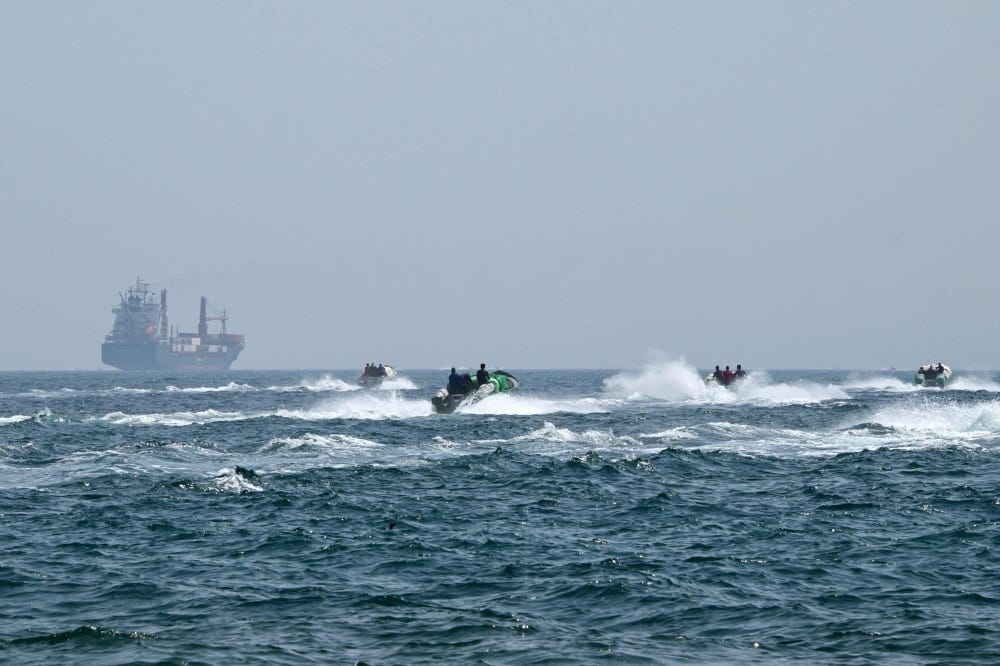
On March 16, a Pakistani-flagged Aframax tanker named Karachi became one of the first non-Iranian cargo vessels to transit the Strait of Hormuz while broadcasting its location, carrying crude from Abu Dhabi through a waterway where Iranian projectiles had struck 16 vessels in the preceding fortnight. The tanker named after Pakistan’s port city got through. The Pakistani workers stranded on the other side of that arrangement are a different story, and Islamabad has been slow to tell it.
Pakistan’s diplomatic response to the Hormuz crisis has been calibrated, persistent, and focused almost entirely on cargo. On March 28, Foreign Minister Ishaq Dar announced that Iran had agreed to allow 20 Pakistani-flagged vessels to transit the strait, two ships crossing daily under the arrangement, escorted by Pakistan Navy warships. The deal took political capital and carried real risk. It also did nothing for Pakistani seafarers employed on the roughly 2,000 vessels flagged elsewhere, registered elsewhere, with operators in Singapore or Athens or Cyprus who have been ignoring their crews’ requests to leave for a month.
The International Maritime Organisation puts the total stranded at approximately 20,000 seafarers across 2,000 vessels. The ITF’s seafarer support helpline has received more than 1,000 emails and messages since the US-Israeli strikes on Iran began on February 28. At least eight seafarers or dockworkers have been killed in war-related incidents. The International Bargaining Forum declared the region a war zone in the conflict’s first weeks, entitling qualifying seafarers to repatriation at the company’s cost and double pay. A significant portion of the stranded fleet operates outside IBF labour agreements, and their operators have largely not responded to union escalation.
Pakistan’s Seafarers Welfare Fund levies mandatory contributions from maritime workers, including those now sending distress emails to a union helpline in London at 3 in the morning. The Directorate General of Ports and Shipping carries a statutory mandate covering Pakistani workers in exactly this situation. What either institution has done in response to the Hormuz crisis has not entered the public record.
Before February 28, the Strait of Hormuz processed between 135 and 138 vessel transits per day, carrying roughly 20 percent of global crude oil and a third of the world’s liquefied natural gas. On March 14, AIS-confirmed crossings in either direction reached zero. Windward AI’s maritime intelligence daily recorded just 16 AIS-visible crossings across the full week ending March 22: 11 outbound and 5 inbound, against a pre-war equivalent approaching 1,000 per week. By March 22, 686 cargo and tanker vessels were confirmed inside the Arabian Gulf itself, 292 tankers and 394 cargo ships, in what Windward’s analysts described not as evacuation but as “staging, waiting, and repositioning.”
Iran has framed this as selective restriction rather than full closure. Foreign Minister Abbas Araghchi stated on March 15 that the strait remains technically open and that only US and Israeli vessels are barred. The operational data describes something more complicated: a transit environment shaped by informal authorisation, where vessels that have called at Iranian ports, or that can pay, are being permitted through on terms the IRGC sets unilaterally. The Karachi tanker was among four cargo ships Windward confirmed crossing overnight on March 13. Iranian parliament has since moved to legalise a toll system; at least two vessels have reportedly paid $2 million a crossing, settled in Chinese yuan. Bulk freighters and tankers with no Iranian port relationship and no leverage are not among those being cleared.
Bloomberg has documented GPS jamming throughout the strait’s approach corridors, meaning vessels attempting even authorised transits are navigating without reliable positioning data. Reuters documented six vessels struck in a single day, including a cargo ship hit by a projectile whose crew evacuated. With Houthi forces now formally entering the conflict, the threat perimeter has extended southward through the Red Sea approach. The Fujairah hub outside the strait, routinely cited as the resilience node sitting clear of Hormuz, was temporarily shut on March 14 when a drone-related fire forced a halt in oil loading operations at a facility holding more than 70 million barrels of storage capacity.
On March 24, a seafarer wrote to the ITF: “Writing to urgently inform you that our vessel is currently facing a critical situation regarding provisions and one crew health conditions. Immediate supply of food, drinking water, basic necessities is required to sustain the crew.” On March 18, a different message arrived: “They are forcing us to continue to do cargo operations and STS operations even when we raise our concerns about our safety and we are in a war like area. They are keeping us in a position with no options.” That second email describes a ship operator refusing crew requests to leave, arguing there were no flights from Iraq and blocking alternative repatriation routes.
Mohamed Arrachedi, the ITF’s Network Coordinator for the Arab World and Iran, told AFP he picks up his phone at 2 o’clock in the morning, then again at 3. “One seafarer called in a panic,” he said. “Saying: ‘We are here bombed. We don’t want to die. Please help me, sir. Please get us from here.’” Lucian Craciun, one of five ITF support team members processing these requests in London, told AFP that roughly half of all messages received concern pay. One email came from a seafarer asking to confirm whether his daily rate would go from $16 to $32 because the IBF had declared a war zone. The International Seafarers’ Welfare and Assistance Network, running a parallel helpline, reported a 15 to 20 percent increase in contacts since the war began, with a third of all messages relating specifically to repatriation.
The 20-ships deal is not nothing. Bilateral negotiation with Tehran during an active conflict, securing passage for flag-state vessels via naval escort, requires political capital and carries reputational risk that most governments in the region have avoided. Pakistan also hosted regional talks on March 28, with foreign ministers from Egypt, Saudi Arabia and Turkey meeting in Islamabad focused in part on conditions for reopening the strait. The New York Times reported earlier in March that Pakistan deployed naval escorts partly because of rupee pressure accumulating from disrupted energy imports, with Gulf conflict threatening remittance corridors that sit at the structural base of the national balance of payments.
The limit of what all this produced is precise. Twenty ships, out of 2,000 confirmed stranded, carry flag-state protection. The Pakistani seafarers on the other 1,980 vessels carry something else: the mandatory levy receipts from the Seafarers Welfare Fund, issued by a state that has not yet explained what it has done with the mandate those receipts represent.
The ITF has noted that many unresolved cases in the Gulf involve vessels whose flag states have been contacted and have not responded, and that escalation to state port authorities leads nowhere quickly in a war zone where port operations are themselves disrupted. IMO chief Arsenio Dominguez called on governments to act on March 25. The call was addressed to all flag states. What Pakistan’s Directorate General of Ports and Shipping did with it has not been reported.
What is not yet publicly documented is how many of the 1,000-plus contacts logged by the ITF were made to Pakistani government welfare channels first, and what those workers were told. The ITF has that data. The Directorate General of Ports and Shipping has a statutory obligation that covers it. The Seafarers Welfare Fund was built on contributions from the same workers now writing to London at 3 in the morning. A tanker named Karachi got through. The men are still in the water.


