
THE SOVEREIGNTY PAKISTAN CANNOT CLAIM
THEY SHOT OUR PEOPLE AND ISLAMABAD APOLOGISED FOR THEM
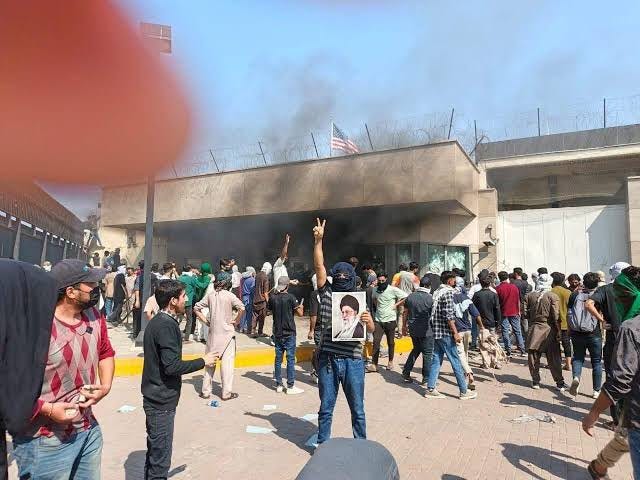
The bodies came to Civil Hospital with bullet wounds. Not tear gas injuries. Not baton fractures. Bullets. At least twelve Pakistani citizens, killed on Pakistani soil, in Pakistan’s largest city, by Marine Security Guards stationed inside the United States Consulate on Mai Kolachi Road. The Edhi rescue service moved the dead. The hospital logged the wounds. The government of Pakistan, once it had gathered itself to respond, directed its language not at Washington but at the people who had just buried their dead.
That sequencing is the story.
Interior Minister Mohsin Naqvi went on camera. He did not address the shootings. He called the day a day of mourning for the Muslim Ummah, acknowledged Pakistani grief over the killing of Ayatollah Ali Khamenei, and asked citizens not to take the law into their own hands. Sindh Chief Minister Murad Ali Shah described the consulate deaths as “extremely regrettable,” ordered an investigation he has no institutional capacity to conduct against a foreign military contingent protected by diplomatic cover, and then spent the remainder of his afternoon telephoning religious leaders and asking them to calm the public down. Prime Minister Shehbaz Sharif, in a statement on X, called Khamenei’s assassination a violation of international law and then, in the same breath, expressed concern over Pakistani protesters damaging US consulate property.
The Foreign Office issued no statement on the killings. No demarche was filed with the US Embassy. No ambassador was summoned to the Ministry of Foreign Affairs on Islamabad’s Constitution Avenue. No press secretary stood before cameras and used the words that the situation demanded: that American military personnel had shot and killed Pakistani citizens on Pakistani territory and that this government requires an accounting.
This is not the first time Pakistani civilians have been killed by Americans on Pakistani soil and Islamabad has found reasons to manage the fallout rather than pursue it. In January 2011, Raymond Davis, a CIA contractor operating under diplomatic cover, shot and killed two Pakistani men in Lahore, Faizan Haider and Muhammad Faheem, in broad daylight on a public road. The families were pressured into accepting diyat blood money payments under circumstances that Pakistani legal observers described at the time as coerced. Davis was released and flown out of the country within weeks. No American faced criminal accountability. The Pakistani government absorbed the domestic political damage, managed the religious leadership, and moved on. The mechanism is the same on March 1, 2026. Only the scale and the visibility have changed.
The Vienna Convention on Consular Relations does establish host-state obligations for the physical security of diplomatic premises. Pakistan failed that obligation on Sunday, and Washington will extract whatever institutional price it decides to extract for that failure through the channels available to it. But the Vienna Convention does not grant consular security personnel a license to kill citizens of the host country without consequence. The legal framework runs in both directions. Islamabad has chosen to invoke only one direction.
Pakistan’s Shia community numbers approximately 37 million people, roughly fifteen percent of a national population of 250 million. It is one of the largest Shia communities in the world, and its relationship to Khamenei’s authority was not political in the way a Western readership might understand the term. He was a marja, a source of religious emulation, the figure through whom religious obligation was channeled for millions of Pakistani households across every province. The US-Israeli strikes that killed him on February 28 did not register in these communities as a geopolitical event. They registered as an assassination of a religious authority. The organized march to the consulate the following morning was grief with institutional infrastructure behind it. The dead on Mai Kolachi Road were people who went to a building to express that grief and came back in ambulances.
Their government’s response was to tell the living to go home.
The Punjab government imposed a seven-day ban on public gatherings. Section 144 was in force across Sindh, Punjab, and the capital territory simultaneously. In Islamabad, thousands who gathered at Aabpara Chowk to march toward the US Embassy were stopped at Serena Chowk with tear gas, leaving two dead. In Skardu, the normally quiet Shia-majority north produced scenes no one who knows it expected, with the UNMOGIP offices burned and government buildings attacked. The security apparatus of the Pakistani state was fully deployed on Sunday, and it was deployed in one direction only: between the population and the diplomatic missions of the country whose Marines had just killed Pakistani citizens.
Sharif postponed his planned visit to Moscow, scheduled for March 3 to 5. The optics of an overseas trip while the body count was still rising were evidently calculated. The equivalent political calculation, of what it means domestically and historically to have American guns kill Pakistani citizens in Karachi and produce no formal diplomatic response whatsoever, was either not made or not considered significant enough to act on.
That calculation tells you everything about the relationship and nothing about sovereignty.
A government that condemns its own citizens for protesting a foreign military’s killing of Pakistanis on Pakistani ground has answered, without ambiguity, the question of whose interests it is organized to serve. The protesters at the consulate knew this before they arrived. The dead knew it too, in the way people who have grown up inside a system of managed subordination understand it without needing it explained. The grief was real. The bullets were real. The silence from the Foreign Office is real.
Everything else is administration.


