
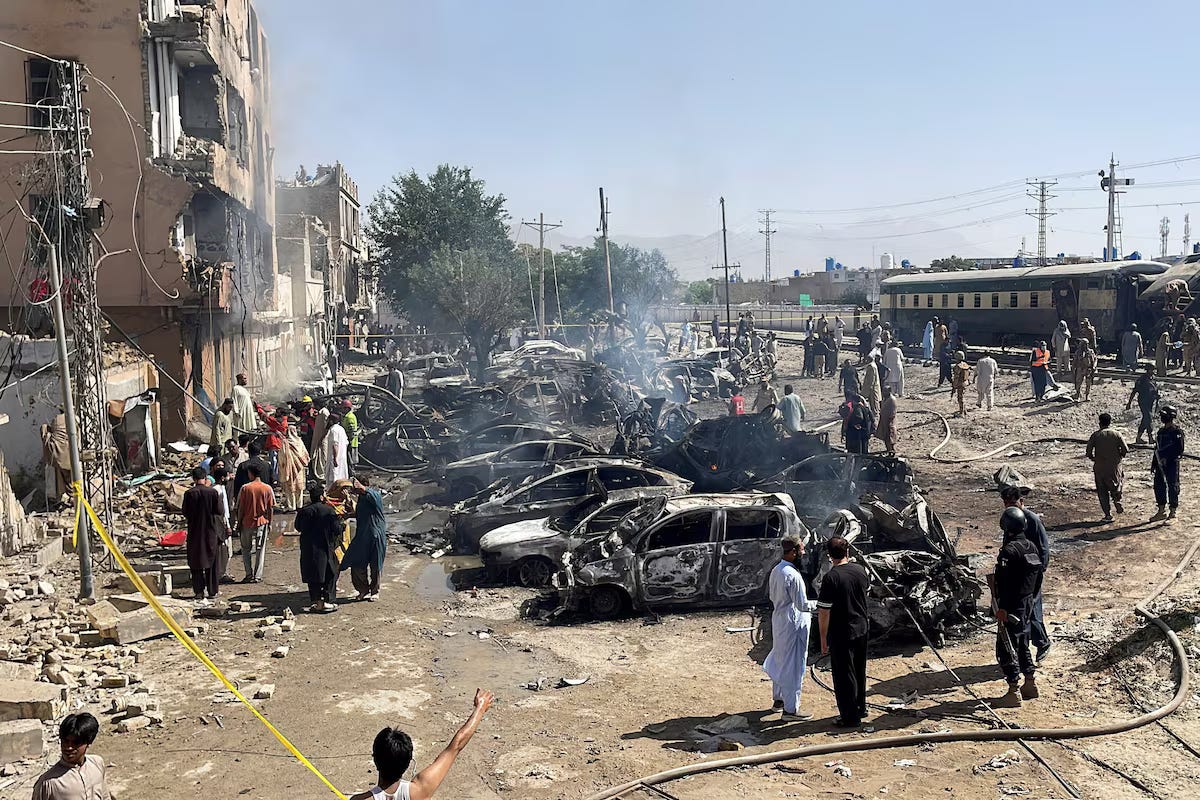
The Smoke Above Quetta
Pakistan’s government condemns the attack. It always does. The dead are already being counted.
Ikhtiar Hussain was a senior ticket inspector at Quetta Railway Station. He was 47 years old when he arrived for work on the morning of November 9, 2024, at 8:25am local time. Seconds after he reached the platform, he heard the explosion and fell to the ground. Shrapnel from the blast hit his right cheek. He was taken to Civil Hospital Quetta with wounds on his face. From his hospital bed, he described to Al Jazeera what he saw on the platform in the seconds after the bomb went off. “It was a view of Judgement Day,” he said, “because in seconds people smiling at the station fell down on the ground in a bloodbath.”
That attack at Quetta Railway Station killed at least 26 people. An outlawed secessionist group, the Balochistan Liberation Army, claimed responsibility.
On November 10, 2024, the government condemned the attack.
On Sunday morning, May 24, 2026, a suicide bomber detonated an explosives-laden vehicle near the railway track at Chaman Phatak in Quetta as a train carrying military personnel and their families passed through. The explosion caused two carriages to overturn and catch fire. Thick black smoke rose above the neighbourhood. More than a dozen vehicles parked along the road were destroyed. Nearby buildings were badly damaged. Doctors at local hospitals received the wounded, with twenty in critical condition. The final count reached at least 24 dead and more than 50 injured. Many of the soldiers on the train were travelling home to celebrate Eid. The BLA claimed responsibility.
Prime Minister Shehbaz Sharif posted on X. “Such cowardly acts of terrorism cannot weaken the resolve of the people of Pakistan,” he said. “We remain steadfast in our determination to eliminate terrorism in all its forms and manifestations.”
Between Ikhtiar Hussain’s Judgement Day and this Sunday morning, eighteen months passed. Two attacks on the same train system in the same city. The same organisation. The same condemnation. The same hospitals on emergency footing.


The attack this morning follows a sequence the Pakistani state has demonstrated repeatedly it cannot interrupt. On January 31, 2026, the BLA launched coordinated assaults across at least twelve towns and cities in Balochistan simultaneously: Quetta, Mastung, Nushki, Dalbandin, Kharan, Panjgur, Tump, Gwadar, and Pasni. The BLA called it Operation Herof 2.0, meaning Black Storm in Balochi. Schools, hospitals, banks, markets, and security installations were hit in a single afternoon. Thirty-one civilians and seventeen security personnel were killed before the day ended. In the desert town of Nushki, home to roughly fifty thousand people, the insurgents seized the police station and held it for three days. The Pakistan Army deployed helicopters and drones to retake a town inside its own borders.
The military announced afterward that it had killed 216 militants in a weeklong counter-operation. The government in Islamabad called the situation under control. Three months and twenty-four days later, a suicide car bomb derailed a military shuttle in Quetta and killed two dozen people.
The Pakistan Institute for Peace Studies documented 254 attacks in Balochistan in 2025 alone, a twenty-six percent increase from the previous year, resulting in more than 400 deaths. These are the numbers for a single year, in a single province, before the January wave and before today. The trajectory is not ambiguous. The attacks are not sporadic. They are, in the documented record, accelerating.
The government’s response to each attack follows the same sequence. A statement of condemnation is issued within hours. A counter-operation is announced within days. Casualty figures for militants are released by the Inter-Services Public Relations directorate. The province returns to what officials describe as normalcy and what residents describe as a managed state of fear, interrupted at irregular intervals by another explosion, another convoy ambushed on a desert highway, another train derailed in a provincial capital.
After January 31, Pakistan’s military announced it had killed 216 fighters and degraded the BLA’s operational capacity. Today, Quetta is again under emergency medical protocols, its hospitals ordered to full staff.
The question this state has not answered in seventy-seven years is also the simplest one: what does a Baloch life cost, and who is paying it?
Balochistan is Pakistan’s largest province. It covers forty-four percent of the country’s total land area. It holds copper, gold, coal, natural gas, and chromite reserves of sufficient scale to have attracted sustained foreign investment interest. The Reko Diq copper-gold project alone is valued at over ten billion dollars. The China-Pakistan Economic Corridor runs directly through it, connecting Gwadar port to Xinjiang. The infrastructure, the investment, the strategic value, the mineral wealth: all of it concentrates in this one province.
The Pakistan Institute of Development Economics places Balochistan’s poverty rate at seventy percent of its population. The literacy rate is 54.5 percent. There are 0.3 hospital beds per thousand people. The provincial budget for 2025-26 totals Rs 1.03 trillion, the largest in the province’s history, and the overwhelming majority of those receipts, Rs 801 billion, come from federal NFC transfers rather than any locally generated revenue. The province extracts wealth from its own ground and receives it back, filtered through Islamabad, at whatever rate the centre considers appropriate.
This arithmetic is not incidental to the violence. It is the violence, translated into a slower register.
The soldiers killed today were Pakistanis too. Many were travelling home to celebrate Eid with their families. Their deaths are Pakistan’s loss as much as anyone’s, and the state that sends them into this province without resolving what produces the violence against them is failing them as surely as it is failing the Baloch communities caught between the BLA and the counter-insurgency.
The BLA’s stated grievance is the extraction of Balochistan’s resources by the Pakistani state and its foreign partners without any meaningful benefit flowing to the Baloch population. This is not a fringe claim. The HRCP has documented it. The PIDE has documented it. Journalists who have reported from Balochistan’s interior towns, not the CPEC corridor and not the provincial capital, have documented it for decades. The security apparatus has legitimate work to do here: the BLA’s attacks on civilians, on schools, on markets, on trains carrying families home for Eid, are not acts of liberation. They are acts of violence against ordinary Pakistanis. But security operations against a genuine militant threat and political accountability for structural grievances are not the same response, and Pakistan has spent twenty-five years treating them as if they were. The result has not been redistribution, or genuine provincial autonomy, or a renegotiated constitutional arrangement. It has been more operations, more press releases, and more of the same.
What the government does not discuss alongside the BLA’s bombings is what its own security apparatus has been doing in Balochistan in the intervals between attacks.
Paank, the human rights wing of the Baloch National Movement, documented 1,355 enforced disappearances in Balochistan in 2025 and 225 killings it classifies as extrajudicial. Its monthly tallies for 2026 show 82 disappearances in January and 109 in February. The Baloch Yakjehti Committee submitted formal documentation to the Government of Balochistan in April 2026 covering more than 1,250 cases in 2025 and 231 cases in the first three months of 2026. Of those, 821 individuals from 2025 and 142 from early 2026 remain missing, with no information provided to their families about their location or condition. The BYC noted explicitly that these figures represent only verified and reported cases, and that limited access means the actual number is likely higher.
The HRCP conducted a fact-finding mission to Balochistan in July 2025 and produced a report titled “Balochistan’s Crisis of Trust.” The commission described enforced disappearances as the province’s most urgent human rights crisis. Drawing on police data provided during the mission, HRCP documented 356 disappearance cases, of which only 116 individuals had been traced. Twelve were confirmed to have been killed in custodial encounters. One hundred and ninety-two remained missing.
The HRCP also documented what families and activists have long called “kill and dump,” a practice the commission described as an evolution from prolonged secret detention toward staged extrajudicial killings framed as combat fatalities. The targets, the commission found, are students, activists, human rights defenders, journalists, and politically vocal young men and women. The Human Rights Council of Balochistan reported that in March 2025 alone, 151 individuals were subjected to enforced disappearances and 80 people were killed, with the Frontier Corps implicated in 97 of the 151 disappearances and more than sixty percent of cases occurring during house raids. Nine of those disappeared in 2025 were women, including students, health workers, and housewives.
The Pakistani state amended its Anti-Terrorism Act in 2025, with a Balochistan-specific provision allowing detainees to be held for up to ninety days without charge and without substantive judicial oversight. HRCP described this as a mechanism that directly enables torture and procedural abuse. The law was passed and signed without significant national debate.
In March 2025, UN special procedures experts formally demanded the release of detained Baloch human rights defenders and called for an end to the crackdown on peaceful protest. The government did not respond substantively.
Dr. Mahrang Baloch, the Baloch Yakjehti Committee’s most prominent figure, has been imprisoned repeatedly under the ninety-day provision, released, then detained again. This cycling of detention without charge is not an oversight in the system. It has become structural.
The state’s argument, deployed consistently across every government of every party since 2000, is that security operations are a response to militant violence. The counter-insurgency logic runs: the BLA kills soldiers and civilians, the army acts to protect citizens, the province will eventually be pacified.
This argument requires, for its coherence, that the enforced disappearances and extrajudicial killings be either untrue or justified. The HRCP report, the Paank documentation, the BYC submission to Balochistan’s own government, and the testimony of hundreds of families make the first position untenable. The second position, which is the operational one held by those running the counter-insurgency, produces exactly what we are observing: twenty-five years of declared victories followed by larger and more sophisticated attacks.
The BLA’s January operation, which it named Black Storm, was not conducted by a degraded organization. It was conducted by a group that coordinated simultaneous strikes across nine cities and twelve locations, held a district town for three days against the Pakistan Army’s helicopter response, and four months later placed a suicide car bomb precisely against a military shuttle train in the provincial capital. Whatever the ISPR’s body counts measure, they have not measured the BLA’s operational capacity accurately.
The CPEC dimension compounds every existing grievance. Chinese investment in Balochistan is concentrated in infrastructure serving the corridor: the Gwadar port, the roads connecting it northward, the energy facilities supporting the route. The province’s own fishing communities in Gwadar have held sustained protests against their exclusion from the port’s economic zone. Revenue from Gwadar’s port authority flows almost entirely away from Balochistan, a point Brief.pk has documented separately. Chinese workers have been repeatedly targeted by the BLA precisely because the corridor is understood locally as a bilateral extraction arrangement in which Pakistan and China are the principals and Balochistan is the territory.
Al Jazeera’s correspondent in Quetta noted today that BLA attacks have increased in both ferocity and frequency in recent months, and that they have specifically targeted Chinese workers in opposition to Beijing’s presence in the province. The government’s response to this dimension of the conflict has been to increase security around Chinese personnel and installations. That is protection for the investment corridor. It is not governance for the population.
The condemnation cycle is not just ineffective. It is a functional system for managing visibility without producing accountability. After each attack, a statement is issued. The statement signals that the government is aware of the event. Awareness is confirmed, responsibility is affirmed in the abstract, and no specific mechanism is established to prevent the next attack. The next attack occurs. The sequence repeats. What this cycle produces is a permanent record of condemnations without a single instance in which the underlying political conditions of the province were addressed with the seriousness that twenty-four dead in a single morning demands.
Governance produces the conditions it then has to manage. When a son is taken from his home in the night with no charge filed and no court informed, he does not disappear without consequence for everyone who watched it happen. What those witnesses absorb about the state is not abstract. The bodies that appear on roadsides, shot and identified, confirm it. The gas revenues extracted from Balochistan’s ground that return through federal transfers, reduced and conditional, complete a long education. Seventy-five years of it, uninterrupted, has produced the present.
Governance always ends up having to manage the very conditions it creates. When a young man is taken from his home in the middle of the night without a charge or a court record, he doesn’t just vanish. His disappearance leaves a permanent mark on everyone who saw it happen. For those witnesses, the power of the state stops being an abstract concept and becomes something brutally real, spelled out by the bodies left on the sides of roads. Add to that the economic reality of gas revenues being taken from Balochistan’s ground only to return as small, conditional federal handouts, and the lesson is complete. The present reality is the result of seventy-five years of this exact education.
The BLA is a product of this crisis, not the cause of it. An institutional failure this deep, ignored for this long, was never going to stay contained. The geopolitical layer is real enough; Pakistan’s government has documented cases alleging that Indian intelligence offers operational support to these networks, and both the cross-border Baloch population and Iran’s strategic anxiety on its eastern border complicate things further. External players looking for a way to destabilize Pakistan are always going to find a better foothold in a province that has been completely abandoned.
The real tragedy is that Islamabad uses these outside forces to avoid looking in the mirror. Officials point to a foreign hand, the press conference wraps up, and the domestic issues that made that hand welcome in the first place are completely ignored. This political collapse goes deeper than any current minister or general in command. Pakistan keeps relying on military crackdowns and foreign blame because both are easy to put in a press release. But if you want to actually close the door to outside interference, you have to give the people their province back.
Ikhtiar Hussain described a view of Judgement Day from a hospital bed in November 2024. The state issued a condemnation. Eighteen months later, the scene repeats at the same railway line, in the same city, with the same organisation responsible and the same statement prepared. There is a word for a government that keeps condemning the same event. It is not resolve.


