
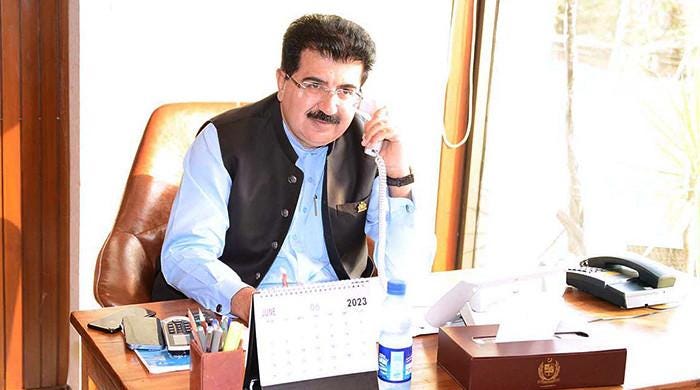
The Sanjrani Franchise
How one family from Naukundi claimed Balochistan's mines, its Senate chair, and its chief ministers and why no one stopped them
On a Monday evening in February 2025, a convoy of 30 vehicles carrying blister copper from the Saindak project through Mangochar Bazaar in Kalat district was ambushed. The Baloch Liberation Army first destroyed a military escort vehicle with a remote-controlled IED, then opened fire on the convoy. Seven Pakistani soldiers died. In a statement the following day, BLA spokesperson Jeeyand Baloch described Saindak as “an exploitative venture operated by foreign companies in collaboration with the occupying state.” The group named Reko Diq in the same statement. It warned companies involved in what it called “the plundering of Balochistan’s resources” to leave. “Otherwise they will face more fierce attacks,” it said.
The convoy the BLA ambushed was, according to the operational structure that has governed Saindak’s transport for fifteen years, almost certainly carrying loads arranged by Al-Sadiq Goods Transport. Al-Sadiq is a family company owned by Khan Muhammad Asif Sanjrani, father of Mir Muhammad Sadiq Khan Sanjrani, former Chairman of the Senate of Pakistan and current Member of the Provincial Assembly for PB-32 Chagai, the constituency that contains the mine. Al-Sadiq holds the exclusive contract for moving Saindak’s output to Karachi port. No competitive tender has ever been held for this contract. Akbar Notezai’s investigation for Lok Sujag, the most detailed on-ground reporting done on this family’s relationship with the Saindak project, found the company’s Taftan office above a tyre shop on the Pakistan-Iran border: 80 square feet, open to the elements, paying Rs8,000 a month in rent. “Even now, ten years later, there is no auction of the contract,” former Naukundi union council chairman Haji Arz Muhammad Barech told Notezai.
Sanjrani also chairs Sanjrani Mining Company (Pvt) Ltd. The company’s own website describes itself as “a family-owned business, now progressing into its third generation,” with operations in copper, coal, marble, and onyx, and lists among its active projects an iron ore mine at Saindak. In February 2025, Profit by Pakistan Today reported that Mari Energies had signed an agreement through its subsidiary to acquire an 87.5% stake in multiple mineral exploration licenses in Chagai from Sanjrani Mining Company, covering 40 square kilometres, disclosed to the Pakistan Stock Exchange. In November 2025, Sanjrani Mining Company signed an MOU with Chinese firm Guangdong Handar in Guangzhou to establish a joint venture for mineral extraction and processing under CPEC.
The mine in Chagai is a state asset. Everything positioned between the mine and its proceeds belongs to the same family.
The Saindak Copper-Gold Project was established by Saindak Metals Ltd, a federal state enterprise, in 1995 at a cost of Rs13.5 billion. Average annual yield, per the Balochistan government’s own figures: 15,810 tonnes of blister copper, 1.47 tonnes of gold, 2.76 tonnes of silver. In October 2002, the project’s operating assets were transferred to Chinese company MCC/MRDL under a profit-sharing lease. MRDL celebrated its twentieth year of Saindak operations in 2022, reporting total production of more than 290,000 tonnes of blister copper and $2.6 billion in foreign exchange generated. Of that revenue, Balochistan’s provincial share is approximately five percent.
The South Ore Body, the zone with the highest copper grade and the one mined first, was projected to last nineteen years. It lasted roughly fifteen. The North Ore Body is also depleted. Only the East Ore Body remains. NAB investigators who spoke to Notezai in his Lok Sujag investigation named overmining as their explanation for the premature depletion, arguing that extraction volumes had consistently exceeded what official invoices recorded. The depletion timeline is the arithmetic of the allegation made concrete.
The invoicing discrepancy, as documented in Notezai’s reporting, runs like this: Customs and Export Processing Zone documents show each trailer leaving Saindak officially carries approximately 54 metric tonnes of blister copper. An insider source at SML told Notezai that loads of up to 65 metric tonnes had regularly been placed on vehicles recorded as 53 to 54. A former president of the Taftan transporters’ union confirmed this independently. A source close to the operation noted to Notezai that since Sadiq became Senate Chairman, there was more caution about overloading. The caution was new. Before the chairmanship it was not considered worth observing.
A NAB official who met Notezai at the Almas Hotel on Saddar Road in Karachi had, some years earlier, intercepted 28 of these trucks at Hub carrying substantially more than their invoiced weights. He had notified the Southern Command, the sector commander of Balochistan, and the DG Rangers Sindh. The trucks were caught. Days later, he was told to release them. The pressure came, he said, from the Chinese ambassador and from China itself, backed by the Frontier Corps. “I discovered that Raziq and some Chinese have been involved in this plunder for several years,” he told Notezai. “But he’s unbelievably influential. That’s why none can put their hands on him.” The truck driver detained in that operation told Notezai only this: “We were taken to a large walled compound. We were held for some days. No one would tell us why.”
Raziq Sanjrani is Sadiq’s younger brother and, since 2008, the Managing Director of Saindak Metals Ltd.
He was 24 years old when he was appointed. The position of MD at SML requires a minimum of 25 years of professional experience, including a decade in large-scale industrial mining. Raziq had none. The appointment was made on the recommendation of then-Balochistan Chief Minister Aslam Raisani, in the same year the PPP came to power at the centre and the same year Al-Sadiq Goods Transport shifted from Naukundi to Taftan and picked up the transport contract. In 2018, the National Accountability Bureau concluded the appointment was illegal. Raziq stayed. He held the post for fifteen years. No case was registered.
In February 2023, MPA Arif M. Hasni raised the matter in the Balochistan Assembly, alleging that Chinese companies had embezzled more than Rs7 billion from the Saindak project and that the government was taking no action out of fear of damaging its relationship with Beijing. He named Raziq Sanjrani’s appointment directly, calling it illegal from its first day, as reported by the Balochistan Post. The assembly went quiet.
There was a third operation running beneath this. Pakistan Monthly Review, republishing Notezai’s investigation, documented that behind the Saindak site, waste from the South Ore Body had accumulated over decades into a mountain of its own. Behind that waste sat a black deposit of iron ore. Raziq Sanjrani and his brother-in-law Khalid Gul, then a vice president at MRDL, are alleged by named sources in Notezai’s reporting to have privately mined that iron ore using Saindak project machinery, diesel, and equipment without authorisation. The iron ore was sold to Pakistan Steel Mills in Karachi. “When the matter came to light, they stopped doing it,” a source told Pakistan Monthly Review. Raziq has denied these allegations. Sanjrani Mining Company’s own website lists an iron ore mine at Saindak among its active projects.
The Saindak-Taftan railway line was built to carry the mine’s copper output to the railhead. It is broken now. The deterioration began in 2002 and accelerated into something that looked like a decision from 2008, the year Raziq became MD, the year Al-Sadiq acquired the transport contract, and the year, according to Notezai’s investigation, the railway line began failing with more purpose. Locals across the area told Notezai they believe the track was deliberately left to die.
Raziq’s explanation to Notezai is that road was more economical than rail on security grounds. No competitive process was opened to verify this. Al-Sadiq’s representative in Taftan, a man named Ameer Jan who does not speak to media but spoke to an undercover journalist posing as a trailer owner, described earnings of around Rs55,000 per trailer. Load dates are arranged ten days in advance. Drivers are called to confirm how many tonnes they can carry. The company decides who gets the job.
With no railway and no competing tender, Al-Sadiq Goods Transport is the only vehicle between Chagai’s copper and Karachi’s port. Every tonne that leaves Saindak under-invoiced leaves in a truck the family dispatched.
In November 2022, Customs Enforcement Balochistan published a statement, reported by CustomsNews.pk, naming the sitting Senate Chairman directly. Over the preceding six months, the statement said, Sanjrani had effectively occupied customs checkposts in the province’s border areas, including Nokandi and Dalbandin, and was extracting Rs30,000 from every loaded vehicle passing through. His network invoked the names of security outfits to enforce the collections. An average of 250 vehicles passed through those posts per day: Rs7.5 million, daily, running for six months, through checkposts at the Pakistan-Iran and Pakistan-Afghanistan border corridors, extracted by the Senate Chairman of Pakistan. The statement said the practice had “severely impacted Customs Enforcement activities.” No case was registered. No inquiry was opened.
Sadiq Sanjrani arrived at the 2018 Senate election as, in Dawn’s own description, “a little-known politician from Chagai.” He was elected senator as an independent and, within days, elected to the chairmanship of the Senate, the third-highest constitutional office in the country, by a coalition assembled primarily by PPP co-chairman Asif Ali Zardari, with PTI, MQM, and Balochistan independents. Notezai’s Lok Sujag investigation, citing named sources, reports Sanjrani paid more than Rs300 million to secure his Senate seat, described in the reporting as the second-highest sum paid in that election cycle. Before taking office, he had been a director at Hubco, the power company. Within ten days of his becoming Senate Chairman, his brother Ejaz was appointed director of Hubco. The selection process for that appointment has not been made public.
In August 2019, a joint opposition with 67 senators filed a no-confidence motion requiring 53 votes to pass. In the standing vote, 64 senators publicly backed it. In the secret ballot, 50 votes were recorded in favour. Fourteen senators who had stood publicly for the motion put their ballot elsewhere. PTI held 36 Senate seats at the time. Sanjrani received 45 votes against the motion from a chamber where his own side could produce no more than 36.
Hasil Bizenjo, the opposition’s candidate for the chairmanship, told reporters after the result: “This is a game played by ISI. If today we have lost, we have lost because of ISI,” as reported by VOA News. The arithmetic of the vote required no inference. Nine senators from an opposition with 67 members had been turned, in secret, after all 64 had stood in public.
Three years later, after Lt. Gen. Faiz Hameed was retired from military service in November 2022, Asif Zardari was seated at a gathering alongside Sanjrani and said to him, in front of others: “Faiz is gone. What will you do now?” Sanjrani indicated he would look to Zardari for support. Zardari replied: “Their reign does not last forever, but ours does.” The Frontier Post reported this exchange. It is not a disclosure. It is the language of men who consider the arrangement they are describing a permanent condition of Pakistani governance, notable only in its candor.
Sanjrani was re-elected Senate Chairman in March 2021.
On the night of October 24, 2021, Jam Kamal Khan Alyani, Chief Minister of Balochistan, resigned. Dawn reported that his resignation came after two marathon sessions of negotiations conducted directly by Senate Chairman Sadiq Sanjrani and federal Defence Minister Pervez Khattak. Sanjrani then appeared at a joint press conference alongside acting BAP president Zahoor Buledi and Khattak to announce that Abdul Quddoos Bizenjo would be the next chief minister. He did not announce it from the background. He stood at the podium and said it to the cameras.
The Express Tribune later reported, in May 2022, that Sanjrani had “rendered unconditional support to Bizenjo in the removal of Jam Kamal.” Pakistan Monthly Review’s investigation, citing Quetta and Islamabad sources, added that Sanjrani had also requested through a senior intelligence official that Balochistan governor Amanullah Khan Yasinzai be appointed to his post.
The Reko Diq deal was signed under Bizenjo. Reko Diq sits in Chagai, the same district as Saindak. It holds what Barrick Mining Corporation has described as one of the world’s largest undeveloped copper-gold deposits. Pakistan reached an out-of-court settlement with Barrick in March 2022, setting aside $11 billion in international arbitration penalties and establishing a $10 billion development framework. Barrick holds 50%. The remaining 50% is split between federal state enterprises and the Balochistan government. Barrick CEO Mark Bristow met with Bizenjo personally. The project’s inauguration ceremony in January 2023 was held at the chief minister’s secretariat in Quetta, with Bizenjo presiding, as reported by Dawn. The International Finance Corporation disbursed $300 million for the project in April 2025 and a further $700 million in June 2025. Barrick signed a $440 million equipment agreement with Komatsu that same month. Production is targeted for 2028.
The man who negotiated the removal of the chief minister under whom no such deal was signed, and who publicly installed the chief minister under whom it was, now sits as MPA for the assembly seat covering both mines.
In August 2024, Sanjrani briefed Prime Minister Shehbaz Sharif on the Chagai Mineral Corridor, a proposed infrastructure framework connecting Chagai’s mines to Gwadar port via a new railway line, as reported by Express Tribune. The PM Office issued a press release crediting Sanjrani’s briefing. A grid station for Chagai was announced. A Nokundi master plan was named.
For more than two decades, the people of Naukundi had no reliable electricity. No paved water supply. The main income in the town that sits above two of Pakistan’s largest mineral sites was smuggling: Iranian petrol, undocumented migrants across the Pakistan-Iran border, whatever the desert allowed. The CSR fund from the Saindak project, Haji Arz Muhammad Barech told Notezai, went to “vested interests” rather than the community. The infrastructure was not built when people needed it. It is being built now because the mines require it.
In February 2019, Sanjrani led a Senate delegation to call on Saudi Crown Prince Mohammed bin Salman at the Prime Minister’s House during MBS’s visit to Islamabad. The delegation presented the crown prince with a gold-plated Heckler and Koch MP5K submachine gun and a painted portrait of him, as reported at the time by Pakistan Today, the Express Tribune, and The News. The gift was presented after the crown prince agreed to invest $20 billion in Pakistan, reported Middle East Eye. Whether the gold plating came from Chagai is not in the public record.
The BLA has not attacked Saindak once. It has made Saindak a recurring operational target.
In February 2025, seven soldiers were killed in the Mangochar ambush. In April 2025, BLA fighters established a blockade on the Quetta-Karachi highway at Khazinai in Kalat district, conducted snap checks, and explicitly targeted vehicles associated with the Saindak project, in the same operation in which an ISI officer named Muhammad Nawaz was killed in Pasni, as reported by the Balochistan Post. In October 2025, the Balochistan Liberation Front, a separate armed group, used grenade launchers to target vehicles supplying goods to the Saindak project in Chagai district, the Balochistan Post reported. BLF spokesperson Major Gwahram Baloch said police escorts were deliberately spared. The group called the mine “an exploitative colonial project” and warned vehicle owners directly: do not aid resource extraction in Balochistan. Armed men also established a checkpoint near Dalbandin and seized a Saindak vehicle, as reported by ProKerala citing local sources.
The BLA and BLF, in their communiques on these attacks, use the same word: exploitation. The NAB official who was told to release the 28 trucks at Hub used the same word to describe what he had found: plunder. Arif M. Hasni, standing in the Balochistan Assembly, used the same word about the Chinese take from the project. Three different actors, operating through three irreconcilable means, looking at the same mine, reaching the same description.
The people who operate Al-Sadiq’s trucks are not the Sanjrani family. They are drivers from Taftan and Dalbandin and the dusty towns along the Quetta-Karachi corridor, men who take Rs55,000 a load and provide for their families through whatever work the border economy offers. The BLF, in its October 2025 statement, warned them. The armed groups and the accountability bodies have each decided that the mine is the problem. The drivers are carrying the consequences of both conclusions at once.
When incoming Senate Chairman Yusuf Raza Gilani launched an inquiry in 2024 into staffing practices under Sanjrani’s six-year chairmanship, it identified 502 illegal hires and 250 improper deputation placements authorised without competitive process or proper authorisation, per Grokipedia’s aggregation of public record. The inquiry was subsequently shelved without published findings or disciplinary action.
The Customs Enforcement statement from November 2022 naming Sanjrani and his operation at the border checkposts produced no registered case.
The NAB investigation into under-invoicing at Saindak, opened on personal initiative by an official who named the mechanism, the quantities, and the people involved, was not taken up institutionally. The NAB’s 2018 finding that Raziq Sanjrani’s appointment as MD was illegal produced no removal, no prosecution, and no consequence for anyone who made the appointment.
Four accountability processes. Each named the same family or its operations. Each closed without result.
In November 2025, Sanjrani, as chairman of Sanjrani Mining Company, signed a joint venture agreement with Guangdong Handar in Guangzhou. The deal covers resource extraction and mineral processing in Balochistan under CPEC. The other active mine in the district, Reko Diq, has $1 billion in IFC financing committed, a $440 million equipment contract, and a 2028 production start. The Chagai Mineral Corridor, when built, will provide the railway that Saindak’s blister copper never had and Naukundi’s residents were never offered.
Sanjrani Mining Company describes its iron ore mine at Saindak as an active project. The private mine sits at the site of the state mine whose output the family’s transport company moves under a contract that has never been tendered. The family’s brother ran the state mine for fifteen years after an illegal appointment. The family’s patriarch founded the transport company that carries the state mine’s output. The family’s son became Senate Chairman and, from that position, brokered the appointment of a provincial governor and personally negotiated the removal of a chief minister whose successor signed the agreement that unlocked $10 billion for the second mine in the family’s district.
The question the documented record cannot yet answer is who authorised the private iron ore mining at Saindak, who approved the transfer of the transport contract to Al-Sadiq without tender, and under what provision of the law any of this is permissible for a sitting parliamentarian representing the constituency that contains the mines his family operates. These are not investigative questions requiring more digging. They are administrative questions requiring answers from institutions that have consistently refused to ask them.
Sources
Lok Sujag / Sujag, Akbar Notezai — investigation filed from Naukundi, Taftan, Hub, Karachi, and Quetta
Pakistan Monthly Review, Vol. 8 No. 4, April 2026 — republication of Notezai investigation
Balochistan Post — February 2023, MPA Arif M. Hasni assembly address; February 2025, Mangochar convoy attack; April 2025, BLA attack and ISI killing in Pasni; October 2025, BLF Chagai attack
CustomsNews.pk — November 4, 2022, Sanjrani customs checkpost extortion statement
Profit by Pakistan Today — February 12, 2025, Mari Minerals acquisition; February 28, 2025, joint venture details
Balochistan Pulse — November 2025, Guangdong Handar MOU
Express Tribune — August 2024, Chagai Mineral Corridor; May 2022, Sanjrani-Bizenjo-Jam Kamal; February 2019, MBS gift
Dawn — October 2021, Jam Kamal resignation negotiations; January 2023, Reko Diq inauguration; March 2018, Senate chairman election; August 2019, no-confidence vote
Geo News — October 2021, Bizenjo nomination press conference
Pakistan Today — February 2019, MBS gift
Middle East Eye — February 2019, MBS gift and $20 billion investment context
The News — February 2019, MBS gift
VOA News — August 2019, Hasil Bizenjo ISI statement
The Frontier Post — Zardari-Sanjrani-Faiz Hameed exchange
Barrick Gold Corporation official press releases — October 2022, January 2023
IFC disbursement announcements — April 2025, June 2025
Business Recorder — February 2025, Mari Minerals PSX disclosure notice
Sanjrani Mining Company website, smcl.pk — project listings including iron ore mine at Saindak
Trade Chronicle — February 2025, SMC project details
ProKerala — May 2025, Dalbandin checkpoint and Noshki convoy attacks, citing Balochistan Post and local sources
World Geostrategic Insights — August 2023, Saindak ore body depletion timeline
NAB 2018 finding on Raziq Sanjrani’s illegal appointment — confirmed in Balochistan Post reporting


