
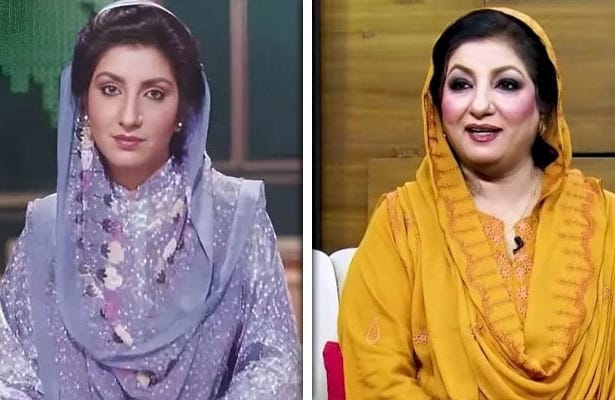
The Quiet Exit of Ishrat Fatima
After forty five years reading the news, Pakistan’s most familiar broadcaster walked away from an institution that stopped wanting her there
On a January evening in 2026, Ishrat Fatima delivered her final bulletin on Radio Pakistan. Her voice carried the same calm authority it always had, the same careful pronunciation that made even routine headlines feel like they mattered. She thanked her listeners, her parents, and God, then stepped away from the microphone she had held for more than four decades. For anyone who grew up with Pakistani state television in the 1980s and 1990s, that voice needs no introduction. Ishrat Fatima was the woman who read the nine o clock Khabarnama, night after night, in an era when there were few channels and fewer choices. Families finishing dinner, shopkeepers closing their shutters, students glancing up from homework all heard the day’s events filtered through her steady Urdu. She did not editorialize. She did not perform. She simply read, and in doing so became a fixture of national routine. Her departure marks not just the end of a long career but the closing of a particular chapter in Pakistani broadcasting, one defined by restraint, discipline, and a kind of institutional loyalty that the institution itself seems unable to reciprocate.
She entered broadcasting almost by accident. As a teenager still in school, she joined Radio Pakistan and hosted a sports program called Khel aur Khiladi. Her mother, a teacher, had insisted on proper Urdu at home, and that early discipline showed in her diction. The household was one where reading was encouraged and language mattered, where careless pronunciation was corrected and clarity was valued. Those early years gave her the tools she would carry through her entire career: an ear for rhythm, an instinct for when to pause, and a respect for the weight that words can carry when delivered with care. When she went to Pakistan Television years later to audition for a weather slot, producers heard something else in her voice. They moved her to the news desk instead. The weather job never materialized. What emerged instead was a decades long presence at the heart of state broadcasting, a figure whose face and voice would become inseparable from the evening news itself.
The job she inherited was tightly scripted. State television in her early years operated under close government supervision, and the boundaries of what could be reported were narrow. Bulletins were written elsewhere, shaped by officials who saw broadcasting as an extension of state messaging rather than as an independent public service. Ishrat Fatima’s task was not to question the script but to deliver it without error, to be the polished surface through which government approved information reached the public. Within that constraint, she built a reputation for reliability. Colleagues remember her rehearsing before going live, checking pronunciation, marking difficult names so nothing would catch her off guard. She treated each bulletin as a performance in the technical sense, something that required preparation and focus, not improvisation. Younger anchors were told to study her tapes and copy her pacing, to notice how she controlled her breathing, how she used pauses to clarify meaning, how she kept her expression neutral so the words themselves would carry the message. In an industry that would later reward volume and personality, she represented an older model: the newsreader as instrument, precise and dependable.
Over time, that discipline gave her a kind of authority that outlasted individual governments. Civilian leaders and military rulers came and went. The newsroom changed bosses. Policies shifted. The country itself moved through cycles of hope and crisis, democracy and dictatorship, but the nine o clock bulletin remained, and so did she. Audiences associated her less with any particular regime and more with a certain standard of seriousness. Even people critical of state media, people who understood that what they were hearing was often sanitized or shaped to serve power, often spoke of her with a grudging respect. She was not blamed for the limits of the system. She was seen as someone who did her narrow job well, who brought professionalism to a role that could easily have been handled carelessly. That distinction mattered. In a country where public institutions are frequently mistrusted, where cynicism about the motives of those in power runs deep, she occupied a strange middle ground: a state employee who was not despised, a familiar face who was not treated as a propagandist.
But the recognition she received publicly did not translate into power inside the institution. In later interviews, she spoke about how major transmissions and special bulletins almost always went to male newsreaders, even when women like her carried the bulk of daily work. The big moments, the events that drew larger audiences and brought prestige to whoever anchored them, were reserved for men. Promotions went to men. Editorial meetings happened in rooms where women were present as on air talent, not as decision makers. She was the country’s most recognizable news voice, yet she had little say in what the news would contain, how it would be framed, or which stories would lead. This is the quiet sexism that structures much of Pakistani media, a pattern where women are visible enough to be useful but not powerful enough to shape the product they help deliver. Ishrat Fatima lived that contradiction for decades, becoming the public face of an institution that never fully invited her into its inner workings.
There were awards, acknowledgments that her service mattered in some official sense. The Pride of Performance came in recognition of her long career, a civil honor that placed her among artists and professionals the state wished to celebrate. PTV brought her back in late 2025 as a mentor, a role that acknowledged her standing among younger broadcasters and suggested that her knowledge was worth preserving. For a generation of journalists, she remained a reference point, the person whose work set the standard before cable news and talk shows turned broadcasting into theater. But these gestures, however sincere, could not change the day to day reality of how she was treated inside the organizations she worked for. Recognition is not the same as respect, and formal honors do not protect aging professionals from being sidelined when their utility to the institution fades.
By the time she reached her mid sixties, the space around her had begun to shrink. In a video she released after her resignation, she described what that felt like. She said she had always hoped to keep reading the news as long as her voice held and her breath stayed steady, that broadcasting for her was not just a job but an emotional commitment formed over decades of practice. The microphone, the studio, the ritual of preparing a script and delivering it cleanly, all of this had become part of her identity. She did not want to leave. She wanted to continue doing what she had always done, to serve the audience that had kept her company for so many years. Instead, she found herself gradually edged out. Shifts were reduced. Opportunities to anchor important bulletins became rare. She described an atmosphere where colleagues no longer competed through merit but tried to eliminate the space where she could work. She said she waited, hoping conditions would improve, that someone in management would recognize her years of service and restore a measure of professional respect. She waited, in her own words, very long for kindness, space, and recognition. It never came.
What finally pushed her to resign was not money. She has been clear about that. It was the sense of being unwanted in a place she had helped define. She described Radio Pakistan as an institution of walls, not people, a structure incapable of empathy or understanding. She said that if anyone at the organization had asked her to stay, if there had been even a small gesture of care, she might not have left. But no one did. The bureaucracy that had relied on her voice for four and a half decades could not find the language to ask her to remain, could not make the small accommodations that might have allowed her to finish her career with dignity intact. Instead, she was left to feel that her presence had become inconvenient, that the organization was waiting for her to leave so it could move on without the awkwardness of forcing her out. That realization, more than any single incident, seems to have been what broke the bond. She chose to go rather than endure further erosion of the professional standing she had spent a lifetime building.
Her departure has prompted an unusual level of public reflection. Fellow journalists, including well known figures in Pakistani media, have praised her contributions and expressed discomfort at the way veterans are discarded once they age out of peak slots. Viewers who grew up hearing her voice have shared clips of her final broadcast with simple captions, many of them acknowledging that an era has ended. The response suggests that whatever frustrations people feel about state media in general, Ishrat Fatima herself is seen differently. She is not blamed for the limits of the system she worked within. Instead, she is remembered for doing a controlled, disciplined job over a very long period, then leaving when the institution made clear it no longer valued that discipline. There is a sadness in the tributes, a sense that something has been lost not just because she is leaving but because of how she is leaving, forced out by neglect rather than celebrated on the way out the door.
Her career does not answer every question about journalism and power in Pakistan. She worked inside a tightly managed structure and did not challenge it publicly. She read scripts written by others and stayed within the editorial lines drawn by people above her. In that sense, she was part of a system that limited what the public could know, that presented official narratives as settled fact, that served the interests of whoever held power at any given moment. But within that role, she brought something that mattered to audiences: consistency, clarity, a refusal to turn the news into a personal brand or a platform for grandstanding. That may seem like a small achievement in a country where journalism is often dangerous and where many reporters have paid with their lives for asking difficult questions. But it is also worth recognizing that not every role in media is the same, and that the person who reads the bulletin cleanly night after night is performing a different function than the investigative journalist or the opinion columnist. Ishrat Fatima occupied her role seriously, and the public response to her exit suggests that many people valued what she brought to it.
In the end, the image that remains is of a woman standing at a microphone for the last time, explaining in plain language why she could no longer stay. The bulletin is over. The red light goes off. And Ishrat Fatima, after forty five years of reading other people’s words, finally gets to choose her own closing line. That choice, made late and under pressure, is the one piece of the story she controlled completely. It is a quiet form of resistance, not dramatic or loud, but deliberate. She walked away rather than fade. She named the conditions that made staying impossible rather than pretending everything was fine. And in doing so, she has left behind not just a body of work but a question for the institutions she served: what does it say about you that a figure like this, someone who gave you decades of loyalty and skill, had to leave because you could not make room for her dignity at the end?


