
The Qabza State In Force
Land, Power, and the Clearance of Islamabad
Yasmeen Bibi is a widow who works as a domestic helper in Islamabad. The first house the state demolished was in Saidpur Village, in the Margalla foothills, where her family had lived for decades. She rebuilt across months of savings, brick by brick. The Capital Development Authority’s bulldozers returned on a Tuesday morning with a police escort and a court order. By afternoon, the second house was rubble. She told Arab News: “First one house of mine was demolished, and now the second one has also been demolished. We are sitting here helplessly and without any support.”
No committee was constituted for Yasmeen Bibi.
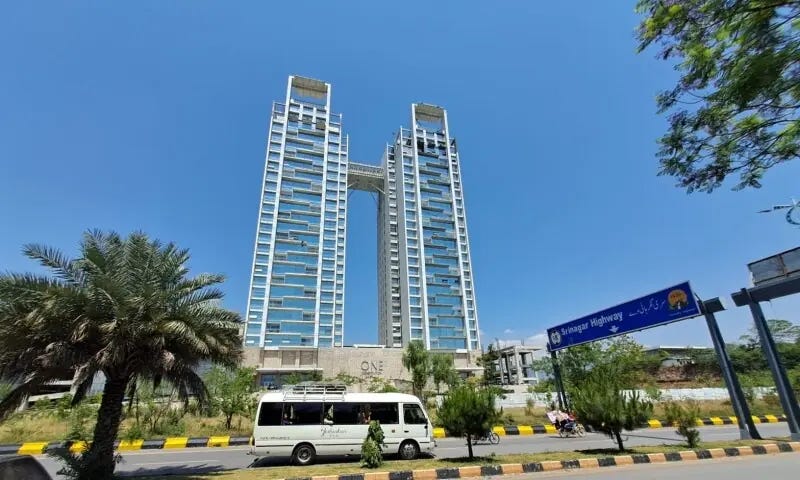
On the night of May 1, 2026, police went door to door in One Constitution Avenue, a glass tower in Islamabad’s Red Zone steps from Parliament House, broke apartment locks, and told residents they had until morning to vacate. By dawn, Prime Minister Shehbaz Sharif had constituted a high-level committee, headed by Law Minister Azam Nazeer Tarar and including the Cabinet Secretary and Commerce Secretary, to review the situation. All affected individuals, the PM’s office announced, would be given an opportunity to present their concerns.
The apartment owner list submitted to the Islamabad High Court in 2017 in compliance with court directions included a former prime minister, a former caretaker prime minister, a former foreign secretary, former federal ministers, a senior journalist, and a squash world champion. These are, by any measure, the people Pakistan’s institutional apparatus is designed to hear.
Yasmeen Bibi is not among them. Neither are the 13,000-plus households demolished in Noorpur Shahan over the six months preceding May 1. Neither are the residents of Muslim Colony, Rimsha Colony, or Allama Iqbal Colony. The committee existed because the people inside One Constitution Avenue had the institutional standing to make its absence visible. That standing, and not the law, is what separates the cleared from those who receive a week’s review.
The Capital Development Authority was established in 1960. Its founding ordinance explicitly includes the regularisation of informal settlements among its obligations. It has not conducted a comprehensive survey of those settlements since 2002. In the intervening years, Islamabad’s population has grown from 800,000 to nearly 2.4 million. The National Housing Policy 2025 records more than 60 katchi abadis in the capital, with a combined population approaching 500,000. The CDA formally recognises six.
A decade-long Supreme Court case on katchi abadis, opened after the CDA demolished the I-11 settlement in 2015 and rendered 20,000 people homeless, has produced repeated judicial directions to the CDA to formulate a regularisation policy. The CDA has not done so. During a May 2025 hearing of the Constitutional Bench, Justice Muhammad Ali Mazhar stated that “the real issue is that contempt proceedings should have been initiated against the CDA.” The Federal Constitutional Court issued a further direction in April 2026, ordering a comprehensive policy within four weeks. The Additional Attorney General told the court the draft was ready but approval had been delayed because the CDA chairman had been changed.
The chairman was changed. The operations continued.
Since January 2026, the CDA has conducted simultaneous clearance operations across at least six locations in the capital. Muslim Colony, near the PM’s House and the Diplomatic Enclave, was demolished completely, leaving thousands without shelter and no resettlement plan on record. In Saidpur Model Village, 200 structures were demolished and 191 kanals retrieved in a single operation, with Interior Minister Mohsin Naqvi present to inspect the progress and announce the commercial tourism development to follow. In Noorpur Shahan, adjacent to the Bari Imam shrine, more than 13,000 houses were demolished across six months; Noori Bagh Mohallah was razed in a single day under a deployment of 1,000 police who used tear gas, fired pellets, conducted overnight search operations, and detained over 50 residents on charges that included terrorism, while roads were sealed from Margalla Road to the Diplomatic Enclave. In H-9, the CDA moved against Rimsha Colony, a Christian settlement whose residents had been directed there by the government in 2012 following sectarian violence in their previous neighbourhood. In G-7, Allama Iqbal Colony, home to domestic workers and daily wage earners including Rubina Saleem, a 56-year-old widow supporting nine family members, faced repeated operations. One Constitution Avenue was cleared on the night of May 1.
The Human Rights Commission of Pakistan condemned the operations. The All-Pakistan Alliance for Katchi Abadis, Awami Workers Party, Aurat March, and the National Commission for Justice and Peace issued a joint statement. Civil society leaders including Abid Hasan Minto, Pervez Hoodbhoy, Farhatullah Babar, Afrasiab Khattak, and Arif Hasan held a National Press Club press conference demanding a halt. None of it slowed the demolitions.
The campaign has an official name. A government press release dated April 28, 2026, describes the operations as “Mohsin Speed”, attributed to Interior Minister Mohsin Naqvi, and calls it “a symbol of fast track good governance.” The CDA’s own January 2026 headquarters meeting records state that the anti-encroachment drive was launched “in line with the vision of Prime Minister Shehbaz Sharif and Federal Interior Minister Mohsin Naqvi.” The authors of this campaign have named themselves in their own documents.
None of it generated the news coverage, the political pressure, or the prime ministerial committee that forty-eight hours of social media activity about One Constitution Avenue produced. The distinction is not about the scale of the displacement. Noorpur Shahan’s 13,000 demolished houses represent a human crisis that One Constitution Avenue’s eviction does not approach in magnitude. The distinction is about who was displaced and whether they had anyone in a position to make noise about it.
On April 12, 2026, US Vice President JD Vance arrived in Islamabad to lead American negotiations with Iran in the first direct US-Iran peace talks since the war began. Field Marshal Asim Munir and Interior Minister Mohsin Naqvi were both at the airbase to receive him. The Red Zone was locked down, streets sealed, military deployed throughout. The talks were held at the Serena Hotel and the Jinnah Convention Centre, in the heart of the same Red Zone where One Constitution Avenue stands.
From the upper floors of One Constitution Avenue, the view covers the American Embassy compound and the full extent of the Diplomatic Enclave. In the weeks before the OCA eviction, a video circulating on social media, filmed from inside the building, showed that sightline: the Diplomatic Enclave, the embassy, the security perimeter, all visible from a privately owned residential tower that had no business being there under the CDA’s current account of the matter. The eviction order came on May 1, nineteen days after Vance’s departure.
This sequence does not prove causation. It is placed on the record because it belongs there.
What is documented without ambiguity is the broader logic driving the transformation of Islamabad’s Red Zone. A Rs57.7 billion PC-1 for a luxury hotel to be executed through public-private partnership was approved ahead of the Shanghai Cooperation Organisation summit scheduled for Islamabad in 2027. A separate Rs19.3 billion allocation for a New Islamabad Convention, Expo and Exhibition Centre was approved alongside it, with an 18-month completion deadline. The CDA chairman directed that the hotel tendering process be expedited. The Jinnah Convention Centre, where Vance’s delegation held its press operations, sits adjacent to the 13.5-acre Red Zone plot that Dogar’s bench cleared on May 1.
Pakistan’s civilian and military establishment has, in the space of four months, hosted a US vice president for war mediation, approved Rs77 billion in convention and hospitality infrastructure for a foreign diplomatic summit, deployed 1,000 police to demolish a settlement of 500-year-old standing, and conducted a midnight eviction of a residential tower in the same Red Zone where foreign delegations stay and negotiate. The people cleared from Noorpur Shahan will not attend the SCO summit. The people who will attend the SCO summit will not be told about Noorpur Shahan.
Mian Mohammad Mansha, one of Pakistan’s most prominent industrialists, responded publicly to PM Shehbaz’s five-star hotel directive by calling it “excellent and necessary” and describing the SCO summit as “a tremendous opportunity to showcase Pakistan’s soft power.” He also raised concern about using CDA and EOBI as execution vehicles, arguing that hotel development requires market-driven private investors. His public argument for private hotel investment, made at precisely the moment a publicly cleared Red Zone plot requires a private PPP partner, is the market case being constructed in plain sight.
Mohsin Naqvi’s involvement in this story is direct operational participation at every stage, from clearance to announced redevelopment, and his proximity to foreign diplomatic operations is not incidental.
He was at the airbase to receive JD Vance in April. He personally visited Saidpur Village in August 2025 to oversee the demolition of 200 constructions and retrieve 191 kanals, announcing a world-class tourism hub to follow. He visited DHA Margalla Enclave in February 2025 to review a joint venture between the CDA and the Defence Housing Authority on 10,000 kanals of state land, set completion deadlines, and specified that travel time from the Prime Minister’s residence to the site must not exceed five minutes. Intelligence sources cited in this investigation’s background reporting indicate Naqvi is also leading the process to transfer One Constitution Avenue to a buyer whose identity has not been disclosed.
The Interior Minister controls the Islamabad police. That force conducted the midnight operation at One Constitution Avenue, used tear gas and pellets at Noorpur Shahan, stood at the perimeter while Noori Bagh Mohallah was demolished, and filed terrorism charges against residents who resisted. Between operations, Naqvi appears in photographs reviewing luxury real estate going up on the cleared land, setting timelines, and receiving American vice presidents at air bases.
The CDA’s January 2026 meeting records confirm the demolition campaign was launched under his direction alongside the Prime Minister’s. The campaign’s official branding, “Mohsin Speed”, is his name on an operation that has displaced tens of thousands of Islamabad’s working poor since January.
IHC Chief Justice Sardar Mohammad Sarfraz Dogar’s two rulings provide the legal architecture for the clearance campaign.
On April 7, 2026, a division bench comprising Dogar and Justice Mohammad Asif suspended a restraining order that Justice Raja Inaam Ameen Minhas had issued protecting Noorpur Shahan residents after they petitioned the court. Dogar’s bench lifted the protection. The enforcement operation resumed. Noori Bagh Mohallah was demolished within days.
On May 1, 2026, the same bench dismissed petitions filed by BNP (Private) Limited and by apartment owners in One Constitution Avenue, upholding the CDA’s cancellation of the building’s 99-year lease. Police arrived at the building within hours of the ruling.
In both cases, the legal protection that existed before Dogar’s rulings was held by those being displaced. After each ruling, it transferred to the CDA.
During the February OCA hearings, Dogar raised from the bench the question of Justice Ijazul Ahsan’s role in the 2019 Supreme Court ruling that had restored OCA’s lease and protected its apartment owners. Ahsan had previously served as BNP’s legal representative before sitting on the bench that ruled in BNP’s favour. The protection that ruling secured was withdrawn by Dogar’s May 1 order.
The IHC, under a different bench, ordered the CDA’s dissolution in June 2025, ruling its revenue and tax powers unconstitutional under the 1960 CDA Ordinance. The CDA continued operating. The dissolution order was set aside on appeal. The institution a court found to be operating on unconstitutional foundations is now the instrument of the capital’s largest land clearance in decades, with enabling orders coming from the same court’s current chief justice.
The Pakistan Army’s land interests in Islamabad and Rawalpindi operate through institutional vehicles that work in sequence: the Frontier Works Organisation builds the infrastructure, the Defence Housing Authority develops and sells the land around it, and the Cabinet provides the approvals.
The Frontier Works Organisation, the army’s engineering arm, is currently building the Dadhocha Dam in Rawalpindi district on land where over 1,000 families from seven villages are being displaced. The Lahore High Court had previously declared DHA’s 18,000-kanal acquisition in the same Bharwala and Dadhocha valleys null and void. DHA kept the land. When the reservoir fills, it will sit at the centre of DHA’s development zone. FWO provides the infrastructure. DHA holds the surrounding plots.
In Islamabad, the CDA-DHA joint venture on 10,000 kanals of Kuri area land formalises the mechanism through cabinet approval in September 2024. DHA holds 45% of developed plots; the CDA retains 55%. Plots went on sale after the December 2025 ballot: 5 marla from Rs15.5 million, 10 marla from Rs30 million, 1 kanal from Rs56 million. The CDA’s DG Planning has stated the revenue potential at Rs1,000 billion. Interior Minister Naqvi monitored the project personally and set its timelines. The project was renamed from Kuri Model Village to DHA Margalla Enclave.
The consistent mechanism across every site: state land cleared through anti-encroachment operations or court-enabled lease cancellation, transferred to DHA through cabinet-approved joint ventures, developed at premium prices, revenue divided between CDA and the army’s real estate arm. The I-11 settlement cleared in 2015, the Dadhocha valley displaced in 2024 to 2026, Kuri Model Village absorbed into DHA Margalla Enclave. The current campaign is the most compressed and geographically concentrated iteration of a process that has been running for over a decade.
The Islamabad Club occupies 352 acres of central Islamabad state land. In 1967, the CDA leased 244 acres at Re1 per acre for the first ten years, with a contractual provision for revision at the decade mark. The revision never happened. The CDA added 108 more acres to the lease instead. The Pakistan Information Commission, responding to an RTI request filed by a citizen journalist after the club refused to disclose its financials and claimed it was not a public body, established that the current annual lease payment is Rs27,000 for 352 acres, or Rs77 per acre per year.
That is the lease. Beyond it, the Islamabad Club is reportedly encroaching on an additional 51 kanals of CDA land. The Gun and Country Club, adjacent, operates without any allotment or lease letter from the CDA at all.
When this was raised at a CDA media briefing last week, Deputy Director General Enforcement Dr Anam Fatima said action would be taken against both clubs and that a committee had been formed to examine the Islamabad Club’s situation. The Building Control Directorate, she said, had issued notices to the Gun and Country Club.
At Noorpur Shahan: 1,000 police, tear gas, pellet fire, terrorism FIRs, 13,000 houses demolished across six months. At the Islamabad Club, with 51 kanals of encroachment beyond an already concessional lease: a committee. At the Gun and Country Club, operating on CDA land with no legal instrument whatsoever: a notice.
The enforcement is consistent. The variable is the class of the occupant.
One Constitution Avenue was auctioned by the CDA in 2005: a 13.5-acre Red Zone plot sold to BNP Group for Rs4.88 billion, with possession handed over after the receipt of only Rs800 million. The developer converted the planned five-star hotel into residential and commercial apartments and sold them. The CDA cancelled the lease in 2016 citing violations. The IHC upheld the cancellation in 2017. The Supreme Court reversed that judgment in 2019, directing BNP to pay Rs17.5 billion in instalments over eight years. BNP paid Rs2.9 billion, 16.6% of the total, and wrote to the CDA in July 2022 acknowledging that it could neither complete the project nor meet its payment obligations, describing both as impossible.
IHC Chief Justice Dogar dismissed all remaining petitions on May 1, 2026. Police arrived that evening.
The apartment owners are, as the 2017 IHC-submitted list documents, among the most prominent Pakistanis in public life. The PM’s committee was constituted within hours of the midnight operation appearing on social media with that list attached. It was not constituted when Yasmeen Bibi’s second house came down in Saidpur. Not when Noori Bagh Mohallah was razed. Not when Rubina Saleem found bulldozers at the edge of her street in G-7. It came into existence because the people displaced on May 1 had the social and institutional weight to make its absence politically costly.
That is not an argument for or against the merits of the CDA’s lease cancellation action. The legal case for cancellation is documented and substantial. It is an observation about what generates state responsiveness in Pakistan, and what does not. The families of Noorpur Shahan, Muslim Colony, and Rimsha Colony did not lack legal grounds for protection. The Federal Constitutional Court had issued a stay. The Supreme Court case had been running for a decade. The Additional Attorney General had confirmed a draft regularisation policy existed. None of it produced a committee within hours, because none of them had anyone on the resident list whose name could make the front page.
The CDA’s position on why informal settlements must be cleared has been formally submitted to the Supreme Court of Pakistan. The document, filed in 2015 and cited in Dawn and The News, reads in part: “It is necessary to identify the fact that most of the katchi abadis are under the occupation of the Christian community who are shifted from Narowal, Sheikupura, Shakargarh, Sialkot, Kasur, Sahiwal and Faisalabad and occupied the Government land so boldly as if it has been allotted to them and it seems this pace of occupation of land may affect Muslim majority of the capital.”
Rimsha Colony, the Christian settlement being cleared in H-9 in 2026, is the direct institutional subject of that logic. Daniyal Masih was among those moved from Mehrabadi to H-9 by the government in 2012 after a Muslim cleric accused a Christian girl in their neighbourhood of burning the Quran. His community was directed to settle in H-9 as a resolution to that crisis. The CDA is now clearing H-9. Masih told Dawn: “The CDA has been trying to displace us just because we are Christians.”
The state moved a Christian community under sectarian pressure to a government-assigned location, filed a Supreme Court document describing the growth of Christian settlement in Islamabad as a threat to the capital’s Muslim majority character, and is now clearing that same community from the address it assigned them. The 2015 filing and the 2026 operation are not in contradiction. They are in continuity.
The hotel PC-1 has been approved. The Convention Centre allocation has been approved. The SCO 2027 deadline is fixed. The Vance talks at the Jinnah Convention Centre demonstrated Pakistan’s capacity to seat a US vice president and an Iranian foreign minister at the same table for sixteen hours. Islamabad is being prepared, at state expense and at the cost of its poorest residents, to be a city that foreign dignitaries can arrive in and find presentable.
The Rs57.7 billion PPP hotel contract has not been tendered. The partner has not been announced. The site has not been formally identified in any public document. A 13.5-acre Red Zone plot adjacent to the Jinnah Convention Centre was cleared by court order on May 1, 2026.
EOBI, the Employees’ Old-Age Benefits Institution managing pension savings for Pakistan’s formal workforce, has been named alongside CDA as an execution vehicle for the hotel project. Whether worker pension capital is the financial instrument for a transaction whose ultimate private beneficiary remains undisclosed has not been confirmed. It is on the record as a question the tendering process, if conducted transparently, will answer.
Pakistan has a word for forcible land seizure: qabza. The term describes what criminal syndicates, local strongmen, and land mafias do to vulnerable property holders. The FIRs filed against the residents of Noorpur Shahan invoke the same statutes used in qabza prosecutions across Pakistan.
The operation running in Islamabad does not sit outside state power. It is state power. The CDA files the notices. The IHC chief justice issues the enabling orders. The Interior Minister visits the cleared sites and names the developments to follow. The Defence Housing Authority holds the joint venture. The army’s top general receives American vice presidents at air bases while his institution’s real estate arm takes delivery of 10,000 kanals of Islamabad state land. The Rs57.7 billion hotel PC-1 sits approved and untendered.
The clearance of Islamabad’s working poor is generating no national media coverage proportionate to its scale because the people being cleared do not have the institutional connections to generate it. Thirteen thousand houses demolished in Noorpur Shahan across six months produced HRCP statements, civil society press conferences, and a Federal Constitutional Court direction that the CDA ignored. Forty-eight hours of social media activity about One Constitution Avenue produced a prime ministerial committee with a named minister at its head.
In 2026, under “Mohsin Speed”, the state has demolished over 13,000 houses in Noorpur Shahan, displaced thousands from Muslim Colony, cleared Saidpur Village for a development whose beneficiary remains unnamed eight months later, moved against a Christian community in H-9 after directing them there under sectarian pressure, cleared a 13.5-acre Red Zone plot in the same zone where a US vice president negotiated an Iran peace deal, and transferred 10,000 kanals of prime state land to DHA through cabinet approval.
The Islamabad Club sits on 352 acres at Rs77 per acre per year with an additional 51 kanals of encroachment and has received a committee.
The one question this record cannot yet answer: when the Rs57.7 billion hotel contract is awarded, will the name of the beneficiary appear in any public document?


