The Price of Patronage
Documented Trafficking Networks in Rahim Yar Khan’s Arab Hunting Grounds
The recent release of Jeffrey Epstein files revealing his extensive ties to UAE elites prompted examination of another exploitation network connected to Emirati royals operating in Pakistan for decades
For nearly five decades, the Cholistan desert surrounding this Punjab city has drawn Arab royalty for houbara bustard hunting expeditions. The infrastructure built to accommodate these visits reads like a catalog of UAE largesse: an international airport named after Sheikh Zayed bin Sultan Al Nahyan, palaces staffed year-round despite infrequent royal visits, hospitals, roads, and schools bearing Emirati names. Official research reports from Save the Children Sweden and Pakistan Rural Workers Social Welfare Organization document systematic human trafficking that flourished alongside this patronage, exploiting the same poverty these development projects were meant to address.
Child Trafficking for Camel Racing
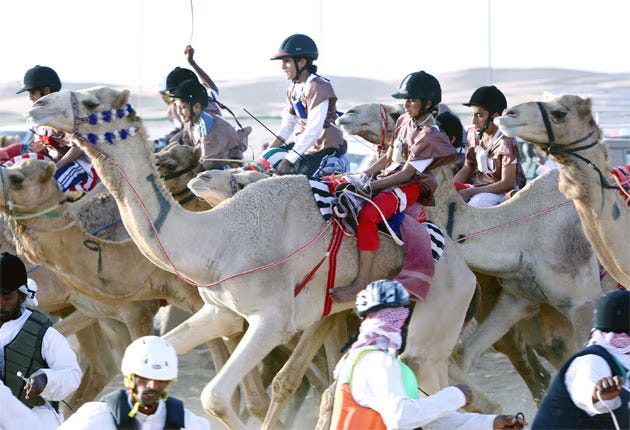
Save the Children Sweden’s 2005 participatory research study documented that 15,000 children were trafficked from Rahim Yar Khan district to the UAE and Gulf states for camel racing over three decades. The practice originated in the mid-1970s when Arab sheikhs visiting for hunting began recruiting local children from the Cholistan desert, according to the organization’s findings published in collaboration with PRWSWO.
The 2004 research examined 46 repatriated child jockeys who had been trafficked at an average age of five years. The youngest was three years old. These children lived 24 hours a day at camel farms, known as azbas, in desert conditions without proper caregivers. Children were deliberately underfed to maintain weights below 20 kilograms, enabling faster camel speeds in competitive races.
Physical and sexual abuse was systematic. “The camel owners would weigh us, if we ate too much, they would give us electrical shocks,” one survivor, Shameem, told Al Jazeera in 2009. He had been trafficked at age three. “I was so scared of them, I remember, if I would lose a race they would beat us.”
The trafficking networks operated through a hierarchy of agents and middlemen. UAE sheikhs paid agents between 300,000 to 400,000 rupees as compensation for each child, but agents pocketed most of this money. They then demanded additional travel expenses from parents, forcing poor families to take loans. Of the children’s monthly wages of 400 dirhams, agents stole half, leaving families with 200 to 250 dirhams that made little difference to their poverty.
Parents consistently reported having no knowledge of the true conditions their children would face until they returned home injured or too heavy to continue racing. The recruitment pattern exploited the same communities that Arab sheikhs encountered during their annual hunting expeditions in the Cholistan desert. The area’s climatic conditions, similar to the UAE, made it both a hunting destination and a source of camel jockeys.
Scale and International Response
By 2005, UNICEF reported approximately 3,000 children were working on UAE camel farms, with 2,800 of them under age 10. The UAE government that year introduced legislation prohibiting camel jockeys under age 18, with penalties including up to three years imprisonment and fines of nearly $14,000.
Under agreements between the governments of Pakistan, Bangladesh, Sudan, and the UAE, the Emirati government committed to repatriating child jockeys and paying $1,000 for each child into rehabilitation funds. By March 2006, UNICEF reported 1,075 children had been repatriated to their homes through the official program.
However, Anti-Slavery International’s Catherine Turner noted the figures were misleading. “Numbers need to be much higher to be confident that most children are being sent back and not simply hidden or re-trafficked across borders,” she said in 2006. With UAE authorities initially identifying 3,000 children working as jockeys, only one-third had been officially repatriated, leaving approximately 2,000 children unaccounted for according to Anti-Slavery International’s estimates.
Abdul Rub Farooqi, executive director of Jaag Welfare Movement and a former UNICEF child protection consultant, told Dawn’s Herald magazine in 2017 that more than 15,000 children had been taken from Rahim Yar Khan to the UAE.
Women and Girls Trafficking
The 2010 trend analysis by Save the Children Sweden and PRWSWO identified emerging trafficking patterns beyond child camel jockeys. Research stakeholders interviewed for the study reported that many young girls and women were being trafficked not only in the international market but also within the country.
Trafficked females, recruited under the pretense of domestic labor positions, ended up sold as sex workers in urban red-light areas. Law enforcement authorities acknowledged awareness of these practices during interviews but failed to take action despite expressing urgency about addressing the issue.
The report identified no official records or documentation of this trafficking, though all interviewed stakeholders confirmed its existence. This absence of documentation occurred despite law enforcement’s stated awareness of the problem.
Documented Allegations of Sexual Violence
A 2017 Herald magazine investigation documented allegations of sexual violence connected to UAE properties in the district. Letters submitted to Pakistan’s Chief Justice included claims that in the 1980s three young girls of Khanpur were taken to the palace by one of the supervisors on the pretext of showing them around the palace. All three were raped and the matter was hushed up, according to the published correspondence.
The letters also alleged that palace officials had blocked a canal in Rahim Yar Khan and diverted water to irrigate an Abu Dhabi-owned plantation called Salluwali farm.
Economic Context and Structural Vulnerability
Researchers from PRWSWO and Save the Children Sweden identified deep pockets of poverty created by exploitative practices of Arab tourists combined with feudalism as driving factors in the district’s trafficking networks. The feudal culture, Arab hunting expeditions, and seasonal tourism created conditions enabling multiple forms of trafficking.
Poverty, lack of economic opportunity, illiteracy, and unawareness about child rights were cited as primary reasons families became vulnerable to trafficking operations. Despite infrastructure development funded by Arab visitors including the Sheikh Zayed International Airport, roads, hospitals, and the Sheikh Zayed Medical Complex in Rahim Yar Khan, these benefits failed to prevent the exploitation of vulnerable populations.
The connection between hunting expeditions and trafficking was direct. Arab sheikhs visiting for houbara bustard hunting in the mid-1970s began recruiting children from the same desert communities they encountered during their hunts. The seasonal nature of hunting expeditions, combined with the UAE royal family’s establishment of permanent palaces and facilities in the district, created infrastructure that facilitated trafficking networks.
Continuing UAE Royal Presence
The infrastructure enabling UAE royal activities in Pakistan predates the hunting expeditions documented by conservationists. In the late 1960s, Agha Hasan Abedi, founder of the Bank of Credit and Commerce International (BCCI), cultivated a relationship with Sheikh Zayed that would transform both the UAE and his own banking empire. A 1992 U.S. Senate Foreign Relations Committee report on BCCI’s collapse noted that Abedi coordinated everything for Sheikh Zayed, “from the building of the Sheikh’s palaces in Pakistan, the furnishing of his villas in Morocco and Spain, his medical appointments, to the digging of wells for his homes in the desert.”
Senate investigators found that “when Sheikh Zayed would come for months in Pakistan, not even a policeman would give him any attention” before meeting Abedi. Yet two months after their introduction, Sheikh Zayed received a state visit to Islamabad and met with Pakistan’s president. The first UAE embassy was opened in Pakistan, and both the Pakistan and London embassies were staffed by Abedi’s appointments. BCCI officials told Senate investigators that Abedi effectively “created the UAE” through his relationship with Sheikh Zayed, suggesting the BCCI chief had conceived the idea of structuring the country as a federation of semi-autonomous monarchies.
The palaces Abedi built for Sheikh Zayed in Pakistan became central to the UAE royal family’s hunting expeditions. By the mid-1970s, these same desert areas where the palaces were located became recruitment grounds for child trafficking to UAE camel racing operations.
UAE royal family members continue to visit Rahim Yar Khan for hunting expeditions. As recently as December 2024, UAE President Sheikh Mohamed bin Zayed Al Nahyan visited the Sheikh Zayed Palace in Rahim Yar Khan where he met with Pakistani Prime Minister Shehbaz Sharif. Crown Prince Sheikh Hamdan bin Muhammad and Deputy Prime Minister Sheikh Mansoor bin Rashid also arrived in Cholistan for hunting in recent years. The hunting season for houbara bustard runs from November through January each year.
The federal government continues to issue special hunting permits to UAE President Sheikh Khalifa bin Zayed Al Nahyan and other royal family members, with permits allowing the hunting of up to 100 birds over 10-day periods. These hunting privileges are described by Pakistani officials as a “cornerstone” of Middle East foreign policy despite provincial governments in Sindh and Balochistan formally opposing the permits.
The UAE royal family maintains multiple properties across Rahim Yar Khan, Bahawalpur, and Multan districts, with palaces, guest houses, and plantations staffed year-round by hundreds of local employees who receive regular salaries even when the sheikhs do not visit for extended periods.
Institutional Failures and Impunity
The documented trafficking occurred despite Pakistan’s ratification of the Convention on the Rights of the Child and the country’s own Prevention and Control of Human Trafficking Ordinance. U.S. State Department Trafficking in Persons reports from 2009 through 2024 consistently noted Pakistan’s failure to adequately address labor trafficking and official complicity in trafficking operations.
The 2022 State Department report specifically cited that “for a third year, the government did not take adequate action against credible reports of official complicity in trafficking.” The 2009 report noted that Child Protection Bureaus had been established in Lahore, Rawalpindi, Rahim Yar Khan, Multan, and Faisalabad, yet trafficking from the district continued despite these institutional mechanisms.
Rahim Yar Khan’s district courts handled 393 rape cases between unspecified years according to 2019 Punjab data, with 370 cases decided and only eight convictions secured, representing a conviction rate of approximately 2 percent.
Sources
Ashghar, Syed Mehmood, Sabir Farhat and Shereen Niaz. “Camel Jockeys of Rahimyar Khan: Findings of a participatory research on the life and situation of child camel jockeys.” Save the Children Sweden, Pakistan Programme, 2005.
Pakistan Rural Workers Social Welfare Organization and Save the Children Sweden. “Child Trafficking: Trend Analysis Report on Camel Jockey in District Rahimyarkhan.” 2010.
UNICEF. “Starting Over: Children return home from camel racing.” 2006.
Anti-Slavery International. “Child Trafficking for Camel Jockeys.” May 2005.
“The great game: The politics of houbara hunting in Pakistan.” Dawn Herald, January 9, 2019.
“Child camel jockeys return home.” The New Humanitarian, January 5, 2006.
“’I was so scared … they beat us.’” Al Jazeera, May 22, 2009.
U.S. State Department. “Trafficking in Persons Report: Pakistan.” 2009, 2022, 2023, 2024.
“Arab royals hunt rare birds in Pakistan despite outcry.” Anadolu Agency, January 3, 2018.
“PM Shehbaz meets UAE president in Rahim Yar Khan.” Dawn, December 30, 2024.
“Dealing with child abuse.” Dawn, June 27, 2019.
U.S. Senate Committee on Foreign Relations. “The BCCI Affair: A Report to the Committee on Foreign Relations.” December 1992.
“’Praise Allah, There Are Still People Like You’: Jeffrey Epstein Nurtured Israel-Emirates Ties Before Abraham Accords.” Drop Site News, January 14, 2026.
“Meet the high-profile Emirati business leader lawmakers are linking to Epstein ‘torture’ email.” CNBC, February 12, 2026.
“Sultan Ahmed Bin Sulayem: Powerful Dubai tycoon replaced after DOJ reveals sexually explicit emails with Epstein.” CNN, February 13, 2026.
“Jeffrey Epstein and the Emirati tycoon.” Middle East Eye, February 12, 2026.
“’I loved the torture video’: Who is the DP World CEO named in Epstein files.” WION, February 2026.
“Dubai-based DP World replaces chief named in Epstein files.” Al Jazeera, February 13, 2026.
“Royal Sheikh Detained by UAE Over Torture Tape Allegations.” ABC News, May 8, 2009.


