
The Price of a Family
Bonded Labour in Pakistan
Nasir Masih was seven years old when his family stopped belonging to themselves.
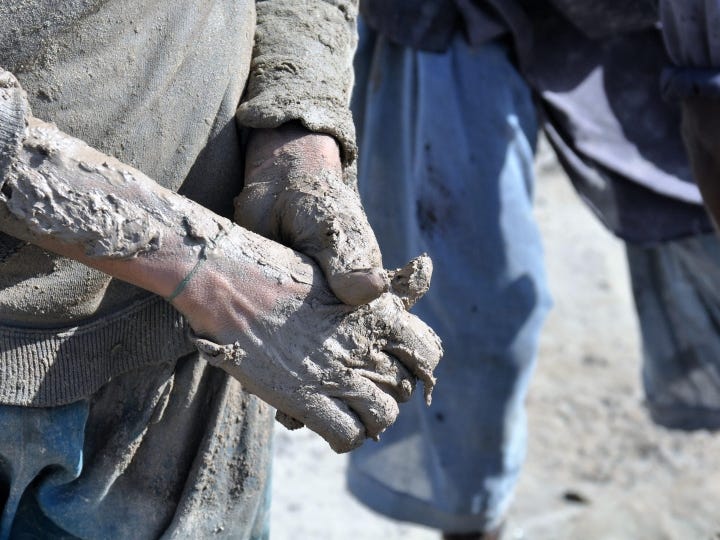
His father had borrowed money from a brick kiln owner in central Punjab, a small sum, enough to cover a medical emergency that would otherwise have gone untreated. The borrowing was ordinary. People with no savings and no access to formal credit borrow from those who have leverage over them. What followed was not ordinary at all. Nasir grew up at the kiln. He made bricks as a child, as a young man, through middle age. He lost a leg in a work accident and continued making bricks sitting down, shaping clay in the heat with his hands and whatever mobility remained to him, while his wife and sons carried the weight he could no longer lift. Forty-seven years passed. The debt was never settled. The accounts were kept by the owner.
When a foreign charity eventually paid what remained of the debt, roughly 1,480 US dollars, Nasir Masih was an old man with one leg, a wheelchair, and children who had never been to school. The organisation that secured his release also paid for the wheelchair and a small amount of capital to start a vegetable stall, bringing the total cost of freeing the family to approximately 2,230 dollars. In the videos that circulated after his release, he wept. He had been waiting, he said, for this his entire life.
The System That Built the Kiln
Pakistan has tens of thousands of brick kilns, most of them concentrated in Punjab and Sindh, where construction demand is constant and rural poverty is deep. The families who work them live on the premises, in rooms provided by the owner, and make bricks in exchange for wages applied toward debts they almost never manage to fully repay. The 2023 Global Slavery Index estimates that more than two million people in Pakistan were living in conditions of modern slavery as of 2021, placing the country among the highest-burden nations in Asia. A significant share of them are at brick kilns.
The mechanism is called peshgi. It is an advance: a loan extended by a kiln owner to a worker, secured not against property but against the worker’s own body and the bodies of everyone in their family. Families take peshgi when illness strikes, when a daughter needs a wedding, when the harvest fails and there is nothing left to eat. The advance is rarely documented in a way the worker can verify. The interest, the deductions for housing and fuel and tools, the penalties for missing production targets: all of these are calculated by the owner and entered into accounts that the worker is seldom shown.
Daily production quotas run to hundreds or thousands of bricks per family per day. Wages are paid per thousand bricks, at rates that human rights researchers consistently find below official minimums, which means that the income generated by a full day’s labour in extreme heat barely covers living costs, let alone reduces the principal. When a parent dies or can no longer work, the debt passes to their children. In this way, a single advance can outlast the person who took it by two or three generations, each successive generation absorbing an obligation they never chose and cannot extinguish.
This is not a marginal or hidden arrangement. The National Commission for Human Rights, in a 2025 study of kilns in Kasur and Faisalabad, found that 97 percent of surveyed workers had entered kiln employment specifically because of an urgent loan, that 90 percent had no written contract, and that most had been at their kilns for years without seeing their debt meaningfully decrease. The same study documented that verbal abuse was experienced by 92 percent of respondents, that physical beatings were common, and that women workers faced systematic sexual harassment with no effective mechanism for complaint or redress.
The Islamabad High Court, in a 2021 judgment on kilns around the capital, reviewed a commission report and concluded that holding workers through debt was a form of modern slavery, that such loans were illegal under Pakistani law, and that no worker could be compelled to remain at a kiln on the basis of an advance. The court ordered the administration to act. The kilns that judgment referenced are still operating.
What the Constitution Says
Article 11 of Pakistan’s Constitution is unambiguous. Slavery is “non-existent and forbidden.” All forms of forced labour are prohibited. These are not aspirational clauses or policy commitments. They are constitutional prohibitions with the full legal force that implies.
The Bonded Labour System (Abolition) Act, passed in 1992, goes further. It abolishes the bonded labour system, voids all existing bonded debts, criminalises the practice, and provides for district vigilance committees to identify bonded labourers and oversee their rehabilitation. Keeping a person in bonded labour carries a sentence of two to five years’ imprisonment and a fine. Provincial laws supplement the national framework, and Punjab’s 2016 Act specifically prohibits child labour at brick kilns, caps advances, and requires written contracts.
The gap between this legislation and what happens at a kiln in Kasur is not a gap of ambiguity. The law is not unclear. The district vigilance committees are non-functional. Labour inspections are rare and, when they occur, focused narrowly on child labour rather than on the broader architecture of debt bondage. Criminal prosecutions under the abolition act are nearly unknown. Researchers who have tracked these mechanisms consistently report the same finding: the institutional machinery for enforcement exists on paper and has no pulse.
The NCHR’s broader bonded labour study, published in 2023, attributed the persistence of kiln bondage directly to enforcement failure: inactive committees, inspectors without political backing, and kiln owners with enough local influence to make complaint a dangerous exercise for any worker who tried. The same owners who hold workers in debt also hold relationships with police, with local government, and in some cases with elected officials. A worker who files a complaint does not file it into a neutral institutional environment. They file it into one their employer already occupies.
Who Is Being Held
The workers at Pakistan’s brick kilns are not a random cross-section of the rural poor. They are disproportionately from communities that the rest of Pakistani society has consistently failed to protect: religious minorities, particularly Christians; low-status Muslim communities with little access to formal credit or legal redress; women who have no independent standing in contracts or wages; and children who have never known another life.
Christian families make up a substantial share of the kiln workforce in parts of Punjab. They come to the kilns through the same economic desperation as everyone else and face, once there, the additional weight of religious discrimination. Christian Solidarity International documented cases in which kiln owners offered to cancel outstanding debts if workers converted to Islam, and in which workers who refused found their debts continuing to grow. Families describe being prevented from attending church, subjected to derogatory treatment, and told that their faith was the reason their complaints would go nowhere.
Women at kilns participate fully in brick production, carrying clay, moulding bricks, and stacking loads in sustained physical labour over long days. None of this appears in contracts, because there are no contracts. Wages, where recorded, are registered under the male household head. Women workers who face sexual harassment from supervisors or owners have no labour inspector to go to, because female inspectors at kilns effectively do not exist. The NCHR’s 2025 Punjab study recommended the appointment of women inspectors specifically because their absence is not incidental; it is structural.
Children begin contributing to brick production as soon as they are strong enough to carry something. The Punjab Act of 2016 prohibits employment of children under 14 at kilns, and there are government schemes to provide stipends and access to schooling for kiln workers’ children. These schemes have enrolled children. They have not resolved the economic logic that keeps families inside the kiln system, where a child who goes to school is a child not contributing to the daily quota.
Researchers at Aga Khan University and Johns Hopkins University, applying rigorous survey methods to kiln workers in Sindh, found that between 16 and 34 percent of sampled workers met operational definitions of forced labour, depending on the indicators used. They also found that the 2022 floods had deepened vulnerability, destroying housing and livelihoods and pushing more families into debt arrangements with kiln owners who were among the few economic actors still extending credit in the aftermath. In a country where public emergency relief consistently fails to reach the most marginal communities first, the kiln owner’s advance fills the gap that welfare should occupy.
The Price of Each Family
In May 2026, a short video circulated widely. An American Christian activist named Aaron Hutchings stood at a brick kiln in Kasur district and described paying off the debt of a family that had been trapped there, in accounts that stretched back more than a hundred years across four generations. The amount paid was reported at roughly 4,000 US dollars. Hutchings described the intervention as the fifth carried out by a small initiative he runs called Project Jubilee, and he was photographed with the family as they left the compound. The claims rest on public statements circulated online rather than on a full independent investigation, but they are consistent with what rights groups and aid organisations have been documenting for years in Pakistan’s brick kiln sector.
The Kasur case is consistent in its mechanics with dozens of documented liberations across the same circuit of NGOs and faith-based organisations operating in Punjab’s kiln belt over recent years. Barnabas Aid reports freeing more than 1,500 Christian families from kiln bondage in Pakistan between 2017 and 2023. Global Christian Relief has stated a target of at least 100 family liberations in a single campaign year, with individual debt amounts in documented cases ranging from roughly 360 to 1,200 US dollars. Families Set Free estimates the average cost of freeing a five-person family and supporting them through two years of aftercare at approximately 2,000 dollars.
The case of Arshad and Shabana, documented by Christian Solidarity International, shows how the system produces these situations in its particulars. Arshad borrowed money from a kiln owner to pay for medical treatment for his wife and two daughters, both of whom had a debilitating muscle disease. The family spent 18 years working at the kiln without clearing the debt. When the owner offered to cancel what they owed in exchange for conversion to Islam, they refused. A donor-funded intervention eventually paid the debt, bought Arshad a rickshaw for income, and provided a wheelchair for his eldest daughter, Tania. The family moved off the kiln and, for the first time in nearly two decades, could attend church without the owner’s permission.
Mehboob Masih, a widowed father documented by Redeem the Oppressed, worked with his children at a kiln from before dawn to after dark for years after his wife died, with no realistic prospect of leaving because the debt remained. A donor campaign paid it off and his children started school. Javed Masih and his extended family were freed through a negotiation between the Pakistani organisation Human Friends and their kiln owner, with funding secured through the International Society for Human Rights. The organisation paid the agreed sum, moved the family to rented housing, provided start-up funds for factory work, and later freed a second family in Sheikhupura through the same channel.
These cases together describe not an exceptional history of cruelty but a specific labour regime operating as designed, in which poverty, physical isolation, opaque accounting, and the absence of any functional state protection produce the same result wherever they combine.
The Tension at the Centre
These liberations are real. The families are free. The children are in school. Nasir Masih has a wheelchair. Arshad has a rickshaw. Javed has a door that he can lock from the inside. None of this should be diminished.
But the Bonded Labour System (Abolition) Act of 1992 does not require a foreign donor to pay a kiln owner before a worker can go home. It does not establish a market price for freedom. It abolishes bonded labour, voids the debts, and criminalises the keeping of workers under these conditions. The act is clear: the debt is void. The worker can leave. The owner who prevents them is committing a criminal offence.
When organisations pay off debts to secure a family’s release, they are working around the law rather than through it. They are treating the advance as a legitimate obligation to be honoured, which is precisely what the abolition act says it is not. The kiln owner who accepts payment walks away with cash and faces no criminal consequence. Nothing in the transaction alters his ability to recruit the next family in the same way. Legal scholars and rights advocates who have studied this question consistently point out that debt redemption, however sincerely motivated, can end up subsidising a criminal system by confirming that debts are real, negotiable, and worth paying.
There is also the question of who gets rescued. Barnabas Aid and similar organisations focus, by their mandate, on Christian families. This reflects genuine solidarity and responds to real discrimination. It also means that the millions of Muslim workers in bonded labour at kilns, who face the same peshgi system and the same production quotas and the same non-functional vigilance committees, do not fit neatly into the fundraising narratives that drive the redemption model. The structural condition is shared. The rescue infrastructure is selective.
Sustainability matters as well. Organisations that combine debt payment with housing, livelihood support, and access to education are working against the risk that families, once freed, face such severe economic precarity that they re-enter exploitative work. But data on outcomes beyond the initial one to two years of aftercare barely exist. A family freed in 2021 has largely left the documentary record by 2024. Whether they remained free, whether their children stayed in school, whether the breadwinner’s new livelihood held: none of this is systematically tracked.
What Enforcement Would Actually Require
The Islamabad High Court’s 2021 order named the problem correctly and changed almost nothing outside its immediate jurisdiction. The reason is not legal ambiguity. Enforcement of bonded labour law requires district vigilance committees with active membership, labour inspectors with authority and physical access to remote kilns, police willing to file cases against owners with local political connections, prosecutors with the expertise to bring them, and courts able to move at a pace that does not render the proceedings pointless.
None of these things is in place at scale. The NCHR’s recommendations from its 2023 and 2025 studies are specific: make the vigilance committees functional with civil society representation and public reporting requirements; expand labour inspection to cover the full range of bonded labour indicators, not only child employment; integrate anti-bondage conditions into government procurement contracts for construction and infrastructure; extend social security and health coverage to kiln workers; and create genuine credit alternatives so that families facing medical emergencies do not have only the kiln owner’s advance available to them.
That last point matters as much as the enforcement apparatus. Families fall into kiln bondage because they need cash and have no safe place to borrow it. Health crises are a recurrent trigger. So are food insecurity, housing collapse, and social obligations such as weddings. Abolition cannot succeed through criminal law alone. It requires social protection, emergency medical support, and accessible credit that reduces the coercive attraction of owner advances. Without those measures, the system will continue to recruit the poor through necessity faster than courts and charities can extract them one family at a time.
The Punjab Act of 2016 created a legal basis for regulating advances and contracts at kilns, and the education and stipend schemes attached to it have moved children into school. These are not nothing. But they operate within a political economy that has not changed: kiln owners with capital and influence, workers with neither, and a state apparatus that was not built to adjudicate between them in the workers’ favour. A small debt enters a household at a moment of vulnerability. The debt becomes labour. Labour becomes inheritance. Inheritance becomes a closed world in which the law exists in principle but not in practice. Then, occasionally, someone pays the price of freedom and a family walks out. The act is humane. It is also an indictment. In a country whose Constitution forbids slavery and whose statutes abolish bonded labour, no family should need a donor to purchase what the law already guarantees.
References
Walk Free, Global Slavery Index 2023, Pakistan snapshot and global report.
United States Department of Labor, List of Goods Produced by Child Labor or Forced Labor, Pakistan bricks entry.
Al Jazeera Interactive, “Bonded labour: Spiraling debt trapping Pakistan’s brick kiln workers.”
Pakistan Code and ILO NATLEX, Bonded Labour System (Abolition) Act, 1992.
WageIndicator, “Forced Labour, Slavery — Pakistan.”
National Commission for Human Rights, The Issue of Bonded Labour in Pakistan (2023).
National Commission for Human Rights, Bonded Labour in Punjab’s Brick Kilns: Kasur and Faisalabad Study (2025).
The News, “NCHR report exposes abuse, exploitation in Punjab’s brick kilns.”
Human Rights Research Center summary of the NCHR Punjab kiln study.
Human Trafficking Search and related CenHTRO materials on forced labour in Pakistan’s brick kilns.
Christian Solidarity International, “Pakistan — Christian brick kiln workers victims of religious discrimination.”
International Society for Human Rights, “Pakistan: Gratitude for liberation” and “Ending debt bondage with the help of ISHR.”
Redeem the Oppressed, “Nasir’s Family Freed from Generations of Slavery.”
Barnabas Aid materials on freeing Pakistani Christian families from brick kilns.
Global Christian Relief, reporting on bonded labour rescues in Pakistan.
Aga Khan University and Johns Hopkins University, Estimating Prevalence of Forced Labor in the Brick Kiln Industry, Sindh.
Allegra Laboratory, “Bonded Labour in Pakistan.”
RSIL Pakistan, “Bonded Labour: What Is the Way Forward?”
Islamabad High Court judgment on bonded labour in kilns surrounding the capital (2021).
Publicly circulated posts and video statements concerning Project Jubilee and the reported Kasur family liberation case.


