
The Nursery at the Edge of Karachi
Almas Kasmani grew up in Rehri Goth, a fishing village the city is slowly consuming. She is planting it back, one propagule at a time.
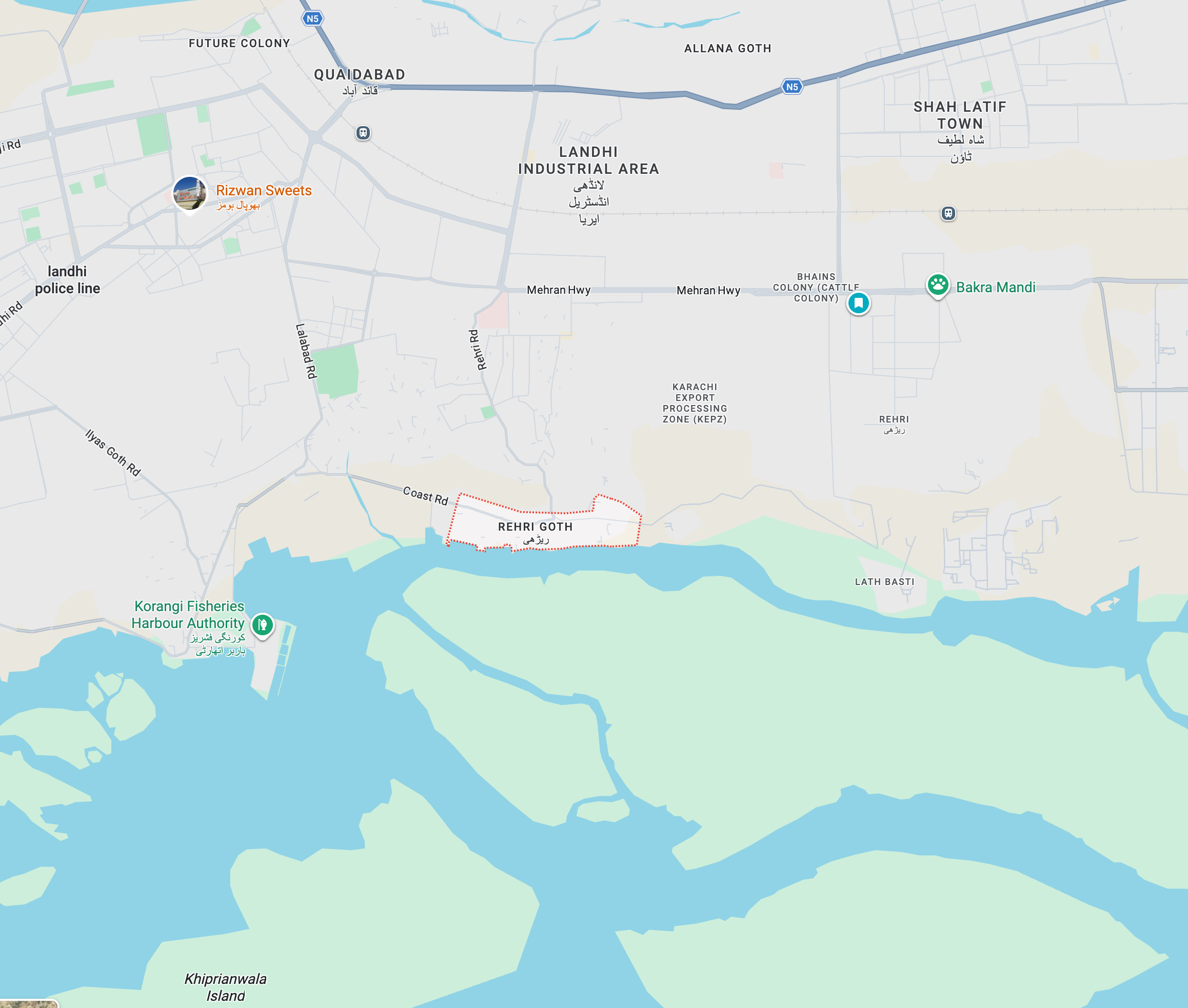
Rehri Goth sits where Karachi finally runs out of road and cement and gives way to mud, tidal creeks, and the smell of fish left too long in the sun. It is one of Pakistan’s oldest fishing settlements, a village that has been sending wooden boats into the Arabian Sea for centuries, now swallowed administratively into the metropolis but still visibly on its edge. Around seventy thousand people live here in a dense strip between the eastern reach of Korangi Creek and the channel to Port Muhammad Bin Qasim, in a settlement that the Karachi Port Trust still legally owns while rarely visiting except on inspection days and ceremonial drives.
The men of Rehri leave before dawn in narrow boats with patched engines and nets that have grown thinner each season, the result of repairs stretched over years in which the catch has not kept pace with the price of nylon. The women gut, clean, and dry whatever comes back on racks of bamboo and rope that line the lanes leading down to the jetty, their hands stained by fish scales and diesel, their work feeding both the family and the middlemen who dominate the Karachi fish markets. Children run on the packed mud along the water’s edge with the unsteady confidence of people who grew up knowing exactly how far the tide will reach and which slick patches to avoid when the sewage pipe discharges at low water.
For most of Rehri’s remembered history, the village sat behind a wall of mangroves that stood between the houses and the open sea. Almas Kasmani grew up among those trees, in a village where it was still possible to stand on the jetty at dawn and see a continuous dark line of mangrove canopy along the horizon, broken only by tidal channels and the masts of fishing boats.
The coast that stopped counting its trees
Karachi’s coastline is part of the Indus Delta, a tangle of creeks and islands that once supported one of the largest expanses of arid-climate mangroves in the world, spread across hundreds of thousands of hectares of tidal wetlands in Sindh. These forests blunt cyclones, slow storm surges, hold the coast in place, and quietly store carbon in amounts that make them some of the most powerful natural climate tools available, acre for acre holding up to four times as much carbon as many terrestrial forests. Their roots create nurseries for juvenile fish, shrimp, and crabs, which spend the most vulnerable part of their lives hiding in the dense mesh of stems and pneumatophores before moving into deeper water.
In July 2024, WWF-Pakistan published a report using satellite imagery and Sindh Forest Department data to document what Karachi has done to this system over the past decade. The numbers were plain. Around two hundred hectares of mangrove forest along Karachi’s coastline disappeared between 2010 and 2022, cleared and filled for housing schemes, industrial expansion, and other development that could only move into the tidal zone because the tidal zone had no powerful constituency to defend it. Images in the report showed mangrove blocks that appeared as dense green patches in 2000 converted almost completely to gridded residential plots by 2024, the trees replaced by paved streets and concrete structures that now occupy land where the tide once stood twice a day.
Once a mangrove stand is cut, it does not return on its own if the land has been reclaimed. The trees need brackish water, a particular range of salinity, the slow accumulation of sediment, and the repeated rhythm of flooding and retreat to establish and regenerate. When a developer pours earth into that intertidal zone to create “solid” land, the damage is not just degradation of habitat. The tidal space itself disappears.
The same report that counted Karachi’s losses also recorded what provincial forestry projects have been doing further east along the Indus Delta, where planting campaigns, often in partnership with conservation groups, have established mangroves on tens of thousands of hectares. Mangrove cover across Pakistan increased between 2016 and 2020 according to REDD+ inventories, yet Karachi’s own coastline moved in the opposite direction, a local erasure within a national success story.
Rehri Goth stands in that contradiction. The village has direct access to islands and mudflats that still carry mangrove stands, yet it sits inside a city that has treated the fringe wetlands as empty plots waiting for investors.
Wastewater, vanished fish, and women in factories
The water that reaches Rehri now is not the water that raised the mangrove forests of Almas’s childhood. For decades, Karachi has been releasing the bulk of its sewage and industrial effluent untreated into the Arabian Sea through drains that empty along the same coastal belt where fishing villages stand. Government figures given to the National Assembly in 2010 acknowledged that roughly ninety percent of the city’s sewage was entering the sea without treatment, a situation later described by marine experts as effectively unchanged more than a decade on. Karachi has no functional wastewater treatment system for a city approaching twenty million people.
Along a ten kilometre stretch of coast that includes Rehri Goth, Ibrahim Hyderi, the Korangi fish harbour, and Landhi, residents describe the same damage in the same order. Tidal creeks where shrimp, small fish, and shellfish were once abundant have become dark, foul-smelling channels where few visible signs of marine life remain, and fishers say they now need to travel much farther into deeper water before their nets fill at all. One marine scientist speaking to regional media noted that lamp shells, a small shellfish that had survived along this coast for millions of years, vanished from these polluted stretches within the last two decades, along with several species of sponges, sea anemones, corals, and jellyfish.
For Rehri’s families, the science arrives as absence. Nets that once met the boat with weight now come up light, and hours at sea translate into fewer baskets on the auction floor. Men who could once support extended families on fishing alone now talk about days when the diesel for the trip costs more than the fish they bring back. Women who grew up cleaning fish at home have taken jobs in garment factories in Korangi and Landhi, stitching export clothes in industrial sheds that sit only a few kilometres inland from the filth flowing toward their village.
Rehri’s shoreline also turned into its own hazard. Local reporting and interviews describe animal carcasses, plastic, and sludge accumulating along the edge of the village, a stench that mixes with the heat and makes long afternoons unbearable. Untreated waste from Landhi and Korangi industrial areas enters the sea near Rehri, and residents talk about skin diseases, respiratory problems, and stomach illnesses that now travel through families the way stories used to travel through communal gatherings at the jetty.
What Almas knows
Almas Kasmani is twenty-three years old, the daughter of a Rehri fisherman, and she has been running Saltwater Marina for two years from a courtyard in the village where she was born. She did not come to the mangroves from a university programme or an NGO grant cycle. She came from families who knew the names of the creeks by what used to live in them, and from a specific memory of what abundance once looked like at the tide line.
Speaking to the French environmental magazine Socialter earlier this year, she described what the pollution had taken in childhood terms. When she was small, the small fish were so abundant in the shallow creeks around Rehri that children would trail their dupattas through the water and pull them back full. Now, she said, the fishermen have to go far out to find anything at all, and neither the mangroves nor the fish survive in the waters close to the village.
That is not a scientist’s assessment of habitat degradation. It is what you see when you grow up on a coast and watch it change across your own childhood, and it is the kind of knowledge that no satellite report has ever been able to map onto a graph.
She told Socialter that what she was doing was not restoration as an abstraction. “This is the very survival of our community,” she said, while unloading seedlings onto an eroding island with her team.
The boat she takes from Rehri in the early mornings passes the factory chimneys and export platforms of the industrial belt on one side and the remaining mangrove stands on the other. Both are part of the same city. One side generates the economic activity that Islamabad calls growth. The other is what that growth has been consuming since the 1970s, hectare by hectare, creek by creek, without any official count of what it has cost the people who live where the city meets the sea.
A nursery in a fishing lane
Saltwater Marina began as a line of plastic containers in a courtyard in Rehri. The starting material is the propagule: a long, pencil-like seed pod that falls from a mature mangrove tree into the water and drifts until it finds a surface soft enough to root in. Almas collects them along the tidal fringes, brings them back to her yard, and stands them upright in containers filled with brackish water and sediment dredged from the creek.
Each propagule needs the right depth, the right mixture of silt and sand, and the right timing with the tides so that when it is eventually transplanted it will not drown or dry out before it can anchor. Plant one too deep and the oxygen-starved seedling rots in place. Plant it too high above the tidal reach and the roots desiccate before they can grip the mud. None of this is written on a laminated instruction board in her courtyard. It lives in the knowledge her community accumulated across generations, in the reading of tide marks on stone and concrete the way others learn to read exam papers, a literacy that no corporate environmental project has ever been able to map.
In Rehri, she runs workshops where residents learn to distinguish between mangrove species, to understand how root systems trap sediment and shelter juvenile fish, and to see the trees as infrastructure rather than background. Youth-led plantation days bring children into the tidal zone as planters, not observers, pushing seedlings into the substrate with mud streaked up to their knees. The organisation also documents biodiversity along segments of Karachi’s coast, recording which birds, fish, and invertebrates appear at which sites and in what numbers, building a baseline that lets them measure loss against any future recovery.
The city’s wastewater kept flowing. The filled plots stayed filled. What changed was the calculation.
Counting carbon, counting credits
Along the wider Indus Delta, far from Rehri’s cramped lanes, the Sindh government and private partners began a project in 2015 that would later be promoted as the world’s largest blue carbon initiative. The Delta Blue Carbon project covers about 350,000 hectares of tidal wetlands on the south-east coast of Sindh, including mangrove forests, intertidal mudflats, and low-lying islands where the river meets the sea. Over a planned sixty year life, the project is expected to remove around 142 million tonnes of carbon dioxide equivalent from the atmosphere by protecting existing mangroves and planting new ones, generating well over a hundred million carbon credits for sale on international markets.
The ecological case behind these numbers is solid. Mangroves are exceptional carbon sinks. Their dense wood and extensive root systems store carbon not just in trunks and branches but in deep, waterlogged soils that can hold deposits for centuries if left undisturbed. Studies cited by the project’s partners note that mangrove ecosystems can store several times more carbon per hectare than many tropical rainforests. Delta Blue Carbon turns this ecological fact into financial architecture: for every tonne of carbon sequestered and verified, a credit can be issued and sold, with revenues supposed to flow back to provincial authorities and coastal communities in the project area.
Rehri Goth sits just outside the main Delta Blue Carbon project boundaries. Close enough to feel the storms that the wider mangrove belt softens. Close enough for its residents to understand that the trees they are planting in their courtyard containers exist inside a global market that values a tonne of carbon more reliably than it values a fishing family’s right to a functioning coast. Almas’s work does not compete with that scale and does not claim to. It insists that the strip of coastline nearest Karachi’s eastern port must also stay in the ledger of living mangroves, not as a forgotten fringe outside someone else’s project boundary, but as part of the same ecological system whose carbon value the market has finally learned to price.
Climate refugees at the jetty
The people arriving in Rehri from the other end of Sindh’s coast bring a different accounting of the same loss. In the town of Keti Bandar, about 145 kilometres away, fishing families have watched rising sea levels, coastal erosion, and storm surges chew through land that once held their homes. Cyclones and floods have struck this coastline repeatedly over the past few decades, and many residents eventually reached the point where rebuilding on the same eroding ground no longer made sense.
More than 150 families from Keti Bandar and nearby coastal villages in Thatta, Badin, and Sujawal moved to Rehri Goth in just a few years, driven out by climate-induced coastal flooding and declining fish stocks in their home waters. Among them was Abdul Latif Abbasi, a man in his fifties whose family had fished near Keti Bandar for generations. When seawater finally submerged his ancestral house, he rented a small place in Rehri, bringing his skills and his exhaustion to a new shoreline where the fish were fewer and the expenses higher.
Nine months after his move, Latif told a reporter that he had hardly gone fishing in the 270 days since arriving in Rehri, not because he did not know the sea, but because the economics no longer worked. The catch near Karachi’s polluted coast was poor compared to what he remembered, trawlers and environmental change had already thinned the stocks, and the rent and electricity bills in his new life turned every trip into a risk. His neighbour, a younger fisherman who had also migrated from Keti Bandar, described suffering a stroke while struggling to earn enough from these waters, while his wife went to work at a garment factory in Korangi for a wage that barely kept the family ahead of their landlord.
Their children share streets and schools with the children of Rehri, breathing the same polluted air and growing up on a coastline that has already displaced them once.
Climate migration statistics arrive in policy reports as projections into mid-century. In Rehri Goth, they arrive as families knocking on doors, paying deposits to landlords, setting up stoves in single rooms, and walking down to a jetty that no longer guarantees a living. What brought them to Rehri is also what Almas Kasmani is trying to reverse: the destruction of the mangrove systems that once held those coasts in place, that sheltered the fish, and that slowed the storm surges enough that a family could stay.
A recent study projected that Karachi will receive 2.3 million climate migrants by 2050, primarily because of saltwater intrusion and rising sea levels. The people already at the jetty in Rehri are the early count.
An ambassador from the tide line
On April 15, 2026, the Karachi Port Trust announced that it was naming Almas Kasmani as its Ambassador for Coastal Mangrove Restoration, a title that wrapped her two years of unpaid local labour in the language of institutional endorsement. The federal minister for maritime affairs described her as an inspiring environmental champion from Rehri Goth and praised Saltwater Marina’s work in community workshops, biodiversity documentation, youth-led plantation drives, and eco-tourism along the coast. Shields and certificates were handed out in Islamabad. Photos circulated on official social media showing Almas in formal clothes under bright lighting, a sharp contrast to the mud and humidity of the creeks where the actual planting takes place.
Official statements noted that she had already restored around 4,000 mangrove plants at the time of the ceremony and had set a near-term target of 100,000 more in the coming year, with suitable coastal sites identified and a nursery already running at her home. By May 2026, reporting from international media placed the figure already above 6,000 trees, with a longer-term ambition, stated by Almas herself, of ten million.
The person who signs a mangrove restoration initiative into a press release and the person who signs a coastal reclamation scheme into a development approval often work in the same ministry. That gap sits at the centre of what the ambassadorship actually means. KPT controls significant stretches of Karachi’s eastern waterfront, and any community group that wants to plant or protect mangroves on those parcels must navigate permissions and security checkpoints designed for a port authority, not a conservation organisation. Having a named relationship with the authority that owns the land where Rehri itself stands changes the terms, at least on paper. It gives Saltwater Marina a badge to show at gates that previously closed on sight when fishermen arrived asking questions about development plans and access to tidal land.
Whether that warmth at the podium reaches the mudflats remains open. Pakistan’s coastal communities have seen high-profile plantation drives on Earth Day before, complete with television footage and handouts, followed by months in which no official appears to check whether the seedlings survived the first monsoon. Almas began planting long before any chair was reserved for her name at a ceremony. She knows how quickly the attention can recede with the tide.
Six thousand trees, and an open question
In late April 2026, on Earth Day, Saltwater Marina opened one of its community planting drives to anyone willing to travel to Rehri and walk into the mud. The invitation was simple: everyone welcome, no age limit, expect to get dirty.
On the tidal flat east of the village, children and adults stood in shallow water, clothes streaked brown, pressing propagules into the soft substrate at the water’s edge while older fishers watched and corrected the angle of a seedling here, the spacing there. Between them moved the specific knowledge Almas had been preserving in her courtyard: when to push the propagule deeper, which patches of substrate would hold and which would shift with the next tide. It was not written down anywhere the government had ever filed. It was alive because the people of Rehri were alive and had not yet stopped passing it on.
More than six thousand young mangrove trees now stand along the creeks east of Karachi that would not exist without the nursery in her courtyard. Their roots are already trapping sediment that would otherwise wash away. Their small canopies are beginning to shelter juvenile fish and crabs. Their presence is establishing seed sources that can help nearby mudflats regenerate on their own. The target Almas talks about now is not the 100,000 that appeared in the KPT press release, though that is the near-term work. The number she gives to interviewers is ten million, enough to restore the mangrove systems of the Indus Delta to something resembling what they were before the city decided the tidal zone was land waiting to be sold.
When the next storm drives water into the Indus Delta and pushes a surge toward Karachi’s eastern edge, whose ledger will matter more: the one that records carbon credits and real estate yields, or the one that counts the mangrove roots holding the mud in place beneath the feet of Rehri’s children.


