
The Mirage of Recovery: How Pakistan’s “Wonderful Indicators” Conceal a Collapsing Economy
Industry is shutting down, capital is fleeing, and millions face hunger. Pakistan is suffocating in borrowed time.
Pakistan’s leaders declare the country “out of economic woes” while standing on borrowed ground. The central bank reserves that ministers trumpet are heavily padded with Gulf deposits that Pakistan cannot afford to repay. Saudi Arabia alone has three billion dollars parked with the State Bank, rolled over again in late 2024 because there is simply no way for Islamabad to pay it back. The UAE has done the same with its deposits. These are not reserves in any normal sense. They are short‑term political props that can be withdrawn if relations sour or if Riyadh and Abu Dhabi decide they need the cash for something else. Strip those out, and Pakistan’s actual earned reserves, the kind built from exports and investment, look far weaker.
The IMF programme, now in its umpteenth iteration, is not a sign of recovery. It is a sign that Pakistan cannot function without external life support. The latest Extended Fund Facility, approved after tense negotiations, comes with conditions that stretch far beyond budget deficits and inflation targets. The Fund is now demanding governance reforms, asset declarations from senior officials, stronger anti‑corruption institutions and changes to the way banks and markets are regulated. These demands appear in the IMF’s own governance and corruption diagnostic report, a document produced at Pakistan’s request but unflinching in its findings. The report describes a system riddled with “persistent and widespread corruption risks,” with rules that are complex, overlapping and often bent to favour politically connected firms. It points to weak financial sector oversight, inconsistent enforcement and institutions that lack real independence. When your main lender is effectively telling you that elite capture and governance failure are sabotaging your economy, you are not in recovery. You are in critical condition with a grim prognosis.
The same story shows up in the banking sector. Rather than channeling savings into factories, startups and farms, Pakistan’s banks prefer the safe bet: government securities. Huge chunks of their balance sheets are tied up financing deficits while the real economy gasps for credit. For industrialists, farmers and entrepreneurs, loans are either unavailable, unaffordable or reserved for the well connected. Banks can earn comfortable returns by lending to a state backed by the IMF and Gulf deposits, so why bother with the risks of a textile mill facing impossible energy costs or a construction firm trying to survive a demand slump. This is not a quirk of one or two institutions. It is how the system is set up. The result is a financial sector that hoards liquidity, fuels fiscal deficits and starves the productive economy. The World Bank’s latest Pakistan Development Update and poverty assessments make clear that without credit flowing to the real sectors that create jobs, growth will remain anemic and poverty reduction will stall or reverse. Yet month after month, the pattern persists.
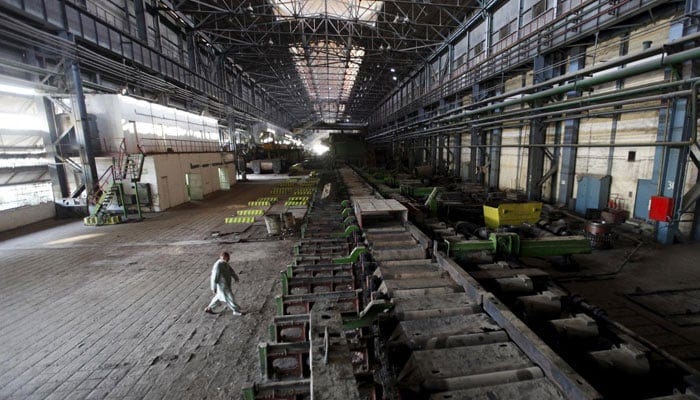
Textiles, which have long been the backbone of Pakistan’s exports and a major source of industrial employment, are in collapse. Industry associations and independent reporting from business dailies document hundreds of mills shutting down or operating at skeleton levels, especially across Punjab. Energy costs are the killer. Electricity and gas tariffs have been raised sharply as part of IMF‑backed reforms aimed at reducing circular debt and ensuring cost recovery in the power sector. On paper, those reforms make fiscal sense. In practice, they have made production uncompetitive. A spinning mill or weaving unit that once could operate profitably now finds that power alone eats a crippling share of costs. Orders are lost to Bangladesh, India, Vietnam. Workers are laid off. Small suppliers and service providers who depend on those mills lose business too. When you walk through industrial zones in Faisalabad or Multan, you see shuttered gates, dust on machinery and men sitting idle on street corners, waiting for jobs that are not coming back.
This is not just about textiles. Cement, steel, chemicals, food processing and other energy‑intensive sectors face similar pressures. The country has plenty of installed generation capacity, much of it built with expensive contracts and guaranteed returns, but cannot afford to run it at full tilt because end users cannot pay the resulting tariffs. The outcome is perverse: idle factories and persistent circular debt in the power sector at the same time. The World Bank has flagged these contradictions repeatedly, noting that without broader energy sector reform that goes beyond tariff hikes and tackles inefficiency, theft and contractual problems, Pakistan will keep losing industrial capacity. Yet every time the IMF review comes around, the focus returns to cost recovery through higher tariffs, which translates into more closures.
Meanwhile, capital and people are leaving. Investigations into property markets in Dubai, London and other hubs reveal extensive Pakistani investment in foreign real estate. Some of this is legal diversification. Much of it is flight from an economy and a political system that wealthy Pakistanis no longer trust to protect their wealth or deliver decent returns. The National Accountability Bureau and other state agencies have openly warned about capital flight and about the need to bring back funds parked abroad. Those warnings come late and achieve little. The money has already gone because its owners concluded that keeping it in Pakistan was too risky. At the same time, professionals, skilled workers and young graduates are emigrating in droves. Doctors, engineers, IT specialists, academics and even mid‑level managers are seeking opportunities abroad, from the Gulf to North America and Europe. Some send remittances back, which helps the balance of payments in the short run. But the long‑run cost is the loss of the very people Pakistan needs to innovate, build institutions and drive change.
The labour market is a disaster that official unemployment figures barely capture. Headline unemployment sits around seven or eight percent, which sounds manageable. But youth unemployment is far higher. Budget documents from mid‑2024 and labour force surveys reveal that nearly one third of young people between the ages of fifteen and thirty‑five are out of work. Millions more are stuck in unpaid family labour, low productivity informal jobs or are simply discouraged and have stopped looking. Women’s labour force participation remains among the lowest in the region, meaning half the population is largely excluded from formal economic activity. When you add underemployment and discouraged workers to the narrow definition of unemployment, you start to approach the real scale of the crisis. Large swathes of Pakistan’s young population are either idle or trapped in work that offers no security, no advancement and no dignity. That is not a country on the mend. It is a society sitting on a powder keg.
Poverty and hunger are widespread and worsening in many areas. World Bank assessments and national surveys put roughly one quarter of the population below the national poverty line, with many millions more hovering just above it and vulnerable to being pushed down by a flood, a drought, a medical emergency or a job loss. Food security analyses show that around eleven million Pakistanis are classified as being in acute food insecurity, meaning they struggle to secure enough nutritious food on a regular basis. These are not abstract statistics. They describe families skipping meals, children going to bed hungry, parents selling livestock or tools or jewellery to buy flour and cooking oil. Malnutrition rates, especially stunting among children, remain stubbornly high, with consequences that will echo for decades in health, education and productivity.
Climate shocks are making all of this worse. The 2022 floods, which submerged large parts of Sindh, Balochistan and Khyber Pakhtunkhwa and affected an estimated thirty‑three million people, caused tens of billions of dollars in damage. Homes, schools, health centres, roads, canals and crops were destroyed. Months after the water receded, families were still living in tents or makeshift shelters. Children missed school. Livestock died or fell ill. Diseases spread. The state launched relief and reconstruction efforts, but resources are stretched thin and each new climate event forces the diversion of funds that should have gone to development. Flooding in 2023, 2024 and again in 2025 has hit rural communities repeatedly, turning what should be temporary shocks into semi‑permanent features of life. Scientific assessments warn that Pakistan faces a future of more frequent and intense heatwaves, heavier and more erratic rainfall, glacial melt in the north and sea level rise along the coast. Agriculture, which still employs a large share of the population, sits directly in the path of these changes. The World Bank’s climate and health vulnerability assessments project average temperatures rising by more than one degree Celsius in the 2030s and nearly two degrees by mid‑century, with sharp increases in extreme weather. For farmers, this means more unpredictable yields, more crop failures, more debt. For the state, it means recurring fiscal shocks and a cycle of emergency spending that crowds out everything else.
Even the IMF, not known for alarmism or moralising, has started to speak more plainly. Its governance diagnostic, released in late 2024, describes a heavily state‑dominated economy operating within complex and often contradictory regulatory frameworks. It points to weak institutional capacity, inconsistent rule enforcement and a pattern in which large, politically connected firms secure favourable treatment while small and medium enterprises face the full weight of bureaucracy and arbitrary power. The report notes that corruption related money laundering enforcement remains weak despite Pakistan’s formal removal from the FATF grey list. It calls for public asset declarations by senior civil servants, stronger and more independent anti‑corruption bodies and deeper reforms in tax administration, procurement and financial regulation. The language is diplomatic, but the message is not. Pakistan’s system is rigged. A small, connected elite extracts rents, blocks change and leaves the rest of society to carry the burden. That rigging is not a side effect of the crisis. It is a core cause of it.
The World Bank’s development updates echo the same themes. Growth projections for the next few years sit around two to three percent, barely above population growth and far below what is needed to absorb the labour force, reduce poverty or build resilience. The Bank’s poverty and resilience assessments note that progress made in the early 2000s has stalled or reversed, that vulnerable groups are being hit hardest and that without deeper, people‑centred reforms, stabilisation will not translate into shared prosperity. It highlights weak labour‑intensive sectors, low employment‑to‑population ratios and the concentration of growth in a narrow band of services and real estate rather than in productive industry and agriculture. The tone of these reports is measured, but the underlying picture is clear: Pakistan is stabilised in a low‑growth, high‑vulnerability trap. The fact that a default has been avoided and inflation has eased does not change that.
Local journalism and analysis have been just as blunt, sometimes more so. Reports in outlets such as Dawn, The Friday Times, and Profit Pakistan Today document mill closures, capital flight, tax evasion by the wealthy, circular debt spirals and the failures of successive governments to implement meaningful reform. Investigative pieces on the “Dubai leaks” and on offshore property holdings by Pakistani elites have forced uncomfortable conversations about where the money is going and who is benefiting from the current system. Opinion columns and editorials speak of a “crisis of confidence,” a sense that the social contract is broken and that those with means are hedging their bets by moving wealth and families abroad. These are not fringe voices. They reflect a mainstream, increasingly bitter recognition that the official narrative of recovery does not match the lived experience of most people.
There is also the matter of what “stabilisation” actually costs. The measures that have brought inflation down and rebuilt reserves, at least on paper, have not been cost‑free. Subsidies have been cut or removed abruptly. Fuel levies have been raised. Utility tariffs have been adjusted upward to meet fiscal targets and IMF conditions. The result is that households and firms face higher costs for essentials even as incomes stagnate or fall. For a middle‑class family in Lahore or Karachi, an electricity bill that used to be manageable is now a source of anxiety. For a small workshop owner, the cost of running machinery has become prohibitive. For a farmer, the price of diesel and fertiliser has climbed while the price received for crops has not kept pace. These adjustments may look necessary from the perspective of a technocrat trying to close a deficit or satisfy a lender. From the perspective of the person paying the bill, they feel like punishment for a crisis they did not cause.
This is the landscape in which Pakistan’s leaders claim to have brought the country out of economic woes. It is a landscape of dependency, deindustrialisation, capital flight, unemployment, hunger and climate vulnerability. The macro indicators they point to, lower inflation, some reserve rebuilding, a slightly more stable currency, are real but narrowly defined. They do not capture the collapse of industry, the exodus of talent, the grinding poverty or the systemic corruption. They do not account for the fact that a large chunk of the reserves are borrowed and can be withdrawn. They do not explain why banks hoard cash rather than lend it, why factories close rather than expand, why young people queue for visas rather than job interviews.
To write honestly about Pakistan’s economy is to refuse the official script. It is to say clearly that the country is not in recovery but in managed crisis, kept afloat by external support and internal compression. It is to point out that the same policies that stabilise the balance sheet often destabilise the real economy. It is to insist that statistics about inflation and reserves matter less than the realities of closed factories, empty stomachs and flooded fields. It is to acknowledge that elite capture and corruption, now documented even by the IMF, are not side issues but central drivers of dysfunction. And it is to recognise that without fundamental change in how power and resources are distributed, Pakistan will remain trapped in a cycle of crisis, bailout, brief calm and relapse.
The government’s narrative asks people to ignore what they can see and feel. It asks textile workers who have lost their jobs to celebrate reserve figures inflated by Saudi deposits. It asks families struggling to buy food to take comfort in falling inflation rates that do not bring prices back down. It asks young graduates locked out of the labour market to believe that the economy is on the mend. That narrative is not just misleading. It is corrosive. It breeds cynicism, erodes trust and makes it harder to build the broad coalition needed for real reform.
A truthful account would start by admitting where the country actually stands. It would say that Pakistan has avoided immediate default by accepting deeper external control and harsher internal adjustments. It would acknowledge that growth is too weak, too narrow and too unequal to lift the majority. It would recognise that the industrial base is shrinking, that capital and talent are fleeing and that millions of people are in poverty and food insecurity. It would point to the climate shocks that are turning temporary disasters into recurring features of life. It would name the corruption and elite capture that distort markets, weaken institutions and concentrate benefits in a few hands. And it would insist that until these realities are faced squarely, talk of being out of economic woes is not just premature. It is a lie.
The task of journalism, and of any honest public conversation, is to tell that truth without flinching. Not to despair, but to clear the ground for something better. People already know they are struggling. What they need is not propaganda about wonderful indicators but a clear, evidence‑based explanation of why they are struggling and what would need to change for things to get better. They need to hear that their experience is not an anomaly or a personal failure but the predictable outcome of a system that is broken by design. They need to understand that stabilisation is not the same as recovery, that avoiding the worst is not the same as achieving the good, and that the only way forward is to stop pretending that survival is victory.


