


Pakistan’s army secures its power by serving foreign strategic interests and protecting an extraction economy in which the people supplying the land have the least authority over what happens to it.
Pakistan’s army has built its power around a bargain with foreign patrons: it supplies strategic services, and their demand for those services helps it remain beyond the reach of the people it governs. Minerals give that bargain a new commodity. Washington wants a supply chain China cannot control. GHQ wants investment, recognition and a kind of authority no election can remove. The frontier is expected to hand over the ore and accept the checkpoints. When its people ask what they get in return, they are treated as a security problem. Their objection threatens the army’s claim to be the institution that can deliver Pakistan to a customer.
The bargain took physical form on October 2 last year. That day US Strategic Metals announced its first delivery of Pakistani minerals: antimony, copper concentrate, and enriched rare-earth material carrying neodymium and praseodymium. It gave no price, no volume and no grade. The shipment was hailed as a national triumph. The announcement said enough to advertise the relationship and nothing that would tell a citizen whether the country had been paid fairly.
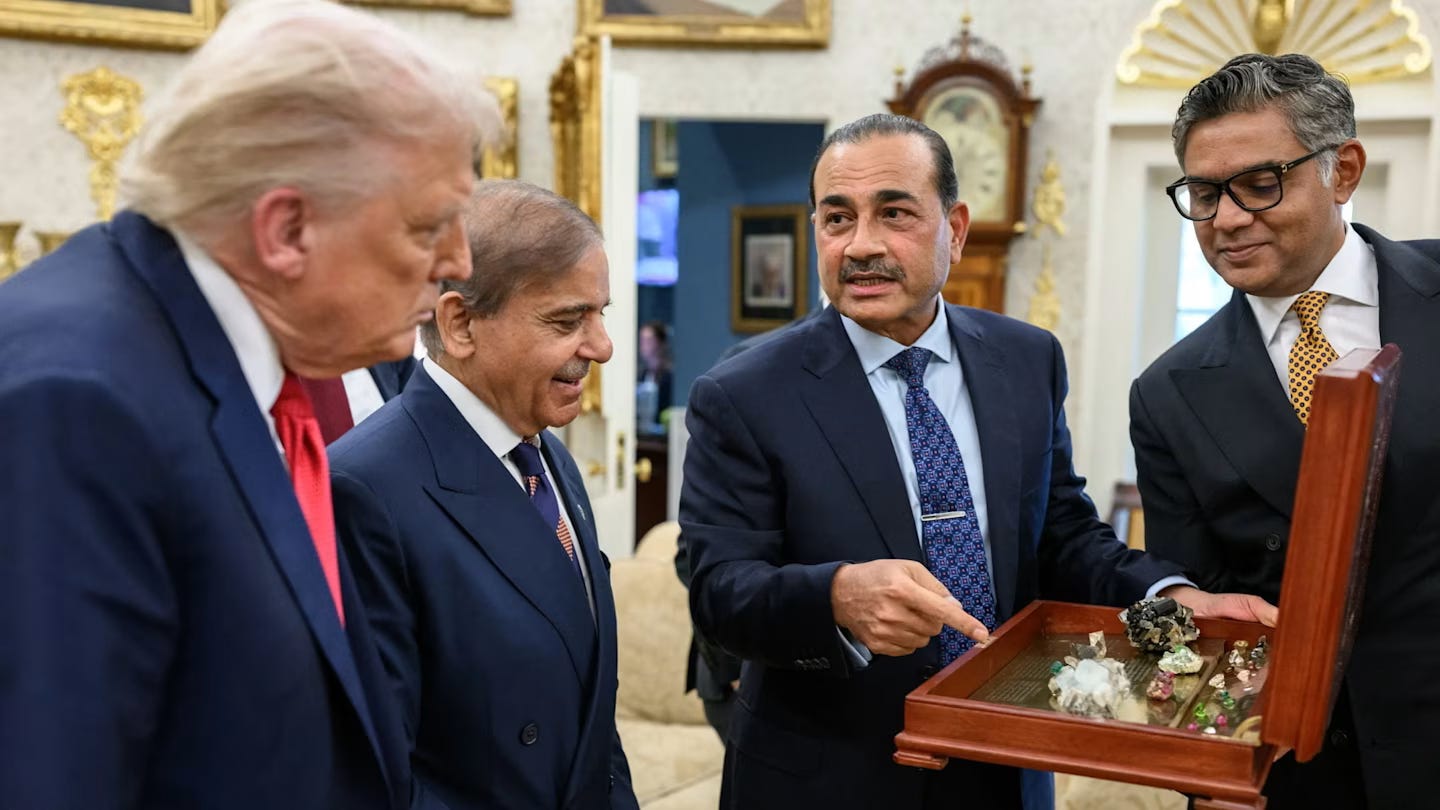
Three weeks earlier the company had signed a memorandum with the Frontier Works Organisation at the Prime Minister’s House. The government said the first phase was “envisaged” at roughly $500 million, followed by a refinery in Pakistan producing for the American market. It called FWO the country’s largest miner of critical minerals. FWO belongs to the army. An army enterprise was negotiating its way into America’s industrial supply chain. The photograph placed the civilian government beside the transaction, while the institution bringing the minerals to the table also held the country’s most powerful means of coercion.
That $500 million was announced as an intention in a memorandum. The announcement did not show how much had arrived, where it went or what strings came with it. The shipment proves that material moved. It proves nothing about provincial consent or compensation. This is how promotional announcements work. They turn a proposed investment into accomplished prosperity. By the time anyone asks what was signed, the announcement itself has become a reason to shield the signatories.
The army’s real product is access. It can offer a foreign buyer what no civilian mining firm can. It sits close to the authority that decides where civilians may travel, which districts need operations, and whose objections count as threats. The commercial value of that authority depends on keeping civilian objections subordinate to its decisions. A provincial assembly can reconsider a law. A community can refuse a proposed use of its land. The army’s advantage as a broker is its power to treat either objection as something to contain.
The customer has a supply-chain problem
China’s dominance gives the bargain its urgency. The International Energy Agency puts China’s share of global rare-earth separation and refining at about 91 percent. Its share of permanent magnet production is 94 percent. On April 4 last year Beijing imposed export licensing on seven medium and heavy rare earths. More restrictions came in October and were then suspended after talks with Washington. Licensing, suspension and bargaining have made supply uncertain enough to send American planners looking elsewhere.
Rare earths are a specific group of elements. The term is not shorthand for anything valuable underground. Copper and antimony matter to important industries, but they are not rare earths. Neodymium and praseodymium, the two named in the shipment, are light rare earths. They do not replace the heavy elements restricted by Beijing, such as dysprosium and terbium. Pakistan’s pitch bundles different commodities into one glittering promise. America’s problem calls for specific materials, processing capacity and reliable delivery. A box of interesting rocks does not solve it.
A deposit is not a mine. It needs a commercially recoverable reserve, water, electricity, transport and a way to separate out what the buyer actually wants. The official talk of trillions beneath Pakistan’s soil skips over that entire distance. It makes good negotiating theatre. It is a poor reason to ask a community to give up its land. It is a worse reason to let an institution with its own commercial stake decide that resistance is sabotage of national recovery.
Washington’s motive is easy to understand. Its defence manufacturers need materials Beijing can switch off, and Pakistani exports might ease part of that dependence. Pakistan’s question is different. Does diversification for the customer bring sovereignty to the supplier? Or does it simply give the supplier’s army one more service to sell abroad while it tightens its grip at home?
Swapping one customer for another does not settle that. Chinese involvement in Pakistan’s copper sector has already shown that a non-Western buyer can join an extraction economy whose local benefits remain disputed. Saindak did not become accountable to the people of Chagai because its operator was Chinese. An American refinery deal will not become accountable because Washington calls it strategic cooperation. The buyer’s nationality and the people’s rights are separate questions. The government would like us to confuse them.
Follow the purchase order
The money trail sharpens at Reko Diq. On November 20 last year the US Export-Import Bank approved about $1.25 billion in financing for Reko Diq Mining Company. Its board minutes name the suppliers, among them Fluor, Caterpillar, Komatsu America, Wabtec and First Solar. American public money opens a market for American equipment. Pakistan’s minerals supply the commercial reason for the purchase.
The borrower is Reko Diq Mining Company, and an approved loan still has to be paid out. The deal carries suppliers, repayment obligations and projected export earnings. The political presentation shrinks all of that into a large dollar figure that Pakistan has supposedly won. The firms selling the equipment understand their role precisely. The citizens asked to celebrate are told far less about theirs.
Other development lenders have joined. Barrick announced a $700 million package from the IFC and IDA in June last year. Public institutions are helping make a commercial mine possible, and the development they finance is organised around the project’s ability to produce and sell. Local employment and provincial revenue can follow. Political freedom does not follow automatically. A financed mine can operate in a province whose residents remain unable to challenge the security arrangements surrounding it.
There is a real London connection, and it needs no invention. In April last year London-listed Capital Limited announced a mining-services contract with Reko Diq Mining Company. It covers early civil works and services for the tailings facility. The company projected annual revenue above $60 million once the contract was fully running. The contractor has a name. The work is specified. The income is declared. That is a London link anyone can examine.
The firms involved do not need a common nationality or a single hidden command. Their interests meet through ordinary commercial arrangements. The equipment supplier wants an order, the contractor wants work and the mine owner wants production. GHQ offers a relationship with the state that can protect access. The result can favour foreign capital and a domestic elite without every participant agreeing on every political decision. The resident whose land makes the project possible has the weakest position in that relationship.
Pakistan is building the export route too. In September last year the Economic Coordination Committee approved the terms of a rail arrangement tied to Reko Diq. It included $390 million in bridge financing and a route of roughly 1,350 kilometres. Bulk minerals need infrastructure on that scale. The route gives physical form to the economic priority: connect the deposit to the market that will buy its output. Residents can benefit from the infrastructure, but the project acquires urgency through its value to an export operation. The needs of a household enter the arrangement on different terms from the needs of a mine.
Pasni belongs in this story as a proposal, not a done deal. The Financial Times reported last October that people around the current army chief had pitched an American-backed terminal there. The reported price was up to $1.2 billion, with a rail link to the western mineral belts. The army disputed the official status of those talks and called the project a commercial idea awaiting consideration. The denial matters. So does what was discussed: an export outlet near Gwadar, offered to a second great power as its gateway to Pakistan’s resources.
A deal can be public and still be unequal. Equipment exporters get orders. Service firms get contracts. Lenders earn agreed returns. The mine’s owners expect profits. Pakistan may receive wages, taxes, royalties and dividends. None of that gives a resident the power to refuse displacement or change the bargain. The people with commercial claims expect enforceable terms. The people with a claim to political control are asked to accept the state’s judgement. That imbalance lets the army present cooperation with foreign capital as a national purpose while treating resistance to its authority as a national danger.
The authority across the table
The Special Investment Facilitation Council exposes the institutional problem. Created in 2023, it places civilian officials and military representatives inside the same investment machine. The prime minister chairs its apex body. The provincial chief ministers sit on it. The army chief attends by special invitation, and military officers hold coordinating roles. Its stated purpose is to clear bureaucratic obstacles and speed investment in chosen sectors, minerals among them.
The selling phrase is “single window.” An investor need not spend years moving between competing offices. But some of what an investor calls an obstacle is a public decision that another institution is duty-bound to make. A provincial assembly, a land claim or an environmental disclosure rule can slow a project for good reason. The language of facilitation puts the delay on trial before anyone examines the right being exercised.
FWO’s mining business sits beside the army’s role in investment coordination and security. Different offices perform different tasks, but the commanding institution gains standing from each. It can help define an investment priority, participate commercially and promise to manage the territory around the project. Civilian opposition then confronts an institution with more than one reason to prevail. Its authority protects its interests, and its interests supply another argument for preserving its authority.
Khyber Pakhtunkhwa shows how fast those questions turn political. The provincial government tabled its Mines and Minerals Bill in April last year. Critics attacked the federal role and provisions they said would weaken provincial control. Supporters said the law would modernise the sector, and the government denied it surrendered ownership. Even inside PTI the fight was messier than a united province resisting a federal invasion.
The government’s retreat showed that political pressure could interrupt an economic arrangement. Reporting in January confirmed the bill had been withdrawn on Imran Khan’s instructions. A follow-up plan for a provincial mineral company was halted too. Elected institutions produced a disputed arrangement, and elected institutions were forced to reconsider it. Public resistance changed the rules. For an institution selling continuity to outside partners, that is the difficulty democracy creates: a promise made at the centre can be challenged by people whose consent was assumed. Suppressing their ability to organise protects the authority to make the next promise.
The army denies it controls KP’s minerals. A security official quoted in The News in August last year said only one of the province’s 4,917 mining licences went to FWO, in North Waziristan in 2015. That rebuttal deserves accurate reporting. One licence is not ownership of a province. But a long list of civilian licences does not answer the separate question of who controls security, investor access and the terms offered to a foreign partner.
The licence count measures a formal holding. The memorandum establishes a foreign commercial relationship. Neither captures the political advantage of being able to negotiate with investors while exercising authority over the province where objections may arise. The source of the first shipment was not named, so assigning it to Tirah would be speculation. The institutional overlap exists without that claim: the army participates in the minerals business and helps determine the security conditions under which residents can resist the state.
Permission to leave, permission to return
In Tirah, the distance between a state decision and a resident’s ability to challenge it became a winter evacuation. Last December the state news agency APP reported an agreement between a 24-member jirga, district officials and security authorities. Residents would begin relocating on January 10 ahead of a planned security operation. Families were expected to leave in winter. The announcement described an organised removal of people, not a series of private choices to escape the cold.
By late January the Associated Press reported more than 70,000 people displaced. The defence minister denied any major operation was planned and blamed the movement on other causes. In the Peshawar High Court the absence of a formal operation order became the centre of the case. The state had announced relocation ahead of an operation. When residents sought an accountable decision, they met official denials of the very operation they had been told to prepare for.
A verbal instruction and a published order differ in one decisive way: remedy. An order has an author, a date and a stated authority. A lawyer can challenge it. A family obeying an instruction passed down through local officials still loses access to its house, its livestock and its income. But it may first have to fight just to learn which office is responsible. Administrative fog becomes one more burden laid on the displaced.
In September residents were still demanding a practical way home. Officials announced a phased return from October 10. Reporting at the end of September described doubts about formal notification, registration and transport. Announcing a return does not repair a house or restore a livelihood. It does not settle compensation. It does not say whether a family’s property is still usable, or what happens if the security services close the road again.
The displaced have not vanished politically. They have protested and kept organising through their representatives. The jirga itself disproves the convenient idea that evacuation leaves no one able to object. What displacement does is make objection harder. Organising now competes with finding shelter, earning a living and securing permission to go home. The state calls that loss of capacity an incidental cost of decisions it refuses to explain.
No published evidence shows Tirah was emptied to open a particular mine. Khan’s imprisonment began in 2023, before the American minerals memorandum. The insurgency is older still. Those facts rule out a story in which one mining deal created Pakistan’s political crisis. They leave a more serious question. How much can a military-commercial institution gain by using an existing emergency to widen its control over land, provincial decisions and the people able to resist?
An institution does not need to invent an insurgency to exploit the powers it gains fighting one. The Pakistani Taliban’s attacks are real. Soldiers, police officers and civilians are being killed. That reality does not give the army an unlimited commercial claim on the region. A security measure needs its own justification. A mining agreement needs its own authority. Letting the first stand in for the second is how a population loses control without ever being asked to surrender it.
The investor wants security
Balochistan exposes the limits of the army’s sales pitch. Barrick owns half of Reko Diq. Three federal state companies hold a quarter. Balochistan holds the last quarter, including a 10 percent free-carried interest. That provincial stake is real and should not be erased to make the indictment tidier. But provincial ownership does not let a household in Chagai read the agreement, press a land claim or hold a security official to account.
Barrick also reports local jobs and community spending. Those benefits deserve scrutiny, not reflexive dismissal. A job can change a family’s life. It carries no right to inspect a concession or contest a security order. A community programme leaves those rights untouched when the agreement governing the project stays out of the community’s reach.
Barrick itself has shown that militarisation does not guarantee investment. It began reviewing Reko Diq in February. In April it slowed development and extended the review into mid-2027, citing worsening security. Last month its chief executive, Mark Hill, said security had to improve before a full construction schedule could go ahead. Endless turmoil costs the investor money. Whatever power GHQ gains from the emergency, the mine still needs the violence to end.
The interests of GHQ and a mining company can overlap without being the same. The company wants predictable access and a working mine. The army gains authority, commercial standing and diplomatic value by presenting itself as the indispensable guarantor of that access, even as the insecurity it promises to manage drags on. Each failure to deliver security becomes an argument for more security powers. Residents are told to accept another restriction while the institution that broke its promise negotiates another chance to keep it.
That is the danger when an investor demands security and civilian checks are weak. Security can mean protecting workers from armed attack, which is necessary. It can also become the state’s licence to crush movements that challenge disappearances, land policy or the sharing of benefits. A company asking for the first cannot ignore the second. That is especially true where its project depends on a government with a documented habit of treating dissent as a security offence.
Mahrang Baloch’s case belongs here because it shows how the state treats organised Baloch dissent. No disclosed contract ordered her prosecution. The doctor and Baloch Yakjehti Committee leader was arrested in March last year. In June she was sentenced to life over allegations tied to a paramilitary soldier’s death at a 2024 rally in Gwadar. Amnesty International described a rushed, secret trial inside a prison. It said there was no direct evidence linking her to violence and called for her immediate release.
The state’s allegation must be stated. A soldier died, and that cannot be wished away. The state’s procedure deserves equal scrutiny. Amnesty’s account makes the conviction a question of fair trial and political repression. Yet the officials marketing Balochistan to foreign investors ask outsiders to trust that same state’s word that security will serve everyone. For the people living there, the same assurance comes from an authority that prosecutes organised dissent. The investor hears a promise of protection. The resident encounters the institution that decides whether an objection is permitted.
The practice reaches beyond mineral belts. This June the authorities banned the Joint Awami Action Committee in Azad Kashmir under anti-terrorism law. Rights groups challenged the ban. A movement associated with electricity prices and demands for representation was folded into a security framework. A dispute over the economic terms of citizenship became a dispute over whether citizens may organise at all.
Kashmir offers a comparison with the frontier, not evidence of a mining motive in Tirah. The state can call a territory nationally vital, draw value from it and still treat local demands as interference. A movement over household costs can become intolerable when it begins to claim political authority. The state wants residents to remain recipients of its decisions, even when their territory supplies the value on which those decisions depend.
An old service, a new commodity
The historical case is stronger than any secret master plan. Colonial extraction relied on local intermediaries who could supply labour, enforce orders and contain resistance. Their value lay in the authority they held over people whose resources were sold elsewhere. The intermediary profited. The foreign buyer escaped much of the cost of direct rule. Both called it development.
Hamza Alavi saw this in 1972. He identified in Pakistan an inherited military-bureaucratic apparatus stronger than the social classes it governed. Its power could not be explained as the tool of any single domestic interest. Ayesha Jalal traced how military dominance was built through Pakistan’s political conflicts and foreign alliances. Both describe institutions with their own room to act. Neither describes a country run by orders from abroad.
Ayesha Siddiqa’s Military Inc. adds the commercial motive. An army with businesses, land and privileges has economic reasons to guard its political position. The danger is institutional. Public authority can be used to protect interests held inside the army’s own commercial network. When that institution becomes an investment broker, the public must be able to tell national revenue from corporate revenue, and corporate revenue from rewards kept for those close to power.
Pakistan’s earlier bargains with Washington traded on geography and military service. The Cold War, the Afghan jihad and the war after 2001 each gave the military external value. Minerals offer a new source of that value. The customer increasingly wants what lies inside the territory, not just services performed from it. GHQ is offering the same authority that can deliver both.
There are precedents, and they are worth studying without pretending they match. Freeport signed its first contract in Indonesian-controlled Papua in 1967, for the Ertsberg deposit. That was two years before the contested 1969 process that claimed to settle the territory’s political status. Indigenous communities paid for an arrangement negotiated over their heads. Ownership changed hands later. The original sequence still teaches the lesson. A state sold a foreign company access while the people most affected had no real say.
The export relationship also decides what gets built. A mine needs a route to a port and electricity steady enough to keep production running. A family needs a road to a school, a clinic, and water it can afford. Sometimes those needs overlap. Their order is set by the investment agreement and the public budget. When the export corridor is financed first and local services remain promises, residents become suppliers of the conditions for someone else’s development. They carry the burden now and are told the reward will come later.
That delay is valuable to the broker. Before construction, the state asks communities to accept restrictions because the investment must be secured. During construction, it asks for patience because production has not begun. Once production starts, it cites repayment, costs and market prices to explain why the public’s share stays small. Each excuse may hold a valid commercial fact. Without disclosure, residents cannot tell a necessary cost from a protected interest. By then, the existence of the project becomes another argument for limiting resistance to it. The community’s freedom to say no is gradually subordinated to commitments made in its name.
Pakistan does not need to repeat that history exactly for the warning to hold. The deciding question is whether local political power comes before the commercial commitment or gets managed after it. Once officials promise reliable access, a community’s objection can be recast as a failure to honour the promise. The community may never have authorised anyone to make it.
The institution protects the bargain
Pakistan’s constitutional changes make accountability harder still. The 27th Amendment, passed last November, reorganised the military command and attached extraordinary protections to five-star rank, including lifetime privileges and immunity from criminal proceedings. The current army chief now sits atop the combined command the amendment created. Commercial deals negotiated around an institution with ever-widening constitutional protection cannot be judged as ordinary transactions between equals.
Immunity does not prove a corrupt mining deal. It changes the balance between those who might demand an investigation and those whose conduct they want examined. A government courting foreign capital should be strengthening independent scrutiny of conflicts of interest. Pakistan has done the reverse. It has given the commanding institution more protection just as that institution moves to the front of investment promotion.
The public pays for the security apparatus as well. This year’s budget gave defence Rs3.01 trillion, with military pensions of Rs822 billion booked separately. These are distinct expenditures, not a single mining subsidy. They show the scale of the institution the public funds while its commercial arms do business. The citizen sustains the institution without acquiring control over its commercial priorities. Public support travels towards the army; political authority stays with it.
This is where the extraction story reaches the citizen who lives nowhere near a mine. Your taxes maintain the institution that presents itself as gatekeeper. It uses its authority to negotiate access to a national asset. Your return depends on decisions you have little power to change, budgets shaped beyond your reach, and representatives whose authority to challenge the arrangement is restricted. You are told to be patient. Everyone holding a contract knows exactly what they expect to receive.
Pakistan’s political struggle therefore has an economic core, and it cannot be waved away as paranoia. Control over elections, provincial authority and public assembly decides who can question a concession. Khan’s imprisonment has its own history and must be fought on its own legal and political grounds. It also disables a centre of opposition capable of challenging federal deals. The persecution of Baloch organisers does the same to people able to contest what investment means on their land.
Party loyalty will not settle this. Nor will a change of civilian government. The KP bill shows that an elected administration can push a questionable measure and retreat only when forced. The conflict concerns the power to contest the use of land and remove officials who ignore the people living on it. A provincial shareholding can produce revenue. It cannot exercise political rights on a resident’s behalf, and an army accustomed to treating those rights as conditional has little reason to welcome their expansion.
The population is the obstacle
Free speech threatens this arrangement because it lets people connect decisions the state would rather keep separate. A journalist can place a commercial announcement beside a displacement order. A political movement can ask why an institution financed by the public has businesses of its own. Residents can challenge the claim that a project serves the nation when they have no effective say in its terms. Once those questions acquire an organised audience, the army must answer as an interested party rather than speak as the unquestioned custodian of Pakistan.
Democracy threatens it for a related reason. An election can give authority to people who reject the centre’s priorities. The KP minerals dispute showed that a government could be pressed into withdrawing a measure it had introduced. A provincial administration with a political constituency can become difficult to manage precisely because that constituency expects it to refuse something. For GHQ, the danger extends beyond a hostile speech or an unfriendly politician. It is the possibility that public consent might become a condition of the services the institution promises abroad.
Violence and the threat of violence reduce that uncertainty by raising the cost of opposition. An arrested organiser has less capacity to bring people together. A displaced household must devote time and money to survival. A movement placed under anti-terrorism law has to defend its existence before it can advance its demands. These measures have different legal histories and stated justifications, and none proves that a foreign company requested them. Their political effect is to weaken the people capable of insisting that the state change course.
Foreign patrons can benefit from that weakened public without issuing an instruction to silence a particular person. They negotiate with the leadership able to offer access and continuity. GHQ gains external importance from fulfilling those priorities, and that importance helps it claim indispensability at home. Calling the relationship a partnership does little for a citizen whose right to question it is constrained. The army can defend Pakistan’s sovereignty in its speeches while making its own power more valuable to governments whose interests the Pakistani electorate cannot control.
Minerals intensify an older arrangement. The army has its own ambitions, commercial interests and reasons to preserve command; foreign governments value an institution that can deliver what they want. The two meet at the expense of people expected to supply the territory and absorb the consequences. The public is told that military authority is necessary because the country needs investment, while foreign partners are offered investment opportunities made dependable by military authority. Each side’s requirement becomes the other’s justification.
Repression keeps the population from becoming a deciding party in relationships conducted over its head. The people of the frontier may receive a wage, a road or a provincial share of revenue, but their ability to reject the arrangement remains a threat to the institution brokering it. Pakistan’s army serves foreign demand and protects its own position by narrowing the choices available to Pakistanis. The citizen is expected to obey.