
The Mediator’s Exposure
Pakistan brokered a ceasefire between Washington and Tehran. The talks have collapsed. Now Islamabad faces an uphill task.
On the morning of April 11, as Pakistani and American officials prepared the Serena Hotel in Islamabad for the highest-level direct talks between Washington and Tehran since 1979, Pakistan Air Force jets landed at King Abdulaziz Air Base in Saudi Arabia’s Eastern Province. The Saudi Ministry of Defense announced the deployment. The Pakistani side did not. The jets touched down under the Strategic Mutual Defense Agreement signed six months ago in Riyadh: aggression against either country, the pact declares, shall be considered aggression against both.
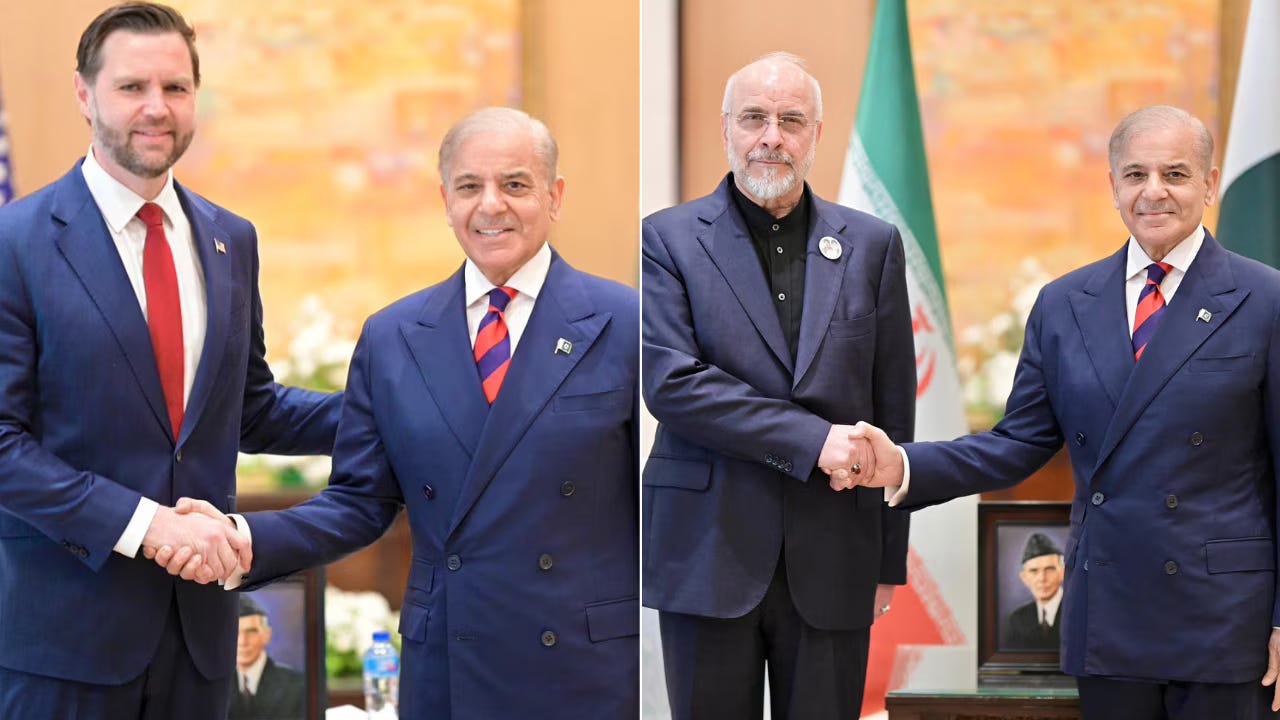
Twenty-one hours later, US Vice President JD Vance walked out of the Serena, gave a thumbs up as he boarded Air Force Two, and told reporters no deal had been reached. “That’s bad news for Iran,” he said, “much more than it’s bad news for the United States of America.” He did not say what would happen when the two-week ceasefire expires. He did not say what Pakistan should do next. He just left.
Pakistan sent fighter jets to one of the combatants’ primary partners while hosting the peace talks. It mediated. It armed. It thanked both sides for attending.
Pakistan imports more than 80 percent of its oil. Qatar is its primary LNG supplier, and Qatar’s cargoes pass through the Strait of Hormuz. The Strait has been, since early March, a controlled passage: Iranian commanders deciding, ship by ship, nationality by nationality, who transits and who waits. Pakistan got a carve-out. On March 16, a Pakistani oil tanker crossed with Iranian permission. On March 4, Pakistan officially requested that Saudi Arabia reroute crude supplies through the Red Sea port of Yanbu. Riyadh arranged one shipment. These are not strategic maneuvers. They are a country improvising its way through an energy crisis its government did not cause and cannot resolve.
Prime Minister Shehbaz Sharif announced sweeping austerity measures in early March: a four-day government work week, schools closed through the end of the month, fifty percent of civil servants working from home on rotation. Fuel prices jumped twenty percent in a single week, the largest single-week rise in Pakistan’s recorded history. In Islamabad, a plumber named Muhammad Zubair told Al Jazeera the fuel crisis was eating into his savings, that his motorbike commute had become expensive enough to cancel his plans to go home to Muzaffarabad for Eid. These are the terms in which Pakistan experiences this war: not as theatre, not as a question of Iranian sovereignty or American nuclear policy, but as the gap between what a plumber earns and what it now costs to get somewhere.
The International Energy Agency called the Strait closure “the greatest global energy security challenge in history.” For Pakistan, the descriptor is accurate but insufficient. Pakistan and Bangladesh are, as analysts have noted, more price sensitive than larger Asian economies to energy disruption. China, Japan, and South Korea have reserves and alternatives. Pakistan had Muhammad Zubair and a request to Riyadh for a rerouted tanker.
If the ceasefire expires without a deal and the war resumes at the intensity it held before April 7, Pakistan’s economists estimate a monthly exposure approaching three billion dollars. The components: roughly 1.2 billion in lost export revenue from Gulf markets, primarily textiles, rice, and surgical instruments; between 500 million and 1.5 billion in remittance shortfalls from the 2.5 million Pakistanis employed in Saudi Arabia alone; and a further 1.4 to 1.5 billion in oil import costs as Brent crude, which briefly approached 120 dollars a barrel during peak Hormuz disruption, climbs again. The IMF repayment schedule does not adjust for regional wars. The State Bank of Pakistan’s foreign exchange reserves do not replenish themselves when Qatari LNG cargoes cannot leave the Gulf.
The Pact and Its Architecture
Ishaq Dar stood before the Pakistani Senate on March 3 and said: “We have a defense pact with Saudi Arabia, and the whole world knows about it. I told the Iranian leadership to take care of our pact with Saudi Arabia.” He said he had obtained assurances from Riyadh that Saudi soil would not be used to attack Iran, and credited the exchange with limiting the scale of Iranian strikes on the kingdom. It was a remarkable public statement: Pakistan’s foreign minister, in real time, in parliament, invoking a military alliance against one of Pakistan’s neighbors during an active war.
The Strategic Mutual Defense Agreement was signed September 17, 2025, at Al-Yamamah Palace in Riyadh, by Crown Prince Mohammed bin Salman, Prime Minister Shehbaz Sharif, and Army Chief Asim Munir. Its core clause commits each country to treat aggression against the other as aggression against both, language deliberately modeled on NATO’s Article 5, though analysts have cautioned against reading it as an automatic military trigger. When a Saudi official was asked whether the pact covered Pakistan’s nuclear arsenal, he said: “This is a comprehensive defensive agreement that encompasses all military means.” Pakistan’s defense minister initially hinted at the same reading, then backtracked. The official text has not been published.
The pact was motivated, in part, by Israel’s September 9, 2025 strikes on Hamas officials in Doha, which shook Gulf states’ confidence in American security guarantees and set off a round of strategic repositioning across the GCC. Saudi Arabia, which had watched the US protect Israeli operations while Gulf infrastructure burned, concluded it needed a different kind of security anchor. Pakistan, which has maintained 1,500 to 2,000 troops in the kingdom for decades, trained more than 8,000 Saudi military personnel, and sent 20,000 soldiers to the kingdom during the Iran-Iraq war in the 1980s, was the available option. The relationship had institutional depth. The pact formalized it.
The Belfer Center assessed the agreement as designed to “signal unity and deter common threats” rather than create an automatic commitment. The Middle East Council on Global Affairs wrote that Dar “spent that ambiguity in a single press conference.” Both are correct. Dar’s March 3 invocation of the pact was not a slip. It was a calculated message: Pakistan has a commitment it may have to honour, and Tehran should factor that into its targeting decisions. The calculation worked, in the narrow sense that Iranian strikes on Saudi Arabia remained below the threshold that would formally require a Pakistani military response. But the calculation cost Pakistan something it had been trying to preserve: plausible neutrality.
By April 11, Pakistan had deployed combat aircraft to the Eastern Province. Michael Kugelman, director of the Wilson Center’s South Asia program, described the deployment plainly: “This is Pakistan signaling to Iran that if Iran is not willing to make the types of concessions that lead to a deal and the conflict resumes and escalates, there is a chance that Pakistan could move itself closer to Saudi Arabia and conceivably invoke the mutual defense pact.” The signal was sent from the same city where Pakistan’s foreign minister and army chief were simultaneously sitting across from the Iranian parliamentary speaker, urging diplomacy.
The Population the Pact Does Not Mention
After Iran, Pakistan has the world’s largest Shia Muslim population, estimated at between 20 and 26 percent of 230 million people: roughly 46 to 60 million citizens. The Saudi-Pakistan pact was not designed with them in mind. The pact was designed with Gulf financing, conventional deterrence, and Sunni strategic alignment in mind. These are different things.
Ayesha Siddiqa, one of Pakistan’s sharpest analysts of civil-military relations, said in March: “Don’t forget that after Iran, the largest population of Shias is in Pakistan. Opening multiple fronts would be a dangerous situation for the country.” She was understating the case. Pakistan’s sectarian geography is not a background fact. It is a live current running beneath every strategic decision Islamabad makes when Iranian blood is being drawn. The 2024 Parachinar violence, the Kurram district attacks, the history of Lashkar-e-Jhangvi and its successors targeting Shia communities across Baluchistan and Sind: these are not dormant. A Pakistan that invokes its Saudi pact in an active war against Iran is not simply making a foreign policy choice. It is making a choice that will be read, by millions of its own citizens, as choosing a side in a conflict that carries confessional weight.
No one in Islamabad has said this. The fighter jets went to Saudi Arabia. Ishaq Dar thanked both sides for attending. The gap between what was done and what was said is not an accident of communication. It is the architecture of a government that has committed itself, financially and militarily, to a posture it cannot explain to a large portion of its own people.
Two Borders at Once
Pakistan is simultaneously fighting on its western border with Afghanistan, where cross-border operations against the Tehreek-e-Taliban Pakistan continue to produce casualties on both sides. Pakistani forces have conducted strikes inside Afghan territory; Afghan forces have conducted strikes inside Pakistani territory. Both sides announced a temporary halt over Eid before warnings resumed. The military is not at leisure. Field Marshal Asim Munir flew to Riyadh in early March to discuss measures to halt Iranian strikes under the SMDA framework, walked alongside JD Vance in Islamabad last weekend, and signed the Saudi pact in September. He is conducting what may be the most complex simultaneous diplomatic and military operation in Pakistan’s history.
The border with Iran runs 900 kilometers. Baluchistan sits between the two countries. Iranian strikes on Saudi Arabia have already prompted discussions, in Islamabad and at think tanks, about what it would mean for Pakistan to open a secondary front along Iran’s eastern flank under the SMDA. The assessment of what such a role would cost Pakistan militarily, politically, and in Baluchistan specifically, where the state’s relationship with its own population is already under severe strain, has not been made public. It may not have been made at all.
A Pakistan at operational tempo in Afghanistan, managing a Strait of Hormuz energy crisis, hosting collapsed peace talks, and stationing its air force in Saudi Arabia is not a Pakistan that can absorb a resumed war at the intensity that preceded April 7.
What the Mediator Role Actually Bought
Pakistan’s elevation to peace broker was not spontaneous. It was, from the beginning, a product of structural dependency carefully leveraged into diplomatic visibility. Pakistan needed the war to end. Saudi Arabia is home to 2.5 million Pakistani workers and the source of a pledged five-billion-dollar investment package, parts of which were expedited specifically in the context of the current crisis. The Strait of Hormuz is the passage for Pakistani LNG. The IMF program requires external financing that Gulf states have repeatedly provided when Pakistan was otherwise insolvent. The mediation was not altruistic. It was an attempt by a country facing three billion dollars in monthly losses to use its unique position as Sunni nuclear state, old Saudi partner, and Iranian neighbour to end a war it could not survive economically if it continued.
The ceasefire that resulted from Prime Minister Sharif’s April 7 appeal to Trump was real. It gave Washington a face-saving pause without requiring any concession. Both the US president and Iran’s foreign ministry named Sharif and Munir in their announcements. Pakistan was credited, visibly, by both parties. The Islamabad talks were the highest-level direct engagement between Washington and Tehran since the Islamic Revolution. The billboards went up near the Serena Hotel. The international press corps arrived. For seventy-two hours, Pakistan was the room where it happened.
Now Vance has left. The talks produced no agreement on the nuclear question, no resolution on the Strait, no clarity on Lebanon, and no commitment on war reparations. Iran’s parliament speaker blamed the US for failing to earn Tehran’s trust. Vance said the offer was final. Neither side indicated a desire for another round. Pakistan’s foreign minister said his country “has been and will continue to play its role.” The role, at this point, is to wait.
The mediator’s trap is structural: having made yourself indispensable to the process, you become associated with its failure. Having publicly committed both your army chief and your prime minister as guarantors, you have spent capital that cannot be recovered if the war resumes. The five-billion-dollar Saudi investment package and the goodwill of both Washington and Tehran were the price of brokering a two-week pause. That pause is now expiring without a permanent settlement. Pakistan got the visibility. The bill has not yet arrived.
The Nuclear Dimension Nobody States Plainly
The Saudi official who told Reuters the SMDA was “a comprehensive defensive agreement that encompasses all military means” was not making a throwaway comment. Saudi Arabia has said, with some consistency, that it will seek nuclear weapons if Iran acquires them. The pact is the first formal military agreement between an Arab Gulf state and a nuclear power. Pakistan has not officially extended a nuclear umbrella to Riyadh. The text has not been published. The ambiguity, as the Belfer Center noted, is likely intentional.
It is also dangerous in a specific way. Iran’s nuclear program, its enriched uranium stockpile, its surviving scientists, its centrifuges, was the central sticking point that collapsed the Islamabad talks. The US demanded a fundamental commitment to forgo a nuclear weapon. Iran’s delegation arrived in black, carrying the shoes of students killed in a US strike on a school near a military compound, and said Washington had failed to earn their trust. The two sides were not close. If the war resumes with nuclear stakes in the open, Pakistan’s defence pact with the kingdom that most fears Iranian nuclear capability becomes something other than a deterrence signal. It becomes a direct stake in the nuclear outcome.
Pakistan’s own deterrence rests on the credibility of its arsenal as a second-strike capability against India. Every strategic commitment Pakistan makes to another party is a question about the availability and command of that arsenal. No one in Islamabad has addressed this directly. The strategic ambiguity that made the SMDA attractive in September 2025 is now the thing that most threatens Pakistan’s relationship with Iran, its domestic stability, and the international non-proliferation architecture that has always treated Pakistan’s weapons with wary tolerance.
What Pakistan Can Still Do
The honest answer, after the collapse of the Islamabad talks, is less than its government will admit. Pakistan cannot compel Washington to accept Iranian nuclear rights. It cannot compel Tehran to surrender what it fought six weeks to protect. It cannot keep the Strait open by diplomacy if Iran decides to close it again. It cannot honor its Saudi pact in full without risking its Iranian border and igniting domestic sectarian tension. It cannot remain fully neutral without abrogating commitments it has publicly made and militarily signaled.
What Pakistan can do is narrower. It can maintain the channel it has built, the back-room access to both delegations that produced the April 7 ceasefire, and use it to push for an extension rather than an expiration. It can work with Egypt, Turkey, and China, the coalition it assembled before the Islamabad talks, to present a revised framework that gives Iran something more than a demand to surrender and gives Washington something more than an ultimatum without enforcement. It can use its relationship with Saudi Arabia to push Riyadh toward a commitment that Gulf territory and airspace will not be used in a resumed US-Israeli campaign: the assurance Tehran most needs and Riyadh most resists.
None of this is certain to work. The US entered these talks looking for a quick resolution and left unsatisfied. Iran entered them looking for recognition of its right to a nuclear program and left having been offered the opposite. Israel is continuing to strike Lebanon while calling for Hezbollah’s disarmament, a contradiction Tehran cannot accept as a ceasefire framework. The structural conditions for a deal are not present. Pakistan’s influence is real but bounded: it can open doors it cannot walk the parties through.
On April 11, 2026, Islamabad was locked down. Thousands of paramilitary troops lined the streets. The sun went down and came back up over the Serena Hotel as Iranian and American delegations traded technical papers and exchanged ultimatums in the register that passes, in diplomacy, for negotiation. JD Vance gave a thumbs up on the stairs of Air Force Two. Pakistan’s foreign minister said his country would continue to play its role. The fighter jets were already in Saudi Arabia.
The ceasefire is expiring. What Pakistan cannot yet answer, not for itself, not for the 46 million Shia citizens watching from Karachi and Lahore and Quetta, not for the workers in Riyadh whose remittances keep the IMF schedule intact, is whether a country that has committed itself in every direction at once can survive the direction the war takes next.


