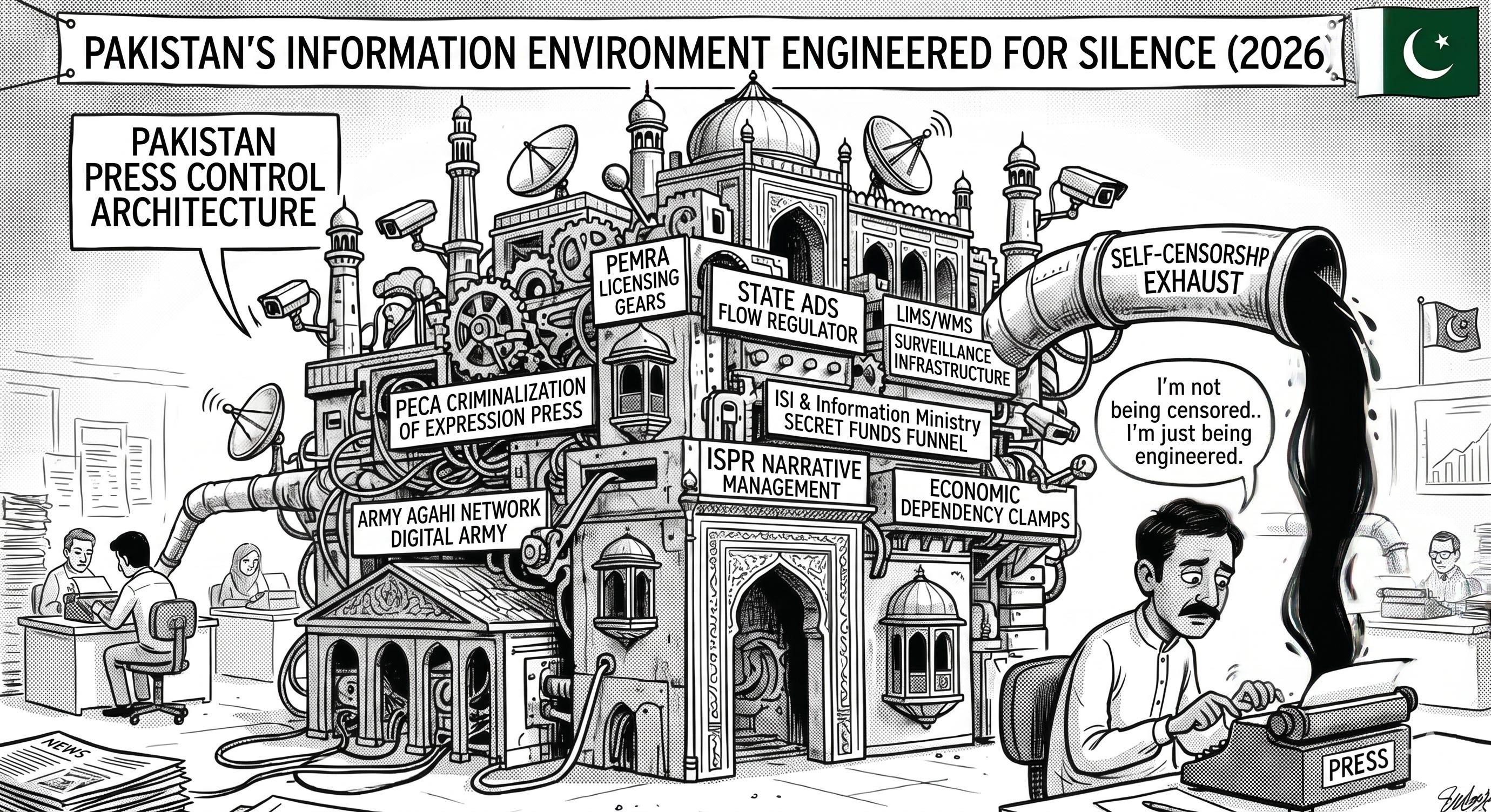
Pakistan's Intelligence Operated Media
How Pakistan's military-intelligence complex built an information environment in which silence is the rational choice.
Pakistan’s architecture of press control did not arrive with one decree. It was constructed across seven decades, each layer added with impunity, each new tool made possible by the tolerance given to the cruder one before it. What exists in 2026 is not censorship. It is an information environment engineered to produce silence without requiring it.
Zamir Niazi spent thirty years documenting Pakistan’s press controls. His word for what he was documenting was not censorship. It was architecture. Individual acts of suppression, he understood, were symptoms. The structure that produced them was the story: the licensing systems, the advertising flows, the unaudited funds, the regulatory appointments, the legal provisions whose vagueness was their primary function. The building, not the blow. The machine, not the fist.
The machine he documented in the 1980s and 1990s was relatively simple in its mechanics: the Information Ministry’s secret funds paid for compliance, the ISI’s parallel funds paid for access, ISPR managed the military’s public face, and the law provided the threat that made the payments feel optional rather than extortionate. This was the press control apparatus of the Zia era, inherited by every civilian government that followed, modified but not dismantled by any of them.
What Niazi could not have documented, because it was built after his time, is the seven additional layers added between 2001 and 2026. Each layer expanded the system’s reach without replacing the one before it. The result is not a censorship apparatus. It is an information environment in which every mechanism of editorial production, every economic dependency of media organizations, every legal instrument available to prosecutors, every surveillance tool available to intelligence services, and every digital platform available to ordinary Pakistanis has been incorporated into a single coherent system of narrative control. The system does not need to censor. It has been built to make the rational choice, for every actor inside it, the same choice.
Understanding how it was built requires tracing the sequence. The sequence is the argument.
I. The Foundation: Colonial Law and the Inherited Architecture
The architecture did not begin in 2001. It began in 1923, when the Official Secrets Act was passed by the colonial British administration and inherited, with minimal modification, by Pakistan at independence. It was reinforced by the Press and Publications Ordinance of 1960, enacted by Ayub Khan in the first military era to give governments the power to revoke newspaper registration for content deemed prejudicial to “national interest,” a category the ordinance left undefined. Zia ul-Haq’s martial law amendments to the Press and Publications Ordinance in the 1970s and 1980s added criminal defamation provisions and created the architecture of pre-publication censorship that operated through the 1980s.
The Pakistani state inherited from the British not just the law but the institutional logic behind it: that the press was a security matter before it was a democratic function. The Intelligence Bureau was established in 1947 with a media monitoring function inherited from colonial intelligence operations. The ISI, formalized in 1948, incorporated a domestic intelligence function from its founding. ISPR, the Inter-Services Public Relations directorate, was established in 1949, two years after independence. Not a ministry of culture. Not an information service. A press relations office for the armed forces, placed inside the military command structure, reporting to the Chiefs of Staff Committee.
The architecture was present at the founding. What changed over seven decades was its scale, its sophistication, and its integration with new tools. But the institutional logic was constant: the military as the arbiter of what could be said about the military, and the state as the manager of information flows in the national interest. That logic was built into the foundation.
II. The War on Terror Deal: What Musharraf Traded and What He Kept
The September 11 attacks transformed Pakistan’s strategic position overnight. A state that had been diplomatically isolated following the 1999 coup and the 1998 nuclear tests, its economy contracting under sanctions, was suddenly the indispensable partner in the most expensive American military operation since Vietnam. The ISI’s institutional knowledge of the Afghan terrain, its networks in the Taliban, its files on al-Qaeda: these were the assets Washington needed and Musharraf understood he was selling.
The price the United States paid was substantial. Over the five years following 2001, Pakistan received approximately $10 billion in direct U.S. funding, largely channeled through the Coalition Support Fund reimbursements for military operations, with significant additional flows through the ISI for specific counterterrorism activities. The price Washington extracted was a public alignment with the War on Terror that placed Pakistan’s civilian government and military on the same side of the transaction, at least in official framing.
What Musharraf understood, and Washington either did not understand or chose not to examine, was that the War on Terror deal had specific implications for Pakistan’s internal architecture of power. Foreign legitimacy and a cash infusion from the world’s only superpower did not loosen the military’s grip on civilian institutions. They reinforced it. The general who had seized power in 1999 now had American backing for a democratic performance that required the appearance of press freedom without its substance. The solution was PEMRA.
The Pakistan Electronic Media Regulatory Authority was established on March 1, 2002, under an ordinance promulgated by Musharraf. Its founding mandate was to facilitate private broadcast media and promote “free, fair and independent electronic media.” Between 2002 and 2008, the number of private television channels operating in Pakistan grew from near zero to more than eighty. The explosion of the media market was real. So was the architecture inside which it operated.
PEMRA issued licenses. PEMRA could withdraw them. PEMRA’s twelve-member authority board was composed predominantly of serving bureaucrats and retired police officers, with no requirement of press or journalistic independence. The organization was established under a presidential ordinance, not an act of parliament, meaning its founding terms could be changed without legislative process. PEMRA’s constitutional mandate included powers to impose restrictions in “the interest of the integrity, security or defence of Pakistan,” language that had no independent definition and no independent interpreter. PEMRA reported to the Ministry of Information and Broadcasting, which reported to the prime minister, who in Musharraf’s construction was subordinate to the army chief.
The media liberalization was genuine in one sense: Pakistanis got news television for the first time. It was structured in another sense: the licensor was the state, the state’s red lines were enforced through the licensing power, and no channel that wanted to keep its license had reason to test whether those red lines were real. Every government after Musharraf maintained PEMRA’s institutional structure. The question researchers have asked, why successive civilian governments never reformed the PEMRA ordinance to remove its control provisions, answers itself when you understand that civilian governments in Pakistan survive only on terms acceptable to the military, and the military had no interest in reforming the press control architecture it had built. The regulatory capture of PEMRA was completed before its first broadcast.
The Kerry-Lugar episode of 2009 demonstrated what PEMRA had made possible. When the Obama administration attempted to shift U.S. assistance from military to civilian channels with the Enhanced Partnership with Pakistan Act, attaching conditions on civilian control of the military and requiring Pakistani action against specific militant organizations, the military responded with a coordinated media campaign that used the new private television landscape as its instrument. ISPR released a formal press statement on October 7, 2009, describing “serious concerns” with the legislation. The army chief, General Ashfaq Kayani, met the U.S. ambassador and called the civilian oversight conditions an attack on the army’s institutional position. Within days, the prime-time conversation on every major Pakistani channel was framing the Kerry-Lugar conditions as an assault on sovereignty. The civilian government of Asif Ali Zardari, which publicly supported the bill, found itself isolated in its own media landscape. The conditions were eventually softened.
This was not an accidental demonstration. The military had discovered, through PEMRA’s architecture, that a media landscape it licensed and could revoke was a media landscape it could, when needed, activate as an instrument of institutional politics. The infrastructure built for domestic press management was also infrastructure for managing civilian governance. The two functions were never separate.
III. The Secret Fund System: The Transaction Layer
Alongside the regulatory architecture operated the transaction layer: the system of unaudited cash, in-kind payments, and access that constituted the ISI’s and Information Ministry’s direct financial relationships with editorial personnel.
This system predated PEMRA. It operated through the 1980s under Zia, through the 1990s under both Benazir Bhutto’s governments and the Nawaz Sharif governments, through the Musharraf era, and into the democratic period. The Supreme Court’s forced exposure of the Information Ministry’s lists in 2013, following petitions by journalists Hamid Mir and Absar Alam, documented Rs177.98 million distributed to 282 journalists between July 2011 and September 2012 alone, and this was only the portion of the fund the ministry chose not to claim privilege over. A second list of 155 additional recipients was expected to follow. A separate panel during the proceedings found that approximately Rs300 million had apparently been transferred to a single private television channel. The ministry clarified these funds had no connection to ISPR or the ISI, a clarification that was technically possible and structurally irrelevant: the three streams served the same purpose through the same institutional logic.
What the 2013 exposure documented was the visible part of a system that existed, by design, mostly in darkness. The ISI’s own funds, described in court testimony but never disclosed in the proceedings, operated under the Official Secrets Act. The IB maintained parallel funds under identical protection. The total financial flow through these instruments across any given year was never established. The 2013 list covered fourteen months under a single government. The practice had been continuous for decades.
The transaction layer had structural limitations. It required repeated contact, produced loyalty contingent on payment, and created records that could, under the right conditions, be presented to a Supreme Court. It worked best at scale during the analogue era, when managing eighty channels required either a very large budget or a more efficient system. By the mid-2010s, the more efficient system was under construction.
The March 2026 Public Accounts Committee examination of Information Ministry accounts found Rs101.4 million in undisclosed spending, including Rs70 million listed as “special publicity,” Rs4.8 million as “secret service costs,” and unspecified additional allocations. The line items looked like the 2013 scandal’s budget. The continuity was not coincidence. It was documentation of a permanent budget category that no government had removed because no government had reason to remove what it was also using.
IV. The Legal Architecture: PECA and the Criminalization of Expression
The Prevention of Electronic Crimes Act, enacted in 2016 under the PML-N government of Nawaz Sharif, brought Pakistan’s digital expression under state criminalization for the first time as a consolidated statute. Its 2025 amendments, under the PDM coalition, transformed it from a legal framework into a systematic instrument of press suppression.
The mechanism is the vagueness, which is not a drafting failure. It is the feature. PECA’s provisions on “spreading false or fabricated information” with intent to “defame” state institutions, on “cyberterrorism” defined broadly enough to include content that “glorifies” or “advances” activities deemed threatening to national security, and on content that “maligns” the armed forces or judicial institutions do not describe a set of specific prohibited acts. They describe a category of expression, criticism of powerful institutions, and assign criminal liability to that category with sufficient definitional flexibility that the same facts can be characterized as prohibited or not prohibited depending on who is doing the characterizing. A factual investigation into military corruption is “false information” when the military denies it. A documented account of human rights violations is “advancing” a security threat when the security establishment considers the documentation inconvenient.
PECA does not operate primarily through prosecution. It operates through the threat of prosecution, which is available as a tool of intimidation regardless of whether charges are ultimately sustained. An FIR filed under PECA triggers an investigation. The investigation permits asset freezing, travel bans, and surveillance orders. It subjects the journalist to months or years of legal proceedings regardless of eventual outcome. It signals to employers, sources, and advertisers that the journalist is under active state scrutiny. In a media environment already economically fragile, this signal is often sufficient to end a journalist’s employment before the FIR reaches a court.
Freedom Network’s April 2026 report for the twelve months ending March 2026 documented 58 legal cases against journalists in that period, the majority under PECA. State authorities were identified as the initiating party in more than 60 percent of all documented violations against journalists. The Freedom Network executive director characterized the effect precisely: PECA had created a climate of fear in which self-censorship was the rational response. This is not a description of a law being abused. It is a description of a law working as designed.
The 2025 amendments introduced additional provisions creating a Social Media Protection and Regulatory Authority to replace the PTA’s existing content governance role, establishing media tribunal proceedings for press-related offenses, and extending PECA’s territorial jurisdiction to apply to Pakistanis publishing from abroad. The last provision is the one with the most significant structural implication: a Pakistani journalist in exile can now be charged under Pakistani law for content published on a foreign platform from a foreign country. The legal arm of the architecture had achieved transnational extension before the physical arm had to be deployed.
Every civilian government from 2016 onward has used PECA. It was a PML-N statute, extended by PTI, amended by PDM. Its provisions have been invoked against journalists, lawyers, human rights advocates, opposition politicians, and judges. The law does not distinguish between these categories. It describes an offense against the state’s self-image, and any expression that threatens that self-image qualifies.
V. The Surveillance Infrastructure: LIMS, WMS, and the Elimination of Private Communication
The Lawful Intercept Management System has been installed in Pakistan’s telecommunications infrastructure since 2007. The year matters: 2007 was the year of Musharraf’s emergency, the year the chief justice was sacked, the year PEMRA channels were blacked out for covering the lawyers’ movement. The surveillance architecture was built during the most acute civil-military confrontation in recent Pakistani history, as the state’s instrument for knowing who was talking to whom at the moment when it most needed to know.
Amnesty International’s September 2025 report documented the full extent of what has been built since. LIMS is a product of the German company Utimaco, delivered through an Emirati intermediary, Datafusion. It allows state agents, including ISI officers, to access call records, location data, text messages, and browsing activity for any phone number entered into the system. No court order is required. No notification to the subject is required. The Pakistan Telecommunication Authority has issued formal directives requiring all four major mobile operators to integrate with LIMS at locations accessible to designated agencies. Amnesty documented the system’s capacity at more than four million simultaneous phone surveillances. The actual operational scope is unknown, because the system operates without transparency or independent oversight.
The Web Monitoring System operates alongside LIMS as the network-level instrument. WMS 1.0 was deployed in 2018 using technology from the Canadian company Sandvine. When Sandvine divested its mass surveillance operations in 2023, Pakistan replaced the system with WMS 2.0, sourced from China’s Geedge Networks, with hardware and software components from Niagara Networks of the United States and Thales of France. WMS 2.0 can inspect internet traffic at the packet level, block up to two million active sessions simultaneously, throttle bandwidth to specific content, block VPNs, and shut down internet access in targeted geographic regions. The capability for regional internet shutdowns has been deployed in Balochistan and Khyber Pakhtunkhwa during protests, without legal process or public accountability.
The PTA, the civilian regulatory body that administers Pakistan’s telecommunications licensing and that issued the directives integrating all four major telecoms with LIMS, is headed by a retired army general. Its predecessor in the role was also a retired army general. The civilian regulator of Pakistan’s communications infrastructure is staffed at its apex by the military institution whose intelligence arm has direct access to the surveillance tools the regulator mandated.
The Digital Nation Pakistan Act 2025 extends the architecture’s reach. The Act establishes a framework for centralizing citizens’ digital identities, consolidating social, economic, and governance data into an integrated national digital infrastructure. Amnesty warned in September 2025 that the Act creates the conditions for interconnecting the LIMS surveillance capability with biometric databases, financial records, and SIM registration data: a surveillance system of a scope and granularity that exceeds anything operating in the most repressive states with comparable infrastructure.
The implications for journalism are structural rather than individual. A journalist who turns their phone on operates within a system where any phone call, any text message, any browsing activity can be seen by the ISI in real time, using a system installed by a civilian regulator, funded by public money, built with technology from six countries whose own legal systems prohibit the surveillance practices they have made possible in Pakistan. The source who calls the journalist is inside the same system. The lawyer the journalist consults is inside the same system. The editor the journalist files to is inside the same system. The totality of the professional operation of journalism takes place inside a surveillance environment with no legal safeguard and no independent oversight.
This does not primarily produce more arrests. It produces the calculation that precedes the call, the text, the filing. It produces what Amnesty’s anonymous Pakistani journalist described: the surveillance becomes the focus of the work. The capacity to report contracts. The story is not written because it cannot be sourced without the source understanding, as all sources in Pakistan now understand, that the conversation is not private.
VI. The Economic Architecture: How the Market Was Made Compliant
The transaction layer of cash payments to individual journalists was, by 2015, an inefficient tool for managing an eighty-channel broadcast environment, several hundred print publications, and an expanding digital media landscape. The structural alternative was already in place. It had been in place since 1947. It required only that the media industry remain economically dependent on the state.
State advertising in Pakistan is allocated entirely at the discretion of the government, through PEMRA for broadcast and through the Information Ministry for print. There is no independent body, no formula, no transparent process. The government allocates advertising to channels and publications whose coverage it finds supportive and withholds it from those whose coverage it finds critical. This does not require a phone call. The outcome is understood from the incentive structure.
The media industry’s economic position amplifies this dependence. Salary delays of two to three months across multiple television channels have become normalized. Layoffs have affected Urdu News, Aaj News, and several smaller outlets. Private advertising revenue has contracted as digital platforms have absorbed an increasing share of advertising spend. The industry’s structural dependence on state advertising has grown as its alternative revenue sources have weakened. The March 2026 Public Accounts Committee finding of Rs101.4 million in undisclosed Information Ministry spending, Rs70 million under “special publicity” and Rs4.8 million under “secret service costs,” sits inside a media economy where the difference between financial survival and closure can be a single government advertising contract.
The media ownership structure adds a further layer. Pakistan’s major media groups, the Jang Group’s Geo and The News, the Express Group, Dawn, ARY, are all owned by business conglomerates whose interests extend well beyond journalism into real estate, manufacturing, and services. These interests are subject to state regulation, taxation enforcement, and government contract allocation in the same way that all large business interests are. An owner who controls a newspaper is also an owner whose construction projects require government permits and whose retail operations require regulatory clearance. The editorial decisions of the newspaper and the regulatory environment of the owner’s other businesses are structurally connected, even if no explicit transaction ever occurs. The state does not need to threaten. The structure provides the calculation.
The implication for the architecture of press control is that the economic layer does not require the kind of administration that the legal or surveillance layers require. It does not produce FIRs or intercept calls. It produces editorial meetings in which the parameters of what is publishable are understood before anyone arrives, in which the red lines are not stated because they do not need to be stated, in which the journalists who work within the parameters keep their jobs and the ones who do not are gradually removed. The economic architecture is the architecture of normal business operations in a media environment where the state is the largest single source of revenue and the most consequential single regulator of all associated business interests.
VII. The Digital Army: From ISPR to the Army Agahi Network
ISPR was established in 1949 as the Pakistani military’s press relations office. Its original function was essentially what any institutional communications department does: release statements, manage access, coordinate coverage of military operations. This function expanded steadily as the media landscape expanded: by the 1980s ISPR was producing documentary films, by the 1990s it was commissioning television dramas, by the 2000s it had developed a comprehensive content production operation whose output was simultaneously entertainment and military narrative management.
The transition to social media was documented, after the fact, by researchers at the Atlantic Council’s Digital Forensics Research Lab, who identified a network of Facebook pages and Instagram accounts linked to ISPR employees in April 2019. The network had more than 2.8 million followers. Facebook removed 103 pages and accounts. The operation was not new. It had been running, apparently since at least 2018, as an organic extension of ISPR’s existing narrative management function into the digital space where most Pakistanis increasingly consumed news.
The Army Agahi Network formalizes what had been an informal operation and substantially expands its scale. Launched by ISPR in 2023 following the protests that accompanied Imran Khan’s arrest, the AAN directs serving military field officers to create and operate fake social media accounts under civilian identities for the purpose of distributing approved military narratives, attacking designated critics, and doxing opponents. Officers receive approved messaging from superiors and share it under aliases. The accounts present as independent civilian voices: investigative researchers, concerned citizens, engaged commentators. They are not.
The structural significance of the AAN is not primarily that it represents an expansion of military influence into the information environment, though it does. It is that it represents the formalization of a standing program that deploys thousands of serving officers in an operation that violates their constitutional oath to remain apolitical, that the operation is coordinated by ISPR which is an institutional component of the military command structure, and that this coordination has now been given a name and a budget line and a hierarchy. The AAN is not rogue officers acting outside their mandate. It is the military’s information operations function extended to the social media layer, run through the same institutional structure that runs ISPR press releases and commissioned patriotic dramas.
After X was blocked inside Pakistan, ISPR issued new directives instructing AAN officers to migrate their primary operations to Facebook, where the target audience is largest. The migration is documented. The orders are documented, from a source inside the program. The program continues.
What this produces for the information environment is a condition in which independent reporting that reaches a Pakistani audience will, within hours, be confronted with an algorithmically amplified counter-narrative from accounts whose military operation is invisible to the audience. The journalist’s story competes in the same platform space as coordinated state messaging presented as organic civilian response. The audience cannot distinguish between them. The AAN’s function is to make the distinction unavailable, not through visible censorship but through the volume and coordination of manufactured consensus.
VIII. The Transnational Extension
The architecture’s most recent structural development is its extension beyond Pakistan’s borders. The five layers described above: PEMRA’s licensing power, the legal instruments including PECA, the LIMS/WMS surveillance infrastructure, the economic dependency architecture, and the AAN’s digital operations, all operated primarily within Pakistani territory on journalists and editors physically present in the country. The growth of diaspora journalism, particularly after 2020 when several prominent journalists moved abroad following sustained pressure, created a gap in the architecture’s coverage.
The gap has been closed through four mechanisms.
PECA’s 2025 amendments extended the statute’s jurisdiction to Pakistanis publishing from abroad. An investigative report published on a U.S.-registered server by a Pakistani journalist resident in Washington can now generate an FIR under Pakistani law. The FIR triggers consequences inside Pakistan regardless of where the journalist is: family members are within Pakistani jurisdiction, family bank accounts are within Pakistani financial jurisdiction, family properties are within Pakistani regulatory jurisdiction.
Platform blocks extend the domestic audience suppression to exiled journalists’ work. Factfocus, the investigative platform founded by Ahmad Noorani, was blocked inside Pakistan in January 2024. Blocking the platform does not silence the journalist. It removes the Pakistani domestic audience from access to the journalism, which serves the same function.
The AAN’s digital operations are not geographically bounded. A smear campaign targeting a journalist in Washington, deploying fabricated audio recordings and coordinated mass-reporting on Facebook, operates identically regardless of where the journalist is located. The target audience in Pakistan is reached. The journalist’s credibility with that audience is damaged. The mechanism requires no physical presence near the journalist.
The fourth mechanism is the use of family members inside Pakistan as a lever on journalists outside. This requires no new law and no new institutional architecture. It is the application of the existing surveillance, legal, and physical apparatus to people who are not themselves journalists, in order to produce pressure on the journalist who is beyond direct reach. The journalist who publishes a report on the army chief’s nepotism, and whose siblings are taken from their home two days later by masked men, understands the mechanism precisely. So does every other Pakistani journalist watching.
The transnational extension does not mean the architecture is complete. It means the gap identified by the first wave of exiles has been systematically closed, and that the calculation a Pakistani journalist makes about whether to leave the country now includes what will happen to the people who remain.
IX. The Civilian Foundation: Why This Architecture Cannot Be Dismantled from One Side
The standard account of Pakistan’s press control architecture frames it as military imposition on civilian society. This account is inaccurate in a specific way that matters for any analysis of whether the architecture can be changed.
Every significant layer of the architecture was built using civilian institutional mechanisms. PEMRA was a civilian ordinance, promulgated by a military president but given its operational form through civilian bureaucratic apparatus and maintained by every subsequent civilian government without reform. PECA was enacted by a civilian legislature under a civilian government, with a civilian prime minister who had every incentive to use it against his opponents as well as every incentive to allow the military to use it against his critics. The Information Ministry secret funds are parliamentary appropriations, allocated through civilian budget processes, administered by civilian ministers. The PTA, which directed all four major telecoms to integrate with LIMS, is a civilian regulatory body. The LIMS system itself, its contracts, its technical installation, its operational parameters, were managed through civilian government procurement processes.
This is not an argument that civilian governments and the military are equivalent actors in Pakistan’s press suppression. They are not. The ISI’s operational interest in controlling journalism about military operations, military corruption, and military interference in politics is more direct and more durable than any civilian government’s. The army’s institutional prerogative has been the consistent variable across governments of every political composition. The civilian governments are contextual variables.
But the architecture’s construction through civilian mechanisms means that its dismantling requires civilian institutional action that no civilian government has taken, because every civilian government that has survived has survived by accepting the terms on which the military permits civilian governance. Those terms include the maintenance of the information environment the military requires. A civilian government that revoked PECA’s press provisions would face an ISPR press statement describing it as a threat to national security. A civilian government that reformed PEMRA’s licensing architecture to remove military red line enforcement would face the same. The governments that have passed the 2025 PECA amendments and the 2025 Digital Nation Act expanded the architecture. This is not coincidence. It is the operating logic of civil-military relations in a state where the civilians’ survival depends on not dismantling what the military considers essential infrastructure.
Tariq Ali’s structural argument about Pakistan’s ruling class applies with particular force here. The civilian governments are not victims of the press control architecture. They are, in the Gramscian sense, its hegemonic partners: junior participants in the management of an information environment that serves both their interests, in eliminating political opponents and embarrassing revelations, and the military’s interests, in managing coverage of institutional conduct. The architecture is not imposed. It is jointly maintained.
X. What the Layers Produce Together
Each layer of this architecture produces a distinct form of compliance. Together they produce something that no single layer could produce alone.
PEMRA produces broadcast compliance: the channel that wants to keep its license does not challenge the red lines. PECA produces digital compliance: the journalist who wants to avoid fifty-eight months of legal proceedings does not file the report that would generate an FIR. The economic dependency architecture produces structural compliance: the editor whose outlet depends on state advertising does not need to be told which stories to spike. LIMS produces source compliance: the source who knows their calls are monitored does not make the call. The AAN produces audience compliance: the Pakistani reader who sees every critical account of military conduct met with immediate coordinated counter-messaging concludes that the account is contested rather than documented. The transnational extension produces diaspora compliance: the journalist in exile who has family inside Pakistan calculates the cost of their work in terms that extend beyond their own safety.
The layers are mutually reinforcing in a specific way. Any single layer could, in principle, be circumvented by a journalist determined enough to accept the personal costs. A journalist willing to lose their broadcast license can still publish. A journalist willing to face a PECA case can still report. A journalist willing to accept surveillance can still make calls on encrypted platforms. A journalist willing to have their credibility attacked on Facebook can still file the story. The architecture produces its most complete control not through any single layer but through their simultaneous operation, which raises the cumulative cost of independent reporting above what any individual journalist’s professional calculation can absorb without accepting the consequences for people who did not choose to be journalists.
The machine does not require heroism to defeat it. It requires heroism to work inside it at all. The majority of journalism that reaches Pakistani audiences has passed through the architecture’s filters, not because the journalists who produced it are corrupt but because the architecture has defined the space in which journalism is possible.
XI. The Question the Architecture Cannot Answer for Itself
The architecture described above is, in the structural sense, stable. Each layer is reinforced by the others. The civilian governments that could in principle change the legal components depend on military acquiescence for their survival. The military that runs the surveillance and digital operations has no institutional incentive to reduce its own capacity. The media owners whose economic interests depend on state advertising have no incentive to contest the conditions on which that advertising is allocated. The technology companies whose products power the surveillance and firewall systems operate under Pakistani procurement law, which does not require human rights impact assessments.
Stability is not permanence. The architecture was built in response to conditions: the War on Terror’s resource flows and legitimacy requirements, the media liberalization that created the scale problem requiring systematic tools, the political crises that produced PECA, the protest movements that produced the AAN. Each of these conditions will change. The international legitimacy that accompanied the War on Terror has already substantially eroded. The economic model that keeps Pakistani media dependent on state advertising is in long-term decline as digital platforms absorb advertising revenue. The PECA architecture is generating international scrutiny from press freedom organizations and, increasingly, from the governments whose technology companies supply the surveillance infrastructure.
What none of these pressures has yet produced is a civilian government with both the institutional position and the political will to begin disassembly. The architecture has not been dismantled by any of the conditions that caused it strain because the actors with the capacity to dismantle it benefit from its existence. Understanding this does not explain how it changes. It explains why it has not.
The architecture is self-maintaining for the same reason it was built in the first place: not through conspiracy but through the rational institutional behavior of each actor within it, optimizing for their own survival within the conditions the system creates. The military maintains the surveillance because it provides operational advantage. The civilian governments maintain PECA because it provides legal tools against their own opponents. The media owners maintain their editorial caution because it protects their business interests. The technology companies maintain their supply because the contracts are profitable. The journalists maintain their self-censorship because the alternative costs them more than they can afford to pay.
The question the evidence raises and does not answer is the same question Zamir Niazi was circling when he spent thirty years documenting the architecture rather than just its effects. Who changes a system in which every actor inside it has a rational reason not to? The architecture of silence was not built by sinister intent. It was built by accumulated institutional self-interest operating over seven decades without accountability. It will not be dismantled by good intentions either.
Sources
Freedom Network, Regulatory Repression of Freedom of Expression, April 2026
Amnesty International, Shadows of Control: Censorship and Mass Surveillance in Pakistan, September 2025
DropSite News — Murtaza Hussain and Ryan Grim, Secret Pakistani Program Directs Military Officers to Attack Social Media Critics, August 2024
Facebook/Meta, Removing Coordinated Inauthentic Behavior and Spam From India and Pakistan, April 2019
Atlantic Council Digital Forensic Research Lab
Reporters Without Borders, 2026 World Press Freedom Index
Committee to Protect Journalists
Public Accounts Committee, Government of Pakistan, March 2026
PEMRA Ordinance 2002 and subsequent amendments
Prevention of Electronic Crimes Act 2016 and 2025 amendments
Digital Nation Pakistan Act 2025
Dawn
The Express Tribune
Al Jazeera
Journalism Pakistan
Carnegie Endowment for International Peace