

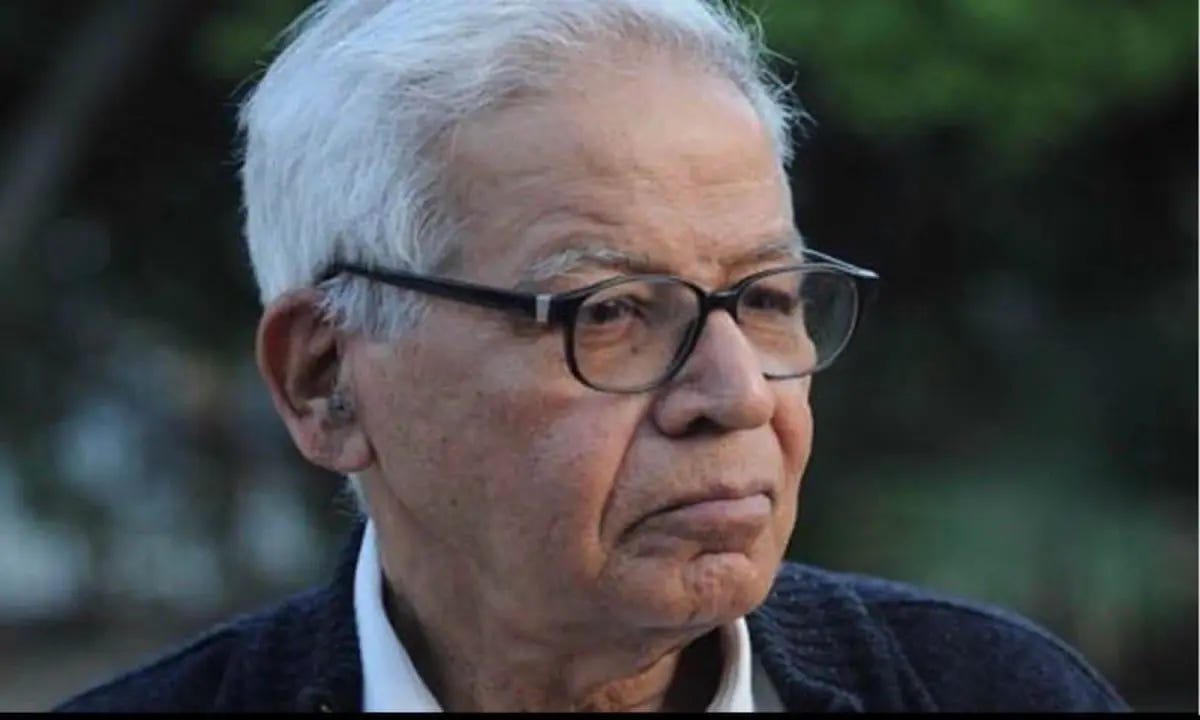
Barrister Aitzaz Ahsan was too ill to preside, leaving the centre chair vacant on the dais of the Human Rights Commission of Pakistan auditorium in Lahore. Hussain Naqi was ill himself. He came to the auditorium on Saturday, November 21, and took the seat.
The slim book on the lectern belonged to Ahmad Farhad, the Kashmiri poet who was forcibly disappeared from his home in Islamabad in May 2024. Farhad and Naqi had never met. Naqi told him he had received the book the previous afternoon and begun turning its pages. He came across Lahore to chair the launch, and when it was his turn to speak he read nearly half the collection aloud, pausing between couplets to catch his breath.
Beside him sat Salman Akram Raja, the constitutional lawyer and secretary general of Pakistan Tehreek-e-Insaf. The party’s founder remained in prison, and some of its supporters had been tried by military courts. Naqi promised to send Raja a copy of his autobiography. Between recitations, he came back to the question that had occupied him through seven decades of martial law and managed elections. What would it take to get people onto the streets together when they knew what the state could do to them there?
Tabdeeli sirf sarkon par aayegi. Zahir hai is mein shahadatein bhi hongi aur qaid-o-band bhi hogi. Agar aap is ke liye tayyar nahin honge toh galay mein ghulami ka tauq hi jari rahega.
Change will come only on the streets. The struggle will bring martyrdom and imprisonment. If you are unwilling to face them, the collar of servitude will stay around your neck.
Farhad recalled that Naqi fell ill on his way back from the launch. Muhammad Ilyas of the HRCP told Dawn that Naqi suffered a heart attack that evening and died in hospital early on Sunday, November 22. Funeral prayers were announced for 12:30 p.m. at Jamia Al-Muntazir in Model Town. President Asif Ali Zardari praised Naqi’s service to journalism and democratic rights. Prime Minister Shehbaz Sharif remembered a principled journalist and offered prayers for him.
On the day Naqi read Farhad’s poems, a Quetta magistrate rejected bail for journalist Shahid Maitla, who remained in district jail on judicial remand. The case was registered under the Prevention of Electronic Crimes Act after a complaint by former caretaker prime minister Anwaar-ul-Haq Kakar. That same day, the Rawalpindi Islamabad Union of Journalists called on the Azad Jammu and Kashmir authorities to remove reporter Soban Iftikhar Raja from the Fourth Schedule, a counterterrorism watchlist that can impose restrictions and reporting requirements. A day earlier, a Karachi court had framed charges against television host Iqrar-ul-Hassan over alleged anti-state content. He denied the allegations and remained on bail.
Naqi began testing authority as a schoolboy in the Lucknow of the 1940s, around Shia College, Taleem Gah and Aminabad. His father practised law, and his elder brother went into engineering. His official birth year was 1936, though in his autobiography he thought he might have been born a year earlier. In the recollections collected by historian Syed Jaffar Ahmed in Jurat-i-Inkaar, the boy was already willing to press a principal to apologise for mistreating a teacher.
Naqi moved to Pakistan in the 1950s while his parents stayed in India. He studied in Lahore and then Karachi, where he joined the National Students Federation. When Britain, France and Israel attacked Egypt in 1956, the federation marched on the British High Commission in Karachi and met police batons and tear gas. Naqi was on the federation’s executive committee. By the time Pakistan came under martial law in October 1958 and political parties were outlawed, campus unions were among the places where people still elected representatives and argued in public.
At Karachi University, where Naqi was elected president of the students’ union, the administration decided to suspend three Baloch students after an incident at a hostel. Naqi made a bargain with the vice-chancellor. The three could stay if he took the punishment himself. The university suspended him for three years, interrupting his postgraduate studies. Naqi had come to Karachi from Lucknow by way of Lahore, and when the university singled out three boys from Balochistan, he put his own place at the university on the table.
The union had also fought for better campus facilities, safer transport for women students and exams that ran on time. Years later, Naqi remembered students of different political loyalties working together on those demands. The same union that could get a bus for its students could stand between them and an expulsion order.
Naqi reported for the Urdu daily Anjam before joining Pakistan Press International. Under Ayub Khan’s Press and Publications Ordinance, editors also lived with “press advice”, the polite name for instructions about which news to kill and which speeches to put on the front page. A correspondent could get into trouble before an editor had even seen his copy.
In Hyderabad, Naqi reported that Makhdoom Hassan Mahmood, an influential landlord from southern Punjab, had defaulted on loans. Around the same period, Hyderabad Commissioner Masroor Hasan Khan organised a hunting expedition for Ayub Khan. Naqi was there to cover the camp. The president spotted him and asked him to speak. Naqi held back at first, but Ayub pressed him. Naqi asked what the president, who spoke so often of accountability, intended to do about Hassan Mahmood. Did accountability reach his own friends?
Naqi was transferred from Hyderabad to Lahore in 1967. His reporting and editing took him through Viewpoint, The Sun, The Muslim, The Frontier Post and The News International, as well as Karachi’s Outlook and English-language weeklies in Dhaka. A transfer put him in front of another set of officials with much the same questions.
Naqi’s account of 1971, given to Syed Jaffar Ahmed for Jurat-i-Inkaar, lays responsibility on the military government for its dealings with both Zulfikar Ali Bhutto and Sheikh Mujibur Rahman. West Pakistani newspapers, under censorship, were carrying the official account of a country coming apart. Naqi recalled urging Bhutto to let Sheikh Mujib take power after the 1970 election. He wanted an answer from a man he thought understood the political stakes as well as anyone in the room.
When Bhutto came under attack at a rally in Sanghar, the English weekly Punjab Punch, which Naqi published, warned that the Indus would run with blood if anything happened to him. The journalist Abdul Aziz Malik, who wrote the line, recalled in 2018 that the paper was banned after it appeared. Once Bhutto was in office, his own government jailed Naqi. Among the editors held with him were Mujeeb-ur-Rehman Shami, Ejaz Hassan Qureshi and Altaf Hassan Qureshi. When Shami arrived in tears, Naqi sat beside him and consoled him. Whatever they had written about one another outside, they were locked up by the same government.
After the July 1977 coup, editors had to send page proofs to provincial information offices for clearance before the morning run. During the Pakistan Federal Union of Journalists’ campaign in 1978, reporters from Musawaat courted arrest and military courts sentenced four journalists, including Nasir Zaidi, to lashes. Police jailed the staff of Viewpoint, and yet the weekly still found its way onto the stands.
Naqi was arrested on Mall Road and taken in handcuffs to the interrogation centre at Lahore Fort. A passerby saw him and asked what he had done. Naqi said he had robbed Zia-ul-Haq’s bank. Decades later, when Hamid Mir asked why he fell out with every government, Naqi gave him much the same answer in a different form. Mujhe nahin, hukumaton ko mujh se ikhtilaf ho jata hai. It was the governments, he said, that kept taking issue with him.
Naqi organised newsroom workers alongside Nisar Osmani and Minhaj Barna in the Pakistan Federal Union of Journalists, served in the Karachi and Punjab unions and was elected president of the Lahore Press Club. At a reception in Hyderabad in December 2018, he recalled a time when the proprietor of The Pakistan Times, Mian Iftikharuddin, asked Faiz Ahmad Faiz’s secretary for permission before entering the editor’s office. Editors chose their own teams, and permanent employment gave a reporter some protection when the proprietor or a public official objected to a story. Once owners took hiring out of the editor’s hands and put reporters on renewable contracts, an employer could silence a reporter by letting the contract expire.
Naqi asked the Hyderabad audience to consider the television proprietors who insured their expensive cameras while leaving the people carrying them uninsured. He had as little patience for the rival camps inside the unions. With journalists divided among competing PFUJs, owners had a much easier time bargaining with the people they employed.
After Zia-ul-Haq’s plane crashed near Bahawalpur in August 1988, a native Urdu speaker from Lucknow who spoke little Punjabi set about publishing Pakistan’s first Punjabi-language daily. Launched in 1989 with Naqi as managing editor and publisher, Sajjan was conceived as a six-month experiment. Young writers worked without salaries, and the paper lasted eighteen months.
British administrators had privileged Urdu over Punjabi in the province’s schools and lower administration. Generations of Punjabis learned to speak one language at home and to use another when dealing with a court or applying for a job. Sajjan put working people’s affairs into the language in which many of its readers spoke about them. It had to survive in a newspaper economy in which the government was a major buyer of advertising. During its eighteen months in print, the Punjab government placed a single advertisement. Sindh’s provincial government and Benazir Bhutto’s federal administration gave the Punjabi daily more support than its home province did. When the volunteers could no longer keep it going, the presses stopped.
Naqi went on to work at the Human Rights Commission of Pakistan alongside I.A. Rehman and Asma Jahangir. Over three decades he helped organise its local groups and correspondents, edited national-language publications and served as treasurer. He also edited the South Asia Media Monitor and coordinated the South Asia Press Commission.
If a family reported that a student had been taken from a hostel in Quetta, a district correspondent had to find out who last saw him, whether the police had registered a case and what the family had been told. A report on a mob attack or a brick-kiln labourer’s beating likewise depended on someone who knew the neighbourhood, could find witnesses and could obtain the police record. Naqi spent years helping the HRCP build a network of people who could do that work outside Lahore and Islamabad. He was still serving on its council when he died. On November 16, that council elected Nasir Zaidi its chair, forty-eight years after a military court had him flogged.
Tabdeeli had spent years on election billboards by the time Naqi used the word at the HRCP auditorium. He put it beside shahadat and qaid-o-band, martyrdom and imprisonment. In Arabic, the word for martyrdom shares a root with the word for bearing witness. The students shot in Dhaka in February 1952 were demanding recognition of Bengali. The workers killed in Karachi in 1972 had taken their demands out of the factory and onto the road. Naqi had lived through both and through the 1983 movement for the restoration of democracy, when demonstrators in Sindh were killed demanding an end to military rule.
Pakistan in November 2026 could put civilians before military courts and keep a reporter in Quetta jail over a former prime minister’s defamation complaint without suspending the constitution on television. The Pakistan Press Foundation reported that the federal journalist protection commission still had no published rules or official complaint address at the end of July. In October, the commission said it would take complaints manually while it built an online portal. By November, a journalists’ union was asking the authorities in Azad Jammu and Kashmir to take a reporter off a counterterrorism watchlist.
Party leaders, bar associations and urban professionals can spend another winter waiting for a sympathetic bench, a phone call from Washington or a bargain that puts their faction back in government. Naqi had seen Ayub Khan’s Basic Democracies, Yahya Khan’s Legal Framework Order, Bhutto’s Federal Security Force, Zia-ul-Haq’s nominated Majlis-e-Shoora and Pervez Musharraf’s National Security Council. Each arrangement had people willing to ask the public to wait. When he spoke to Salman Akram Raja, Naqi put the cost of coming out into the open, in the same room where a poet who had already been taken from his home was listening.
Lahore buried Naqi in Model Town on Sunday. Senator Sherry Rehman remembered the young reporters who had learned their craft at his desk and walked in rallies behind him. The men who issued condolences could praise what he had done because he had already done it, and they could leave Shahid Maitla where he was. When the state demands silence again, who will step onto the street?
Naqi discussed his life and autobiography, Mujh Se Jo Ho Saka, at the Gurmani Centre at LUMS in October 2025.