
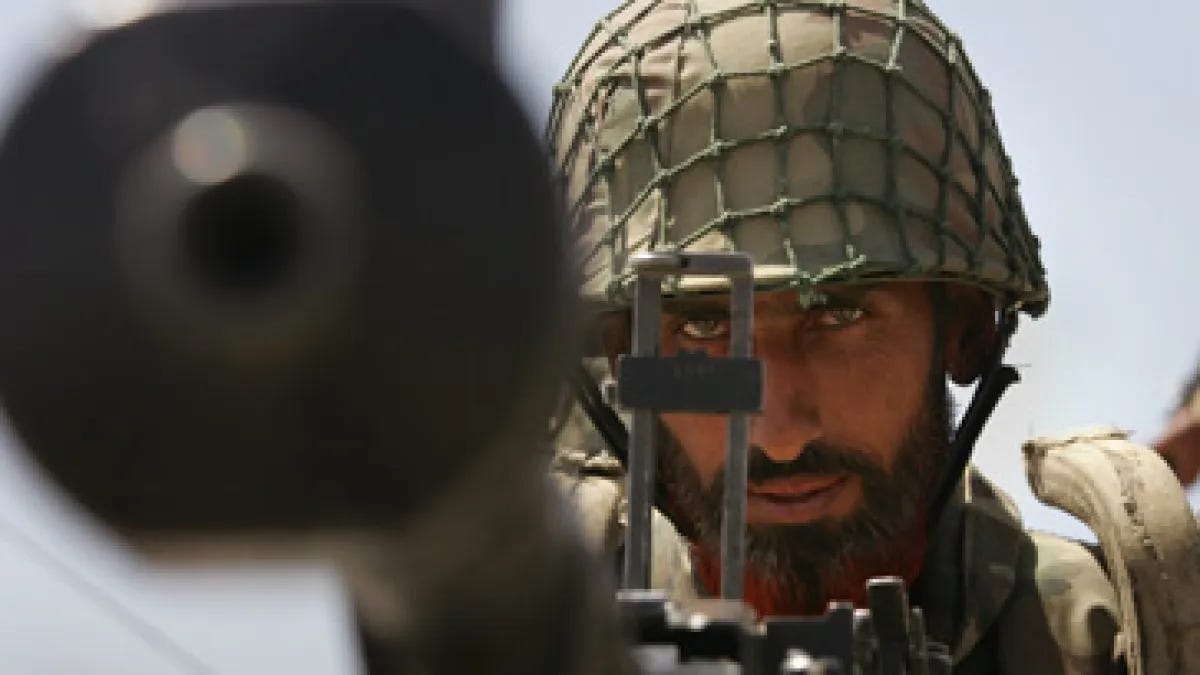
The Institutional Hegemony of the Pakistan Army
A Global Security Export and the Military-Industrial Complex (1947–2026)
The United Nations reimburses troop-contributing countries at a standard rate of $1,428 per soldier per month. Pakistan currently contributes 8,230 uniformed personnel across seven active UN missions. The arithmetic produces roughly $11.7 million in monthly reimbursements flowing to Islamabad. The ordinary Pakistani soldier who generates that figure returns home after a two-year rotation to a cantonment welfare colony where the tap water is intermittent and the power cuts run four hours daily. The gap between those two facts is not a failure of distribution. It is the architecture of a system that has operated without structural interruption since 1960 and without parliamentary accountability since its inception.
Pakistan’s military has been the world’s most durable exporter of soldiery for over six decades. More than 235,000 Pakistani uniformed personnel have served in 48 UN missions across 29 countries. At the peak of bilateral Gulf deployments in the late 1970s and 1980s, between 50,000 and 60,000 Pakistani military personnel were posted abroad simultaneously across 22 countries, making Pakistan the largest Third World military manpower exporter by any measure then recorded. Between 2002 and 2016, the United States paid the Pakistan Army approximately $14 billion through the Coalition Support Fund, a reimbursement programme for counter-terrorism operations along the Afghan border that required no approval from Pakistan’s civilian parliament and passed through no civilian budget line that the National Assembly could inspect. In December 2025, Rawalpindi signed what its own officials described as the largest arms deal in Pakistan’s history, a multi-billion-dollar sale to a Libyan faction operating in direct violation of a UN arms embargo that Pakistan nominally supports as a Security Council member. Three months later, a companion deal to supply weapons to Sudan’s armed forces was cancelled, not by Islamabad, not by any parliamentary motion, but by Riyadh, when Saudi Arabia withdrew the financing it had provided as broker.
The business model across seventy-eight years is consistent: Pakistan supplied bodies, territory, expertise, and eventually weapons systems; wealthy states supplied money, equipment, and political cover. The Fauji Foundation, the Pakistan Army’s welfare-and-commercial conglomerate, was valued at $5.9 billion in 2025, the largest commercial entity in Pakistan by net worth, positioned above every civilian-run business group in the country. The Pakistani state which these soldiers nominally serve was simultaneously enrolled in a $7 billion IMF emergency programme whose continuation was conditioned on a Saudi deposit held at the State Bank of Pakistan and which Saudi Arabia could trigger into collapse by withdrawing a single instrument.
The British built this machine. Pakistan inherited it, refined it, and then sold it. The proceeds went to the institution, not the country.
The Inheritance: 1947
When the British Indian Army was divided on 30 June 1947, Pakistan received the doctrine alongside the regiments. The colonial military’s “martial races” theory, the administrative fiction that Punjabis, Pathans, and Baloch were biologically suited to soldiering while other subcontinent populations were not, had organized British imperial deployment for a century. It was a personnel management system dressed as anthropology. The new Pakistani state inherited it not as ideology explicitly adopted but as institutional common sense, and it shaped recruitment, promotion, and the army’s self-understanding from the first day of independence.
The material inheritance was asymmetric. Pakistan received six armoured, eight artillery, and eight infantry regiments against India’s forty, forty, and twenty-one respectively. The ratio was 1:2 in India’s favour by design; most military infrastructure, the depots, the officer training schools, the heavy equipment, sat geographically within what became India. Pakistan received a fighting force without the administrative state capable of sustaining it. The army spent the next seven decades constructing every available mechanism to close that gap, not by building the civilian economy to a level that could fund it, but by deploying soldiers as commodities in exchange for the resources the state could not generate through domestic taxation.
The first test came within weeks. Pakistani irregular forces entered Kashmir in October 1947, and regular formations followed by May 1948. The conflict produced a ceasefire and an unresolved border that became the army’s permanent institutional rationale: India is the existential threat, and no civilian government may be trusted to manage it. That rationale has sustained every direct and indirect military intervention in Pakistani political life since. It also created a closed loop: the army needed resources to address the India threat; the India threat justified extracting resources without civilian oversight; the resources funded the army’s commercial and political expansion; the commercial and political expansion made the army the primary economic actor in the country; and the country’s economic fragility reinforced the army’s case that only it could manage relations with the foreign patrons who kept the economy solvent.
In 1956, the United States dispatched a Military Assistance Advisory Group to Pakistan, introducing American doctrine and hardware in exchange for strategic geography and professional service. Pakistan joined SEATO and CENTO, giving Washington a forward position on the Soviet border. The arrangement established a template that every subsequent external military relationship would replicate: Pakistan provides, the partner pays, the army manages the accounting, the civilian government learns the terms after the fact.
The First Export: Congo, 1960
Pakistan’s overseas multilateral deployment began formally in 1960 when the first Pakistani contingent arrived in the Democratic Republic of Congo under the United Nations Operation in the Congo. The Cold War had fractured the newly independent state. Belgian officers had been abruptly expelled. Patrice Lumumba’s government was collapsing under the weight of secessionist movements financed from abroad. The United Nations scrambled for troops from countries that could be perceived as neutral: not American, not Soviet, not European. Pakistan qualified on all counts, and the deployment was straightforward. Pakistan supplied personnel with combat experience, institutional discipline inherited from the British, and no colonial history in central Africa. The UN supplied mandate, logistics, and payment.
Three years later, Pakistani troops deployed to West New Guinea under the UN Security Force to manage the territorial handover from the Netherlands to Indonesia. By 1963, Pakistani officers were standing on the bridges of vessels in the South Pacific, supervising the transfer of a territory they had no geographic or historical relation to, because the UN needed capable troops who were not from any of the powers with a stake in the outcome. The arrangement was so efficient that it became permanent. Pakistan learned from Congo and West New Guinea that the UN system produced a reliable revenue stream with no domestic political cost: the missions were far away, the deployments were framed as service to humanity, and the ISPR could generate positive press coverage from each one indefinitely.
The institutional lesson was structural, not moral. Overseas deployment generated income, international prestige, and technical experience that could not be obtained through domestic soldiering alone. It also created relationships with foreign military establishments, particularly American and British, that gave the Pakistan Army access to diplomatic channels and hardware procurement networks unavailable to any civilian ministry. By the time Pakistan sent troops to Somalia in 1992, the UN deployment model was not an altruistic external commitment. It was a revenue line.
Jordan, 1967 to 1970: The Career That Made a Dictator
In 1967, Pakistan dispatched a military training mission to Jordan. King Hussein’s army and air force had been devastated by Israel in the Six-Day War. Jordan needed to rebuild its military capacity rapidly, without depending entirely on American advisers who came with congressional oversight conditions, and without the Egyptian model, which had just failed catastrophically in the same war. Pakistan was available, Muslim, inexpensive by Gulf regional standards, and carried no associations with the imperial powers whose presence had defined the previous decades.
Brigadier Muhammad Zia-ul-Haq arrived in Amman in 1967 as head of the mission and remained for three years. He had time to understand the politics, the terrain, and the particular anxieties of the Hashemite court. When the crisis came, he was not an outside consultant. He was embedded.
In September 1970, King Hussein ordered the Jordanian army to suppress the PLO’s armed presence in the country. The fedayeen had built a state within the state, taxing Palestinians, running courts, controlling the roads through refugee camps. The hijacking of three civilian aircraft by the Popular Front for the Liberation of Palestine and their destruction at Dawson’s Field gave Hussein the political moment he had been calculating toward. He declared martial law. The Jordanian army moved on the camps around Amman. Syria sent armoured units across the border in support of the Palestinian fedayeen, threatening to transform a domestic crackdown into a regional war that Jordan could not survive alone.
CIA official Jack O’Connell’s documented account places Zia at the point of decision. Dispatched north by Hussein to assess Syria’s military position, Zia reported back and recommended the deployment of Royal Jordanian Air Force aircraft to counter the Syrian armour. The assessment proved correct. Jordan’s air force engaged the Syrian tanks; the Syrian government, unwilling to risk a deeper confrontation without PLO coordination, chose not to escalate further. The fedayeen were expelled from Jordan over the following months. The casualties among Palestinian civilians in the camps around Amman were significant; the documented record does not permit a precise number, and Zia’s specific operational role in the ground campaign remains disputed between sources.
What is not disputed: Zia returned to Pakistan with a service record that included defeating the Palestinian fedayeen on behalf of a Hashemite king, a credential that made him useful to every subsequent patron, domestic and foreign. In 1976, Zulfikar Ali Bhutto appointed him Chief of Army Staff, calculating that a general whose career had been spent largely abroad had no domestic political base and would remain manageable. In July 1977, Zia deposed Bhutto. In April 1979, Bhutto was hanged.
The Jordan deployment did not cause the subsequent history of Pakistan. It produced the specific officer who did. The bilateral military training mission is not separable from the coup, the hanging, and the eleven years of martial law that followed.
The Gulf Boom: The Decade When Pakistan Became the Mercenary State
The Arab oil embargo of 1973 transformed the Persian Gulf in eighteen months. States with populations in the low millions suddenly commanded revenues that their populations could not absorb or their armies protect. The British withdrawal east of Suez, completed in 1971, had left a security vacuum across the Trucial States that the Gulf rulers needed filled without surrendering sovereignty to a superpower patron who would extract political conditions along with the base leases. Pakistan was the answer every Gulf ruler arrived at independently.
Defense cooperation agreements were signed through the 1970s with Saudi Arabia, Libya, Jordan, Iraq, Oman, Kuwait, and the United Arab Emirates. The pattern was consistent: Pakistani Air Force, Army, and Navy personnel trained local forces, managed sophisticated equipment including missile sites and radar stations, established the institutional architecture of security services that did not exist, and rotated regularly to maintain continuity and prevent the build-up of local political loyalties that might complicate the relationship. Payment came in cash, in subsidized oil, and in the kind of political goodwill that allowed Rawalpindi to avoid the international isolation that its nuclear programme might otherwise have produced.
The UAE relationship is the most thoroughly documented, and it repays close reading. Pakistani troops had been training Abu Dhabi defence forces since 1968, at the personal request of Sheikh Zayed, before the UAE had formally existed as a state. The Pakistan Army established an armour training school and trained the UAE’s commando battalions and artillery corps officers. The Pakistan Air Force supplied pilots and instructors who became the operational core of what became the UAE Air Force. The first Chief of Air Staff of the UAE Air Force was Air Commodore Ayaz Ahmed Khan, a Pakistan Air Force officer appointed by Zayed himself. He was followed by four more Pakistanis. The first five chiefs of the UAE Air Force were Pakistanis. During the mid-1970s, more than half of all UAE Air Force pilots were Pakistanis. A Pakistani author cited in bilateral accounts described the UAE Air Force at this period as “an extension of the Pakistan Air Force.” The description is not boastful. It is structural.
By the early 1980s, Pakistan maintained military missions in 22 countries. Between 40,000 and 60,000 Pakistani military personnel were deployed abroad simultaneously. Saudi Arabia alone housed approximately 20,000, positioned with a brigade combat force near the Jordanian-Saudi border corridor and with training and advisory teams distributed across the kingdom’s military infrastructure. In Bahrain, Pakistani personnel served across the national security apparatus including the national guard and police. In Kuwait, Pakistani officers held technical and advisory roles in the army. Pakistan had become the preferred security contractor for states that needed professional forces without the political encumbrances that came with American or British advisers.
The financial relationship with Riyadh acquired a particular depth during this period. When the United States sold military hardware to Pakistan through the 1980s, much of the purchase cost was met by Saudi Arabia. GHQ received American F-16s and armoured vehicles; the invoices were settled in Riyadh. The arrangement was not publicly disclosed in Pakistan. It meant that the army’s external deployments were simultaneously funding its domestic military capability through a triangular payment structure: Pakistan provided soldiers to the Gulf; the Gulf provided money and paid Pakistan’s American bills; and the army entered each budget cycle with capabilities that no civilian government had authorized or funded.
Mecca, November 1979
On 20 November 1979, Juhayman al-Otaybi and several hundred followers, armed with weapons smuggled inside coffins, seized the Grand Mosque in Mecca, taking the approximately 50,000 worshippers present as hostages. They declared the arrival of the Mahdi, called for the overthrow of the House of Saud, and barricaded the mosque’s 160 gates. Saudi security forces attempted to retake the compound immediately and took casualties that were, by the accounts of those present, severe. The problem was theological as much as tactical. Islamic law prohibits violence within the Grand Mosque: plants cannot be uprooted without explicit religious sanction. The Saudi government required a fatwa from the senior ulema before authorizing an armed assault. Obtaining it took days.
When the religious authorization came, the Saudi government requested assistance from two external parties: French GIGN commandos and Pakistan’s Special Service Group. The French brought tactical expertise in close-quarters assault. Pakistan brought something the French could not provide: the Islamic identity that made their presence inside the holiest site in Islam theologically permissible where non-Muslim commandos were not.
Pakistani SSG commandos were inserted by helicopter into the mosque complex at multiple locations. The siege ended on 4 December 1979 after fourteen days of fighting through the mosque’s underground corridors and chambers, with the militants eventually gassed and then killed or captured in the subterranean passages. The official tally was at least 255 dead: pilgrims, troops, and insurgents. The rebels’ leader was captured, tried in secret, and publicly beheaded along with 67 surviving associates in the squares of four Saudi cities.
Pakistan issued no official public account of the SSG’s operational role. The deployment did not go through parliament. The theological logic was undisguised: Muslim commandos could enter where non-Muslim commandos could not. Rawalpindi provided the cover that Paris could not. The relationship with Riyadh was deepened by the operation in ways that no formal bilateral agreement could have achieved. When the 1982 protocol was signed three years later, formally stationing Pakistani troops in Saudi Arabia for training purposes, it codified a relationship whose most consequential episode had already occurred in the catacombs beneath the Grand Mosque.
Somalia, 1992 to 1993
When the UN Secretary-General called for troops to protect humanitarian operations in Mogadishu in September 1992, during the famine that had killed hundreds of thousands of Somalis, Pakistan was the first country to respond. Five hundred Pakistani troops arrived in Mogadishu on 14 September 1992. By early 1994, Pakistan had committed 7,150 troops, the largest single national contingent in any UN peacekeeping force at that time.
The mission rapidly became something other than humanitarian. On 5 June 1993, Pakistani troops inspecting a Somali National Alliance radio station and weapons storage site were ambushed. The attack killed 24 Pakistani soldiers and wounded 57 others. It was the deadliest single day for UN peacekeepers in decades. The UN Security Council attributed responsibility to SNA leader Mohamed Farrah Aidid and authorized the use of force to capture or kill those responsible. The hunt for Aidid defined the rest of the UNOSOM II mission and produced the events of 3 October 1993.
The Battle of Mogadishu began as a US special operations raid to capture two of Aidid’s lieutenants and descended into an all-night battle after Somali militiamen shot down two US Army Black Hawk helicopters. Eighteen American soldiers died. Seventy-three were wounded. Task Force Ranger, the Delta Force and Ranger unit conducting the operation, was pinned through the night at two crash sites in southern Mogadishu. The rescue that finally reached them was built around Malaysian armoured vehicles and Pakistani tanks, with companies from the US Army’s 10th Mountain Division riding alongside. Pakistani armoured units absorbed fire through the night that allowed the wounded to be evacuated and the dead retrieved.
The US military drew lessons from Somalia that changed American doctrine for a generation: avoid urban warfare without armoured support, maintain casualty-control as a political constraint, do not allow mission creep without public authorization. The lesson Pakistan’s ISPR drew was simpler and more durable: the rescue of American soldiers in Mogadishu became a prestige narrative that ran through press releases for thirty years, generated ongoing Pentagon goodwill that survived multiple bilateral crises, and demonstrated that Pakistani peacekeepers could be counted on in conditions that no other contributor would have accepted.
The 24 Pakistani soldiers who died in the 5 June ambush, the men whose deaths precipitated the sequence, have no equivalent memorial. Their families have no legal mechanism to audit how the UN reimbursements their deaths helped generate were subsequently spent.
Bosnia, Sierra Leone, and the Blue Helmet as Career Architecture
Pakistan sent 7,200 troops to the United Nations Protection Force in Bosnia-Herzegovina beginning in May 1994. The deployment came directly after Somalia, when the UN needed a replacement contributor willing to operate under fire, and Pakistan was the obvious candidate. Pakistani troops served in Sarajevo and in the eastern enclaves. Their casualties in Bosnia totalled 39 killed.
In Sierra Leone, from 2001 to 2005, Pakistan was the UN mission’s largest contributor with approximately 5,000 troops, and a Pakistani officer, Sajjad Akram, served as Force Commander and Chief Military Observer, a position of command authority over forces from dozens of countries. In East Timor, Pakistani peacekeepers deployed during the territory’s transition to independence. In the Democratic Republic of Congo, Pakistan has maintained a continuous presence since 1960, interrupted only by brief gaps in bilateral negotiations, making it the country with the longest unbroken peacekeeping relationship with the DRC.
The financial mechanics of these deployments reward close examination. UN reimbursement is not limited to the per-capita rate of $1,428 per soldier per month. States that deploy with their own equipment receive additional reimbursement under the Contingent Owned Equipment framework, which compensates for vehicles, communications, medical assets, and engineering equipment. A Pakistani battalion deployed with its own armoured vehicles, communications systems, and field hospital generates significantly more than the per-capita rate alone. Pakistani deployments have consistently arrived with equipment, meaning the reimbursement income per deployed soldier exceeds the headline figure.
At Pakistan’s deployment peak in 2008, with 10,597 uniformed personnel in the field, total earnings from UN peacekeeping were estimated at approximately $600 million per year. By 2015, after a drawdown driven partly by the army’s internal security commitments in the tribal areas and Swat, the figure had declined to approximately $470 million annually. The UN rate had also changed over this period; adjustments in 2019 raised it to the current $1,428 figure, partially recovering the revenue base.
The system created its own institutional incentive structure. Officers who had served on UN missions returned with international networks, foreign military staff experience, and career advantages in promotion boards over officers who had not deployed. The institutions to which Pakistani officers deployed in command positions, the UN secretariat, AFRICOM, NATO logistics commands, became sources of ongoing professional relationships. The doctrine of overseas presence was not foreign policy conducted in service of the Pakistani state. It was the promotion system, and it selected for officers whose primary professional formation had occurred outside Pakistan.
The Coalition Support Fund: 2002 to 2016
The September 11 attacks placed Pakistan at the geographic centre of the most significant American military operation since Vietnam and introduced the Coalition Support Fund, a US Department of Defense programme to reimburse allied nations for costs incurred in direct support of American military operations. Pakistan was the programme’s largest single recipient by a substantial margin. According to Pentagon data confirmed by Dawn, approximately $14 billion was paid to Pakistan under the CSF between 2002 and 2016. Pakistan accounted for 81 percent of all CSF reimbursements globally.
The GAO, reviewing the programme in 2008, found that the Department of Defense had paid over $2 billion in Pakistani reimbursement claims for military activities conducted between January 2004 and June 2007 without obtaining sufficient documentation of what those activities actually were. The report found that the oversight office in Islamabad had not consistently applied its own guidance. Claims were processed, large ones, without the evidentiary basis that the programme rules required.
The CSF payments required no approval from Pakistan’s civilian parliament. They were processed through direct military-to-military channels, between General Headquarters in Rawalpindi and the Pentagon, with the civilian government informed of amounts received rather than consulted on expenditure. The $14 billion that transited these channels over fifteen years funded avionics upgrades, helicopter acquisitions, communications infrastructure, and intelligence capacity that no civilian defence ministry had authorized or budgeted. Express Tribune documented that Pakistan had budgeted $1.34 billion in CSF receipts for fiscal year 2016, treating expected American reimbursements as a revenue line in the defence budget without parliamentary review of the underlying transactions.
In 2016, the Pentagon withheld $300 million in CSF payments, citing Pakistan’s failure to take sufficient action against the Haqqani network, which had been responsible for attacks on American forces in Afghanistan and which operated from sanctuaries inside Pakistan. The withholding was announced by the Pentagon. The Pakistani civilian government learned from the announcement, not from prior consultation. The episode illustrated the dependency in its sharpest form: a significant portion of the defence budget rested on American discretionary decisions that Pakistan’s parliament had no mechanism to influence, predict, or contest.
The Training Industry: How the Army Built Armies It Still Cannot Disown
The Pakistan Army’s institutional influence extends well beyond combat deployments and UN missions into a sustained police and military training business across the Arab world and sub-Saharan Africa that has operated since the 1970s with no dedicated parliamentary oversight.
In Bahrain, Pakistani personnel have served across the national security apparatus for decades, including the national guard and police. The defence cooperation between Bahrain and Pakistan dates to the early 1970s, and Pakistani officers provided training in air and naval forces as well as basic security operations during the period when Bahrain was building its post-independence security establishment.
In Qatar, beyond the 4,500 infantry troops deployed for the 2022 FIFA World Cup, Pakistani officers have served in advisory and training roles since the 1970s. The World Cup deployment was notable precisely because no other country provided combat infantry; France, Jordan, Britain, and the United States sent gendarmes, police, and advisers respectively. Pakistan sent soldiers in formation.
The Zimbabwe deployment, less discussed than the Gulf arrangements, illustrates the geographic range of the training business. When Zimbabwe undertook the reconstitution of its Air Force from the former Rhodesian Air Force in the early 1980s, it sought Pakistani assistance. President Robert Mugabe requested Pakistan detach an officer to command the force. Air Vice-Marshal Azim Daudpota was appointed Commander of the Air Force of Zimbabwe from July 1983 to January 1986, the first and only non-Zimbabwean ever to hold that position. A substantial number of other Pakistan Air Force officers were deployed alongside him.
In Nigeria, Pakistani defence attachés and technical advisers have worked within the Nigerian Air Force, documented in photographs that show Pakistani and Russian attachés visiting Nigerian Air Force communications facilities as recently as 2008.
The training relationships produce effects that are difficult to measure but consequential. Officers trained at the Pakistan Military Academy in Kakul, which has accepted cadets from over 34 foreign countries, return to their home militaries carrying professional formations, doctrine, and personal relationships that typically outlast the Pakistani governments in power when the training was conducted. More than 1,600 cadets from 31 foreign nations, including Saudi Arabia, Jordan, Iraq, Palestine, Qatar, and Bahrain, have trained at Kakul. The Command and Staff College in Quetta has similarly trained officers from Gulf, African, and Asian militaries. The institutional footprint these arrangements create is not bilateral in the formal diplomatic sense alone. It is personal, durable, and not subject to review by any civilian authority in Islamabad.
The Arms Export Turn: Libya, Sudan, and the Discovery of Institutional Limits
In December 2025, Pakistan finalized a weapons deal worth over $4 billion with the Libyan National Army led by Khalifa Haftar. The deal, confirmed to Reuters by four Pakistani defence officials who spoke anonymously because of the sensitivity of the transaction, was finalized after Field Marshal Asim Munir met Haftar’s son, Saddam, in Benghazi. A copy of the agreement seen by Reuters before finalization listed 16 JF-17 fighter jets, 12 Super Mushshak trainer aircraft, and equipment for land, sea, and air operations spread over two and a half years. Two officials put the total at $4.6 billion; two put it above $4 billion. Pakistani officials internally described it as the largest arms sale in Pakistan’s history.
Dawn confirmed the Reuters reporting. Pakistan’s foreign ministry, defence ministry, and ISPR did not respond to any request for comment.
Libya has been under a UN arms embargo since 2011, requiring Security Council approval for weapons transfers. Pakistan was a non-permanent member of the UN Security Council for the 2025-2026 term.
Neither fact appeared in any official Pakistani statement, because there was no official Pakistani statement. The LNA’s media channel confirmed the agreement. The ISPR said nothing. The foreign ministry said nothing. The civilian government of Prime Minister Shehbaz Sharif said nothing. The deal was conducted by the military establishment in the army chief’s name, announced by the purchasing party, and met with total institutional silence in Islamabad.
In January 2026, Pakistan entered the final stages of a $1.5 billion weapons deal with Sudan’s armed forces. Arab News and Profit by Pakistan Today confirmed the reporting, citing a retired Pakistani Air Marshal who described it as “a done deal.” The package included 10 Karakoram-8 light attack aircraft, over 200 drones for reconnaissance and kamikaze attacks, and advanced air defence systems. Saudi Arabia was described by sources as having brokered the arrangement. The financing structure was unclear: some sources placed Saudi Arabia as the financial backer; others said Riyadh was the broker but not the financier.
In April 2026, Pakistan halted the Sudan deal. Saudi Arabia had withdrawn its backing and, according to a security source cited by Reuters and reported in Darfur 24, told Islamabad the deal must be terminated. A March 2026 meeting in Riyadh between Sudanese military leadership and Saudi officials preceded the decision. Western governments had reportedly advised Riyadh to distance itself from proxy conflicts in Africa. Pakistan issued no public statement on the cancellation.
The Sudan episode compressed into three months the logic that has governed Pakistan’s military economy for sixty years. The army negotiated the deal. Saudi Arabia financed it. Saudi Arabia withdrew the financing. The deal died. No parliamentary motion was tabled. No foreign policy review was initiated. The army that had negotiated the deal simply absorbed the cancellation as an operational fact and continued. The civilian government’s role throughout was to be notified.
Saudi Arabia holds a $3 billion rolling deposit at the State Bank of Pakistan that is a condition of the IMF’s $7 billion programme. Riyadh can trigger a Pakistani balance-of-payments crisis by withdrawing a single instrument. The Pakistan Army negotiates arms deals backed by Saudi financing while simultaneously depending on Saudi deposits for national solvency. These are not contradictory arrangements. They are the same arrangement, viewed from different angles.
The Internal Empire: What the Reimbursements Built
Running beneath every overseas deployment is a domestic financial architecture that ISPR peacekeeping anniversary statements do not describe. The Fauji Foundation, established in 1954 by General Ayub Khan with funds originally collected for World War II veterans, was valued at $5.9 billion by the Economic Policy and Business Development Think Tank’s Wealth Perception Index 2025, placing it above every civilian-run business group in the country.
The asset trajectory tells the institutional story directly. Total assets were Rs 152 million in 1970. By 1982, the year of the formal Saudi protocol stationing Pakistani troops in the kingdom, assets had grown to Rs 2,060 million. By 2007, when Ayesha Siddiqa’s Military Inc. documented the army’s commercial expansion, the Foundation had 25 independent business projects of which 18 were wholly controlled. By 2018, assets had reached approximately $4 billion. By 2025, $5.9 billion. The 78 percent growth recorded between 2011 and 2015 coincides with the period of maximum CSF receipts and peak UN peacekeeping deployment.
Key subsidiaries include Fauji Fertiliser Company, the largest fertilizer producer in the country, dominating a market where agricultural subsistence depends on access to inputs; Mari Petroleum, a significant upstream gas producer; Askari Bank; Fauji Cement; and more than thirty industrial units across power generation, food processing, LPG distribution, and private security. The Fauji Consortium’s acquisition of Askari Bank from the Army Welfare Trust consolidated the military’s control over a significant retail banking institution in a single transaction that required State Bank approval, which was granted. Several Foundation subsidiaries are listed on the Karachi Stock Exchange; several are not. The unlisted entities have no public accounts accessible to civilian regulators or independent analysis.
The Army Welfare Trust, Shaheen Foundation, and Bahria Foundation operate parallel commercial structures for the army, air force, and navy respectively. Profits from these ventures are distributed to retired military personnel who hold shares. A 2017 study found that 23 percent of Pakistan Army corps commanders received positions at the Fauji Foundation or Army Welfare Trust after retirement. Board seats rotate among retired generals on three-year cycles. The pipeline from command to corporate directorship requires no application, no competitive process, and no civilian authorization.
No civilian government has successfully audited the Foundation’s unlisted subsidiaries. No civilian prime minister has controlled the promotion boards that determine which officers cycle into which board seats. The institutional logic is self-reinforcing: the more the army deploys abroad and generates multilateral prestige, the more insulated its commercial empire becomes from the regulatory scrutiny that applies to every civilian business it competes against. A fertilizer company that answers to the Chief of Army Staff through a board of retired generals competes against civilian fertilizer companies that answer to the Securities and Exchange Commission.
Pakistan’s Federal Board of Revenue collected taxes equivalent to approximately 9 to 10 percent of GDP in the most recent fiscal year, among the lowest tax-to-GDP ratios in Asia. The Fauji Foundation pays taxes on its listed subsidiaries. Its unlisted subsidiaries do not publish accounts. The army consumes roughly 18 percent of national government expenditure after interest payments, and its off-budget commercial revenues are not included in that figure.
September 2025 and April 2026: The Architecture Made Visible
On 17 September 2025, at Al-Yamamah Palace in Riyadh, Saudi Crown Prince Mohammed bin Salman and Pakistani Prime Minister Shehbaz Sharif signed the Strategic Mutual Defence Agreement. Field Marshal Asim Munir was present. The agreement states, in its officially released summary, that any aggression against either country shall be considered an aggression against both. The full text was not published. Pakistan’s parliament did not vote on it. Pakistan’s constitutional requirement for treaty ratification by the National Assembly was not applied, a pattern consistent with every significant bilateral security arrangement Pakistan’s military has concluded since 1947.
The agreement formalized a relationship that had operated through informal protocols, rotating deployments, and undisclosed financial arrangements for sixty years. Its signing coincided with the aftermath of the May 2025 Pakistan-India military confrontation, which had elevated Munir to the rank of Field Marshal and consolidated the military’s domestic political position to a degree not seen since the Zia period. The SMDA was, among other things, a statement about who governs Pakistan’s foreign policy. The text was not available to the National Assembly. It was available to the Saudi Crown Prince.
Saudi Arabia’s financial leverage over Pakistan operates on multiple simultaneous layers that are individually documented and collectively decisive. The $3 billion rolling deposit at the State Bank of Pakistan is a condition of the IMF programme: if the deposit is withdrawn, the programme collapses and with it the currency stabilization that has kept Pakistan’s external payments manageable. Bilateral Saudi loans add approximately $3 billion more in direct exposure. In April 2026, Saudi Arabia and Qatar jointly pledged an additional $5 billion following Pakistan’s role in mediating the US-Iran ceasefire. The total Saudi financial exposure to Pakistan is approximately $11 billion, across instruments that operate at different time horizons and carry different political conditions. Saudi Arabia is, in effect, Pakistan’s largest single creditor and its most consequential political patron simultaneously. The SMDA commits Pakistan to treating any aggression against Saudi Arabia as an act against Pakistan itself. The arrangement was not designed to benefit the 240 million Pakistanis who were not consulted.
On 11 April 2026, as Pakistan’s Prime Minister guided US Vice President JD Vance to a seat in Islamabad for the highest-level direct American-Iranian talks since the 1979 revolution, Saudi Arabia’s Ministry of Defense posted an announcement on X. A Pakistani military force, including fighter aircraft and support elements of the Pakistan Air Force, had arrived at King Abdulaziz Air Base in the Eastern Province. Ground units from a mechanised division subsequently moved toward the Saudi-Yemen border. The estimated total deployment was approximately 13,000 personnel, the largest Pakistani military presence on Saudi soil since 1991. Pakistan’s 2.5 million workers in Saudi Arabia, whose remittances constitute a significant share of the country’s current account, were not consulted on the deployment that placed Pakistani soldiers inside the strike radius of Houthi missile systems.
Pakistan’s ISPR, which normally issues detailed statements with photographs for far smaller deployments, issued nothing. The SMDA’s full text remains unpublished. The deployment’s specific mandate was not disclosed. The parliament did not convene to discuss it.
The Account
Pakistan has deployed military personnel abroad continuously since 1960. The cumulative UN total exceeds 235,000 uniformed personnel across 48 missions. Bilateral Gulf deployments add tens of thousands across the same period. Pakistani officers built the UAE Air Force and staffed its senior command structure for its first decade of existence. Pakistani SSG commandos cleared the Grand Mosque in Mecca under conditions that required theological credentials no Western ally could provide. Pakistani tanks rescued American soldiers in Mogadishu. Pakistan received $14 billion from the United States for counter-terrorism operations whose strategic direction was set in Washington and whose domestic political cost was paid in Waziristan, Swat, and the Federally Administered Tribal Areas. Pakistan sold over $4 billion in weapons to a Libyan faction in defiance of a UN arms embargo, without parliamentary authorization or public disclosure, while serving on the Security Council. Pakistan attempted to sell $1.5 billion in weapons to Sudan and cancelled when the patron that held its IMF deposit said to.
The institution that accomplished all of this is also the country’s largest commercial conglomerate, its most powerful political actor, and the entity that has effectively controlled the tenure of every elected prime minister since 1947. Its primary welfare foundation is worth $5.9 billion. It operates businesses in fertilizer, cement, banking, gas, food, and private security without civilian audit of its unlisted subsidiaries. It maintains military missions in states that Parliament has not authorized. It signs defence pacts whose texts Parliament does not see. It negotiates and cancels multi-billion-dollar arms deals through defence-to-defence channels while its foreign ministry declines comment and its parliament is not convened.
The UN reimburses Pakistan $1,428 per deployed soldier per month. The state that soldier serves cannot fund its public hospitals without IMF conditionality. Its tax base is approximately 9 percent of GDP. Its electricity grid loses billions annually to transmission theft and circular debt. The Fauji Foundation assets grew 78 percent in four years.
These facts require no proximity to each other. They are the same fact.
Sources
UN Peacekeeping: Scope and Reimbursement
Claim: 235,000+ personnel across 48 missions in 29 countries Pakistan Today, “Pakistan’s UN Peacekeeping Role: Key Missions & Impact,” 9 April 2026. Corroborated by ISPR statement, World UN Peacekeepers Day, May 2022; and Pakistan at the United Nations (PAKUN), pakun.org.
Claim: 8,230 current uniformed personnel, constituting over 9 percent of total UN deployment Pakistan Today, 9 April 2026, citing UN Peacekeeping Department of Operational Support figures.
Claim: Reimbursement rate of $1,428 per soldier per month UN Peacekeeping, “How We Are Funded,” peacekeeping.un.org. Rate set by General Assembly Resolution, effective 1 July 2019.
Claim: Peak 2008 deployment of 10,597 troops; earnings estimated at $600 million annually The News (Pakistan), “Pakistan drops to fourth position in UN peacekeeping,” reporting on State Bank of Pakistan official statement; corroborated by Providing for Peacekeeping, “Contributor Profile: Pakistan,” 3 April 2014.
Claim: Earnings declined to approximately $470 million annually by 2015 The News, ibid. State Bank of Pakistan official quoted.
Claim: Estimated annual income of approximately $220 million at 2013 deployment levels Providing for Peacekeeping, “Contributor Profile: Pakistan,” 2014.
Claim: Contingent Owned Equipment reimbursements are additional to per-capita rate UN Peacekeeping, “Deployment and Reimbursement,” peacekeeping.un.org; General Assembly Resolutions 71/296, 67/261, 68/281.
Early History and the British Inheritance
Claim: Pakistan received 6 armoured, 8 artillery, 8 infantry regiments; India received 40, 40, 21 Military history of Pakistan, multiple corroborating sources including Pakistan Army history (Ayub, Muhammad, “An Army, Its Role and Rule,” 2005). Ratio figure from documented partition of British Indian Army.
Claim: US Military Assistance Advisory Group dispatched to Pakistan in 1956 Historical record, corroborated across multiple academic sources on Pakistan-US relations 1953–1958 period.
Claim: Pakistan’s first UN deployment, Congo, 1960 ISPR, World UN Peacekeepers Day statement, May 2022; Pakistan Today, 9 April 2026; PAKUN, pakun.org.
Claim: West New Guinea (West Irian) deployment, 1963 Pakistan Today, 9 April 2026; UN News feature, “Pakistan: One of the longest-serving and largest contributors to UN peacekeeping,” May 2018.
Jordan and Zia-ul-Haq
Claim: Zia stationed in Jordan 1967 to 1970 as head of Pakistani training mission Zia-ul-Haq, biographical record corroborated by CIA official Jack O’Connell’s account cited in multiple documented sources; Pakistani journalist Raja Anwar’s account also cited in available records.
Claim: Zia assessed Syrian military capabilities and recommended Jordanian air deployment CIA official Jack O’Connell, documented account, cited in multiple biographical sources on Zia-ul-Haq.
Claim: Zia appointed Chief of Army Staff 1976 by Bhutto; deposed Bhutto July 1977; Bhutto hanged April 1979 Established historical record.
Gulf Deployments: Scale and Bilateral Arrangements
Claim: Pakistan maintained military missions in 22 countries by early 1980s; 40,000–60,000 personnel deployed abroad simultaneously Pakistan Armed Forces Deployments, military history records; corroborated by Arab News, “Saudi-Pakistan defense pact: A historic strategic alliance,” 19 September 2025; and bilateral history documentation.
Claim: Saudi Arabia housed approximately 20,000 Pakistani personnel Pakistan–Saudi Arabia relations, documented bilateral record; Arab News, 19 September 2025; Pakistan Armed Forces deployments sources.
Claim: 15,000 Pakistani troops stationed in Saudi Arabia through 1970s and 1980s; 13,000 troops and 6,000 advisers following Gulf War 1991 Pakistan Armed Forces Deployments, multiple corroborating bilateral sources.
Claim: Defense cooperation protocols signed with Saudi Arabia, Libya, Jordan, Iraq, Oman, Kuwait, UAE in the 1970s Arab News, “Saudi-Pakistan defense pact,” 19 September 2025; Pakistan Armed Forces bilateral history documentation.
Claim: Formal Saudi-Pakistan security cooperation agreement finalized 1967; 1982 protocol Arab News, 19 September 2025; Al Jazeera, “Can Pakistan juggle US-Iran mediation with Saudi defence commitments?”, 14 April 2026.
Claim: Saudi Arabia paid for US military equipment sold to Pakistan in the 1980s Pakistan Armed Forces, Wikipedia corroborated by multiple bilateral history sources; Carnegie Endowment for International Peace documentation of military-civilian relations.
UAE: Training and Air Force Command
Claim: Pakistani troops training Abu Dhabi defence forces from 1968 at Sheikh Zayed’s request Pakistan–UAE relations documented record; Pakistan Armed Forces deployments history.
Claim: First five Chiefs of Air Staff of UAE Air Force were Pakistanis; Air Commodore Ayaz Ahmed Khan was first, appointed by Zayed Pakistan–United Arab Emirates relations, documented bilateral record; Pakistan Armed Forces deployments history.
Claim: More than 50 percent of UAE Air Force pilots were Pakistani during mid-1970s Pakistan–UAE bilateral documentation, corroborated by multiple sources on Gulf security arrangements.
Claim: UAE Air Force described as “an extension of the Pakistan Air Force” (Pakistani author Shahid Amin) Pakistan–UAE bilateral record, cited in multiple documented sources.
Claim: Pakistan Army established armour training school in UAE and trained commando battalions Pakistan Armed Forces deployments, documented bilateral record.
Grand Mosque Seizure, 1979
Claim: Seizure by Juhayman al-Otaybi, 20 November to 4 December 1979; approximately 255 dead Grand Mosque seizure, documented historical record, multiple sources corroborating casualties and timeline.
Claim: Pakistani Special Service Group commandos deployed at Saudi request alongside French GIGN Grand Mosque seizure, documented historical record; Pakistan Armed Forces deployments record.
Claim: Pakistani SSG commandos inserted by helicopter KJ Reports, “The 1979 Siege of Makkah”; corroborated by multiple historical accounts of the operation.
Claim: 1982 protocol signed formalizing Pakistani troop stationing in Saudi Arabia Al Jazeera, 14 April 2026; Arab News, 19 September 2025; Strategic Mutual Defence Agreement documentation.
Somalia
Claim: Pakistan first country to respond to UN call, September 1992; 500 troops arrived 14 September 1992 Pakistan Today, “Pakistan’s Armed Forces’ Contribution to UN peacekeeping,” May 2024.
Claim: 7,150 troops committed by early 1994, largest single national contingent Pakistan Today, May 2024; corroborated by multiple UN Somalia mission records.
Claim: 24 Pakistani soldiers killed, 57 wounded in ambush of 5 June 1993 BlackPast.org, “The Battle of Mogadishu (1993)”; corroborated by War History Network.
Claim: Pakistani tanks participated in rescue column, Battle of Mogadishu, 3–4 October 1993 Military.com, “32 Years Ago, UN Troops Came to the Rescue in Mogadishu,” October 2025; corroborated by multiple documented accounts of the operation.
Bosnia, Sierra Leone, and Deployment Economics
Claim: 7,200 troops to Bosnia-Herzegovina under UNPROFOR from May 1994; 39 killed Pakistan Armed Forces deployments; Pakistan Today, UN peacekeeping record.
Claim: 5,000 troops to Sierra Leone (UNAMSIL); Sajjad Akram served as Force Commander and Chief Military Observer 2003–2005 Pakistan Today; UN Sierra Leone mission records.
Claim: Pakistan Army’s 2008 peak deployment of 10,597 peacekeepers The News; State Bank of Pakistan official cited.
Coalition Support Fund
Claim: Approximately $14 billion paid to Pakistan under CSF, 2002 to 2016; Pakistan received 81 percent of all CSF reimbursements Dawn, “Pentagon not to pay Pakistan $300 million in military reimbursements,” 24 December 2016 (cites Pentagon data); US Government Accountability Office, GAO-08-806, June 2008 (81 percent figure, verified through 2008).
Claim: DoD paid over $2 billion in Pakistani claims without sufficient documentation US GAO, “Combating Terrorism: Increased Oversight and Accountability Needed over Pakistan Reimbursement Claims for Coalition Support Funds,” GAO-08-806, June 2008.
Claim: Pakistan budgeted $1.34 billion in CSF reimbursements for fiscal 2016 Express Tribune, “Coalition support fund: US Congress links Pakistan payments to NATO routes,” May 2012 (establishes budgeting practice); Dawn, 2016.
Claim: $300 million withheld in 2016 citing Haqqani network concerns Dawn, “Pentagon not to pay Pakistan $300 million in military reimbursements,” 24 December 2016.
Police and Military Training Export
Claim: 4,500 infantry troops deployed to Qatar for FIFA World Cup 2022 Pakistan Armed Forces deployments; multiple corroborating sources.
Claim: Air Vice-Marshal Azim Daudpota commanded Air Force of Zimbabwe 1983–1986 Pakistan Armed Forces deployments, documented bilateral record.
Claim: Pakistan Military Academy has trained cadets from over 34 foreign countries; 1,600+ cadets from 31 nations including Saudi Arabia, Jordan, Iraq, Palestine, Qatar, Bahrain Arab News, “At Pakistan Military Academy, Palestinian cadets of today strive to become officers of tomorrow,” 28 January 2025.
Claim: Pakistan-Saudi Arabia Police Training Exchange Program launched late 2025 The Diplomatic Insight, “Pakistan, Saudi Arabia Launch Police Training Exchange Program,” 2025.
Libya Arms Deal
Claim: Pakistan finalized deal worth over $4 billion with Libyan National Army; 16 JF-17s, 12 Super Mushshak trainer aircraft included Reuters (primary reporting), confirmed and published by: Dawn, “Pakistan snaps up major arms deal with Libyan force,” 23 December 2025; Arab News, “Pakistan strikes $4 billion deal to sell weapons to Libyan force,” 22 December 2025; Middle East Eye, 22 December 2025.
Claim: Deal finalized after meeting between Field Marshal Asim Munir and Saddam Khalifa Haftar in Benghazi Dawn, 23 December 2025; Arab News, 22 December 2025.
Claim: Pakistan’s foreign ministry, defence ministry, and military did not respond to comment requests; ISPR issued no statement Dawn, 23 December 2025.
Claim: Libya under UN arms embargo since 2011 Established international legal record; Middle East Forum, “How Pakistan and Libya Just Killed the UN Embargo,” 2025.
Claim: Pakistan was non-permanent member of UN Security Council for 2025–2026 term Established record.
Sudan Arms Deal and Its Cancellation
Claim: $1.5 billion deal with Sudan’s armed forces in final stages as of January 2026; 10 K-8 Karakoram aircraft, 200+ drones, air defence systems; retired Air Marshal Aamir Masood described it as “a done deal” Arab News, “Pakistan nears $1.5 billion deal to supply weapons, jets to Sudan,” 9 January 2026; Profit by Pakistan Today, 9 January 2026 (Reuters sourced reporting); The Washington Institute, “Pakistan Steps In: Sudan and the Transformation of Regional Security.”
Claim: Saudi Arabia withdrew financing and requested Pakistan terminate the Sudan deal; security source cited; March 2026 Riyadh meeting preceded decision Darfur 24, “Pakistan Halts $1.5 Billion Arms Deal with Sudan After Saudi Funding Withdrawal,” 21 April 2026 (citing Reuters); corroborated by Reuters security source reporting.
Claim: Pakistan issued no public statement on the cancellation No official statement retrieved from Pakistan foreign ministry, defence ministry, or ISPR as of date of publication.
Fauji Foundation and the Military Commercial Empire
Claim: Fauji Foundation valued at $5.9 billion, EPBD Wealth Perception Index 2025; ranked first among all public-listed conglomerates in Pakistan Economic Policy and Business Development Think Tank (EPBD), Wealth Perception Index 2025; reported in The Print, “Stake in PIA to UAE deal, Fauji Foundation — the money machine that keeps Pakistan Army running,” December 2025.
Claim: Assets grew from Rs 152 million in 1970 to Rs 2,060 million by 1982, to approximately $4 billion by 2018 Fauji Foundation (established historical record); The Print, December 2025.
Claim: 78 percent asset growth between 2011 and 2015 Fauji Foundation; The Print, December 2025, citing 2017 academic study.
Claim: 23 percent of corps commanders received Fauji Foundation or Army Welfare Trust positions after retirement; 2017 study 2017 study, cited in The Print, December 2025, and multiple corroborating sources.
Claim: Key subsidiaries include Fauji Fertiliser Company, Mari Petroleum, Askari Bank, Fauji Cement Fauji Foundation public records; The Print, December 2025; Profit by Pakistan Today, February 2013.
Claim: Pakistan army absorbs approximately 18.3 percent of national government expenditure after interest payments (2021 figure) Pakistan Armed Forces, documented budget share.
Claim: Federal Board of Revenue collected approximately 9–10 percent of GDP in taxes Multiple Pakistan economy sources; IMF programme documentation.
September 2025 SMDA and April 2026 Deployment
Claim: Strategic Mutual Defence Agreement signed 17 September 2025 at Al-Yamamah Palace; “any aggression against either country shall be considered an aggression against both” Strategic Mutual Defence Agreement, official record; Al Jazeera, 14 April 2026; Arab News, 19 September 2025; Pakistan Today, 12 April 2026.
Claim: Full text of SMDA never published; parliament did not vote on it Drop Site News, “Leaked Documents Reveal Details of the Secret Saudi Arabia–Pakistan Mutual Defense Pact,” April 2026; Al Jazeera, 14 April 2026.
Claim: Saudi Arabia holds $3 billion rolling deposit at State Bank of Pakistan as IMF programme condition; total bilateral loan exposure approximately $6 billion; Saudi-Qatar joint pledge of $5 billion in April 2026 House of Saud, “Saudi-Qatar $5B to Pakistan Bought Troops, Not Mediation,” April 2026; Al Jazeera, 14 April 2026; Reuters reporting via Pakistan Today and Arab News.
Claim: Pakistani military force arrived at King Abdulaziz Air Base in Saudi Eastern Province, 11 April 2026; approximately 13,000 personnel, largest deployment to Saudi Arabia since 1991 Pakistan Today, “Pakistan deploys air contingent to Saudi base as defence ties deepen under strategic pact,” 12 April 2026; The Media Line, “Pakistan Deploys Troops, Fighter Jets to Saudi Base Under 2025 Mutual Defense Agreement,” April 2026; House of Saud, “Pakistan Deploys 13,000 Troops to Saudi Eastern Province,” April 2026; Al Jazeera, 14 April 2026.
Claim: 25th Mechanised Division reported toward Saudi-Yemen border The Week India, “Amid West Asia conflict, Pakistan deploys desert troops in Saudi Arabia-Yemen border,” 16 April 2026. (Single source; flagged for verification before publication.)
Claim: ISPR issued no statement on April 2026 deployment No ISPR statement retrieved as of date of publication; noted in Pakistan Today, 12 April 2026.
Claim: Pakistan’s 2.5 million workers in Saudi Arabia form significant share of current account remittances House of Saud; Al Jazeera, 14 April 2026; multiple Pakistan economy sources.


