
The Gulf Extracted Pakistani Labor For Decades
Calling it a favor is the fraud the coercion argument runs on.
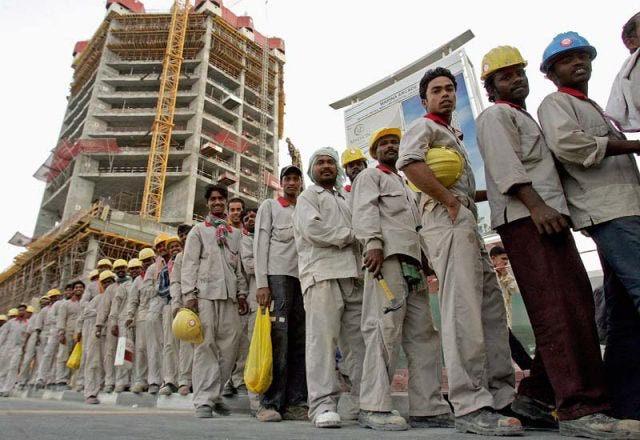
There is a version of the Gulf that its governments prefer to present: a civilisation conjured from desert and oil revenue through the vision of its rulers, its towers and highways and hospitals the expression of a sovereign ambition made material. This version is not entirely false. The oil was real, the ambition was real, and the money was spent. What the version omits is who built it. In Bahrain, Kuwait, Qatar, and the UAE, non-citizens account for more than eighty percent of the total population. In Qatar and the UAE, that figure approaches ninety. In the UAE’s private sector, foreigners constitute ninety-nine percent of the workforce. The towers of Dubai were built by men from Punjab and Khyber Pakhtunkhwa. The hospitals of Riyadh were staffed by nurses and orderlies from Sindh. The roads that connect the Gulf’s cities, the ports that move its goods, the construction sites still running in Fujairah and Ajman even as Iranian missiles have been falling on Gulf soil since February: all of it is Pakistani work, South Asian work, the physical output of people who came because the economy at home had no room for them and the Gulf needed bodies to build a civilisation it could not build on its own.
Pakistan sends roughly six million workers to the Gulf. In the last fiscal year those workers sent home $38 billion, a sum that accounts for 53 percent of Pakistan’s total remittance inflows, exceeds the entire value of the country’s active IMF programme, and constitutes somewhere between nine and ten percent of GDP. For a country that has spent the better part of its existence negotiating emergency financing with international lenders, the arithmetic of Gulf remittances is not an abstraction. It is the difference between a functioning rupee and a crisis. This is known. It is known in Islamabad and in Riyadh and, in a more immediate and untheoretical way, in the towns of Khyber Pakhtunkhwa and Punjab from which the majority of these workers come. What is less often stated plainly is what the $38 billion actually is. It is wages. It is not a transfer. It is not generosity extended from a wealthy neighbour to a struggling one. It is payment for work performed, under conditions the workers did not design and cannot legally escape.
The kafala system, which governs the lives of migrant workers across most of the GCC, binds each worker to a specific employer for the duration of his contract. He cannot change jobs without that employer’s permission. He cannot leave the country without that employer’s permission. If he walks off a worksite where he has not been paid in three months, he can be charged with absconding, a criminal category, and deported or imprisoned. His passport may sit in his employer’s office drawer, a practice that is both illegal under the laws of each Gulf state and effectively universal on the ground. The kafala is not a side arrangement that exists alongside the Gulf’s labour market. It is the architecture of that labour market. The Gulf’s ability to sustain a near-total migrant private workforce without extending those workers citizenship, political voice, or portable legal rights is not a flaw in the system. It is the system’s purpose. The Pakistani electrician working in Dubai, the construction foreman in Riyadh, the driver running deliveries through the night in Abu Dhabi: none of them are participating in a free market. They are participating in a system designed so they cannot exit it on their own terms.
This background matters now because a particular argument has gathered momentum since the war began on February 28, when joint US-Israeli strikes killed Iran’s Supreme Leader and opened a conflict that has so far killed more than 1,900 people in Iran and 22 in the Gulf states, including three Pakistani workers struck by drone debris in the UAE. The argument is presented in the language of strategic realism: Pakistan signed a mutual defence pact with Saudi Arabia in September 2025 whose operative clause holds that aggression against either party shall be considered aggression against both; Pakistan’s economy is structurally dependent on Gulf remittances; therefore Pakistan has both a treaty obligation and an economic compulsion to come to the Gulf’s defence. The case is made in television studios and newspaper columns and the language of retired generals who find strategic clarity invigorating. It is not made by the workers sleeping near drone-strike sites, who cannot afford to go home.
What the argument requires, and what its proponents do not say directly, is that the $38 billion in wages be reclassified as charity, retroactively converted from earned income into a debt that Islamabad now owes. The logic runs: you needed us, we gave you the opportunity, now you owe us. This is a precise inversion of the actual transaction. The Gulf did not bestow work on Pakistani labourers out of generosity toward a struggling economy. It recruited them, in the hundreds of thousands each year, because its own citizens would not and could not do the work. Pakistan exported 763,000 workers to GCC countries in 2025 alone. Those workers did not go because Pakistan is grateful to Saudi Arabia. They went because Pakistan’s unemployment rate stands at 7.5 percent, because 5.9 million Pakistanis are formally without work, and because the domestic economy has never been built in a way that could absorb them. The Gulf got exactly the workforce it required. Pakistan’s workers got wages they earned in full, under legal conditions that ensured they had almost no room to refuse the terms of the transaction.
The diplomatic record of this relationship is instructive on this point. In 2015, when Saudi Arabia launched its military campaign against the Houthis in Yemen and asked Pakistan to join, Pakistan’s parliament voted no. The relationship survived, because both parties have always understood it correctly: it is transactional, not fraternal. When Foreign Minister Ishaq Dar stood before reporters on March 3 and warned Tehran not to strike Saudi Arabia, invoking the September 2025 defence agreement, and when Defence Minister Khawaja Asif told those same reporters that Pakistan’s military capabilities would be placed at Riyadh’s disposal, only to walk the statement back entirely the following day, it was not a diplomatic accident. It was a demonstration of the ceiling this relationship has always had, and of the limited distance Islamabad is willing to travel from theatre to commitment. The ambiguity was built into the pact on purpose. It is the only architecture in which Pakistan can survive this moment.
What was not built in, anywhere in the pact or in the strategic commentary that followed it, is any serious reckoning with what this war costs the people who are not sitting in Al-Yamamah Palace or the Foreign Office. The Pakistan Institute of Development Economics estimates that if the conflict persists, 500,000 Pakistanis may be unable to secure Gulf employment this year, and another 500,000 currently in the Gulf may be compelled to return. A million people, concentrated in the districts of KPK and Punjab that have historically sent the most workers, absorbed back into a domestic labour market where they were already surplus before they left. The government official who described the prospect of this disruption as “manageable” spoke from Islamabad. The disruption will be managed in Dera Ismail Khan and Chakwal and Swabi.
The coercion argument, stripped of its strategic register, reduces to this: we hold six million of your people under a labour system they cannot exit unilaterally, their combined wages constitute your economy’s primary cushion against collapse, and therefore you will do what we require of you. It is the logic of the kafala applied to states rather than individual workers. The same structural dependency that prevents a construction labourer from walking off a site where he is not being paid now prevents Islamabad from walking away from an obligation it did not fully choose. In both cases, the party with the least power is told it owes the most.
The workers who built the Gulf are its creditors, not its dependents, and the debt has always run toward Pakistan.


