
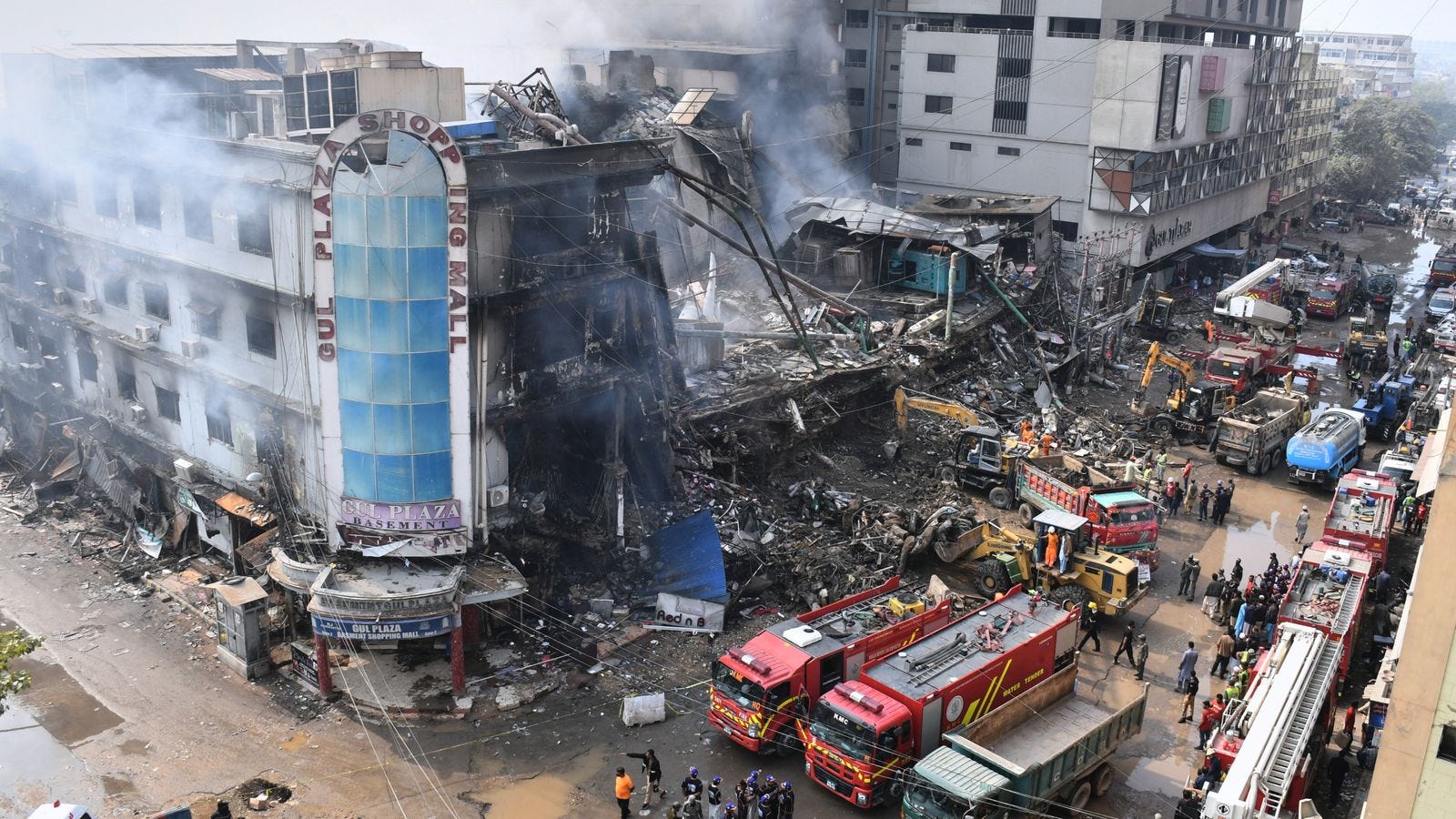
The Gul Plaza Inferno
How Decades of Local Government Failure Transformed Karachi’s Largest Shopping Complex Into a Death Trap
On the evening of January 17, 2026, a devastating fire erupted at Gul Plaza, a sprawling commercial shopping center on Muhammad Ali Jinnah Road in Karachi, Pakistan. The inferno claimed 28 lives, left between 65 and 81 people missing, and destroyed merchandise valued at approximately Rs 3 billion (USD $18 million). The fire raged for nearly 36 hours before being brought under control, making it the deadliest fire in Karachi since 2012. The disaster exposed critical governance failures, building safety violations, and systemic negligence spanning years. Rather than representing an unforeseen tragedy, this fire was a foreseeable consequence of institutional decay, regulatory capture, and the systematic prioritization of commercial revenue over human safety. The incident serves as a watershed moment exposing the comprehensive failure of Karachi’s urban governance structures and reveals that without fundamental reform to institutional incentives and accountability mechanisms, preventable catastrophes of similar magnitude will recur.
Incident Timeline and Scale
The fire broke out at approximately 10:15 PM on Saturday, January 17, 2026, in a ground-floor shop specializing in artificial flowers and related merchandise. The first emergency call was received at 10:38 PM, approximately 23 minutes after the fire began. Rescue 1122 personnel responded by dispatching two vehicles and fire tenders from the Karachi Metropolitan Corporation (KMC) arrived by 10:57 PM, approximately 42 minutes after the initial emergency call. What began as a localized blaze spread with terrifying rapidity through the complex structure, engulfing multiple floors within hours.


By the time firefighting operations ceased on Monday morning, January 19, the structure had suffered catastrophic damage. Approximately 40 to 60 percent of the five-story building (basement plus four floors) had collapsed. The commercial plaza housed approximately 1,200 shops spanning an area of 8,000 square yards, larger than a football field. The complexity of rescue operations was compounded by severe structural instability, poor ventilation that filled the building with choking smoke, and the presence of highly flammable materials including carpets, blankets, and resin-based goods that intensified the blaze and prolonged firefighting efforts.
Emergency response mobilized substantial resources: 22 to 24 fire tenders, four snorkel vehicles, ten water bowsers, 33 ambulances, approximately 200 firefighters from Rescue 1122 and the KMC, along with support from the Pakistan Navy, Sindh Rangers, and civil administration. Approximately 1.4 million gallons of water were deployed in the firefighting effort. Fire tenders remained at the site for 36 hours of continuous operations, with heavy equipment brought in for debris removal and structural stabilization.
The incident created an unprecedented strain on Karachi’s emergency services. Multiple hospitals received casualties, with Civil Hospital Trauma Centre, Abbasi Shaheed Hospital, and Jinnah Postgraduate Medical Centre all managing burn victims and those suffering from smoke inhalation. The initial medical response was adequate, with 33 ambulances deployed and hundreds of medical personnel mobilized. However, the scale of the disaster exceeded what would normally be anticipated from a commercial fire, suggesting that the incident was not a standard emergency but rather a catastrophic failure with dimensions that emergency planners had not adequately prepared for.
The Perfect Storm: Structural Violations and Systemic Safety Failures
The Gul Plaza inferno represents not a tragedy born of chance but rather the culmination of years of systematic regulatory failure and deliberate circumvention of safety standards. An investigation by the Sindh Building Control Authority (SBCA) revealed a staggering architecture of violations that transformed the commercial complex into what survivors correctly described as a “death trap.”
The severity of regulatory failure cannot be overstated. This was not a case of minor code violations overlooked through administrative negligence. Rather, the building was operated in flagrant violation of fundamental safety principles while authorities responsible for enforcement systematically collected fees in exchange for tolerance of these violations. The systematic nature of these violations, spanning over two decades and involving multiple government agencies, reveals a pattern that extends beyond isolated administrative failure to constitute institutional capture and corruption.
### Unauthorized Construction and Structural Overloading
The original building plan, approved in the 1980s, permitted 1,021 shops across a basement and three floors. However, approximately 1,200 shops were ultimately constructed, representing 179 shops in excess of approved capacity. An additional floor was illegally added in 1998 and subsequently regularized in 2003 through a completion certificate issued on April 14, 2003. Rather than representing legitimate commercial expansion, these modifications constituted structural overloading that compromised the integrity of emergency systems and load-bearing capacity.
The decision to regularize an illegal floor added nearly a quarter-century after its construction demonstrates the complete indifference of regulatory authorities to safety implications. Regularization in 2003 was not the result of accidental oversight or bureaucratic inertia; it was an explicit policy decision. The fact that the building operator, having illegally added a fourth floor in 1998 without authorization, was subsequently granted a regularization certificate in 2003 indicates that the SBCA had abandoned any pretense of enforcing building codes. If authorities will regularize a floor added illegally in 1998 when the original authorization had occurred in the 1980s, what message does this send about the enforceability of safety regulations?
The structural implications of these modifications are substantial. A building designed for a basement plus three floors experiences different loading patterns, ventilation requirements, and emergency egress needs than a building with a basement plus four floors. The roof was converted to parking, placing additional dead load on structural systems designed without anticipation of vehicular weight. The addition of 179 shops beyond the approved capacity means that the building housed approximately 17 percent more commercial operations than its structural design contemplated. This overloading would create stress on HVAC systems, electrical systems, and load-bearing walls. When fire occurred, it placed greater demand on structural elements already operating beyond design specifications.
Emergency Routes Converted to Commercial Space
In a particularly egregious violation, 179 of the excess shops were constructed in designated corridors, walkways, and parking areas, effectively converting emergency exit passages into commercial storefronts. This conversion was not accidental or the result of organic expansion. Rather, it reflects a deliberate calculation by building management that maximizing retail floor space would generate more revenue than maintaining functional emergency egress. That the SBCA not only permitted but regularized this conversion reveals the depth of regulatory capture.
Building codes worldwide reserve corridors, walkways, and certain designated areas for emergency egress precisely because these pathways are essential for rapid evacuation during crises. Converting these spaces to retail use is not a minor violation; it is a fundamental destruction of a building’s emergency infrastructure. When shoppers or workers need to evacuate a burning building, they rely on knowledge that designated corridors will be navigable. When those corridors have been converted to retail space, occupants encounter surprise obstacles that impede rapid egress. In the darkness and smoke that accompanied the Gul Plaza fire, the presence of these unexpected obstacles would have transformed evacuation from difficult to impossible for many individuals.
The deliberateness of this violation suggests that building management was not unaware of the conversion or the regulatory violation it represented. Rather, management appears to have made a conscious decision that the regulatory risk and potential penalties were less significant than the revenue generated by the additional 179 shops. This calculation proved horrifically accurate; the penalties imposed have been minimal compared to the revenue generated over two decades of illegal operation.
Exit Gates Locked and Sealed
At the time the fire erupted, approximately 10 PM on Saturday evening (near the complex’s closing time), 24 of the plaza’s 26 exit gates were locked, leaving only two access points for evacuation. This is not merely a violation of safety codes; it represents a conscious decision to restrict human exit from a structure during operating hours. The locking of emergency exits is among the most dangerous practices in building management, yet this practice proceeded unchallenged by authorities for years.
The practice of locking gates during business hours, even if done with the intention of preventing shoplifting or controlling access, represents a fundamental disregard for human safety. Emergency responders and fire safety officials around the world have long recognized that keeping emergency exits locked or inaccessible is one of the leading causes of death in fire incidents. The tragedy at the Triangle Shirtwaist Factory in New York in 1911, in which 146 workers died, was directly attributable to locked exit doors. The lessons from that tragedy have been incorporated into fire codes worldwide for over a century. That Gul Plaza in 2026 maintained 24 of 26 exit gates in locked condition suggests not merely negligence but a conscious disregard for lessons learned over more than a century.
According to survivor testimony, one businessman named Zubair, who managed to escape, stated that he had more than 20 people in his shop at the time, and “darkness and thick smoke made it impossible to escape.” Another shopkeeper recounted entering the burning building to rescue unconscious individuals, describing the locked gates as the mechanism that transformed the plaza into a “death trap.” These are not the recollections of individuals in shock; they are factual descriptions of preventable lethal conditions created by deliberate managerial choices.
The locking of emergency exits during operating hours appears to have been standard practice at Gul Plaza. This practice was not implemented as an emergency measure during the fire; the gates were already locked before the fire began. This suggests that management had made a deliberate decision to lock gates, presumably to prevent unauthorized access or to control foot traffic. The fact that this practice persisted for years without intervention from regulatory authorities indicates that authorities either did not inspect the building or did not enforce exit gate requirements when violations were discovered.
Inadequate Ventilation Systems
The building featured poor ventilation infrastructure, causing thick, toxic smoke to accumulate and spread throughout the structure. This density of smoke not only incapacitated occupants but severely hampered firefighting and rescue operations, delaying access to trapped individuals. The failure to install adequate ventilation systems in a large commercial building housing 1,200 shops is a fundamental violation of building codes in every jurisdiction with functional fire safety regulations.
Ventilation systems serve multiple critical functions in commercial buildings. They maintain air quality during normal operations and, in buildings equipped with fire safety features, help contain and manage smoke during fire incidents. Modern commercial buildings typically feature mechanical ventilation systems that can be controlled to reduce smoke spread. The absence of adequate ventilation at Gul Plaza meant that when fire began on the ground floor, smoke rapidly spread upward through the building without meaningful mitigation. Occupants on upper floors would have encountered thick smoke within minutes, making rapid evacuation impossible.
Survivors described conditions as “darkness and thick smoke,” language that suggests smoke density was so severe that visibility was essentially zero. In such conditions, individuals cannot navigate hallways or identify exit routes. The smoke density also incapacitated many individuals, likely through a combination of heat exposure and chemical inhalation. The poor ventilation design transformed a manageable fire incident into a catastrophic one.
Cause of the Fire and Contributing Factors
Initial investigations point to an electrical short circuit in a ground-floor shop specializing in artificial flowers and decorative items as the likely origin. However, the precise cause remains under formal investigation pending forensic examination. The presence of highly flammable materials, including imported carpets, blankets, and resin-based household goods, accelerated the fire’s spread vertically through the structure. According to Sindh Inspector General Javed Alam Odho, “The layout and construction of this market was such, and secondly, the nature of the items in it, such as carpets, blankets and other objects made of resins, so the fire is still simmering because of these.”
Initial police investigations found no evidence of sabotage or criminal intent to set the fire. The tragedy thus emerged from the convergence of two factors: a foreseeable electrical malfunction in an aging commercial complex and a structural design that had been systematically compromised to maximize retail revenue at the expense of human safety. An electrical short circuit is not an exceptional occurrence in large commercial buildings. What is exceptional, and inexcusable, is maintaining a building without adequate fire suppression systems, with blocked emergency exits, and with poor ventilation to contain such incidents when they occur.
The presence of highly flammable materials in quantity throughout the building appears to have been permitted without any corresponding fire suppression measures. A building housing large quantities of carpets, blankets, and resin-based goods should be equipped with sprinkler systems, fire alarms, and rapid notification procedures. The absence of these systems, combined with the presence of highly flammable materials, suggests either that no fire risk assessment was conducted or that assessments were completed but recommendations were ignored by building management and not enforced by regulatory authorities.
The electrical short circuit, when it occurred, was not an isolated incident but rather an event that triggered a cascade of failures. The fire, beginning in a shop on the ground floor, would normally be contained through several mechanisms: occupants would evacuate rapidly through emergency exits, alarm systems would alert authorities, fire suppression systems would begin automatic response, and firefighting personnel would arrive and suppress the fire. In Gul Plaza, nearly all of these mechanisms failed. Emergency exits were blocked or locked. The sequence of failures suggests systemic rather than isolated problems.
Human Cost: Casualties and Identification
As of January 20, 2026, 28 deaths have been confirmed, with 18 bodies identified and ten undergoing DNA testing at the University of Karachi’s forensic laboratory. The death toll is expected to rise as rescue operations continue and missing persons are found. Police and medical authorities have collected DNA samples from 15 to 38 relatives of missing persons to facilitate identification, as many bodies have been severely burned and rendered visually unrecognizable.
The identification process represents an additional layer of trauma for grieving families. The requirement to provide DNA samples and wait for laboratory results means that families cannot immediately transition to funeral rites and mourning. Instead, they exist in a state of prolonged uncertainty, simultaneously grieving presumed loss while waiting for official confirmation. This liminal state, in which a family member is presumed dead but not officially confirmed, creates psychological trauma extending far beyond the immediate shock of the incident.
Among the deceased is firefighter Furqan Ali, 38 years old, from the Nazimabad Fire Office, who died while attempting to rescue trapped civilians. Ali was married for just over a year and is survived by a six-month-old son, a widow, two brothers, and four sisters. According to his family, Furqan was the primary financial support for his sisters following their father’s death, also a firefighter. The family reported that his last ambition was to see his son grow up and become a lawyer, a dream that will never materialize.
Furqan Ali’s death deserves particular attention because it exemplifies the moral hazard created by regulatory failure. Ali entered a burning building to rescue civilians trapped by locked emergency exits. He did not need to enter a building with inadequate emergency systems if the building had been properly constructed and maintained. His death was not an unavoidable risk inherent in firefighting but rather a direct consequence of regulatory authorities permitting a building to operate with systematic safety violations. The valorization of Ali’s sacrifice, while appropriate, must not obscure the reality that his death was preventable through enforcement of existing building codes.
Karachi Mayor Murtaza Wahab announced immediate financial assistance of Rs 100 million (approximately USD $360,000) to Furqan’s family and pledged that the KMC would provide employment to his widow and bear all educational expenses for his son. The Nazimabad Fire Station has been renamed in his honor. These gestures represent appropriate recognition of Ali’s sacrifice, but they do not address the systemic failures that necessitated his heroic action in the first place.
The other deceased individuals were predominantly shopkeepers and employees working in the plaza at the time of the fire. Many were young, in their twenties and thirties. Several were sole breadwinners for extended families. The economic impact of these deaths extends far beyond the immediate families; sisters, brothers, parents, and dependents lost individuals upon whom they relied for financial support. The compensation offered by the government, while substantial in absolute terms, addresses only a fraction of the long-term economic impact on surviving family members.
The Missing and the Extended Crisis
Between 65 and 81 individuals remain officially reported as missing, though police have indicated that based on cellular data analysis and witness reports, approximately 32 to 38 of these individuals had their last known location traced to Gul Plaza at the time of the fire. The discrepancy reflects the chaotic nature of the evacuation and the difficulty in definitively confirming whether individuals trapped in the building have perished, remain trapped, or managed to evacuate without reporting to authorities.
The presence of missing individuals creates an additional layer of uncertainty. Some families have no body to bury and no confirmation of death. The absence of remains means that funeral rites cannot be performed according to Islamic law, which requires that remains be washed and given proper burial. Families face an indefinite liminal state in which a loved one is presumed dead but not officially confirmed. This uncertainty can persist for months or years if remains are never recovered, creating permanent trauma for surviving family members.
Grieving families gathered at Civil Hospital Karachi’s morgue, providing police with detailed descriptions of missing loved ones, including clothing, physical characteristics, and distinguishing birthmarks, to assist with identification. The emotional toll was evident: one woman named Razia described how six of her relatives worked in the plaza. One of them jumped from the building with two friends; one friend broke his legs, and the other died on impact. Another family member, Ibrar, who worked in a flower shop, broke down a door to help others escape but remained trapped himself.
Razia’s account illuminates the arbitrary nature of survival. Her relative who jumped survived because his friend broke his legs and cushioned his fall. The other friend died because he landed differently. Another relative, Ibrar, attempted to help others and died for that choice. These random variations in outcome create a sense of injustice that permeates survivor narratives. Those who died were not fundamentally different from those who survived; often the difference was a matter of which stairwell they entered or which direction they ran when the fire began.
Heroic Rescue Operations and Operational Challenges
Emergency response personnel worked with extraordinary dedication despite formidable constraints. Rescue operations established three separate access points to enter the devastated structure, using thermal cameras and heavy machinery to navigate the debris field. Fire brigade personnel cut through windows and demolished walls with hammers to create pathways for rescue teams. The level of physical effort required was extraordinary; firefighters and rescue workers labored for 36 hours in conditions of extreme heat, poor air quality, and structural danger.
The heroism of rescue personnel should not be understated. Many individuals, when faced with a burning building, immediately seek to minimize personal risk. Firefighters and rescue workers instead enter burning buildings to search for trapped individuals. The rescue personnel at Gul Plaza did exactly this, working systematically through the destroyed structure despite the risk that the building would collapse at any moment. Several rescue workers sustained injuries; at least one died.
However, the rescue effort faced substantial obstacles that were not inherent to firefighting but rather the direct result of regulatory failure. The building’s poor ventilation caused thick smoke to accumulate, obscuring visibility and slowing rescue operations. Structural instability necessitated extreme caution. Fire officials warned that the building could collapse at any moment, forcing rescue teams to proceed with deliberate, methodical care rather than speed. Initially, teams managed to access only 5 to 10 percent of the building’s interior, with the first floor remaining inaccessible for many hours due to severe structural damage and debris accumulation.
The contrast between the rapid initial fire spread and the slow subsequent rescue operations is striking. The fire spread throughout the building in a matter of hours because the building had inadequate fire suppression systems, poor ventilation that allowed smoke and heat to spread rapidly, and insufficient structural integrity to resist fire damage. The rescue operations proceeded slowly because rescuers had to navigate a partially collapsed building in darkness and poor visibility, searching for individuals who had taken refuge in locked rooms or had fallen and become inaccessible.
Additionally, rescue officials noted that roadside encroachments and unauthorized construction near Gul Plaza caused delays in vehicle access, hampering response times during the critical early hours of the fire. This cascading failure demonstrates how decades of uncontrolled illegal construction throughout Karachi’s commercial districts create conditions that compromise emergency response even before accounting for problems within the building itself. When fire response vehicles cannot access a burning building because informal settlements or unauthorized construction block the streets, the response time increases unnecessarily. At Gul Plaza, these external obstacles appear to have contributed to delays during the critical period between fire initiation and arrival of heavy firefighting equipment.
Regulatory Collapse and Institutional Negligence
The Gul Plaza inferno represents not merely an isolated tragedy but rather the culmination of systemic failure across multiple levels of government. The Sindh Building Control Authority, the primary body responsible for enforcing building codes and safety standards, had issued a completion certificate in 2003 despite known violations. Documents subsequently revealed that the plaza had been operating for over two decades with 179 shops constructed in violation of approved plans.
The regulatory failures here are not matters of negligence or bureaucratic incompetence. They reflect a deliberate system of institutional capture whereby regulatory authorities systematically prioritized collection of “maintenance fees” and other payments from building operators over enforcement of safety standards. The term “maintenance fees” is euphemistic language for bribes paid to regulatory officials in exchange for ignoring safety violations. This system could only persist if officials throughout the chain of authority, from field inspectors to supervisory personnel to senior administrators, participated in or acquiesced to the corruption.
Governor Kamran Tessori’s public comments underscored the depth of institutional corruption. He remarked, “The individuals involved in these actions, including lower-level staff and inspectors collecting fees while neglecting safety standards, this money is payment for murder, not bribery.” This characterization, from a senior government official, constitutes an implicit acknowledgment that regulatory authorities had facilitated a system in which human lives were sacrificed to provide revenue streams for corrupt officials.
The terminology “payment for murder” is not hyperbolic. If regulatory officials knowingly permit a building to operate with locked emergency exits, inadequate ventilation, and structural overloading in exchange for payment, they are participating in a system that foreseeably increases the likelihood of death in a fire incident. When that fire occurs and individuals die, the officials who accepted payment for ignoring safety violations bear responsibility for those deaths. Governor Tessori’s willingness to characterize this as “payment for murder” suggests an understanding that the system was not merely corrupt but lethal.
The petition filed in the Sindh High Court on January 19, 2026, contends that the tragedy constitutes a “direct consequence of gross negligence” and “maladministration” by relevant authorities. The petition references a December 2020 Sindh High Court directive mandating that fire tenders be maintained in operational status, emergency helplines be functional, and divisional task forces conduct regular inspections with strict enforcement protocols and 48-hour complaint resolution timelines. Despite over four years passing since that court directive, the petitioners assert that respondents “have knowingly and willfully failed to implement these directives in their true essence,” with task forces existing “primarily on paper,” inspections being “infrequent,” and enforcement being “virtually non-existent.”
This failure to implement a judicial directive over a four-year period is not a bureaucratic oversight. It represents a deliberate choice by regulatory authorities to disregard explicit court orders. The fact that such a choice could proceed without consequence until 28 people died illuminates the complete absence of accountability mechanisms in Karachi’s governance structures. If a judicial directive to enforce fire safety measures can be ignored for four years without consequence, what enforceability do building codes possess?
Economic Devastation and Long-Term Consequences
The fire destroyed merchandise and capital valued at approximately Rs 3 billion (USD $18 million), with traders estimating that each shop contained stock valued between Rs 2.5 million and Rs 3 million, much of which had been purchased in preparation for the upcoming wedding season. The destruction rendered approximately 6,000 employees instantly unemployed, as the plaza housed roughly 1,200 family-operated retail businesses.
The economic impact extends far beyond the immediate loss of inventory. Many traders had invested their life savings in their businesses. The fire destroyed not merely commercial stock but life accumulations of capital built through years or decades of work. For a trader who had invested Rs 5 million in inventory and store setup over a decade of business, the fire represents not simply a business loss but the destruction of accumulated wealth. If the trader had a family depending on that business for income, the fire simultaneously renders that income source unavailable, often for an indefinite period.
One trader described standing outside the plaza “holding his hands in prayer, tears streaming down his face” while confirming that five of his friends remained trapped inside. The juxtaposition of personal financial ruin with the loss of friends creates a compound trauma that extends far beyond a simple commercial loss. This trader had lost both capital and social connections in a single incident.
Traders submitted requests to the government for rehabilitation assistance of up to Rs 5 billion, a figure comparable to the rehabilitation package announced following the 2012 Baldia Town factory fire, which killed 258 to 289 workers. The disproportion between requests and likely government response is substantial. If government allocates Rs 5 billion for trader rehabilitation, that represents approximately 0.17 percent of Sindh’s annual budget. The fact that such a request appears substantial suggests the limited resources available for disaster recovery in Karachi.
The long-term economic consequences are difficult to quantify but potentially severe. Approximately 6,000 employees will be unable to find work until the building is reconstructed and shopkeepers resume operations. In Karachi’s labor market, displaced workers from small retail businesses often lack other employment options and may experience prolonged unemployment. If reconstruction takes one year, 6,000 workers represent 6,000 person-years of unemployment, equivalent to 6 million workdays without income. For workers living near subsistence, this unemployment creates not merely economic disruption but potential destitution.
Traders who owned multiple shops or relied on Gul Plaza for their primary income face similar long-term challenges. A trader who operated five shops in the plaza and lost all five has lost their primary business and capital investment simultaneously. Reconstruction could take years, and even after reconstruction, there is no guarantee that traders will be able to resume business if their capital was destroyed and they lack resources to purchase new inventory.
Government Response and Adequacy of Compensation
Sindh Chief Minister Syed Murad Ali Shah announced a multi-faceted response package on January 19, 2026.
Financial Assistance and Compensation Limitations
Each family of a deceased victim will receive Rs 10 million (approximately USD $36,000) in compensation, with disbursement beginning January 20. Firefighters’ families received additional compensation: Furqan Ali’s family was promised Rs 100 million with guaranteed employment for his widow and educational support for his son.
While this compensation represents a substantial immediate commitment, it warrants critical scrutiny. Rs 10 million represents approximately USD $36,000, a figure comparable to the annual income of working-class families in Karachi. In a context where individuals work decades to accumulate capital worth tens of millions of rupees, a one-time payment of Rs 10 million cannot reasonably be characterized as adequate compensation for loss of a breadwinner. For families where the deceased was the sole income earner, this payment represents survival assistance rather than genuine compensation for loss.
Consider a family in which the deceased was a 35-year-old shopkeeper who had been working for 20 years and had another 25 years of potential earning capacity. The lifetime earning loss from losing a 35-year-old is substantial. A worker earning Rs 25,000 monthly would have a remaining earning capacity of Rs 7.5 million over 25 years before discounting. The compensation of Rs 10 million represents only marginally more than this bare calculation, and does not account for lost financial support beyond the mere present value of earnings, such as support for children’s education or assistance to extended family members.
Furthermore, Rs 10 million compensation provides no income stream. After the one-time payment is exhausted, the family has no continuing means of support unless other family members find employment. For widows in Karachi, employment opportunities are limited, particularly for those with limited education. The government’s commitment to provide employment to Furqan Ali’s widow is welcome but suggests that comparable commitments will not be made to other widows. If only the family of a firefighter receives employment support while widows of shopkeepers do not, the government is implicitly signaling that deaths of emergency personnel are valued more highly than deaths of workers.
Reconstruction Commitment and Timeline Uncertainty
The CM pledged that the destroyed Gul Plaza building would be fully reconstructed, with affected traders receiving rehabilitation and temporary or alternative commercial spaces to resume business operations as quickly as possible. However, no timeline or funding mechanism for reconstruction was specified. Given bureaucratic timelines in Pakistan’s construction sector, traders face an indefinite period without access to their commercial spaces.
In Pakistan’s experience, government-supported reconstruction projects routinely exceed anticipated timelines by 100 to 200 percent. A project anticipated to take 18 months often requires three years. This is not due to lack of effort but rather reflects the complexity of coordinating between multiple government agencies, securing funding, managing contractor relationships, and addressing technical challenges that emerge during construction. For traders, this means that the anticipated timeline for resuming business is likely much longer than official projections suggest.
The absence of a specified timeline is problematic because it leaves traders unable to plan business recovery. Should they seek alternative business locations during reconstruction? Should they attempt to acquire inventory on credit? Should they seek employment in other sectors? Without knowing when their shop spaces will be available, traders cannot make informed business decisions. The uncertainty itself is a form of economic damage, as traders cannot plan and execute business recovery strategies.
Inquiry and Investigation Processes
An inquiry committee led by Karachi Commissioner Hassan Naqvi was established to investigate the fire’s cause, identify safety lapses, and assess responsibility. The CM left open the possibility of forming a judicial commission if necessary. However, the presence of an inquiry committee, absent explicit independence, accountability deadlines, and enforcement mechanisms, has historically proven insufficient to generate meaningful accountability for institutional failures in Pakistan.
Multiple previous inquiries into disasters, including the 2012 Baldia Town factory fire and various air crashes, have concluded with detailed findings regarding institutional failures but without significant consequences for responsible officials. Inquiries identify failures, recommend reforms, but do not typically result in prosecution, dismissal, or meaningful disciplinary action against officials. The establishment of an inquiry committee is appropriate but should not be mistaken for genuine accountability.
The possibility of a judicial commission is welcome but also potentially problematic. Judicial commissions can investigate complex institutional failures in greater depth than standard inquiries. However, judicial commissions also proceed slowly, often taking years to complete work and render findings. A judicial commission into Gul Plaza might not produce findings until 2028 or 2029, by which time memory of the incident will have faded and political will for accountability will have diminished.
Fire Safety Reforms and Their Insufficiency
The government announced immediate implementation of the Fire Safety Audit 2024, which had previously reviewed 145 buildings in Karachi but had not been enforced. Buildings found non-compliant, particularly those lacking adequate emergency exits, fire suppression systems, or alarms, would be directed to undertake immediate remedial works. Additional measures include mandatory installation of fire alarms in all shops, enhanced sprinkler systems, and expedited legislation including the Sindh Community Safety Act 2026 and stricter building safety regulations.
The announcement of safety reforms is noteworthy primarily for what it reveals about the status quo ante. The government is now proposing measures that should have been implemented years, if not decades, earlier. That the government must announce mandatory fire alarms for commercial buildings in 2026 demonstrates the failure of regulatory frameworks that should have been established decades earlier. The fact that 145 buildings had been audited in 2024 but the audit had not been enforced indicates that the problem is not knowledge of safety deficiencies but rather the political will to enforce compliance.
The announcement of expedited new legislation including the Sindh Community Safety Act 2026 raises questions about why such legislation was not in place prior to 2026. If a comprehensive community safety act is needed to address fire safety in commercial buildings, this suggests that existing legislation is inadequate. The need for new legislation following a major disaster is understandable, but the fact that such critical legislation did not exist prior to the incident demonstrates the policy failure that preceded it.
The effectiveness of these reforms depends entirely on implementation. Pakistan’s regulatory history is replete with examples of announced reforms that were not followed through, were implemented inconsistently, or were abandoned after initial implementation. The announcement of enforcement of the Fire Safety Audit 2024 is welcome, but whether buildings will actually be brought into compliance remains uncertain. If enforcement of these measures is inconsistent or incomplete, similar incidents will recur.
Institutional Restructuring Efforts
The CM directed that all local government fire services be unified under Rescue 1122 to ensure professional and coordinated emergency response across Sindh province. This proposal, while potentially beneficial for future emergency response coordination, does not address the fact that Rescue 1122 responded to the Gul Plaza fire within approximately 20 minutes. The actual failure occurred not in emergency response timing but in decades of regulatory negligence preceding the fire.
The unification of fire services is reasonable and potentially beneficial, but it represents institutional reform of emergency response rather than reform of building regulation or enforcement. Faster or more coordinated emergency response cannot prevent fire incidents; it can only mitigate consequences. The fundamental failure at Gul Plaza occurred long before the fire, during the decades in which the building was permitted to operate without adequate safety systems. Institutional restructuring of fire services does not address this fundamental failure.
Political Response and Absence of Accountability
The Gul Plaza fire immediately became a focal point for political debate about governance in Karachi. On January 20, 2026, the National Assembly resonated with calls for institutional reform and accountability. Yet the political response has been characterized more by finger-pointing than by genuine commitment to address systemic failures.
Opposition Party Criticism
Jamaat-e-Islami’s parliamentary leader Muhammad Farooq submitted an adjournment motion demanding accountability for negligence and highlighting how the tragedy had “exposed Karachi’s corrupt and dilapidated system.” MQM-P leader Dr. Farooq Sattar criticized what he characterized as the Sindh government’s “prolonged inaction, negligence, and corruption,” noting that the CM arrived at the scene 22 hours after the fire began. Sattar called for empowerment of local government structures, arguing that centralized provincial control had left Karachi underfunded and under-resourced compared to its scale and population.
These criticisms, while highlighting real failures, came primarily from opposition parties without meaningful power to implement reforms. In Pakistan’s political system, parliamentary criticism rarely translates into meaningful institutional change absent pressure from civil society, media sustained attention, and courts willing to enforce accountability. Statements by opposition parties represent political theater rather than institutional reform. The political incentives are for opposition parties to criticize the government and for the government to defend its record, with little incentive for either party to implement fundamental institutional change.
Federal Provincial Coordination
Khyber Pakhtunkhwa Chief Minister Sohail Afridi sent an official letter expressing condolences and solidarity with the Sindh government, stating that “the sorrow of one province resonates throughout the nation.” While expressing appropriate sympathy, such gestures do not constitute action toward preventing similar disasters in other provinces or at the federal level.
Government Defense and Deflection
PPP lawmaker Shehla Raza acknowledged management failures at the site while defending the emergency response timeline, noting that rescue services arrived within minutes of the first call and that such fires can occur in various locations regardless of preparedness levels. This response exemplifies the problematic conflation of emergency response (which was adequate) with decades of regulatory failure (which was comprehensive). The fact that rescue services responded quickly does not absolve regulatory authorities of responsibility for permitting a building to operate with systematic safety violations for two decades.
This argument represents misdirection. The government is correct that emergency response was rapid. However, the disaster did not occur because emergency response was slow; it occurred because the building was permitted to operate with locked emergency exits, inadequate ventilation, and structural overloading. These are failures of regulatory enforcement, not emergency response. By defending the emergency response, the government deflects attention from the actual failures.
Absence of Official Accountability
Critically, no government official responsible for regulatory oversight at the SBCA, KMC, or provincial administration has publicly accepted responsibility or announced resignation. In contrast to private sector norms where executives resign following institutional failures resulting in loss of life, Pakistani government officials involved in systematic regulatory negligence proceeded with business-as-usual operations. This absence of consequences demonstrates that institutional incentives have not changed. Officials calculate that accepting a position in government entails no personal consequences for regulatory failure, provided that failure is sufficiently widespread and the political will for accountability is insufficient.
Judicial Proceedings
A petition was filed in the Sindh High Court naming the Sindh government, Sindh Building Control Authority, Karachi Metropolitan Corporation, the chief fire officer, director general of Rescue 1122, and the director general of civil defense as respondents, seeking criminal, departmental, and contempt proceedings for negligence and non-implementation of safety directives. The presence of judicial proceedings is noteworthy, but the history of litigation regarding similar disasters suggests that legal processes can extend for years with uncertain outcomes.
The judicial system in Pakistan operates slowly. A case filed in 2026 might not be resolved until 2030 or beyond. By that time, public attention will have moved to other crises, political pressure for accountability will have dissipated, and the likelihood of meaningful enforcement will have decreased. The presence of legal proceedings is appropriate, but it should not be mistaken for accountability.
Historical Context: Karachi’s Fire Safety Crisis and Pattern of Failure
The Gul Plaza fire represents the deadliest fire in Karachi in over a decade, but it follows a pattern of catastrophic fire incidents in Pakistan that has not fundamentally changed despite repeated tragedies. This is not a new problem; it is a recurring failure with a clear pattern of causation.
The most significant precedent is the 2012 Baldia Town garment factory fire, which killed between 258 and 289 workers. That fire occurred in a facility where nearly all exit doors were locked and windows were covered with iron bars, eerily similar to the Gul Plaza situation. A court later ruled that arson was responsible for the 2012 fire, attributing it to criminal activity by an organized political group demanding extortion payments. What is notable is not merely that the fire occurred but that the building operators had locked the exits and barred the windows, demonstrating that safety was systematically neglected.
The 2012 tragedy prompted reforms in Pakistan’s approach to industrial safety. Government committees were formed, recommendations were made, and legislation was proposed. Yet the persistence of locked exits, poor ventilation, and regulatory non-enforcement in commercial spaces nearly 14 years later suggests that institutional learning has been minimal and systemic problems persist. Despite these years of institutional commitment to prevent recurrence of 2012-style tragedies, Karachi’s largest shopping complex in 2026 maintained fundamentally similar conditions: locked emergency exits, inadequate ventilation, and regulatory authorities that either were unable or unwilling to enforce safety standards.
The fact that a tragedy of comparable magnitude occurred in 2026 after lessons were purportedly learned in 2012 suggests that the problem is not merely knowledge of what needs to be done but rather the absence of political will and institutional capacity to enforce compliance. When identical conditions recur 14 years after a similar catastrophe, it indicates systemic failure rather than isolated negligence. This is not a case of officials being unaware of fire safety principles; it is a case of officials being unwilling to enforce compliance with those principles.
Survivor and Eyewitness Narratives: Voices of the Trapped
Survivor testimonies provide harrowing evidence of the conditions that transformed the plaza into a death trap. Shopowner Shahbaz Iqbal, 27, described his initial disbelief at the scale of the disaster: “We thought it was a small fire. No one ever thought it would be this bad. It engulfed the whole mall in front of our eyes.” He and his coworkers managed to escape by running upstairs and accessing one of the basement exits, a pathway unavailable to those trapped in upper floors. This account suggests that survival was often determined by physical location at the moment the fire began rather than by any action taken by the individual.
Survivor Zubair provided explicit testimony about the exit gates: despite the plaza having 26 gates for emergency egress, only two were accessible at the time of the fire. “When I went in to the building, I saw the locks,” recalled rescue worker Aqeel, who declined to provide his full name due to lack of authorization to speak to media. This account confirms that the locking of gates was apparent to rescue personnel, suggesting that the locked condition was intentional and obvious rather than accidental or camouflaged.
Another shopkeeper entered the burning building to rescue trapped individuals, pulling several unconscious people to safety. This individual survivor vividly described the conditions: “There were no emergency exits and those locked gates had turned the building into a death trap.” This is not hyperbole or emotional exaggeration; it is factual description of conditions created by deliberate managerial decisions regarding gate locking procedures. The phrase “turned the building into a death trap” echoes language used in fire safety literature to describe buildings where emergency exits are locked or inaccessible. This terminology is used precisely because locked emergency exits transform buildings from safe to lethal.
Shafi Ahmed, who owned a store in the basement, stood outside the plaza holding his hands in prayer, tears streaming down his face. When asked if anyone he knew was inside, he stated that five of his friends remained trapped. He repeated, broken with grief: “These are all our people. These are all my people. These are our people.” The repetition of this phrase suggests the surreal quality of the incident; Shafi was unable to process that people he knew, colleagues in the same business district, were trapped in a burning building.
One audio clip that circulated on social media captured a man pleading from inside the burning building: “We’re trapped on all sides. Fire is... Please forgive me if I did something wrong,” before the recording abruptly ended. The phrase “please forgive me if I did something wrong” is particularly poignant because it suggests an individual not merely facing death but conscious of the injustice of his situation. He had done nothing wrong; he was simply trapped by the deliberate locking of emergency exits. That he felt compelled to ask forgiveness suggests internalization of guilt even though he was a victim rather than a perpetrator.
These survivor testimonies, collected collectively, constitute evidence that the incident was not merely a fire but a structure designed to trap individuals. When multiple independent observers describe locked gates, darkness, thick smoke, and inability to escape despite the plaza having 26 designated emergency exits, the pattern is clear: the building’s emergency infrastructure had been systematically compromised.
DNA Identification Process and Extended Trauma
Police Surgeon Dr. Summaiya Syed supervised the identification process using DNA analysis at the University of Karachi’s forensic laboratory. As of January 20, 2026, DNA samples had been collected from seven bodies and 38 relatives for comparison testing. The identification process has been complicated by the severely burned condition of many bodies, rendering visual identification impossible. Families have been asked to submit DNA samples and provide detailed descriptions of missing individuals to facilitate identification.
The requirement for DNA identification adds significant time to the process of confirming deaths. A family member who died in the fire will not be confirmed dead until DNA results are received from the laboratory. This can take weeks or months depending on laboratory capacity and backlog. The Citizens-Police Liaison Committee established an emergency identification camp outside Civil Hospital Trauma Centre where families could provide information about distinguishing characteristics of their loved ones. Unidentified bodies have been transferred to Edhi Foundation morgues pending DNA confirmation.
The presence of unidentified bodies in morgues creates a secondary trauma layer. Families know that bodies of their loved ones are in the morgue but do not know which body belongs to whom. The process of waiting for DNA results and the anxiety of the unknown extend the crisis period far beyond the immediate fire incident. For some families, this period could extend indefinitely if remains are not recovered or are too damaged for identification.
Structural Assessment and Implications for Future Building Safety
As rescue operations progressed, engineers assessed the remaining structure and deemed it critically unstable. Approximately 40 to 60 percent of the building had already collapsed due to the fire’s intensity and the structural damage caused by intensive firefighting operations. The remaining sections posed an imminent danger of further collapse, prompting officials to deploy cranes and heavy equipment for controlled demolition to prevent catastrophic structural failure.
Fire officials estimated that complete debris clearance would require 15 to 17 days of continuous operations using heavy machinery and round-the-clock labor. The Sindh CM indicated that the entire building might require complete demolition and reconstruction rather than partial rehabilitation due to the extent of damage. This raises a critical question: if the structure was sufficiently damaged to warrant complete demolition, what does this imply about its structural integrity at the moment the fire began?
The answer is that the building’s structural compromises, including the illegal fourth floor and conversion of load-bearing walls into retail space, exacerbated the fire’s destructive potential and the ultimate scale of damage. A properly constructed building, even one that experienced a fire, would likely be salvageable. The fact that Gul Plaza requires complete demolition suggests that the structural integrity was compromised before the fire. The fire was merely the catalyst that revealed pre-existing structural weakness.
The requirement for complete demolition and reconstruction rather than repair has major implications for timeline and cost. A building that could be partially repaired might be operational within six months. Complete demolition and reconstruction could require two to three years. For the 6,000 employees who worked in the plaza, this represents a prolonged employment crisis. For the 1,200 traders who operated shops, this represents years without access to commercial space.
Systemic Lessons and Deeper Implications
The Gul Plaza inferno illuminates fundamental pathologies in Pakistan’s approach to urban commercial safety regulation. An analysis published in Dawn newspaper stated: “Buildings transform into lethal traps not due to ambiguous regulations, but because enforcement has been systematically undermined.”
The fire revealed that several systemic problems require attention:
Regulatory Capture and Institutional Corruption
The Sindh Building Control Authority had been compromised to the extent that officials collected “maintenance fees” from building operators while systematically overlooking documented safety violations spanning multiple decades. The regularization of an illegal fourth floor nearly a quarter-century after its construction, combined with the continued operation of 179 shops in violation of approved plans, demonstrates that regulatory oversight was effectively abandoned. If authorities will regularize a floor added illegally in 1998, what message does this send about the enforceability of safety regulations?
The system of fee collection appears to have created perverse incentives. Officials who collected fees for overlooking violations had a financial interest in maintaining that system. Rather than enforcing regulations, which would eliminate the fee-collection mechanism, officials systematized the corruption. This is not merely individual corruption but rather institutional capture, in which the regulatory agency itself has been subordinated to fee-extraction activities.
Non-Enforcement of Judicial Directives
A December 2020 Sindh High Court directive mandating fire safety measures was ignored for four years, with task forces existing “primarily on paper” and inspections remaining “infrequent.” The failure of regulatory authorities to implement a judicial directive over a four-year period is not bureaucratic incompetence; it represents a deliberate choice to disregard explicit court orders. The consequences of this choice include the deaths of 28 individuals and injuries to dozens more. If a court can issue a directive and authorities can disregard it without consequence for four years, what enforceability do building codes possess?
Institutional Leadership and Capacity
Leadership at regulatory agencies has been subject to rapid, unjustified turnover, undermining continuity and accountability in safety enforcement. If a senior official at the SBCA is rotated to another position every 18 months, that official has minimal incentive to invest in long-term institutional reform. Instead, the incentive is to manage current operations without generating controversy. In such an environment, accountability for past failures and enforcement of future compliance become low priorities.
Commercial Incentives and Profit Prioritization
The conversion of emergency exit routes into retail space demonstrates how profit motives systematically override safety considerations in the absence of credible enforcement mechanisms. A building operator calculated that the revenue generated by 24 additional shops in emergency corridors exceeded the value of maintaining functional emergency exits. This calculation proceeded without interference from regulatory authorities, suggesting that the regulatory apparatus had either abandoned oversight or been compromised by financial arrangements compensating officials for their tolerance.
### Emergency Response and Infrastructure Access
Roadside encroachments and unauthorized construction near Gul Plaza caused delays in emergency vehicle access during the critical early hours of the fire. This cascading failure demonstrates how decades of uncontrolled illegal construction throughout Karachi compromise emergency response even independent of problems within the building itself. When fire response vehicles cannot access a burning building, response time increases unnecessarily and lives are lost.
Absence of Accountability Consequences
As of January 20, 2026, no government official responsible for regulatory oversight has announced resignation or accepted personal responsibility. This absence of consequences demonstrates that institutional incentives have not changed and that officials have calculated that regulatory negligence, even resulting in mass death, does not trigger consequences they fear more than the benefits of regulatory capture.
Conclusion: Systemic Failure and the Need for Fundamental Reform
The Gul Plaza inferno of January 17 to 19, 2026, claimed 28 lives, left 65 to 81 individuals missing, destroyed approximately USD $18 million in merchant capital, and rendered 6,000 workers unemployed. The destruction of the building will require years to remediate and reconstruction will be decades in the making. However, the disaster transcends these quantitative measures to represent a watershed moment exposing systemic governance failure in one of Pakistan’s largest metropolitan centers.
The fire was not an “accident” in any meaningful sense. It emerged from the convergence of three preventable factors: (1) an electrical short circuit in an aging building, a foreseeable hazard in any large commercial complex; (2) structural compromises including 179 illegal shops, blocked emergency exits, and poor ventilation that had been tolerated by regulatory authorities for over two decades; and (3) locked exit gates that transformed a commercial space into a death trap at closing time. Each of these factors was preventable through adequate regulatory enforcement.
The fact that a tragedy nearly identical to the 2012 Baldia Town factory fire occurred 14 years later suggests that institutional learning has been minimal and systemic problems persist. The announcement of safety reforms like mandatory fire alarms in 2026 demonstrates the failure of regulatory frameworks that should have been established decades earlier. That authorities discovered this need only after 28 people died reveals the complete absence of proactive regulatory engagement prior to the tragedy.
The compensation offered to families of deceased individuals, while substantial in absolute terms at Rs 10 million per family, represents approximately 3 percent of the total economic loss to traders and leaves the vast majority of economic damage uncompensated. More fundamentally, money cannot compensate for the loss of human life resulting from regulatory negligence. No compensation package can restore a child’s parent, a widow’s husband, or a family’s primary breadwinner.
The response announced by provincial authorities, including reconstruction commitments and implementation of previous safety audits, represents appropriate crisis management. However, systemic accountability for the regulatory failures that enabled the disaster remains incomplete, with judicial proceedings ongoing at the Sindh High Court. Critically, no government official responsible for decades of regulatory negligence has announced resignation or accepted personal responsibility. This absence of consequences suggests that institutional incentives remain unchanged and that future regulatory failure is foreseeable absent fundamental reform.
Until Pakistan’s regulatory institutions are rebuilt with genuine independence, professional leadership insulated from political manipulation, and credible enforcement mechanisms with consequences for non-compliance, Karachi and other Pakistani cities will remain vulnerable to preventable catastrophes like Gul Plaza. The current institutional structure, in which regulatory officials can systematically accept payments in exchange for tolerating life-threatening safety violations with impunity, is fundamentally incompatible with public safety. The Gul Plaza inferno represents not an aberration but rather an inevitable consequence of regulatory capture and the absence of meaningful accountability.
The path forward requires several specific reforms: (1) establishment of independent regulatory bodies with professional leadership appointed through merit-based processes; (2) mandatory public inspection protocols with results published in real-time to enable community oversight; (3) severe financial and criminal penalties for regulatory non-compliance and fee-taking for overlooking violations; (4) personal accountability for regulatory officials through both criminal prosecution for corruption and professional consequences for regulatory failures; and (5) empowerment of courts to impose specific compliance timelines with contempt proceedings for non-compliance.
Without such fundamental reforms, the cycle of regulatory failure, catastrophic incidents, political recrimination, and temporary reforms will continue indefinitely. The Gul Plaza inferno occurred on January 17, 2026. Another similar incident will occur in 2028 or 2030 unless Pakistan’s regulatory institutions are fundamentally reformed. This is not a prediction based on inference; it is a statement based on the observable pattern of institutional failure spanning multiple decades and multiple fire incidents. The question is not whether another Gul Plaza will occur, but rather when, where, and how many will die before political will for genuine institutional reform emerges.


