
The Five Percent Door
Pakistan's markup subsidy scheme does not solve a housing crisis. It finances one.
Noor Ahmed is forty-four. He lays blocks for boundary walls in Phase 8 of the Defence Housing Authority. He takes the W-11 minibus from Orangi Town at six in the morning and returns after dark. He has built the perimeters of thirty-seven homes. He does not own a wall of his own.
He is paid twelve hundred rupees a day, in cash, on Thursdays. His name is not in any commercial bank’s database. He has no tax number, no salary slip, and no collateral that a legal department would recognize. For twenty-two years he has built the foundations of a city whose paperwork excludes him entirely.
He is precisely the person the State Bank of Pakistan says it is trying to rescue.
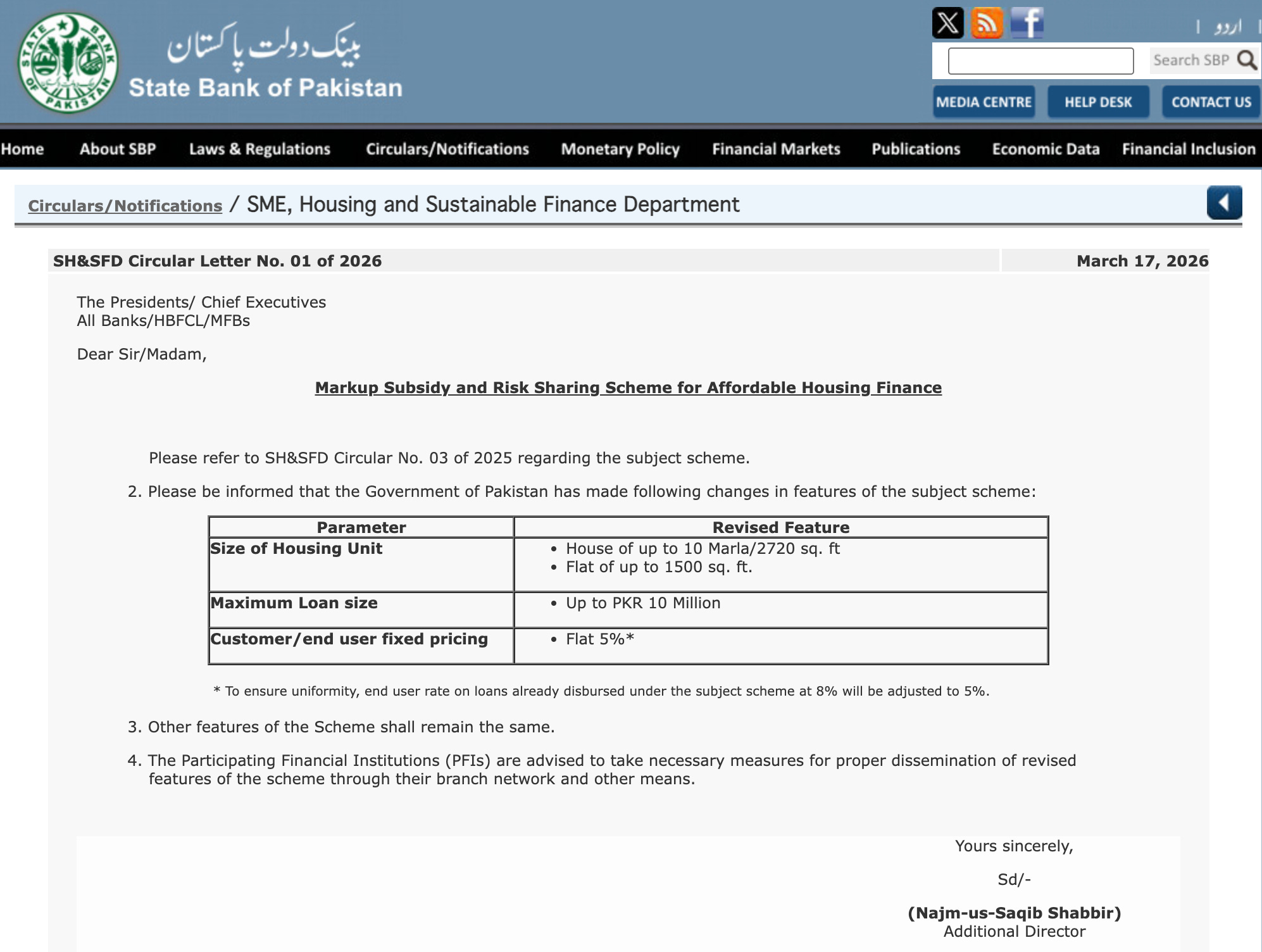
On March 17, 2026, the SBP’s SME, Housing and Sustainable Finance Department issued Circular Letter No. 01 of 2026. It revised the Markup Subsidy and Risk Sharing Scheme for Affordable Housing Finance. The customer-facing interest rate dropped to a flat 5 percent. The maximum eligible loan was capped at 10 million rupees, for a house of up to 10 Marla or a flat of up to 1,500 square feet. All bank presidents and chief executives were instructed to disseminate the revised features through their branch networks and other means.
The Scale of the Deception
Pakistan’s housing shortage sits at approximately 10 million units. It grows by roughly 350,000 units every year, a number that accelerates with every wave of urbanization into cities that were never designed to hold the people now living in them. Karachi’s informal settlements house between 50 and 60 percent of the city’s population. Lahore’s katchi abadis are not slums in the newspaper sense. They are neighborhoods, with mosques and schools and small factories and families who have lived there across three generations. The housing crisis is not a shortage in the abstract. It is a specific, documented geography of who the state has chosen to build for and who it has not, across every administration, without exception, since 1947.
To close a deficit of 10 million units at a conservative construction cost of two million rupees per unit, Pakistan would need to deploy approximately 20 trillion rupees in direct housing investment. The government allocated Rs. 5 billion in the FY26 budget for markup subsidy under the current scheme. That is 0.025 percent of what direct construction would require. The gap between the stated ambition and the fiscal commitment is not a rounding error. It is the measure of how seriously the state takes the problem it claims to be solving.
The scheme announced in March 2026 is not new. It is the third iteration, in roughly fifteen years, of a state attempt to mortgage its way out of a structural problem that no mortgage scheme can solve.
The previous version, Mera Pakistan Mera Ghar, was launched in October 2020, operated through the SBP, and abruptly suspended on the night of June 30, 2022. The reason was not administrative failure or fraud. The reason was an IMF bailout condition requiring the reduction of subsidy expenditure. By the date of suspension, 514,490 applications had been submitted, 235,954 approved, and 99,818 loans actually disbursed. The families holding those 99,818 mortgages were not notified in advance. The scheme’s cancellation was announced after it happened. The government called it a necessary budget adjustment. The IMF called the wider consolidation a milestone. The families in Rawalpindi and Hyderabad and Faisalabad who had signed what they believed were long-term agreements called it something else, and no government official has gone on record to acknowledge what it was: a betrayal of a contractual promise made in the state’s name, withdrawn the moment a foreign creditor required it.
The current scheme, Mera Ghar Mera Ashiana, was launched in September 2025 with a ten-year subsidy period and a twenty-year loan tenure. The customer rate was set at 5 percent. The bank’s actual funding cost is indexed to the one-year Karachi Interbank Offered Rate plus 3 percent. KIBOR has ranged from 6 to 22 percent over the past four years, touching 22 percent in 2023 when the SBP raised its policy rate in response to inflation driven largely by rupee collapse and imported energy costs. At 22 percent KIBOR, the bank’s funding cost was 25 percent. The government was covering a 20 percentage point spread on every disbursed loan. This is fiscally unsustainable at scale, which is precisely why it does not scale, and precisely why it gets cancelled, and precisely why the circular goes out anyway because the announcement is the point, not the house.
The Footnote
The March 2026 circular contains a footnote. It reads: to ensure uniformity, the end user rate on loans already disbursed under the subject scheme at 8 percent will be adjusted to 5 percent.
The scheme was launched with borrowers being charged 8 percent. The circular, issued six months into the scheme’s life, corrects this to 5 percent. The system mispriced its own product at launch. Borrowers signed agreements at 8 percent. They made payments at 8 percent. For however many months the scheme ran before this circular was issued, they were paying more than the scheme’s own stated rate, and there is no public documentation of how many borrowers this affected, how much they were overcharged in aggregate, or what remediation process, if any, was put in place.
The footnote exists because someone inside the SBP noticed the discrepancy. It does not exist because anyone was held accountable for it. There will be no statement from the Ministry of Finance acknowledging the error. There will be no press conference. The adjustment will appear in the next institutional report as a routine correction. The borrowers who overpaid will receive no explanation unless they ask, and there is no mechanism described in the circular for how they might ask, or who they would ask, or what they would be entitled to if they did.
This is the quality of execution behind the scheme being marketed to the working class as affordable housing. The state cannot correctly price its own product at launch, cannot notify borrowers when it misprices, cannot explain to overcharged families what they are owed, and cannot keep its subsidy alive long enough for a child born at the scheme’s launch to finish primary school. It asks the working poor to trust it with a twenty-year commitment.
What the Numbers Say
A 10-million-rupee loan at 5 percent over twenty years demands a monthly payment of approximately sixty-six thousand rupees. The minimum wage in Sindh is thirty-seven thousand rupees. The gap between those two numbers is twenty-nine thousand rupees a month, every month, for two hundred and forty months, and that calculation assumes the 5 percent rate holds for the full twenty years, which the scheme’s own structure cannot guarantee because the subsidy that funds it has a ten-year political horizon inside a state that has not completed a ten-year subsidy commitment in this sector in living memory.
The documentation required to access the loan excludes the 72 percent of Pakistan’s workforce operating in the informal economy. To qualify, a borrower must have a bank account, verifiable income, a clean credit record, and the capacity to service a loan that exceeds the median formal-sector salary in Karachi. Noor Ahmed earns his wages in cash on Thursdays, which means he has none of these things, which means the scheme’s actual customer is not the mason from Orangi Town but the salaried government employee or the documented small-business owner in a city with a functioning bank branch. That is a description of roughly the upper quarter of Pakistan’s income distribution.
The state is subsidizing mortgages for people who already have bank accounts. It is calling this poverty alleviation. The finance minister will cite disbursement numbers at the next press conference. The disbursement numbers will not include Noor Ahmed’s name, because Noor Ahmed’s name was never going to appear in them, and the finance minister knows this, and announces the scheme anyway.
What the Bank Can Do to You
There is a piece of legislation that neither the circular nor any of the scheme’s marketing material mentions. The Financial Institutions (Recovery of Finances) Ordinance of 2001, under Section 15, grants a bank the right to sell mortgaged property by public auction without the intervention of any court, after a final notice period has elapsed and the borrower has defaulted. This provision was challenged and upheld by the full bench of the Lahore High Court in 2020 as constitutional.
What this means in plain language: a family that takes a mortgage under this scheme, falls into arrears because the government subsidy has been cut and the monthly payment has become unserviceable, and cannot negotiate a restructuring with the bank, faces summary dispossession without judicial protection. The bank is not required to go to court. It is required to publish a notice in one English-language and one Urdu-language newspaper, have the property valued, and proceed to auction. The family’s home, the one they used as collateral for the loan that was supposed to give them a home, can be sold while they are still living in it.
This is not a hypothetical. The 99,818 MPMG borrowers abandoned in 2022, in the year that KIBOR was moving toward 22 percent, were facing exactly this legal exposure. Their subsidized rates had disappeared. Their fixed-rate agreements had become floating-rate instruments tracking a benchmark that was climbing 2 percentage points a month. The SBP issued no coordinated public guidance on their position. The Housing Finance Support Bureau established within the SBP to assist distressed borrowers has no documented public record of a coordinated response to the 2022 cancellation’s impact.
The scheme is, in legal terms, a mechanism through which the state invites a low-income family to pledge their most significant asset against a loan whose affordability depends on a political decision that will be made by a government that does not yet exist, administered by an institution whose fiscal autonomy is constrained by a creditor in Washington, enforced by a legal framework that gives the bank every right and the borrower almost none.
Who the Banks Serve
The participating financial institutions carry the upside of this arrangement and almost none of its risk. They originate loans against state-subsidized rates. The government absorbs a portion of default losses through the risk-sharing mechanism. The banks collect origination fees and float on every disbursement regardless of what happens to the borrower afterward. They carry no pricing risk and limited credit risk. When the subsidy is cut, they continue to hold the mortgage instruments and the right to foreclose under the 2001 Ordinance. They are not required to return the fees already collected.
The SBP’s own housing finance reform documentation acknowledges that banks restrict housing loans to ten to fifteen years because they cannot attract the long-term deposits required to safely fund twenty-year mortgages. This is not a temporary condition. The deposit base is short. The liabilities are long. The scheme demands twenty-year tenures from institutions that cannot safely fund them. The banks participate anyway because the state has guaranteed the gap from public funds that will, by documented precedent, eventually be withdrawn.
Pakistan’s banking sector allocates the majority of its assets to government treasury bills. Risk-free returns backed by state revenue require no relationship management with informal workers in Orangi Town. The housing scheme asks these institutions to extend their business model into a customer segment they have spent fifty years avoiding, with the inducement that the state will absorb the losses. When the state withdraws the inducement, the banks retain their position. The borrower retains the liability. This arrangement has a name in financial economics. It is called moral hazard, and it operates here entirely at the expense of the borrower.
The Microfinance Precedent Pakistan Chose to Forget
Pakistan has been told this story before. The microfinance sector offered the same promise, in the same language, through the same institutional architecture, beginning in the 1990s. Khushhali Microfinance Bank was established in 2000 as a dedicated state-backed institution to provide credit to the rural poor. The World Bank and Asian Development Bank provided initial capitalization. The framing was identical: financial inclusion, underserved markets, leveraging formal credit to lift the informal economy.
By 2016, Dawn was reporting that microfinance loans in Pakistan were wrapping the poor in layers of more and more debt, pushing them further from poverty alleviation rather than toward it. Interest rates on microloans were running above 30 percent per annum in real terms. A World Bank study found that between 50 and 70 percent of microloans nominally issued to women in Pakistan were actually controlled by male relatives, while the women remained solely accountable for repayment. Nearly 68 percent of women borrowers required a male relative’s written permission to qualify in the first place. The institutions required two male guarantors for loans to women, and would not accept women as guarantors for each other, which is a precise institutional description of a credit system designed to extract from women without transferring power to them.
In Pakistan’s flood-affected districts in 2010, documented cases exist of women who had lost their livelihoods continuing to service loan repayments to microfinance institutions that maintained recovery operations through the disaster. The MFIs were not acting illegally. They were acting within the terms of their loan agreements, which the borrowers had signed, and which the borrowers had not fully understood, and which the institutions had not been required to explain in plain language as a condition of their operating licenses, because the regulator’s interest was in disbursement numbers, not in borrower comprehension.
The housing scheme does not acknowledge the microfinance precedent. The SBP circular does not reference it. The government’s press releases for Mera Ghar Mera Ashiana do not mention Khushhali Bank or the two decades of documented evidence that formal credit extended to the informal poor in Pakistan has consistently served the institution more than the borrower. The institutional memory of financial inclusion in Pakistan is deliberately short. A longer memory would complicate the announcement.
The Other Housing Policy
While the government runs markup subsidy schemes for the poor that are cancelled every two to three years under IMF pressure, Pakistan maintains a second housing policy for a different class of citizen. It does not appear in any circular. It operates through the Defence Housing Authority network, the cantonment boards, and the private real estate developers whose land acquisition histories are written in Supreme Court judgments.
DHA Karachi was allocated state land in Deh Kathore and adjacent areas at a price documented in land acquisition records at a fraction of commercial market value, land that was transferred to a military-linked housing authority for the development of schemes whose plots are now sold at among the highest per-square-foot prices in South Asia. The buyers are senior military officers, civilian bureaucrats, and the upper-middle and upper classes of Pakistani cities. The subsidy to this population is not a markup rebate announced in a circular. It is the land itself, acquired below value, developed with infrastructure laid at public cost, and sold at private market rates.
Bahria Town Karachi was developed over 23,300 acres in Malir, Karachi’s green belt. The Supreme Court ruled in 2018 that the land acquisition was illegal and declared it void from its inception, criticizing the Sindh Board of Revenue and the Malir Development Authority for their facilitation of it. The court later allowed Bahria Town to retain 16,896 acres after a settlement payment, an arrangement that drew its own legal criticism for the differential treatment it represented compared to the terms applied to ordinary land occupants. By 2025, the Federal Investigation Agency had collected evidence of money laundering through Bahria Town-linked entities, involving the transfer of billions through hundi-hawala networks. Accounts were frozen. Employees were arrested. The scale of land held by a single private developer through a process the Supreme Court had already declared illegal is not a scandal in Pakistan’s political discourse. It is a business model.
The land that DHA and Bahria Town and their imitators occupy was, in significant part, the land that previously housed the lower and lower-middle income population of Pakistan’s cities. Those people were displaced. They moved into katchi abadis. Their children are now in the housing deficit that the 5 percent scheme claims to be addressing. The same state that created the displacement is running a press conference about solving it.
These are not two separate housing policies operating in parallel by coincidence. They are the same policy, serving the same class interest, expressed in two different registers: subsidy for the elite through land transfer, and political theater for the poor through a markup rebate that will not survive the next IMF review.
The Washington Architecture
Goldman Sachs published its projection in 2022: Pakistan’s economy will become the world’s sixth largest by 2075. The report traveled as these reports do, cited in federal budget speeches, investor roadshows, and the kind of keynote remarks that Pakistani finance ministers deliver in Davos and Dubai while the rupee is being quietly repriced in Karachi’s inter-bank market.
What the projection requires, and what very few Pakistani officials said plainly, is the absorption of the country’s enormous informal working class into formal financial systems. That absorption is not incidental to the growth forecast. It is the forecast. The unbanked Pakistani worker is not a passive beneficiary of a projected economic expansion. In the model, she is the input. Her entry into formal credit markets is the mechanism through which consumption grows, through which housing finance scales, through which the economy reaches the trajectory that produces the sixth-largest-by-2075 headline. The projection is not a gift. It is a business plan. The business plan requires Noor Ahmed to have a mortgage.
Goldman Sachs’s inclusive growth platform names affordable housing finance directly as a target investment thesis, describing it as addressing underserved markets through financing solutions. The IFC, the World Bank Group’s private sector arm, runs the Housing for Pakistan initiative, a multi-phase program designed to build the primary mortgage market through investment facilitation and capacity-building at participating financial institutions. The IFC’s stated target group for this initiative is households earning between five hundred and twelve hundred dollars a month. At current exchange rates, that bracket begins at approximately 140,000 rupees per month. It is a description of the documented middle class. It is not a description of Noor Ahmed’s household. But Noor Ahmed’s image is in the brochure.
The architecture of this system follows the same sequence wherever it is deployed. A country with a large unbanked population and a documented housing deficit is identified as a market. Advisory services produce a feasibility study. A risk-sharing scheme is proposed that de-risks commercial bank participation. The state provides the subsidy. The bank provides the product. The citizen signs the thirty-year liability. When the fiscal environment tightens, which it always does in countries carrying Pakistan’s debt loads and which have signed the number of IMF programs Pakistan has signed, the subsidy is cut. The liability does not follow it out the door. The bank’s fee income, already collected, does not return. The IFC’s development outcome report counts the disbursement as a success regardless of what happened to the borrower after the subsidy ended, because the disbursement is what the report was designed to count.
The specific people who designed this framework for Pakistan are not anonymous. The World Bank’s Pakistan Housing Finance Project, approved in January 2022 with additional financing of 150 million dollars, explicitly identifies the risk-sharing facility model as its primary instrument for market development. The project’s development objective is to increase access to housing finance for low and middle-income households. The World Bank’s own completion reports on predecessor housing finance interventions in comparable markets document the same pattern: disbursement targets are met, subsidy periods end, borrower outcomes are not tracked to completion. The framework generates inputs. It does not track outputs. The output is Noor Ahmed. He is not in the database.
The IMF Pattern
Pakistan has entered 24 IMF programs since 1958. This is not a record of a country that has been repeatedly rescued. It is a record of a country that has been repeatedly returned to the same position of needing rescue, under conditions that the rescuer helped create.
The conditionality attached to those programs has not varied in its structural direction across seven decades. Subsidies are cut. Administered prices rise. The fiscal deficit is compressed from the expenditure side. The compression falls on public spending, not on expanding the tax base of the sectors that generate the revenue available to avoid it. Pakistan’s tax-to-GDP ratio has averaged between 9 and 11 percent across the past decade, among the lowest in the region, sustained by a tax system that extracts from the documented salaried class and exempts the landed and commercial elite whose political representation inside the institutions that negotiate with the IMF is total.
An analysis of IMF programs in Pakistan from 1988 to 2008 documents the subsidy trajectory precisely. Total per capita subsidies fell from Rs. 64.4 in 1987-88 to Rs. 24.7 in 1996-97 under successive program conditionalities. In percentage of GDP terms, subsidies declined from 1.50 percent in 1987-88 to 0.48 percent in 1997-98. The housing subsidy launched in 2020 and cut in 2022 was not an anomaly in this sequence. It was the sequence. Every subsidy program in Pakistan operates inside a fiscal envelope that the IMF ultimately controls, and the IMF ultimately controls it because the Pakistani state has never built the fiscal base that would allow it to say no. It has never built that fiscal base because the class that controls the state benefits from not building it. The IMF is not the cause of this arrangement. It is its most reliable enforcer.
The seven billion dollar IMF program approved in September 2024 carries conditions that Finance Minister Muhammad Aurangzeb described publicly as requiring transitional pain. Economist Kaiser Bengali, who resigned from several government advisory committees in the same period, said the deal would help Pakistan pay its immediate debts and nothing more. The subsidy allocated for housing finance in the FY26 budget exists within a fiscal framework whose IMF-conditioned parameters will determine whether it survives to FY27. The scheme’s ten-year subsidy horizon is a promise made by a government operating inside a fiscal cage it did not build and cannot escape to borrowers who are being asked to make a twenty-year commitment on the strength of that promise.
When the IMF’s next review finds the subsidy line too large, the circular that cancels Mera Ghar Mera Ashiana will be issued the same way Mera Pakistan Mera Ghar was cancelled: at night, without advance notice to borrowers, with a one-line description in the next morning’s press release. The families inside it will discover what the 99,818 families discovered in June 2022. The state’s word is valid until Washington’s conditions change. Then it is not.
The Imported Framework
The mortgage market, the risk-sharing mechanism, the KIBOR-indexed pricing, the tiered subsidy structure, the participating financial institution model: these instruments were developed in capital markets with functioning land registries, reliable credit bureaus, enforceable foreclosure law, and a formally employed middle class whose income can be documented and used as the basis for a commitment that runs two decades. Pakistan does not have these conditions fully in place and has not had them in place at any point during which these schemes have been launched.
The land registry in Karachi is partly digitized and partly controlled by interests that have made careers from its opacity. The foreclosure process under the Financial Institutions Ordinance of 2001 is, as described above, swift in the bank’s direction and offers no equivalent protection to the borrower. The credit bureau infrastructure covers a fraction of the adult population. The judicial system’s capacity to adjudicate a mortgage dispute in a timeframe that a financial institution’s risk model would treat as actionable is constrained by a case backlog that the Law and Justice Commission has documented at over two million pending cases across Pakistan’s civil courts.
Allama Iqbal spent his intellectual life identifying the condition in which a society adopts the institutional categories of its colonizers and then cannot understand why those categories produce unfamiliar outcomes. The framework looks right. It has the right names and the right vocabulary and it is administered through the right-looking institutions. The SBP issues circulars. The banks sign participation agreements. The government announces the rate. The brochure features a family in front of a new house. The infrastructure that would make any of this work for the people it claims to serve is absent, and has been absent at every prior launch, and will be absent at the next one.
The specific decision to address Pakistan’s housing problem through a mortgage subsidy model rather than through direct public housing construction was not made from Pakistani conditions. It was recommended through IFC advisory engagements and World Bank technical assistance, in documents that cite South Korea and Singapore as proof of concept without noting that South Korea built its land registry before its mortgage market and that Singapore subsidized public housing through direct state construction, at scale, across decades, before introducing mortgage instruments. The sequence matters. In Pakistan, the credit product arrives first. The supporting infrastructure is described as a work in progress. It has been a work in progress since 2005, when the first serious World Bank housing finance advisory engagement was completed. It will be a work in progress when the current scheme is cancelled.
The Pakistani finance minister who presents the 5 percent rate as evidence of state care for the poor is not lying in the ordinary sense. He has internalized the framework so completely that the disbursement figure has become, in his accounting, equivalent to the house. The loan is the shelter. The scheme is the policy. The circular is the solution. He will present it at the next Housing Finance Conference, to an audience of bankers and IFC representatives and World Bank economists, and they will nod, because the disbursement number is what their frameworks were designed to count, and what is not in their frameworks is Noor Ahmed, who will take the W-11 back to Orangi Town while the conference lunch is being served.
What Accountability Looks Like When There Is None
The 99,818 families whose MPMG mortgages were abandoned in June 2022 have not been the subject of a parliamentary inquiry. No standing committee has produced a report on what happened to them. No ministry has published the names of the banks that continued recovery operations on mortgages whose subsidy component had been unilaterally withdrawn by the state. No banking ombudsman ruling has been issued in their favor on the specific question of whether the state’s withdrawal of the subsidy constituted a material change in the loan terms that should have triggered renegotiation rights for the borrower.
This silence is not an accident of bureaucratic slowness. Pakistan’s bureaucracy moves with considerable speed when it is moving in the direction of the powerful. The MPMG cancellation circular was drafted, approved, and issued in a single working day. The response to the families left holding the consequences has now taken three years and produced nothing.
The banks that originated those 99,818 loans have reported their housing portfolio performance in their annual accounts. Those accounts do not itemize which borrowers are in distress specifically because the government withdrew a subsidy that was a condition of the original loan pricing. The SBP’s banking sector reviews do not isolate MPMG-originated loans as a category requiring specific supervisory attention. The Housing Finance Support Bureau within the SBP exists to provide guidance and facilitation, but its public record contains no documentation of a coordinated response to the largest single disruption in Pakistan’s housing finance history.
The March 2026 circular does not mention any of this. It announces a new rate, describes new parameters, and instructs banks to spread the word. It is written as though June 2022 did not happen, because for the institutional purposes it serves, June 2022 did not happen. The scheme that was cancelled was a different scheme with a different name under a different government, and the families inside it are in a different political cycle’s ledger, and the current government’s disbursement count begins at zero.
Pakistan has been building housing schemes for the poor since before Noor Ahmed was born. Noor Ahmed has been building the state’s housing since he was twenty-two. The distance between those two facts is not a policy failure in the conventional sense. A policy failure implies that the policy was trying to succeed. The evidence across three schemes, three governments, three IMF programs, and 99,818 abandoned mortgages suggests something more deliberate. The poor are in the announcement. They are not in the house.


