
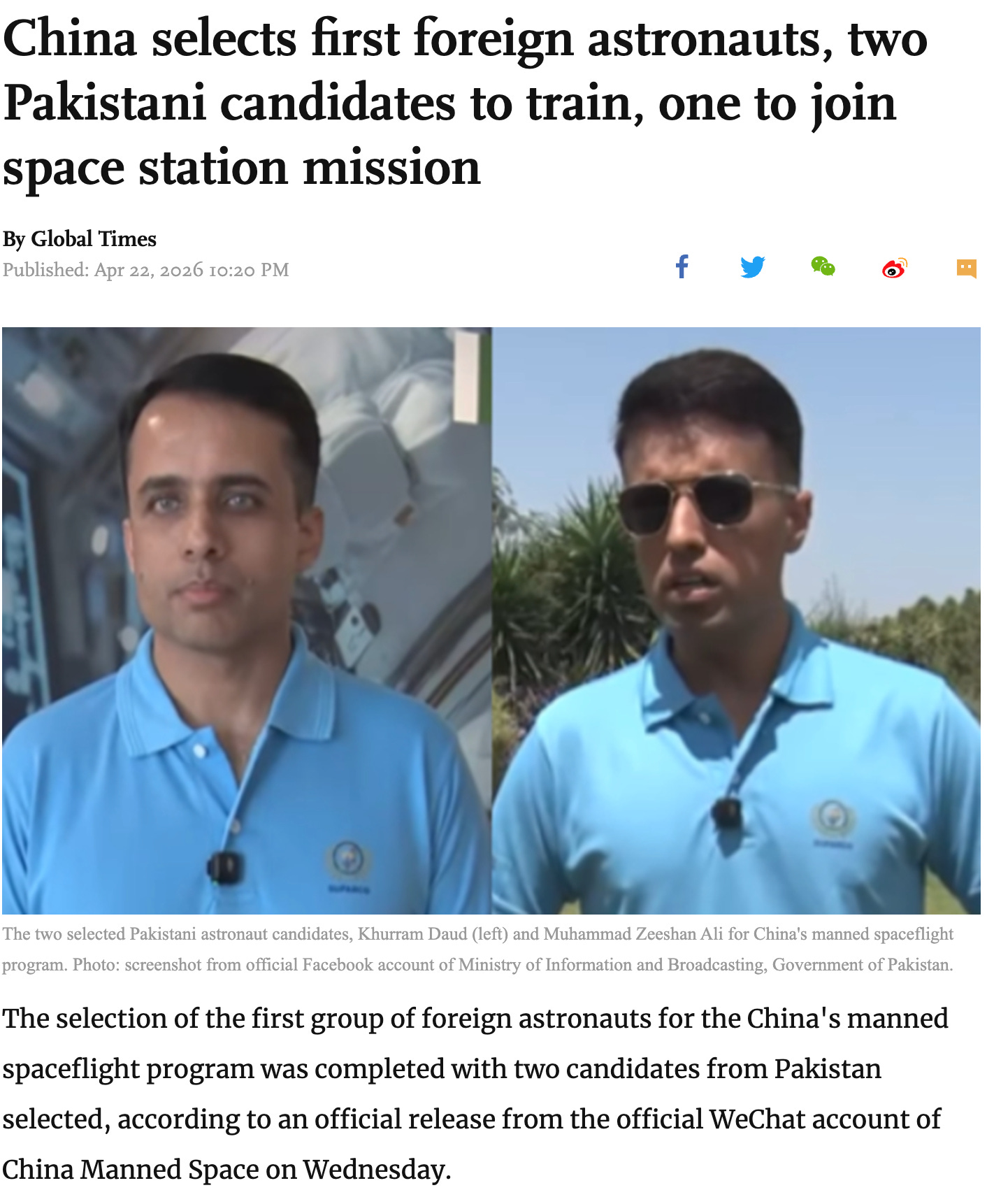
Muhammad Zeeshan Ali is a name Pakistan learned on Wednesday. So is Khurram Daud. Two men, now known to the country primarily through a China Manned Space Agency press release, through ISPR’s endorsement of that press release, and through a photograph circulated on the Ministry of Information and Broadcasting’s official Facebook page. Before Wednesday, neither man existed in Pakistan’s public record. Their biographies, their ages, their service branches, their scientific formation, what they have spent their working lives doing, none of it has been placed in front of the Pakistani public. What was placed in front of the Pakistani public was the announcement. The announcement is the entire story, as far as Islamabad is concerned.
This is worth sitting with before proceeding to the celebration, which will come regardless, which is already underway, which the television anchors are managing with their usual flags and their usual music.
China’s Manned Space Agency announced on April 22, 2026, that Muhammad Zeeshan Ali and Khurram Daud had been selected as the first foreign astronaut candidates for its human spaceflight program. The two men cleared three stages of screening and evaluation, described in the official release as preliminary selection, secondary selection, and final selection, conducted at the Astronaut Center of China and assessed against international human spaceflight standards. After completing further training and evaluation at that center, one of them will fly to the Tiangong space station as a payload specialist, accompanying a Chinese crew. If this proceeds as described, that person will become the first foreign astronaut to board Tiangong, the station China completed in 2022 that orbits the Earth at approximately 400 kilometres. The mission is currently targeted for late 2026.
This is an extraordinary thing. It is also exactly the kind of extraordinary thing that requires a careful reader.
What the Agreement Actually Says
The cooperation agreement underpinning this selection was signed in February 2025 between SUPARCO, Pakistan’s Space and Upper Atmosphere Research Commission, and the China Manned Space Agency. The agreement was signed at a ceremony attended by Prime Minister Shehbaz Sharif in Islamabad, and according to ISPR, it “reflects the prime minister’s vision and support, which were instrumental in enabling Pakistan’s participation in human spaceflight”. Under the agreement, the Chinese government will select and train a group of Pakistani astronauts and send one to Tiangong as what the documents describe as a payload specialist.
A payload specialist is a specific designation in the grammar of human spaceflight. It is not a mission commander. It is not a pilot. It is not a flight engineer. It is a mission role created, historically, for scientists and specialists who are carried aboard a spacecraft to conduct specific experiments but who are not professional astronauts in the command sense. The American space shuttle program used the category extensively for scientists and corporate researchers in the 1980s. The distinction is not pedantic. It is structural. Muhammad Zeeshan Ali or Khurram Daud will not be flying a spacecraft. They will be passengers with scientific duties. This is the arrangement Pakistan has negotiated, and it is not a trivial arrangement, and it is also not an equal one.
The scientific experiments the Pakistani astronaut is expected to conduct aboard the China Space Station span microgravity research in materials science, fluid physics, life sciences, and biotechnology, with stated applications in climate resilience, food security, and industrial innovation. These are genuinely significant scientific domains. The question that Pakistan’s scientific community should be asking, and that SUPARCO has not yet answered in public, is who owns the data these experiments generate. Whether the research protocols were designed by Pakistani scientists. Whether the intellectual output from the microgravity experiments accrues to Pakistan’s scientific record or to China’s space programme. The announcement contains no answer to any of these questions. The announcement contains the words “milestone” and “landmark” and “testament to bilateral friendship.”
SUPARCO’s Sixty Years
Pakistan’s space programme is older than most Pakistanis know. SUPARCO, established in 1961, was the first space agency in Asia. Not second. First. Before India’s ISRO. Before Japan’s JAXA. Before China’s own civilian space apparatus reached its current form. In September 1962, Pakistan launched a sounding rocket called Rehbar-I from the Sonmiani launch site on the Balochistan coast, becoming one of the earliest nations in the developing world to enter the space sciences. This is not mythology. This happened.
What also happened in the sixty-odd years since is that SUPARCO, despite its early promise, stalled. It lost its edge to institutions that were better funded, better staffed, and operating in countries where the civilian scientific enterprise was not perpetually competing for budget against a military apparatus that absorbed the lion’s share of national resources. India built an independent launch capability, an indigenous satellite programme, a Mars orbiter, a lunar lander. Pakistan built a space agency that, as of 2026, is preparing to send its first astronaut to space as a guest on another country’s station, in a role designed and assigned by another country’s space programme, on a timeline set by another country’s mission calendar.
Sixty years. The starting line was the same. The distance covered is not.
This is not an argument against the current mission. It is context that the celebration tends to omit.
What China Gets
China’s space programme has been systematic and patient in a way that Pakistani institutional life rarely permits itself to be. Tiangong’s construction began in 2021, its third and final module was docked in 2022, and by 2026 it is a fully operational station conducting scientific research, hosting regular crews, and now, opening its hatches to foreign guests. China’s manned space engineering office described the Pakistani selection as a “landmark achievement in international cooperation” and as “another successful example of the implementation of the China-Pakistan all-weather strategic cooperative partnership in the space sector”.
Read that sentence again. The framing is China’s. The selection is China’s. The training facility is China’s. The spacecraft is Chinese. The station is Chinese. The mission parameters are Chinese. Pakistan’s contribution to this arrangement is two men who passed a selection process designed and administered by the Chinese government, who will train at a Chinese facility, and one of whom will eventually fly on a Chinese rocket as a specialist conducting experiments in a Chinese space station.
China gets something valuable from this arrangement. It gets the first foreign astronaut on Tiangong, and it gets to choose who that first foreign astronaut is. It chose Pakistan, its “all-weather strategic cooperative partner,” the country through which the China-Pakistan Economic Corridor runs, the country that has opened its ports and its mountains and its political endorsement to Chinese infrastructure investment across two decades. The first foreign body in Chinese space is a Pakistani body, and the choice of Pakistan as that first is not separable from what Pakistan represents in Beijing’s strategic calculus. This is not cynicism. This is the way strategic partnerships work. Pakistan knows this. China knows this. The ISPR statement knows this. The press release that describes it as a “testament to bilateral friendship” is performing a different kind of knowing.
None of which diminishes what Muhammad Zeeshan Ali or Khurram Daud will carry into orbit. One of them will leave this gravity. One of them will look at the subcontinent from four hundred kilometres above it and carry in their body the entire weight of what this country has been trying to become since 1947, the aspiration for self-determination that has never been fully realized on the ground but that might, for the duration of a space mission, be briefly visible from above. This is real. It is not nothing.
The Question the ISPR Statement Does Not Ask
Pakistan’s Inter-Services Public Relations confirmed the selection and provided its own statement on April 22. The ISPR, which is the media arm of the Pakistan Army, issued a statement about a space mission. This is, by itself, a data point. SUPARCO is a civilian agency. The astronaut cooperation agreement was signed under a civilian prime minister’s attendance and endorsement. The mission is framed, officially, as a civilian scientific enterprise.
The ISPR’s presence in the announcement chain is consistent with how military-adjacent decisions tend to present themselves in Pakistan’s public record: the civilian frame is maintained, the military imprimatur is registered, and the civilian-military distinction that the outside world is supposed to believe matters is simultaneously upheld and quietly dissolved. Which branch of service Muhammad Zeeshan Ali and Khurram Daud come from has not been confirmed in the available public record as of this writing. The selection criteria have not been made public. Whether SUPARCO’s scientists were involved in designing the scientific payload these men will carry has not been confirmed.
These are not hostile questions. They are the basic questions of accountability journalism about a publicly-funded national programme that is asking the Pakistani public to celebrate it.
Why It Matters Anyway
Farid Ahmed, a schoolteacher in Khanewal, teaches physics to students who have no telescope and whose school has no functioning science laboratory. He has been teaching the same chapter on orbital mechanics from the same textbook for nine years. The textbook was printed in 2011. On Wednesday, his students watched a television in the staff room announce that two Pakistani men would fly to a space station before the year was out.
This is what the announcement means at the level where announcements actually land. Not in the rooms where strategic partnerships are signed, not in the ISPR’s media cell, not in the Global Times’ approving editorial. It means that a physics teacher in Khanewal now has something to point at. That the abstract machinery of orbital mechanics and microgravity research is no longer entirely abstract, that it has Pakistani names attached to it, that somewhere in the country two men are preparing to do the thing the textbook describes.
The meaning at that level is not contaminated by the structural analysis above. Both things are true simultaneously. The arrangement is asymmetric. The celebration is real. The sixty-year failure of SUPARCO to build an independent launch capability is documented. The boy in Khanewal who decides this week to keep studying physics is also documented. These are not contradictions. They are the full picture.
The Payload Specialist and the Borrowed Orbit
Pakistan has sent satellites to space before, all of them launched on Chinese or other foreign rockets. PakSat-1R and PakSat-MM1 were built and launched with Chinese support. The remote sensing satellite launched alongside Chinese payloads in recent years was a cooperative project in the same mould. Every Pakistani object that has reached orbit has reached orbit on someone else’s propulsion. This is not unusual for a developing nation with constrained resources and a state that spends its discretionary budget elsewhere. It is a structural condition that has persisted for six decades.
The payload specialist designation, the specific role one of these two men will carry to Tiangong, is in a sense the human embodiment of that structural condition. Pakistan sends its best into space. It sends them on another country’s spacecraft, in another country’s station, in a role defined by another country’s mission architecture. The orbit they will inhabit is not Pakistan’s orbit. Pakistan does not have a launch vehicle. Pakistan does not have a space station. Pakistan does not have the ground infrastructure to bring its own astronaut home. The Chinese mission will do that.
What Pakistan has is two men who were good enough, rigorous enough, resilient enough to pass a selection process administered in China against international standards. Whatever those men carry in their scientific formation, in their capacity to function under the physiological and psychological pressures of spaceflight, in their ability to conduct meaningful research in microgravity, they earned. The structure around them is borrowed. The capability inside them is not.
What Should Be Demanded Now
If the Pakistani public, which is being asked to celebrate this moment, is also entitled to ask anything of the state that is taking credit for it, the demands are specific. SUPARCO should publish the scientific protocols governing the microgravity experiments the Pakistani payload specialist will conduct. The intellectual property framework governing research output from those experiments should be made public before the mission launches. The biography and professional formation of both Muhammad Zeeshan Ali and Khurram Daud should be placed in the public record, not because they owe the public their private lives, but because a national programme funded by public money and celebrated in the name of the Pakistani people should be legible to those people.
The timeline and budget for SUPARCO’s post-mission capacity building should be published. China’s cooperation agreement, whatever its full terms, should be accessible to parliamentarians and to the scientific community that will be asked to absorb the lessons of this mission into Pakistan’s own future space ambitions. Prime Minister Shehbaz Sharif’s endorsement of the agreement should be accompanied by a commitment to the Parliamentary Committee on Science and Technology about what Pakistan intends to build toward independence in human spaceflight, and over what horizon.
These are not extraordinary demands. They are the minimum that makes a celebration a national achievement rather than a press release.
One of Them Will Go
Sometime in the last weeks, or months, or years, one of them, Muhammad Zeeshan Ali or Khurram Daud, lay awake turning over what it would mean to leave the atmosphere. To pass through the turbulence of ascent. To arrive at a weightlessness that no Pakistani body has ever known. To look down at the brown geometry of the subcontinent through a Chinese porthole at four hundred kilometres and see Sindh and Punjab and Khyber and Balochistan arranged together as they almost never are on the ground. To carry the weight of sixty years of SUPARCO’s unfulfilled ambition and the joy of a physics teacher in Khanewal and the calculus of a strategic partnership and the ordinary human terror of the void all at once, in a single Pakistani body, four hundred kilometres above everything.
The question the evidence cannot yet answer is what Pakistan will build from this moment after the television anchors move to the next story. The mission itself is settled, or nearly settled. What is not settled is whether it becomes the beginning of something Pakistan owns, or the highest point of something Pakistan borrowed.


Very exciting. The nations that figure out how to mine our solar systems asteroids will dominate the next 500 years just like those nations that were able to exploit the New World’s resources dominated the last 500 years.
https://mirrorsfortheprince.com/muslims-desperately-need-to-look-up/