


Albin Tybulewicz remembered that passengers crossing the Arabian Sea to Karachi were forbidden to strike a match. He had left Ahvaz by train in the summer of 1943, reached the Iranian port of Khorramshahr and boarded a ship in a convoy guarded by corvettes. The rules he recalled in an account preserved by the Polish History Museum extended to scraps of food, which passengers were told to keep aboard for fear of giving away the convoy. He remembered the little things a person could do to put a ship at risk. The voyage ended at a port already receiving Polish civilians who had survived deportation to the Soviet interior.
A few years later, the Pakistani High Commission in London went looking for people who knew how to keep aircraft in the air. The Polish Embassy’s account puts Władysław and Zofia Turowicz in Karachi in 1948, with about thirty Polish recruits on contracts with the new air force. Władysław went to the technical training section at Drigh Road. Zofia taught gliding. The wartime refugees and the postwar aviation recruits came by different routes and under different arrangements, and yet their stories belong to the same city. Karachi took in people whose lives had been broken open by the war, and the country that inherited Karachi found room for some of them to teach Pakistanis how to fly.
The way out of the Soviet Union
Germany invaded Poland on September 1, 1939. Soviet forces crossed into eastern Poland on September 17 under the territorial arrangements the two powers had made in secret. Deportations followed, sweeping Polish citizens into prisons, labour camps and forced settlements across the Soviet Union. The distinction between a labour camp and a settlement mattered to the people held in them, and the deportees included children whose experience of Soviet custody was the experience of a family compelled to live and work where it had been sent. The United States Holocaust Memorial Museum’s account traces the route out through a change in the war. Germany attacked the Soviet Union in June 1941, making Moscow an ally of the countries whose Polish partner it had helped dismember.
The Sikorski–Mayski agreement, signed on July 30, 1941, restored relations between Moscow and the Polish government-in-exile. Its accompanying protocol used the word “amnesty” for Polish citizens deprived of their freedom on Soviet territory. The Soviet government was offering to release people it had taken from a country it had invaded, and yet freedom on paper could leave a family hundreds of miles from the nearest reliable source of food or transport. General Władysław Anders began assembling a Polish army. Civilians travelled toward its recruiting centres because the army offered a route out and because a family looking for a missing man had reason to go where Polish men were gathering.
The Holocaust Memorial Museum estimates that more than 116,000 people reached Iran in the evacuation associated with Anders, among them about 41,000 civilians and between 5,000 and 6,000 Jewish refugees. Pahlevi, today Bandar Anzali, was the principal point of arrival across the Caspian. Nearly 3,000 refugees died within months of reaching Iran. That toll belongs in the account of an evacuation remembered for the number of people it saved. The crossing got them out of the Soviet Union. Years of hunger and illness came ashore with them, and Iran had to find provisions and medical care in the middle of its own wartime shortages.
A second route began with trucks from Bombay. The Polish History Museum dates their departure to November 11, 1941, with sixty tonnes of aid bound for Ashgabat. Eugeniusz Banasiński, the Polish consul general in Bombay, and his wife Kira, who worked through the Polish Red Cross and the government-in-exile’s welfare delegation, helped organise the effort. Moscow’s subsequent permission to take children out meant the vehicles that had carried supplies in could carry people back across the Soviet-Iranian frontier. The journey into South Asia had acquired an outbound and a return leg, and the return cargo included children who had no parent left to arrange a ticket.
Wiesław Stypuła was eleven when he made the crossing from Ashgabat to Mashhad in 1942. In the recollection collected by the museum, he remembered somebody falling and someone else spilling a bundle amid the confusion. Tybulewicz remembered the food scraps and the match. Put those two journeys next to one another and you can see why the Karachi arrivals resist being reduced to a single train at Cantonment Station. The children and their guardians used land routes, the convoy passengers came by sea, and the city received people at different points in journeys that might continue long after they had first slept in Sindh.
Country Club and Malir
The camps stood near University Road, at a place called Country Club, and farther east at Malir. Both were administered by British authorities and representatives of the Polish government-in-exile. Dawn’s account of a 2009 briefing puts about 28,000 refugees passing through or staying at the two camps between August 1942 and December 1944. The figure belongs to a retrospective account of a transit operation and is best read alongside the refugee registers and camp records that survive in scattered collections. A person who passed through Karachi and a child who spent months there both needed a bed, and yet their entries in an arrivals account tell you very different things about the city each came to know.
Malir opened as movement through Country Club put pressure on space there. The camps had hospitals, schools, canteens, churches, a post office and organised performances, according to the same account. A photograph of Malir held by the KARTA Center records a visit in 1943 by Jan Stańczyk, the Polish minister of labour and social welfare. Its catalogue places the image in an album of Polish settlements in India held by the Polish Institute and Sikorski Museum in London. An official came out to a camp in Sindh on the business of a government operating from exile in England. The people charged with running a classroom the next morning had to make a small piece of that government work at the end of a very long supply line.
Karachi’s place in the network becomes easier to understand if you follow the children onward. The Polish History Museum distinguishes the transit camps at Country Club, Malir and Quetta from longer-term settlements in Balachadi, near Jamnagar, and Valivade, near Kolhapur. A child could be registered, clothed and treated in one place and finish school in another. A classroom in a transit camp still mattered. An arithmetic lesson gave the child a part of the day that had once belonged to school. The camp post office gave a family an address it could put on a letter.
When Polish filmmaker Anna Pietraszek came to Karachi to research the refugees’ story, she and the Polish consul general spoke of residents who had opened their homes to refugees. That recollection belongs beside the evidence of formal relief. British and Polish officials could assign space and administer rations, and Karachi residents could receive a family in a home where the children had no reason to understand what the host was saying. The city that did this was still in British India. Five years after the first arrivals it would become Pakistan’s capital and have to reckon with movement on an altogether different scale, as Partition drove Muslims into Sindh and Hindus and Sikhs out of homes across the new border. The 1951 census, examined by historian Sarah Ansari, became one of the new state’s ways of deciding who counted as a displaced person and what that status entitled them to claim.
The figure Karachi can attach to individual burials is fifty-eight. In 2005 the Polish consulate renovated fifty-eight refugee graves at Gora Qabristan, the Christian cemetery on Shahrah-e-Faisal. A convoy report can count the people who disembarked and a camp register can follow them to the next settlement, and yet the cemetery keeps the record of the people whose journey ended in Karachi. It also holds the grave of a man who arrived under a contract after the war and made a home here.
Three years at Drigh Road
Władysław Turowicz grew up in Siberia, where his father was involved in building the Trans-Siberian Railway, according to the Polish Embassy’s biography. The family moved to Poland after it regained statehood. He studied aeronautical engineering at Warsaw Polytechnic and met Zofia through their interest in gliding. When Germany invaded in 1939, his unit was ordered to disable its aircraft before crossing into Romania. Romanian authorities interned the men. The pair eventually reached Britain, where Władysław worked in aviation at Farnborough. Their road to Karachi ran through an aircraft industry and a recruiting office in London. It had started with an order to put their own planes out of use.
The RAF Museum records the service of 145 Polish pilots in the Battle of Britain, and its history of No. 303 Squadron traces how Polish airmen entered the fighting in 1940. The feats of No. 303 belong to the wartime history of the wider Polish air service. Turowicz’s documented experience in Britain includes technical aviation work, and it was precisely this experience that Pakistan could use. A fighter squadron can receive the attention of a country in a week. Teaching enough people to inspect and maintain its aircraft is work a country has to keep doing after the fighting ends.
Britain withdrew recognition from the Polish government in London on July 5, 1945, and recognised the provisional government in Warsaw. As the British government later told the House of Commons, Polish units under British command refused allegiance to the new government, and Warsaw in February 1946 ceased to recognise the Polish land, sea and air units abroad as part of its armed forces. The veterans had survived the war in the service of a Polish government Britain had recognised, and yet its signature on their wartime agreement could no longer secure them a place in the armed forces of their own country. Pakistan’s offer of three years’ paid work arrived in that gap.
In August 1947 Pakistan inherited airfields, equipment and some of the men who had served in the Royal Indian Air Force. According to the Pakistan Air Force Museum’s institutional history, the new air arm began with sixteen fighters. Drigh Road already had a history as a colonial flying station and wartime base. The task now was to make that inheritance serve a new state that needed its own instructors and technicians. An aircraft entered on an inventory could be allocated in a negotiation over the division of property. The judgement of the person who would certify it safe to fly had to be developed on the ground.
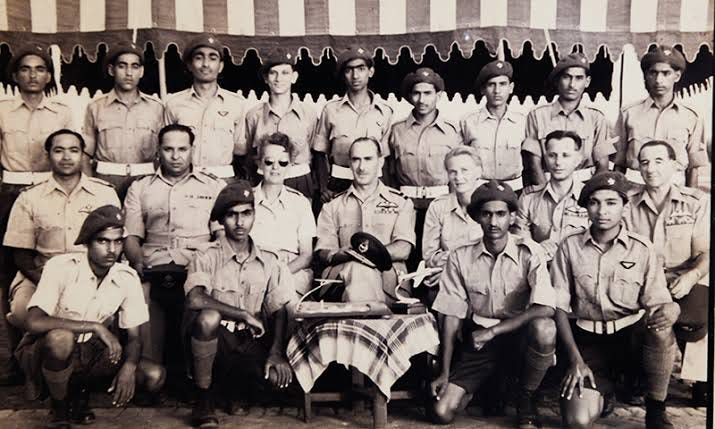
Turowicz began in the Technical Training Section at Drigh Road. Other Polish personnel went to stations including Peshawar and Chaklala. Pakistani airmen interviewed for Pietraszek’s film remembered Polish instructors at Risalpur. It is worth keeping the classroom and the workshop in the same account. The flying instructor had to teach a pupil to recognise what the aircraft was doing and correct it before it got beyond him. The technical instructor had to teach people on the ground to distinguish wear they could accept from a defect that had to stop a flight. Both involved passing on a judgement that the pupil would eventually have to make alone, without an instructor or a translator.
Most of the Polish recruits left after their contracts, the embassy history records. A few went into civil aviation with Orient Airways. The Turowiczes stayed and became Pakistani citizens in 1961. Władysław held postings at Chaklala and Kohat and later worked at Air Headquarters. When Air Headquarters moved to Peshawar the family stayed in Karachi so the children could remain in school. He lived in the officers’ mess during the posting and came back when he could. The decision to remain in Pakistan acquired the ordinary complications of belonging to a place. The children were in school, work was in another city, and a family with years of experience crossing borders now had to organise itself around the school holidays.
Zofia’s pupils
Zofia was a pilot before she was anyone’s instructor in Karachi. She studied aeronautical engineering in Warsaw, took part in gliding and parachuting, and met Władysław at the Warsaw Aero Club. In a 2005 interview with Business Recorder, she recalled teaching the Shaheen Air Cadets between 1950 and 1954 in Karachi and Rawalpindi. She worked as a civilian, and another Polish glider pilot, the wife of a serving officer, also instructed cadets. The military contract records explain why the families travelled. The account of who actually taught Pakistanis to fly has to make space for women whose authority came from being able to handle an aircraft and show a novice how to do it.
A pupil in a glider has the height the aircraft has gained and the air it is travelling through. With no engine to call on, the learner has to pay close attention to speed and to how much altitude a turn or a poor approach will cost. From the ground it is a quiet form of aviation, and yet a pupil approaching a landing has to make decisions whose results arrive quickly enough to leave very little room for argument. Zofia recalled giving pilots confidence. A teacher earns that confidence by showing a pupil how to read what the aircraft is doing, and by making sure that the pupil can still read it when she is no longer there.
She also taught mathematics at the Karachi American School. The two kinds of teaching gave her working life in Pakistan a continuity that a biography arranged around her husband’s promotions will miss. She had learned to fly in Warsaw, taught cadets in Karachi and Rawalpindi, and taught mathematics in the city where her own children grew up. In 2005 Poland’s consul general presented her with a medal for her wartime service. When a reporter asked her about Pakistan, she wanted to talk about her pupils.
The winds above Sonmiani
A rocket rose from the Balochistan coast near Karachi on June 7, 1962, released sodium vapour at high altitude and gave observers a means to measure the winds above them. The American government’s contemporary chronology calls Rehbar-I Pakistan’s first space experiment and records an altitude of about eighty miles, or 130 kilometres. The United States supplied the Nike–Cajun vehicle, and NASA trained Pakistani scientists and technicians before the launch. The experiment took place five years before Turowicz became executive director. The full credit for it belongs with the people who arranged the cooperation and got the scientific work done at Sonmiani.
The physicist Abdus Salam helped set Pakistan’s space effort in motion and chaired the Space and Upper Atmosphere Research Committee. The committee’s report to the United Nations describes its operation as a separate organisation from September 1964 and Salam’s continued direction of its affairs from Trieste. The initials SUPARCO survived the evolution from committee to commission. In those first years the programme could be both Pakistani and international in the most practical sense. Scientists abroad could help provide the equipment and training, and a team on the ground in Pakistan had to prepare the range, organise the observations and take responsibility for the measurements.
Tariq Mustafa was working at Oak Ridge in Tennessee when Salam summoned him to Washington in 1961. In Mustafa’s recollection of the meeting, the two men sat down with Arnold Frutkin, who handled international relations at NASA. The Americans wanted measurements of the upper atmosphere in a part of the world where they had little data. They offered equipment and rockets in exchange for the raw observations. Salam asked Mustafa in Punjabi what he thought of the proposal. Mustafa remembered answering that it would fulfil their dream. He was on a flight to NASA’s Wallops Island range that afternoon. The work then proceeded at both ends, with Pakistanis training at Wallops while plans for the range and its facilities took shape in Karachi.
The disciplines involved are there in a photograph Mustafa supplied of the Rehbar-II team. Its caption identifies A. Z. Farooqui with communications, Rehmatullah with meteorology, Salim Mehmud with electronics and Sikander Zaman with engineering, alongside Mustafa. A national first usually ends up with one name attached to it, and yet the size of the team and the spread of its trades explain why a physicist with a willing partner at NASA still needed a working institution in Pakistan. Somebody had to turn a rocket, a range and an experiment into one undertaking.
A sounding rocket goes up to make a measurement and comes down. The sodium makes part of the atmosphere briefly visible, and the drift of the luminous trail can be used to estimate how the air is moving. That made the rocket an instrument for studying a region beyond the reach of ordinary aircraft. At Sonmiani the subject was the winds, and the result depended as much on observing the trail as on reaching the altitude. The part everyone could see, the launch, was over quickly. What the scientists had to show for it was a set of measurements another scientist could use.
The report to the United Nations describes twenty-two Judi-Dart launches from Sonmiani to study subtropical winds and records subsequent Rehbar experiments involving Pakistani, British and American institutions. Twenty-two flights meant the team could take measurements at different times and compare them, which a single sodium trail could never provide. Sonmiani helped fill the gap in observations that Frutkin had described to Salam and Mustafa in Washington.
Turowicz moved to SUPARCO in 1967 after nineteen years in the air force. The Polish Embassy dates his executive tenure to 1967–1970. Pakistan gave the administration of its space research organisation to a man it had first hired to help train technicians. He took over an institution with experiments in progress, scientists of its own and relationships abroad. The administrative job began where the launch photograph ended, with experiments still to be staffed and supplied and a range that had to be ready when the teams arrived. The institution put that work in the hands of a man who had spent his career teaching people how to make flying equipment ready for use.
The names on Shahrah-e-Faisal
The Polish Embassy dates Turowicz’s death to January 8, 1980, and records that Zofia died in Karachi in 2013. At Gora Qabristan in 2005, the priest who blessed the restored graves of the wartime refugees also blessed Władysław’s grave. The same act of remembrance reached people who had arrived as civilians trying to survive a war and a man who arrived with a term of employment and became a Pakistani. The priest could walk from one history to the other in a cemetery beside the road where Turowicz had reported for duty in 1948.
The PAF Museum memorial photographed for Dawn gives the aviation story a public address of its own. There are names and postings on that side of the history, and there are family recollections and camp registers on the other. Where in Karachi can a schoolchild see the names from Malir and Country Club alongside the names of the people who taught at Drigh Road and Risalpur? The records sit in collections from Karachi to London and Warsaw. The people who would make use of them are already here.
The camp at Malir was put up to help people move on, and the air force hired the Turowiczes for three years, and yet when the Polish consulate came to restore the graves in 2005, it did so in a city where Zofia still lived. There were people in Karachi who had known her as a teacher. The children buried at Gora Qabristan had been here for a much shorter time. Karachi was their last address.