
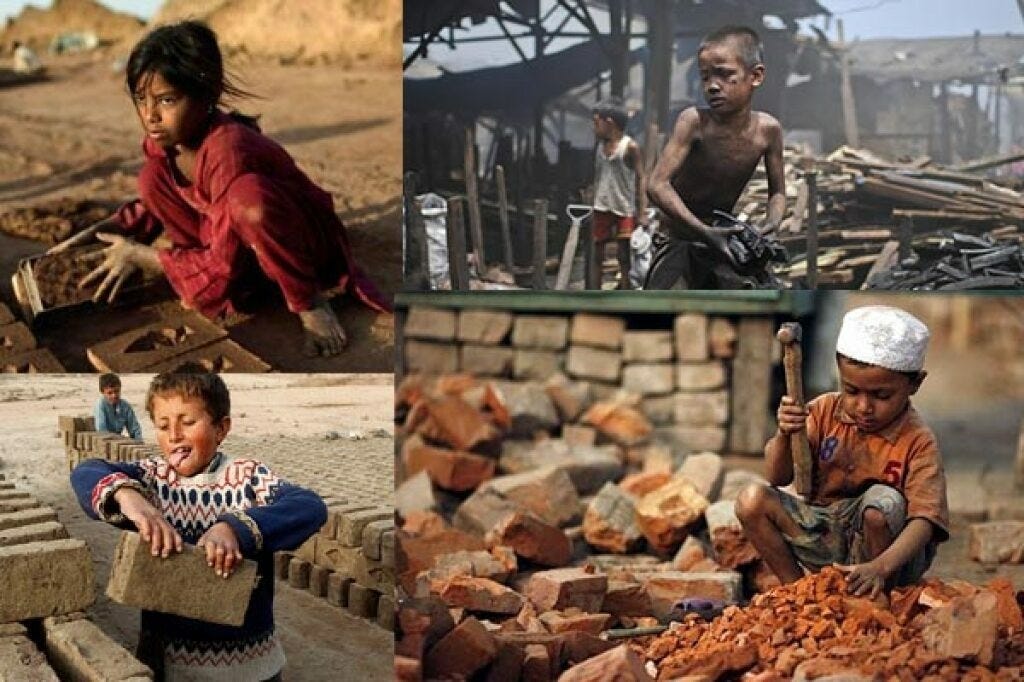
The Children of Pakistan With Trapped Childhoods
Overview
Pakistan is in the midst of a deepening child labor crisis. Recent estimates from the International Labour Organization (ILO), UNICEF and Pakistan’s own human rights institutions indicate that around 8.6 million children between the ages of 5 and 17 are working, many in hazardous and exploitative conditions that meet international definitions of the “worst forms” of child labor. More than 6.6 million of these children are in work that directly threatens their health, safety and development, and the burden falls disproportionately on rural, poor and marginalized households.
This report traces how those 8.6 million children are distributed across provinces and sectors, examines the structural drivers that push children into labor, maps the legal framework that claims to prohibit such work, and documents the enforcement failures that allow the practice to continue. It also connects the crisis to Pakistan’s wider education emergency, in which roughly 25 million children remain out of school and are at high risk of entering the labor force prematurely.
The evidence shows that child labor in Pakistan is not an aberration at the margins of the economy. It is woven into agriculture, brick kilns, domestic work, waste-picking, small workshops and supply chains tied to export industries. It persists despite constitutional guarantees, national legislation and international commitments, because enforcement is weak, poverty is entrenched, and political will is inconsistent. Floods, inflation and slow recovery from repeated crises have pushed more families to rely on children’s earnings, even when that means pulling them out of school.
The final sections outline what would be required to move from rhetoric to serious reduction: a fully resourced national child labor survey, harmonized provincial laws, targeted social protection, enforcement that reaches informal and rural work sites, and a political choice to treat each working child as evidence of state failure rather than as an invisible component of economic survival.
The New 8.6 Million Estimate: Scale and Geography
In June 2026, the ILO, UNICEF and Pakistani counterparts marked World Day Against Child Labour with a media briefing in Islamabad that placed the current estimate at 8.6 million working children aged 5 to 17. A complementary report by the National Commission for Human Rights (NCHR), produced in partnership with UNICEF, uses the same 8.6 million figure and notes that more than 6.6 million of those children are engaged in hazardous work. The NCHR stresses that this is a conservative count based on partial data, and that Pakistan’s last fully comprehensive child labor survey dates back to 1996.
Provincial breakdowns from the NCHR report show that Punjab carries the heaviest burden, with around 6 million child laborers. Sindh follows with approximately 1.6 million, while Khyber Pakhtunkhwa has around 745,000, Balochistan just over 200,000, and the Islamabad Capital Territory around 15,000. These figures reinforce the concentration of child labor in Pakistan’s most populous and agriculturally intensive regions, and highlight a pattern in which rural children are far more likely to be working than their urban peers.
The ILO briefing in June 2026 further emphasized that nearly 88 percent of child labor cases are located in rural areas. This reflects both the dominance of agriculture in Pakistan’s labor market and the weakness of labor inspection systems outside urban industrial zones. It also means that many working children are embedded in family farms or small enterprises that are rarely visited by regulators and are often perceived as “helping out” rather than as formal workers.
Child Labor and the Education Emergency
The child labor figures sit against a background of chronic under-enrollment in school. Recent government and independent data suggest that roughly 25 to 25.4 million children between the ages of 5 and 16 are out of school, representing about one third of that age cohort. A 2025 report drawing on census data noted that 25.37 million children, or 35.6 percent of those aged 5 to 16, are not in school. The Pakistan Institute of Education has similarly estimated over 25 million out-of-school children, with around 20 million having never attended school at all.
UNICEF and ILO analyses make the link explicit: children who are out of school are far more likely to be in child labor, and child labor itself, especially at older ages, significantly depresses school attendance. In Sindh’s provincial child labor survey, only around 40.6 percent of working children attend school, compared to 70.5 percent of non-working children. Attendance declines steeply with age, especially for girls, who carry a heavier burden of unpaid household labor alongside any paid work they perform.
The 2022 floods further damaged an already fragile education system. More than 18,000 schools were fully or partially destroyed nationwide, including nearly 16,000 in Sindh alone, and thousands of school buildings were repurposed as shelters for displaced families. UNICEF warns that the disaster deepened pre-existing inequities; a third of all children were already out of school before the flooding, and the loss of classrooms, roads and bridges made it even harder for children in affected districts to access education. In this context, it is not surprising that civil society organizations such as the Hari Welfare Association (HWA) report increases in child labor in the aftermath of floods, as families losing crops, homes and livelihoods lean on children’s work to survive.
Where Children Work: Sectors and Activities
Agriculture and Bonded Labor
Agriculture is the single largest employer of working children in Pakistan. Various surveys and international reports estimate that roughly two-thirds to over 70 percent of working children aged around 10 to 14 are engaged in the agricultural sector. They work on family farms and in sharecropping arrangements, often handling pesticide-laden crops, operating tools, and performing physically strenuous tasks that exceed safe limits for their age.
In Sindh, HWA estimates that of the 1.7 million bonded laborers in the province’s farm sector, around 700,000 are children. These children work under conditions of debt bondage, where entire families are tied to landlords through advances and inflated accounts. Court-ordered raids between 2013 and 2021 resulted in the release of more than 3,300 children from agricultural bondage in Sindh, and a further 3,700 children and accompanying family members were reportedly freed between 2013 and 2023. Yet HWA believes that these rescues represent only a fraction of the total number of children trapped in the system.
Documents tabled in Pakistan’s Senate and reported by national media in late 2023 indicate that more than 693,000 children between 10 and 14 are engaged in forced labor in agriculture, with another 24,478 children compelled to work in brick kilns. The majority of these children are in Punjab, followed by Sindh, Balochistan and Khyber Pakhtunkhwa. Many of them work long hours in fields for little or no direct pay, with wages often paid to adults who themselves remain indebted.
Brick Kilns and Hazardous Industry
Brick kilns remain one of the most documented sites of hazardous and bonded child labor in Pakistan. Children at kilns mould, carry and load bricks, often working under intense heat, dust and toxic fumes. International and domestic reports describe children in the kiln sector waking before dawn, performing repetitive heavy lifting, and sustaining injuries that go largely untreated. Many families in brick kilns are also in debt bondage, with advances tying them to kiln owners and limiting the possibility of exit.
Research on Pakistan’s worst forms of child labor lists brick making alongside coal mining, carpet weaving, glass bangle production, surgical instruments manufacturing and deep-sea fishing as sectors where child workers face some of the most dangerous conditions. Children in these sectors may be exposed to open furnaces, sharp tools, chemical fumes and collapsible structures. They can also be subject to coercion, physical punishment and restrictions on movement.
Domestic Work and High-Profile Abuse Cases
Child domestic work is widespread but difficult to measure because it occurs inside private homes and is often arranged informally. International agencies and rights groups classify it as one of the worst forms of child labor due to the isolation, lack of oversight, and frequent reports of physical, emotional and sexual abuse.
Several high-profile cases in recent years have thrown a spotlight on the brutality faced by some child domestic workers. The “Tayyaba torture case,” which came to light in 2016, involved a ten-year-old girl employed as a housemaid by a judge in Islamabad, who was found with severe injuries after being beaten and abandoned. In 2023, the case of thirteen-year-old Rizwana, allegedly tortured by the wife of a civil judge in Islamabad, dominated headlines after photos and medical reports showed broken bones, strangulation marks and signs of prolonged abuse.
Another case that stirred national outrage was the torture and death of ten-year-old domestic worker Fatima Furiro in Ranipur, Sindh, in August 2023. Video footage showed the child bearing visible bruises and struggling to move before collapsing. The employer was subsequently arrested and charged with murder, but legal proceedings have moved slowly and advocates argue that such cases represent only a small, documented fraction of the violence faced by child domestic workers.
Urban Informal Work and Street Economies
In urban areas, child labor is concentrated in the informal sector: street vending, automobile repair workshops, construction, garbage scavenging and small family businesses. Children collect recyclable materials from dumps, repair tires and engines in roadside workshops, carry loads in markets and work in small-scale manufacturing of textiles, garments and handicrafts. Many of these activities involve sharp tools, heavy objects, moving vehicles and exposure to waste and pollutants.
Reports from the US Department of Labor and other sources highlight that children in Pakistan also work in leather tanning, coal mining, stone crushing, and manufacturing of glass bangles and surgical instruments. These industries, often located in and around urban centers like Sialkot, Karachi and Lahore, have been the focus of international scrutiny and some ILO-supported programs that aim to reduce child labor in export-linked supply chains such as soccer ball stitching.
Commercial Sexual Exploitation and Trafficking
Beyond visible forms of labor, children in Pakistan are subjected to commercial sexual exploitation, begging rings and trafficking, both within the country and across borders. Some are recruited or coerced into work in the sex trade, others into drug trafficking or other illicit activities. International reports also document instances of children being recruited by non-state armed groups or used in armed conflict. These forms of exploitation are harder to quantify but form part of the recognized “worst forms of child labor” under ILO Convention 182.
Legal Framework: Promises on Paper
Constitutional Guarantees and Core Statutes
Pakistan’s Constitution prohibits slavery, forced labor and trafficking, and specifically states that no child below the age of fourteen shall be engaged in any factory, mine or other hazardous employment. Article 11(3) is clear in its wording, and Article 25-A, added later, establishes education as a fundamental right for children between 5 and 16 years.
The Employment of Children Act, 1991, sets the general legal framework for child labor, defining “child,” restricting the employment of children under 14 years in certain occupations, and providing a schedule of hazardous work where child employment is entirely prohibited. It also requires employers who hire adolescents and older children in permitted work to maintain registers and comply with limits on working hours and conditions.
The Bonded Labour System (Abolition) Act, 1992, formally abolishes bonded labor, frees bonded laborers from outstanding debts, and criminalizes attempts to compel or enforce such labor. Violations can carry prison terms of up to five years and fines up to tens of thousands of rupees, at least on paper. Pakistan has ratified ILO core conventions on minimum age for employment and the elimination of the worst forms of child labor, committing to progressive realization of higher working age thresholds and effective enforcement.
Provincial Laws and Inconsistencies
With the devolution of labor regulation to provinces, each federating unit has enacted its own child labor laws. Punjab, Sindh, Khyber Pakhtunkhwa and Balochistan have separate acts setting out age thresholds, hazardous occupation lists and enforcement mechanisms. However, a 2025 policy brief by the National Commission on the Rights of Child (NCRC) highlights deep inconsistencies across these provincial frameworks: different definitions of “child” and “adolescent,” varying provisions for “light work,” and uneven requirements for educational access and non-discrimination.
For instance, some provinces mandate the government to develop detailed health and safety rules for young workers, while others leave such rulemaking discretionary. Hazardous occupation lists differ in coverage and are sometimes outdated, failing to capture emerging sectors where children are present. These discrepancies lead to uneven protection and enforcement depending on where a child lives or works. Domestic work remains particularly under-regulated, despite being a known site of abuse.
Parliament has considered new federal legislation, such as the Islamabad Capital Territory Child Labour Bill, which proposes clearer penalties for employing children and establishes a Child Labour Monitoring Committee. Draft provisions include imprisonment and fines for employing children or adolescents in hazardous work and grant inspectors powers to seal non-compliant workplaces temporarily. Yet implementation still depends on inspectorates that are understaffed and often reluctant to act against politically connected or economically influential employers.
Enforcement Gaps: Why Laws Do Not Reach Children
Under-Resourced Inspections and Data Gaps
Reports from the US Department of Labor and national human rights bodies consistently note that labor inspectorates in Pakistan lack sufficient human and financial resources, especially at provincial levels. Inspectors are few, responsible for large geographic areas, and often focused on formal industrial establishments rather than the rural and informal sectors where most child labor is concentrated.
Compounding this is a chronic shortage of reliable data. The NCHR points out that Pakistan has not completed a comprehensive national child labor survey since 1996, although UNICEF and technical partners have supported new Child Labour Survey exercises in several provinces between 2016 and 2023. Without updated, disaggregated data, policymakers cannot accurately target interventions or track progress. The 8.6 million estimate thus serves both as a warning and as a reminder of statistical neglect.
Corruption and Impunity
The US Department of Labor’s 2024 assessment of Pakistan’s efforts to eliminate the worst forms of child labor concludes that while there have been moderate advances in law and policy, enforcement remains weak and subject to corruption. Police officers have reportedly accepted bribes to ignore child labor cases, particularly in sectors where powerful interests are involved. Prosecutors rarely build cases that fully apply existing child labor and trafficking laws, and conviction rates remain low compared to the scale of the problem.
In bonded labor cases, civil society organizations such as HWA routinely secure habeas corpus orders from courts to release families from landlords’ custody. However, landlords are seldom prosecuted under the Bonded Labour System (Abolition) Act, and many return to the same practices once attention shifts elsewhere. The absence of consistent penalties signals to employers that employing children, even in hazardous work, carries minimal risk.
Social Norms and Economic Pressures
Legal prohibitions also clash with entrenched social norms that treat child work as part of family duty, apprenticeship or survival strategy. Many parents send children to work because adult wages are low, social protection is limited, and schooling appears either unaffordable or of poor quality. For some families, especially in rural areas, children’s labor is seen as necessary to pay off debts, secure access to land, or maintain relationships with patrons.
UNDP and NCRC’s joint 2026 report on child labor in Pakistan’s private sector stresses the role of structural drivers: poverty, limited access to quality education, and weak enforcement enable child labor to remain embedded in informal and supply chain-linked environments. The report notes that one in every ten children in Pakistan is engaged in child labor, often in hidden or unregulated spaces where monitoring is rare. Without tackling these underlying conditions, legal reforms alone are unlikely to significantly reduce the numbers.
Child Labor After the 2022 Floods: Climate Shocks and Vulnerability
The historic floods of 2022, which submerged around a third of Pakistan’s territory and affected some 33 million people, half of them children, have intensified vulnerabilities that feed into child labor. Millions of homes were destroyed, crops and livestock lost, and key infrastructure including schools, health facilities, roads and bridges severely damaged.
UNICEF estimates that at least 3.4 million children required urgent humanitarian assistance in the months following the floods, and that more than 400 children were killed. In Sindh alone, over 6.4 million children were already out of school before the floods, many engaged in the worst forms of child labor including in agriculture, brick kilns and informal urban work. The destruction of nearly 16,000 schools in the province further pushed children away from classrooms and into work.
HWA reports that child labor, including bonded child labor in agriculture and brick kilns, increased in the aftermath of the floods as families, stripped of assets and savings, accepted advances from landlords and kiln owners. Government resettlement and rehabilitation policies, particularly in Sindh, have been criticized as falling short of addressing the specific needs of children working in harsh conditions, including their access to education, healthcare and psychosocial support.
These dynamics illustrate how climate shocks intersect with existing inequalities. Children from landless, minority or otherwise marginalized communities are more likely to lose homes and schooling in disasters and less likely to benefit from reconstruction efforts. Without targeted interventions, each climate event risks adding a new cohort of children to the labor force.
Recent Initiatives and Partial Progress
Despite the bleak picture, there have been some notable initiatives and areas of progress. Pakistan has participated in multiple ILO-IPEC programs targeting child labor in specific sectors such as carpet weaving, soccer ball stitching, surgical instruments manufacturing, coal mining and glass bangle production. In Sialkot’s soccer ball industry, a combination of monitoring, social labeling and community-based schooling reportedly reduced the incidence of child stitching over time.
At the provincial level, the Sindh Child Labour Survey 2022 to 2024, carried out with UNICEF support, provides updated data on the prevalence and characteristics of child labor in the province, including the finding that over 1.6 million children are trapped in child labor and that more than half of those aged 10 to 17 work in hazardous conditions. The survey also documents lower school attendance among working children and highlights the disproportionate burden of unpaid household work on girls.
At the federal level, Pakistan’s membership in international conventions has spurred periodic reviews and action plans. The government has developed strategies to eliminate child labor in selected sectors and has established committees to update hazardous occupation lists. The National Commission on the Rights of Child and the National Commission for Human Rights have both produced recent policy briefs and reports calling for harmonization of child labor laws and stronger enforcement.
The Huqooq-e-Pakistan II project, funded by the European Union and implemented by NCRC in partnership with UNDP, recently launched a report titled “At the Margins of Protection: Child Labor in Pakistan’s Private Sector,” which examines how child labor persists in supply chains and informal production networks linked to private sector actors. It calls for responsible business practices, due diligence in supply chains, and collaboration between government, companies and civil society to reduce the reliance on child labor.
Pakistan in the Global Context
Globally, updated ILO and UNICEF estimates released in 2025 suggest that around 138 million children were in child labor in 2024, including roughly 54 million in hazardous work. This represents a modest reduction of a little over 20 million compared to 2020, reversing a previous spike but still falling short of global targets to eliminate child labor. Pakistan’s 8.6 million working children form a significant share of this global burden, particularly within South Asia.
While some countries in the region have achieved sharper declines through aggressive enforcement, conditional cash transfers and expansion of quality schooling, Pakistan’s progress has been uneven. The Sindh survey notes a nearly 50 percent reduction in child labor compared to the 1996 baseline in that province, but the absolute numbers remain high and child labor remains entrenched among the poorest households. Nationally, the absence of recent comprehensive survey data makes it difficult to assess long-term trends with confidence.
Pakistan’s economic pressures, including high inflation, energy costs and debt servicing, limit fiscal space for social protection programs that could compensate families for the loss of children’s income. Yet international experience shows that cash transfers tied to school attendance, school feeding programs, and targeted support for vulnerable households can reduce child labor significantly when implemented at scale and accompanied by enforcement.
What It Would Take to Bring the Number Down
1. A Credible National Child Labor Survey
The first requirement is to rebuild the evidence base. Pakistan needs a nationally representative, methodologically robust child labor survey that covers all provinces and territories, updated regularly and disaggregated by age, gender, sector, location and socioeconomic status. UNICEF-supported provincial surveys provide a starting point, but they must be integrated into a coherent national picture.
Such a survey should explicitly capture hidden forms of child labor such as domestic work, informal urban work and commercial sexual exploitation, using ethical methodologies that protect child respondents. Without this, national strategies will continue to rely on extrapolation and outdated figures, making it easier for denial and underestimation to persist.
2. Harmonized Laws That Cover All Children
Pakistan’s constitutional protections for children need to be translated into harmonized provincial laws that leave no gaps. This would mean standardizing definitions of “child” and “adolescent,” ensuring that prohibitions on hazardous work apply uniformly across provinces, and explicitly covering domestic work and informal sector occupations where children are prevalent.
Federal legislation for the Islamabad Capital Territory can serve as a model for clearer penalties, registration requirements and monitoring mechanisms. However, enactment is insufficient without political backing and resources. Bringing domestic work under the scope of labor law, with clear age thresholds, working hour limits and inspection powers, would address one of the current blind spots.
3. Enforcement That Reaches Beyond Factories
Effective enforcement requires increasing the number and capacity of labor inspectors, expanding their mandate to cover informal and rural workplaces, and insulating them from political interference. Inspectorates must be adequately funded to conduct regular, unannounced inspections, including in villages, brick kilns and urban informal clusters where child labor is concentrated.
At the same time, sanctions must be meaningful. Employers found using child labor, particularly in hazardous and bonded conditions, need to face fines, closure orders and, in serious cases, criminal prosecution under child labor, bonded labor and trafficking laws. Cases such as the torture of child domestic workers should result in swift, public accountability, sending a signal that the state will not tolerate such abuse.
4. Social Protection and Education as Core Pillars
No serious child labor strategy can rely on policing alone. Families must have alternatives that allow them to keep children in school without falling deeper into poverty. This requires expanding social protection programs such as cash transfers, food support and school stipends targeted at households with working children or those at high risk of sending children to work.
Education systems need investment in quality as well as access: building and repairing schools, hiring and training teachers, and providing safe transport in rural areas. Special measures are needed in flood-affected and conflict-affected districts, where infrastructure damage and displacement have severed children’s connection to school. For older children who have already missed years of schooling, flexible learning options and vocational training programs can offer realistic pathways out of exploitative work.
5. Private Sector Responsibility and Supply Chain Due Diligence
Given the role of private sector supply chains in sectors like sporting goods, surgical instruments, textiles and agriculture, companies, both domestic and international, must adopt and enforce policies against child labor. This includes conducting due diligence on suppliers, supporting independent monitoring, and contributing to remediation when child labor is found, such as funding schooling and family support packages.
Initiatives in Sialkot’s soccer ball industry show that industry-wide commitments, supported by international buyers and monitored by independent bodies, can significantly reduce child labor in export-linked sectors. However, these efforts need to be extended beyond a handful of industries, and must not simply displace children into even more invisible, unregulated forms of work.
6. Community Mobilization and Changing Norms
Local communities, trade unions, teachers and religious leaders have a crucial role in shifting attitudes towards child labor. Awareness campaigns that connect legal norms to religious and cultural values, community-based child protection committees, and school management councils that track absenteeism can all help identify and respond to child labor cases early.
Survivors’ testimonies and high-profile cases can also serve as catalysts for change when they are used to demand systemic reforms rather than treated as isolated incidents. Civil society organizations will continue to be central in documenting abuses, litigating for victims, and pressuring authorities to act.
Conclusion
Pakistan’s 8.6 million child laborers are not a statistical curiosity; they are living evidence of a development model that has normalized the use of children’s bodies to absorb economic shocks and compensate for state failures in education, social protection and law enforcement. The majority of these children are in rural areas, in fields, kilns, homes and workshops that the law rarely reaches. Many are bound by debt or trapped in domestic spaces where abuse goes unreported, and nearly all pay for their work with lost schooling and damaged health.
Reducing that number will require more than launching reports on commemorative days. It demands a sustained choice to treat every working child as a rights violation that requires response, a rebuilding of data systems to make the invisible visible, and an alignment of laws, budgets and enforcement with the constitutional promise that no child will be sent into a factory, a mine or any hazardous place instead of a classroom. Until that alignment is made, the figure 8.6 million will not mark the size of a problem being solved; it will mark the number of childhoods the state has decided to spend.


