
The Budget Pakistan Never Sees
The Ministry of Finance published two documents on June 12. The budget speech puts total federal expenditure at Rs 18.77 trillion. The Annual Budget Statement, released the same day, puts gross federal flows at Rs 25 to 26 trillion. Both are accurate. Only one of them includes the constitutional transfer to the provinces. The Rs 7 trillion difference is not a rounding error. It is the National Finance Commission Award, and it is the reason Pakistan borrows.
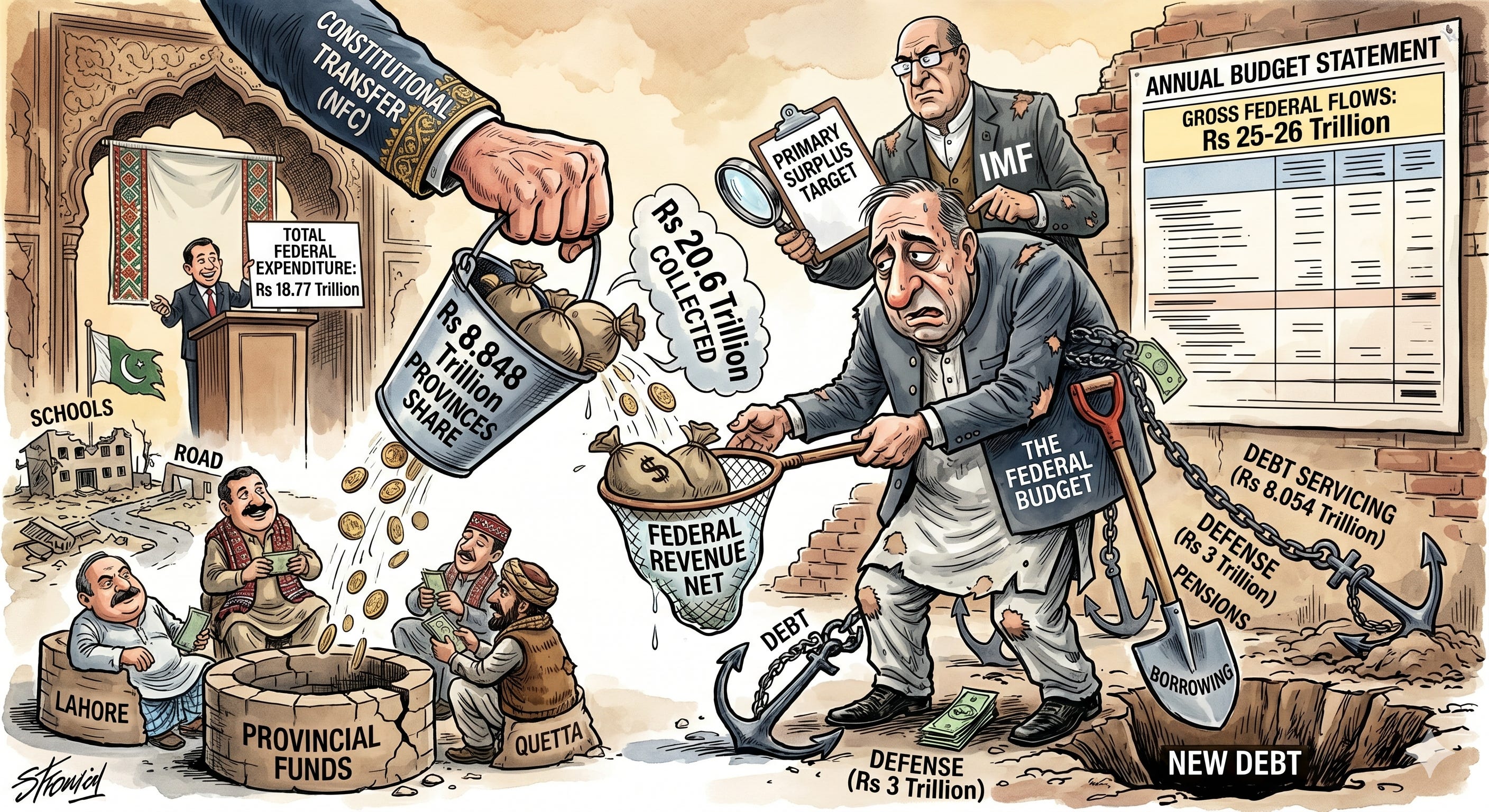
The Annual Budget Statement is not a classified document. It is on the Finance Ministry’s website alongside the speech. It tracks the actual movement of money from the moment FBR collects a rupee to the moment the federal government runs short and reaches for fresh borrowing. The argument it makes is not partisan. It is arithmetic. Pakistan borrows not because the federal government spends more than it collects, but because the constitutional transfer to the provinces under the NFC Award is made before the federal government finances a single rupee of its own operations. After Rs 8,848 billion exits the federal account for Lahore, Karachi, Peshawar, and Quetta, what remains is not enough to cover what the federation must spend on interest, defense, and pensions, let alone anything else.
The Rs 18.77 trillion figure Aurangzeb announced is the budget speech number, built from net federal revenue receipts after the provincial transfer and from federal expenditure on the same net basis. Total federal tax revenue for FY 2026-27 is projected at Rs 15,264 billion, up 17.6 percent from the outgoing year’s Rs 12,983 billion. Non-tax revenue, comprising State Bank profits, petroleum levy, SOE dividends, royalties, and fees, is projected at Rs 5,336 billion. Combined, total federal revenue receipts come to Rs 20.6 trillion. The government collects Rs 20.6 trillion and announces a Rs 18.77 trillion budget. The distance between those two figures is not explained in the speech.
The Annual Budget Statement resolves it. Of the Rs 20.6 trillion in projected revenue, Rs 8,848 billion is constitutionally owed to the provinces under the 7th NFC Award of 2010, which set the provincial share of the federal divisible pool at 57.5 percent. Of the FBR’s Rs 15,264 billion tax projection, Rs 8,848 billion goes to the provinces before the federal government touches it. The federal net revenue receipts, what the federation retains, come to Rs 11,751 billion. Against that, the federal government’s expenditure requirements produce a deficit that must be covered by borrowing. The Rs 18.77 trillion speech total uses net figures throughout. The cashflow picture uses gross figures throughout. Neither is wrong. Only one of them makes the transfer visible.
When Finance Minister Aurangzeb confirmed on June 14 that the provincial share under the NFC Award would remain unchanged for FY27, the announcement was reported as a decision about provincial relations. It was also a statement about federal fiscal arithmetic: the Rs 8,848 billion transfer is fixed, and everything the federal government does with the remaining Rs 11,751 billion flows from that constraint.
Federal net revenue retained: Rs 11,751 billion.
Against that, the three largest hard-floor expenditure items in the FY27 budget: debt servicing at Rs 8,054 billion, defense at Rs 3,000 billion, and pensions at Rs 1,169 billion. Added together: Rs 12,223 billion. The hard floor has already exceeded the federal government’s entire retained revenue by Rs 472 billion, before a single rupee is spent on the civil administration at Rs 1,071 billion, or the federal development program at Rs 1,000 billion, or subsidies at Rs 1,091 billion, or BISP and social protection at Rs 838 billion, or grants and transfers that bring the total outlay to Rs 18.77 trillion in the speech and to the higher Annual Budget Statement figure when measured gross.
The federal government collects Rs 20.6 trillion. It transfers Rs 8,848 billion constitutionally. It retains Rs 11,751 billion. Three line items, interest on borrowed money, defense, and pensions, consume Rs 12,223 billion. The deficit is not produced by what comes after those three items. It is produced before the government has funded a school, a road, a BISP transfer, or a civil servant’s salary. The borrowing that produces next year’s debt service and the year after’s is structural before it is discretionary.
The fiscal deficit for FY 2026-27 is pegged at Rs 5,226 billion, 3.6 percent of GDP, on a nominal GDP of Rs 143.6 trillion. This will be met, per the government’s own projections, through Rs 1,794 billion in required provincial surplus, Rs 813 billion in external financing, and Rs 6,046 billion in domestic borrowing. The primary surplus, revenues measured against non-debt expenditure, is targeted at Rs 2,828 billion, 2 percent of GDP, the fourth consecutive year. That primary surplus is the trophy the government carries to the IMF. The mechanism that generates it, the compression of development and social spending below the revenue floor after the transfer, is not the subject of the budget speech.
the provincial share in full
Punjab receives Rs 4,402.83 billion. Sindh receives Rs 2,207.18 billion. Khyber Pakhtunkhwa receives Rs 1,443.34 billion, including the additional one percent weighted for counter-terrorism costs. Balochistan receives Rs 795.13 billion, weighted upward in the NFC formula because its own revenue base is thin and its population has historically received the least from the Pakistani state. The 7th NFC Award formula was itself a correction: for decades the center had retained revenues the provinces were constitutionally owed, and the smaller provinces absorbed the sharpest end of that extraction.
These numbers were confirmed in the June 12 budget documents and cross-referenced in Business Recorder’s coverage of the same date. They are constitutional entitlements, not line items that any finance minister can adjust through budget speech. The NFC Award requires a constitutional process to renegotiate, an inter-governmental commission with provincial assent, a political negotiation that no federal coalition government currently has the arithmetic or the political capital to survive. When Aurangzeb confirmed the provincial share would remain unchanged, he was not choosing generosity. He was acknowledging a constraint so structural it does not appear on the budget’s expenditure side as a choice.
The consolidated fiscal deficit of 3.6 percent of GDP depends on the provinces generating a surplus of Rs 1,794 billion in FY27, a steep increase from the revised Rs 1,379 billion the provinces generated in the outgoing year. The money constitutionally transferred to build schools, hospitals, and roads in the provinces must be withheld from that purpose, held as a surplus, so that the federal government can claim a consolidated primary balance the IMF accepts. Balochistan, which received Rs 795 billion and where the poverty rate is the highest of any province, is among the governments being asked to underspend its constitutional share to produce a surplus for a creditor in Washington. The Eighteenth Amendment gave the provinces the money. The IMF program, routed through the federal budget, instructs them not to spend it.
Pakistan’s Extended Fund Facility, the program signed in July 2023 and extended in 2025, targets FBR revenue at Rs 15,264 billion for FY 2026-27, a 17.6 percent increase over the outgoing year. The program was negotiated with Islamabad. The provinces are not parties to it.
But the taxes that fund the IMF’s primary surplus are collected federally and transferred provincially at the 57.5 percent NFC rate. Of every additional Rs 100 FBR collects through expanded income tax coverage, stricter withholding, or new levies, Rs 57.50 goes to the provinces under the constitutionally mandatory formula. The federal government retains Rs 42.50. Against a debt service bill of Rs 8,054 billion, the federal share of every incremental rupee raised through the IMF-mandated tax push covers less than six rupees of what it costs to service the debt already on the books. The cycle runs: collect more tax, transfer the constitutional share, retain a fraction of the increment, use the fraction to partially service debt, borrow the rest, service the new borrowing next year.
The program does not publicly engage this arithmetic. Restructuring the NFC Award would require a constitutional amendment and a provincial negotiation that no government can deliver on the IMF’s quarterly review timeline. The smaller provinces, Balochistan and KPK, receive shares weighted in their favor specifically because their populations have the least, and no federal coalition would survive being seen to cut their constitutional entitlement. So the program runs on the assumption that federal revenue can be raised without limit, that the federal government retains enough of the increment to service its debt, and that the adjustment cost, the compression of health, education, and development, is an acceptable price for the primary surplus. The people who pay that price are in the provinces that received the transferred funds but were then instructed not to spend them.
The interest bill for FY 2026-27, Rs 8,054 billion, is nearly identical to the NFC provincial transfer of Rs 8,848 billion. Two line items of equivalent scale sit at the top of the federal cashflow: one is a constitutional obligation to the provinces, the other is a contractual obligation to lenders. Together they consume Rs 16,902 billion of the Rs 20.6 trillion in federal revenues. What remains is Rs 3,698 billion to cover defense, pensions, civil administration, development, subsidies, and social protection in a country of 250 million people, 28.9 percent of whom the government’s own Economic Survey placed below the national poverty line as of FY26.
The government borrows Rs 6,046 billion in domestic debt this year to cover the gap. That debt will carry interest. That interest will appear in next year’s debt service bill, larger than this year’s. The cage is built from interest and nothing escapes it. What the cashflow picture adds to that observation is where the cage was assembled: not in the defense vote, not in the civil service payroll, not in the BISP allocation, but in the Rs 8,054 billion that leaves the account before any of those disbursements begin, and in the Rs 8,848 billion that leaves before that.
The two largest outflows from the federal account are not decisions made in this budget. They are decisions made in 1947, in the successive rounds of military rule that ran up the debt stock, in the 7th NFC Award of 2010, and in each year’s borrowing decision by governments that had no other option because the post-transfer fiscal base was already insufficient. The FY27 budget inherits all of it and borrows more.
The conventional budget presentation will not change next year. The Rs 18.77 trillion speech total will appear again in some adjusted form, the provincial transfer will sit inside an expenditure table without being called the reason borrowing exists, and the IMF primary surplus will be celebrated as evidence of fiscal discipline. The reason this framing persists is not bureaucratic inertia. It is political.
Naming the NFC transfer as the primary structural cause of federal borrowing would force a public conversation about whether the constitutional revenue distribution formula serves the federation’s fiscal sustainability, and that conversation leads directly to whether Punjab’s Rs 4,402 billion entitlement is appropriately sized, whether the provinces are spending transferred funds on the services they were meant to fund, and whether the federal government’s own revenue base is sufficient after the transfer to meet its constitutional obligations without permanent structural borrowing.
No ruling coalition in Pakistan’s current parliament can have that conversation publicly. The parties that govern Punjab and Sindh, who form the coalition or the opposition in Islamabad with equal regularity, will not consent to a renegotiation that reduces their provincial transfers. Army-aligned institutions will not accept scrutiny of the defense line that sits alongside the NFC transfer as the second pillar of the fiscal constraint. A finance minister fluent in the IMF’s vocabulary of primary surpluses and structural benchmarks cannot announce in a budget speech that the reason the state borrows is that the constitutional order of the state requires it to distribute its revenues before it pays its own bills.
The cashflow chart is honest about all of this. The budget speech is not. The distance between the two documents is the distance between what the Pakistani state does with money and what it tells citizens about that.
The FY 2026-27 budget projected a primary surplus of Rs 2,828 billion on the back of an FBR target that requires 17.6 percent revenue growth in a year when nominal GDP growth is projected at around 12 percent. The implied tax effort exceeds economic growth by more than five percentage points. Previous FBR targets of similar ambition have been missed. The revised FBR collection for FY 2025-26 was Rs 12,983 billion against an original target of Rs 12,970 billion, a near-miss after a year of aggressive withholding expansion. A 17.6 percent growth target in a lower-inflation year with a wider provincial transfer will test whether the federal government can sustain a primary surplus without the inflation dividend that made the last few years’ collection numbers easier to hit.
If the FBR misses by ten percent, Rs 1,526 billion, the federal government retains roughly Rs 652 billion less after the NFC transfer (at 57.5 percent provincial share, the federal share of the shortfall is Rs 652 billion), and the deficit widens, and the domestic borrowing requirement climbs. That is the scenario the budget does not discuss and the question the cashflow sequence opens. The primary surplus target is built on a revenue assumption. The revenue assumption is built on enforcement capacity the FBR has not yet demonstrated at this scale. Whether the consolidated fiscal framework holds together at the Rs 1,526 billion revenue-miss stress test is the number worth watching when the quarterly reviews arrive.
Pakistan’s fiscal problem is structural before it is behavioral. The state borrows because the constitution distributes its revenues before the federation pays its bills, and because the debt incurred in previous decades of that same sequence now consumes a sum equivalent to the entire provincial transfer every year in interest alone. Both facts are in the published documents. Neither appears in the budget speech.


