


Pakistan’s rulers celebrate new borrowing in London while military power reaches further into the assets, land and minerals that belong to its people.
Muhammad Aurangzeb once ran JP Morgan’s corporate banking business across the Asia-Pacific region. He went on to lead Habib Bank Limited, and in March 2024 he moved from the bank’s chief executive’s office to Pakistan’s finance ministry. His official biograph presents those credentials as his qualification to manage the country’s finances. On 29 September 2026, his former employer was among the banks meeting Pakistan’s delegation in London, with Aurangzeb attending as finance minister. A banker who had spent his career inside international finance was now bringing that world a sovereign borrower and a programme of public asset sales
.
HBL called his departure an “act of national service” National service now requires him to explain whose interests his financial expertise serves. The lender wants a return, the government wants time before its next repayment, and the citizen needs an economy capable of paying without another round of taxes and asset disposals. Aurangzeb’s work should be judged by how he resolves those competing claims. His ability to secure a meeting or place a bond establishes access to finance; the terms establish what Pakistan pays for that access.
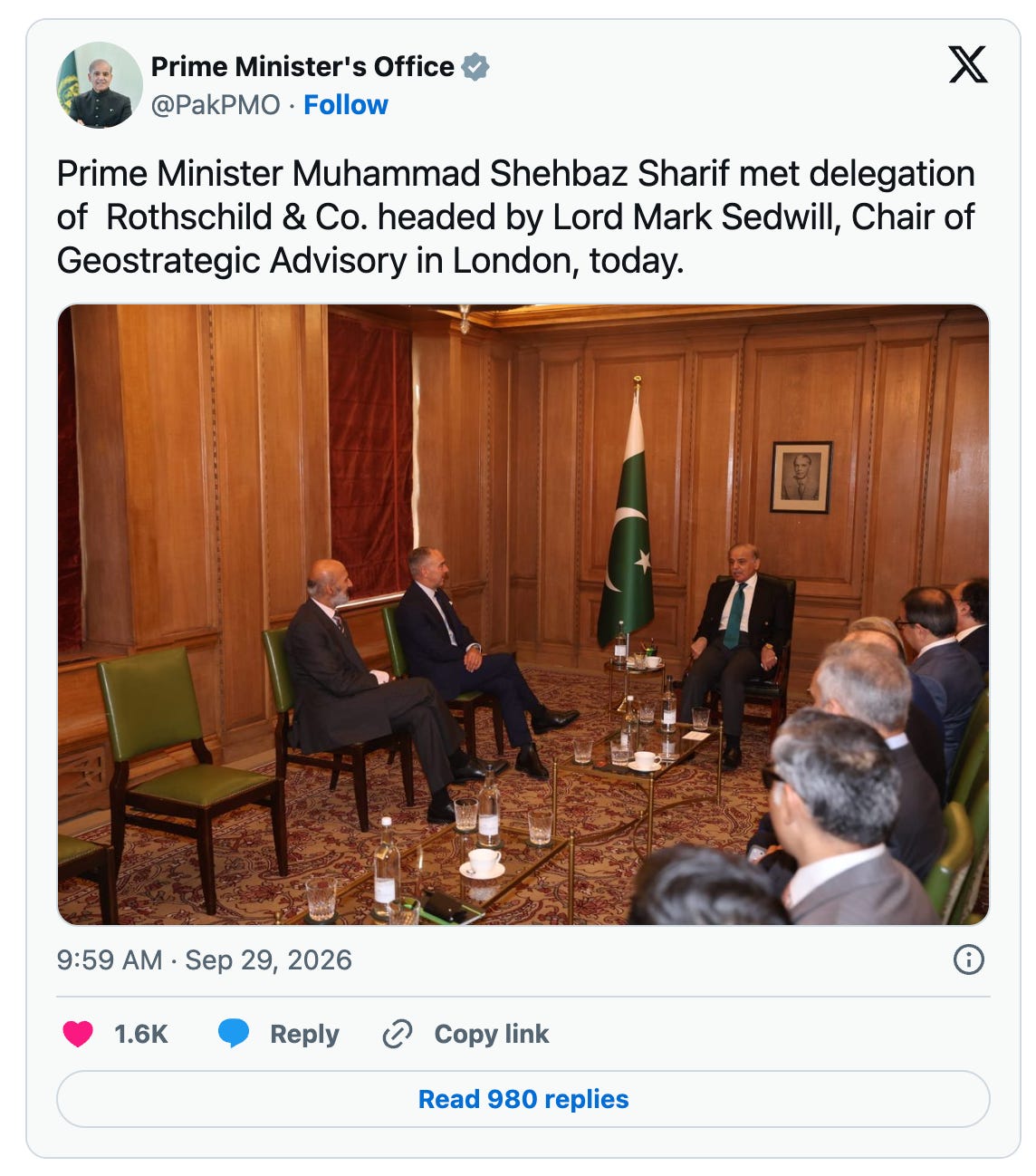
The London itinerary put his responsibilities together in one place. He attended Sharif’s meetings with JP Morgan, Citi and Rothschild & Co, then held his own meeting with Standard Chartered’s Bill Winters, where privatisation transactions were explicitly discussed. Borrowing and asset sales were being presented to the same financial market by the minister responsible for the public accounts. Aurangzeb is the civilian official who must explain how those transactions serve Pakistan while the military’s economic role expands at home. The voter is owed an account of the costs, ownership changes and conflicts that his ministry accepts.
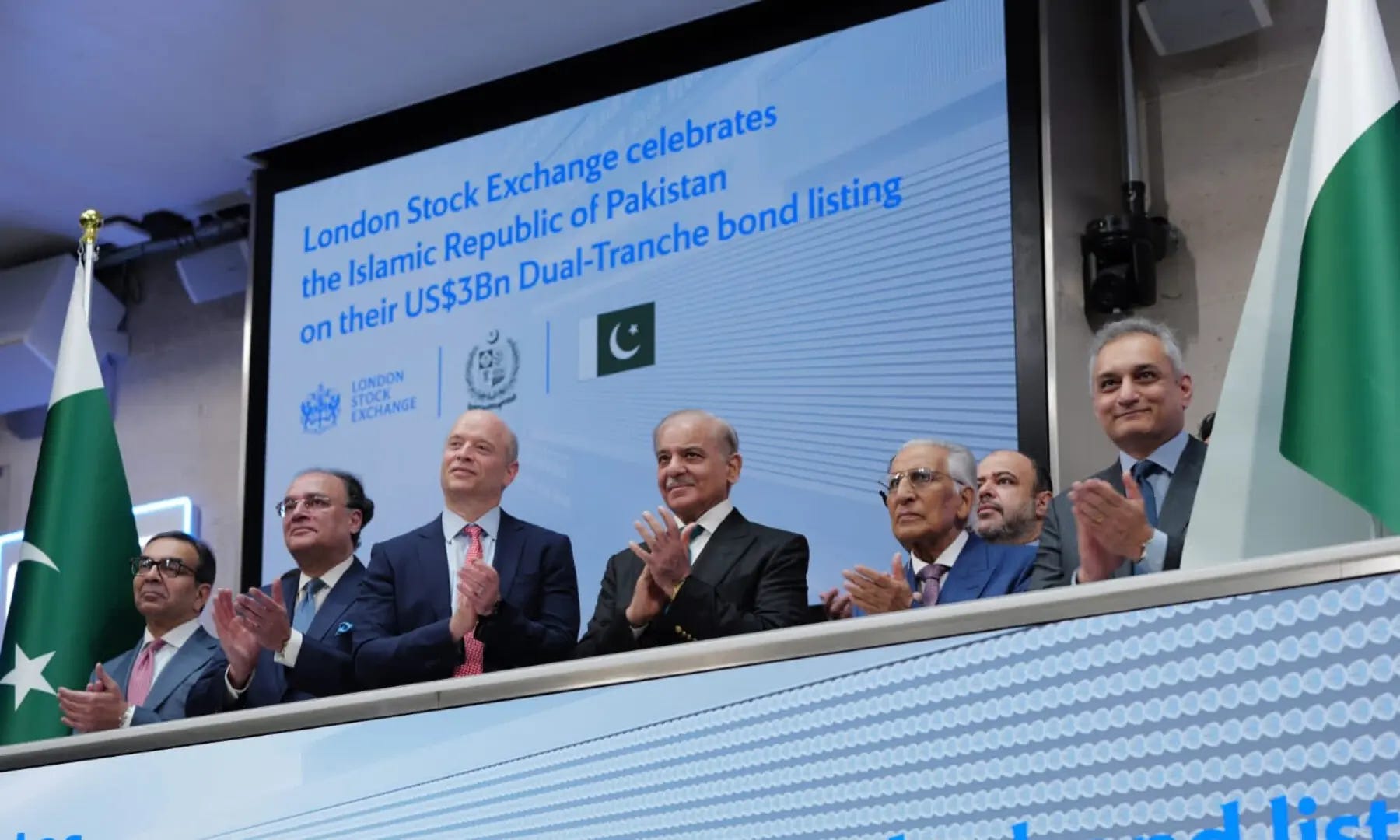
Shehbaz Sharif rang the bell in London on 29 September. At the London Stock Exchange’s headquarters in Paternoster Square, he inaugurated the listing of Pakistan’s $3 billion Eurobond and received a commemorative memento from the exchange group’s chief executive, David Schwimmer. The government had borrowed the money earlier in September. Pakistanis will still owe the longer portion of that debt in 2036, and yet the prime minister presented the occasion as a national achievement. The photograph belongs to his government. The repayment belongs to whoever is earning, paying taxes and buying fuel ten years from now. The Express Tribune’s account also records his invitation to cooperate on privatisation.
The government’s own statement records meetings with Barclays, JP Morgan, Citi, BlackRock and Rothschild & Co, attended by Aurangzeb and privatisation adviser Muhammad Ali. JP Morgan expressed interest in sovereign debt markets and corporate banking. For the Rothschild meeting, the statement supplied one sentence about possible advisory work on investment and capital markets, identifying Lord Mark Sedwill and Majid Ishaq as the firm’s representatives. It supplied no engagement letter, fee schedule or list of assets discussed. A government asking citizens to trust its management of public property gave them a guest list where they needed terms.
The distrust has a documented foundation. After the 2024 election, the Human Rights Commission of Pakistan demanded an independent audit and publication of the election forms needed to test the result. Form 45 records the count at a polling station; Form 47 consolidates constituency results. The dispute concerns whether those totals faithfully carried the votes into parliament. Sharif’s parliamentary majority does not answer that dispute, and a government whose mandate remains contested has an even greater duty to disclose transactions that bind the country beyond its own term.
The London trip deserves examination because debt, privatisation and military power already meet inside Pakistan’s economic institutions. The public record establishes a financial roadshow with asset sales on the agenda. It leaves the scope of the Rothschild conversation unresolved. Which Pakistani assets, if any, were discussed across that table? The answer belongs to the people who own them.
Borrowing to repay the borrowing
In April, Pakistan borrowed $3 billion from Saudi Arabia to repay the United Arab Emirates. The Saudi loan had an initial three-month term and received an extension into October. Shahbaz Rana’s September reporting quoted a finance ministry official saying the new Eurobond would repay Riyadh. The ministry’s formal response described broader financing needs and the option of replacing short-term debt. Either description leaves Pakistan with another repayment obligation after a ceremony celebrating its ability to borrow.
A Eurobond is a bond sold in international markets outside the jurisdiction of its currency. Pakistan’s issue is denominated in US dollars. The London venue does not turn it into a £3 billion loan, and the word Eurobond does not mean the debt is in euros. Investors advance money, Pakistan pays interest, and the original amount comes due under the bond’s terms. The two portions, called tranches, have different repayment dates. The reported terms are:

The coupon is the scheduled interest payment calculated on the bond’s face value. Using those terms, the first tranche carries $721.875 million in coupons over five and a half years, and the second carries $987.5 million over ten years. Together, the scheduled interest is about $1.709 billion, before fees and assuming both bonds remain outstanding for their full terms. Pakistan must also return the $3 billion principal. The combined $230 million annual coupon burden lasts while both tranches are outstanding; after the shorter bond matures, the longer bond continues with its own payments.
Extending a three-month obligation into longer debt can reduce the danger of an immediate repayment crisis. Aurangzeb makes that case, and it deserves to be assessed against the actual alternatives available. His banking experience equips him to distinguish a successful placement from a good deal for the borrower. He must disclose the cost of the Saudi facility, the bond’s issue price and the transaction fees before anyone can establish the saving or additional cost. A coupon rate also differs from the investor’s yield when a bond sells below face value. The public needs the amount Pakistan received after deductions, as well as the amount it promised to repay.
Refinancing can keep a country solvent without adding productive capacity. Where the proceeds replace an existing creditor, the transaction itself adds no factory, export order or power plant that will earn the dollars needed for repayment. Pakistan obtains time and accepts a new schedule, and yet its rulers sell that breathing space to the public as proof that the underlying economy has been repaired. The test comes when the next payment falls due and the country either earns the money or borrows again.
The currency places another risk on Pakistanis. The bondholder’s claim stays in dollars even if the rupee loses value. More rupees are then needed to purchase the same dollars, putting pressure on a budget funded largely in rupees. Export earnings can offset that risk; photographs at a stock exchange cannot. A government celebrating access to international credit should explain how its economic policy will produce the foreign exchange that makes the credit repayable.
The public pays in rupees
The federal budget for 2026–27 provides the domestic account of those priorities. It allocates about Rs18.77 trillion in total spending, Rs8.054 trillion in interest, roughly Rs3 trillion for defence services and Rs822 billion for military pensions under a separate head. Federal development spending receives Rs1 trillion. The figures appear in the Finance Division’s Budget. Adding interest, defence services and military pensions produces about Rs11.88 trillion, or approximately 63 rupees out of every 100 rupees of federal expenditure.
That calculation concerns the federal budget. Provincial governments fund much of Pakistan’s schooling and healthcare, so it would be wrong to describe the remaining federal money as the country’s entire social budget. The comparison still establishes the scale of the claim that creditors and the military make on federal resources. Interest alone receives eight times the federal development allocation, and yet citizens who ask for functioning services are repeatedly told that the treasury has little room.
Interest spending includes domestic creditors as well as foreign lenders. Pakistan’s banks and other local investors therefore sit inside this account alongside external bondholders. The political choice concerns whose claim receives priority and whose income is easiest to collect. The salaried worker’s tax is deducted before the wage arrives. Fuel levies enter the cost of a rickshaw journey, a delivery and the movement of food. The household can reduce consumption only so far before the saving becomes a missed meal or an unpaid bill.
Fiscal discipline has a class character when the state protects powerful institutions while collecting from people with little bargaining power. A defence allocation, an interest payment and a development cut are decisions made by identifiable offices. They can be debated and changed. When ministers treat creditor confidence as the public interest itself, they remove from debate the question of whether the people paying for that confidence receive anything in return. Pakistanis are financing a state that offers them sacrifice at home and investment opportunities abroad.
The name on the door
The Rothschild surname carries a political history that the government cannot pretend Pakistanis will overlook. On 2 November 1917, British Foreign Secretary Arthur Balfour addressed his declaration to Lord Walter Rothschild for transmission to the Zionist Federation. The House of Commons historical briefing reproduces the letter. It promised British support for a Jewish national home in Palestine and described the Arab population as “existing non-Jewish communities,” whose civil and religious rights were to be protected. Their political rights received no equivalent recognition in that sentence.
Britain made a promise about a country whose population had not authorised it, and yet the people already living there appeared in the document through what they were not. The declaration became part of the imperial foundation on which the Zionist state-building project advanced. Its consequences were developed through the British Mandate, settlement and later war; the dispossession of 1948 had a history before it became the Nakba. The letter establishes a specific relationship between British state power and a named Zionist representative.
The family’s own record supplies further evidence. The Rothschild Archive documents Edmond de Rothschild’s support for colonies in Palestine. In a 2017 interview reported by Jewish News, Jacob Rothschild called the Balfour Declaration a “miracle” and described Dorothy de Rothschild’s role in connecting Chaim Weizmann with the British establishment. He also acknowledged disagreement within the family at the time. Named participants, financing and political access carry this history; ancestry alone cannot establish the conduct of a present company.
Pakistan’s commitment to Palestinian rights makes that history politically relevant. It increases the government’s obligation to explain its choice of adviser and the proposed work. The public deserves to know what services Islamabad sought from the firm and what conditions accompanied the discussion. A claim that a Pakistani asset was pledged or a sale authorised requires the transaction record. The documented history gives citizens grounds to demand those papers; the government controls whether they receive them.
The man across the table
Sedwill’s career connects the London meeting to a more recent exercise of Western power in Pakistan’s neighbourhood. He served as Britain’s ambassador to Afghanistan and NATO’s senior civilian representative there. The University of St Andrews’ career account records his service as UK Special Representative for Afghanistan and Pakistan from 2011 to 2013. He later became Britain’s National Security Adviser and Cabinet Secretary. His professional knowledge of this region was acquired inside the institutions that directed Britain’s part in the Afghan war.
Rothschild & Co’s current profile lists him as chair of its geopolitical advisory operation and its Saudi Arabia business, as well as a supervisory board member. It also lists his leadership of the International Institute for Strategic Studies and the Special Forces Club. The overlap is public. A former senior representative of the Western security order now advises private capital on geopolitical risk, and the Pakistani government receives him while managing a debt relationship with Saudi Arabia.
Sedwill brings knowledge of the state’s security relationships, its creditors and the institutions capable of guaranteeing policy into commercial advice. Pakistanis have reason to examine who purchases that expertise and what it is meant to secure. A military-dominated government can offer an investor continuity across civilian administrations while denying citizens the ability to contest the commitments made in their name. The foreign adviser gets access to the prime minister and the privatisation chief; the Pakistani voter gets a sentence from the press office.
Rothschild’s sovereign advisory work is also documented. Ukraine’s government named it financial adviser on the September 2024 restructuring of $20.5 billion in sovereign and sovereign-guaranteed Eurobonds. A restructuring changes repayment terms through agreement with creditors. It can reduce the amount owed, postpone payments or change interest obligations. Ukraine’s government presented the operation as a way to restore debt sustainability and free budget resources during war, within its IMF programme.
Pakistan had already received a Rothschild delegation on 21 February 2023. The official announcement names partner Eric Lalo and managing director Thibaud Fourcade at their meeting with Ishaq Dar. It records discussion of financial services and Pakistan’s economic position. There is a history of contact, but the published announcements do not establish a Pakistani restructuring mandate. A government can seek financial advice for several purposes. It owes the public a precise statement of which purpose it has chosen, how the adviser was selected and how payment will be calculated.
The assets already on the list
The strongest evidence that London involved an asset-sales pitch comes from the finance ministry itself. Aurangzeb’s meeting with Standard Chartered chief executive Bill Winters included possible capital-market transactions supporting privatisation, on both the “buy-side and sell-side,” according to the 29 September official statement. The privatisation adviser attended. In plain language, the discussion covered financial work connected to purchasers and to the state as seller. The public can demand the appointment terms and conflict safeguards without inventing what happened in another meeting.
The government’s revised programme reported in Jul covered 25 entities and added the airports at Karachi, Lahore and Islamabad. It included power distributors and financial institutions. The transaction structure matters. An airport concession can transfer operating rights for a fixed period while the state keeps ownership; a share sale transfers an ownership stake. An announcement that places both under privatisation gives citizens too little information to judge either arrangement.
For an airport, the public needs to know who receives passenger charges, which investments the operator must make and what happens if it fails. For a power distributor, the questions concern service, loss reduction, tariffs and liabilities. For an insurer, policyholders need protection for money accumulated over years. Selling the shares does not remove these obligations. The state can collect a payment today while accepting guarantees that cost the budget later, and yet the sale announcement can present the upfront receipt as the whole benefit.
The selection of electricity distributors also challenges the claim that the government is disposing only of hopeless burdens. Privatisation Commission secretary Usman Akhtar Bajwa told parliament that IESCO, FESCO and GEPCO were selected because their financial position and manageable losses made them easier to privatise. Business Recorder’s July account records that explanation. If better-performing companies go first, the government must show how their sale improves the remaining system and what income the public gives up.
PIA and the military buyer
The December 2025 PIA auction produced a Rs135 billion winning bid for a 75 per cent stake from an Arif Habib-led consortium. The announced structure assigned 7.5 per cent of the bid, Rs10.125 billion, to the government and 92.5 per cent, Rs124.875 billion, to fresh equity inside the airline. That split appears in Mettis Global’s account of the transaction. The headline bid therefore represented a package of ownership transfer and recapitalisation. The government could not spend the full Rs135 billion on schools, hospitals or debt repayment.
Requiring new owners to put money into a struggling airline has a commercial rationale. It can provide capital for aircraft and operations. Assessing whether the public received fair value requires the liabilities retained by the state, liabilities transferred to the airline, tax concessions and the value of the remaining public stake. The July parliamentary briefing cited Rs191 billion in assets alongside Rs182 billion in liabilities. Comparing the gross asset figure with the treasury’s cash receipt alone would conceal most of the transaction rather than establish that PIA was sold cheaply.
The consortium subsequently included Fauji Fertilizer as a strategic partner, as reported in June. The company’s corporate profile in its 2024 annual report identifies its relationship with Fauji Foundation. A military-linked commercial enterprise acquired a place in a transaction advertised as withdrawal of the state from business. The public relinquished control of its airline and a company connected to the military’s welfare-commercial system joined the new ownership arrangement.
The conflict concerns a military institution with influence over economic policy and a commercial network able to benefit from that policy. Shareholdings, financing and any institutional role in the sale must be disclosed together. Citizens are entitled to independent valuation and clear rules preventing the institution that influences the sale from advantaging its own companies. The ownership changes hands and the military retains its place in the economy, and yet the public is asked to celebrate the government’s withdrawal from business.
SIFC puts power inside the transaction
The Special Investment Facilitation Council was established in 2023 to accelerate investment and coordinate government approvals. Its leadership incorporates the prime minister and army chief. The Transnational Institute’s study of the Green Pakistan Initiative traces its relationship with military-led corporate farming and long-term access to state land. The arrangement gives the armed institution an economic role extending far beyond defence, while land users and provincial residents must deal with decisions made above them.
The IMF’s November 2025 governance diagnostic, published on Pakistan’s own finance ministry website, examines the council’s regulatory discretion and protections for decision-makers. It calls for disclosure of facilitated investments and concessions. Articles 10F and 10G concern regulatory relaxation and protection for actions taken under the law. Their practical effect requires scrutiny because exceptions can determine which company receives access, which requirement is waived and what cost is left with the state.
An investment concession can have a value even when the government writes no cheque. A tax exemption gives up revenue. Preferential land access gives up another possible use. A guarantee exposes the budget if the investor’s project fails. Each benefit should appear in the transaction account, and yet a press release can report the promised investment while leaving the public contribution out of the sum. Aurangzeb must account for the revenue surrendered and liabilities accepted, including commitments made through SIFC. The military’s influence over the investment machinery increases his duty to publish the fiscal costs. Citizens need to know what Pakistan supplies before judging what the investor brings.
Agriculture makes the consequences physical. Under the corporate-farming programme, land described as barren becomes available for long leases and irrigation. That description cannot settle customary use, grazing access or the claims of communities already depending on it. The six proposed Indus canals generated resistance in Sindh, including the Babarloi sit-in. On 28 April 2025, the Council of Common Interests halted the canal plan pending agreement among the provinces. Soch Fact Check distinguishes that suspension from permanent cancellation.
The protests forced water allocation and provincial consent into an investment programme presented as national development. A corporate farm’s need for irrigation reaches the farmer downstream whether that farmer was invited to the announcement or not. Provincial approval must therefore mean more than a minister’s presence at a signing ceremony. The people losing access to land or water need enforceable rights, published terms and a means of refusal before the promise of new investment becomes their loss.
Minerals leave through the same institutions
On 8 September 2025, the Frontier Works Organisation signed a $500 million memorandum of understanding with Missouri-based US Strategic Metals. A separate agreement paired the National Logistics Corporation with Portugal’s Mota-Engil. Business Recorder’s account describes the minerals initiative, and Associated Press identifies the logistics agreement and plans for a refinery. These are commitments to develop a partnership. An MoU’s announced value does not establish that the full amount has been invested.
US Strategic Metals announced its first mineral delivery on 2 October 2025. The announcement is the company’s account, not an independent audit. It establishes a claim of activity and allows the government to be asked for the shipment’s origin, quantity, declared value and payment. Mineral wealth creates public income only through the actual contract, processing arrangements, taxes and royalties. A valuable deposit beneath the ground does not feed a family above it.
FWO and NLC bring military-linked institutions into extraction and transport. Where those institutions occupy several stages of a supply chain, parliament must be able to examine the margins at each stage. The province and the district hosting a mine need to see how revenue is distributed and how environmental obligations will be enforced. A contract can generate exports and still distribute benefits unfairly. The public must be able to test both results against records rather than accept a photograph of visiting executives as proof of national prosperity.
The announced refinery also creates a clear test. Processing minerals inside Pakistan could add skilled work and retain more value than shipping raw material abroad. The government should disclose the investment timetable, financing and binding requirements that turn that promise into capacity. Otherwise, immediate exports can proceed while the local industrial benefit remains a future claim. Pakistan’s resources then strengthen someone else’s supply chain before they strengthen its own economy.
The brown sahib state
Pakistan’s rulers have sold strategic usefulness to foreign capitals before. The American Government Accountability Office recorded $5.56 billion in Coalition Support Fund reimbursements for the period from October 2001 to June 2007. The payments covered military operations and support during the war on terror. Washington could account for Pakistan as a security expense while Pakistan’s border communities experienced the war as a condition of daily life. The arrangement made the military relationship valuable abroad without giving those communities control over its costs.
The brown sahib is a governing class that treats access to foreign power as its source of authority and the country it governs as the means of maintaining that access. Today the offer includes investable assets and mineral supply chains alongside strategic geography. A creditor seeks repayment, a buyer seeks commercial rights and a military institution seeks an expanded economic role. Their interests can converge while citizens receive little influence over the resulting terms. Each participant has a reason to prefer continuity; the public has a reason to demand control.
The constitutional changes make that demand harder. The 27th Amendment, passed in November 2025, placed the new Chief of Defence Forces role with the army chief, expanded military command and gave extraordinary protections to the highest ranks. It also created a Federal Constitutional Court and shifted constitutional jurisdiction. The institution influencing investment decisions gained stronger protection within the political order at the same time that citizens needed stronger means to challenge its decisions.
Repression limits who can make that challenge. Human Rights Watch reported on 18 September 2026 that Imaan Mazari-Hazir and Hadi Ali Chattha were rearrested hours after the Supreme Court granted bail. Their earlier convictions concerned social-media posts supporting activists and criticising the military; the new detention invoked an older protest case. Amnesty’s March appeal documented a year of detention for Mahrang Baloch and other Baloch activists, alongside fair-trial and medical-care concerns. Communities whose resources attract investors face a state that restricts the people representing their grievances.
The government can negotiate with international finance and the military can offer political continuity, and yet a citizen trying to contest the use of public wealth confronts institutions equipped to detain dissenters. That imbalance gives the phrase military government its substance. Civilian ministers conduct the roadshow while military power sits inside the economic machinery and the political system that protects it. The criticism attaches to those powers and transactions, which must remain answerable regardless of the name on the prime minister’s office.
What must happen now
Parliament must require Aurangzeb to publish the Eurobond offering documents, issue prices, net proceeds and fees paid to each bookrunner. He must show how the proceeds were used and the terms of the debt they replaced. The government must also state whether Rothschild & Co has any Pakistani mandate, publish its scope and payment terms if one exists, and identify the assets discussed in London. A claim that a meeting was exploratory can be put on the record and tested against subsequent appointments.
Every proposed asset transaction needs an independent valuation, the buyer’s ultimate ownership, liabilities retained by the taxpayer and all concessions or guarantees. Military-linked companies must disclose their stakes and the financing behind them. SIFC transactions require a public account of regulatory exceptions and their financial value. Provinces must be able to inspect and contest agreements affecting their resources before implementation, with enforceable protection for the communities that bear the consequences.
The public should be able to follow a payment from the investor to the treasury and a royalty from the mine to the province. An asset sale should show what control passes to the buyer and what obligation stays with Pakistan. Sharif’s government has enough authority to take the country to London and market its future income; Pakistanis have enough ownership to require the papers before another transaction closes.