
The Boom at the Gate
Pakistan’s Ports and the Someone Else’s Windfall
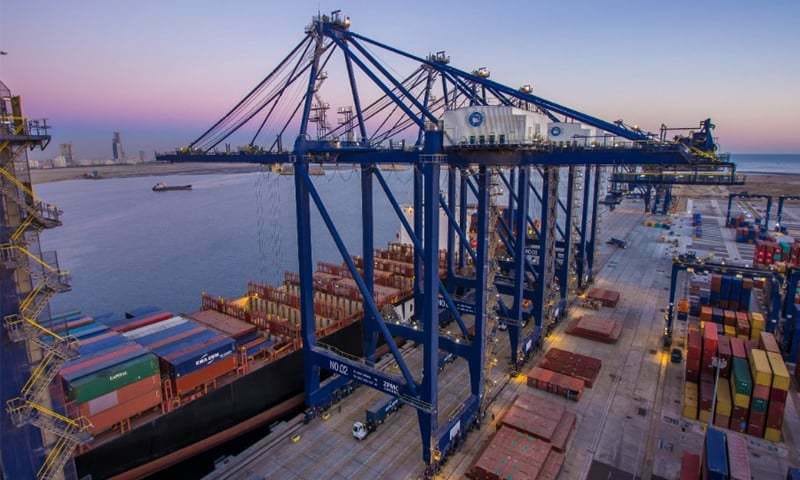
In March 2026, Karachi Port processed approximately 11,000 trans-shipment containers, more than it had handled in the entirety of the preceding calendar year. In the first twenty-four days of that month alone, 8,313 containers moved through the terminal, a 1,423 percent increase against the year-prior baseline. Ships that six months ago were queuing at Jebel Ali, at Fujairah, at Salalah and Khor Fakkan now anchor off Karachi. The war in Iran and the functional closure of the Strait of Hormuz as a safe commercial corridor, transformed under the dual pressure of IRGC interdiction and a U.S. naval presence into a contested military passage, have redirected some of the heaviest cargo traffic on earth toward the Arabian Sea’s eastern edge. Pakistan, for the first time in its maritime history, sits at the center of a regional shipping rerouting of historic scale.
The government has described this as a windfall. The Ministry of Maritime Affairs has used the word “opportunity” in three separate press statements since February. Federal ministers have toured the quays with journalists in tow, pointing at cranes and containers the way governments point at infrastructure when they need something to stand next to. None of them have explained who is collecting the money. The answer, embedded in concession agreements signed during the years when Pakistan was in no position to negotiate, is that the money is largely going elsewhere.
To understand what Pakistan actually earns from the surge, one needs to examine the port concession agreements that were signed when the country was desperate enough to accept almost any terms from anyone willing to invest in maritime infrastructure. These agreements are not classified. They are simply never discussed in the same breath as the traffic figures, because placing them side by side produces a conclusion the government would prefer the public not reach.
At Gwadar, the operating authority is China Overseas Ports Holding Company (COPHC), which holds a 40-year build-operate-transfer concession signed under the CPEC framework. The revenue split is not in dispute: China takes 91 percent of gross port revenue; Pakistan retains 9 percent. Gwadar was built, promoted, and sold to the Pakistani public for two decades as the jewel of CPEC, the mechanism through which Balochistan would finally access the wealth generated by its own geography. The pitch was sovereignty through infrastructure. The contract delivered something closer to the reverse. When Gwadar processes a trans-shipment container diverted from Bandar Abbas because the Hormuz corridor is closed to commercial traffic, COPHC collects ninety-one cents of every dollar that container generates. Pakistan collects nine.
At Karachi’s Gateway Terminal Limited (KGTL), operated under a joint venture in which Abu Dhabi Ports holds the majority shareholder position, Pakistan’s direct return is $36 per container in royalty. Not a percentage of profit. Not a fee adjusted to market conditions. A flat $36 per container, regardless of what the market for trans-shipment handling actually bears during a period of regional disruption, when rates climb sharply. At Port Qasim, the Queen’s International Container Terminal (QICT) is operated by DP World, the Dubai-based port management company running facilities across seventy countries. Pakistan’s royalty there is $15 per container. DP World collects the handling fees, the storage revenue, and the operational margin. Its parent company reported revenues exceeding $19 billion in 2025. The $15 figure at Port Qasim is not an oversight. It reflects who held leverage when the deal was signed, and who did not.
These three facilities, Gwadar, KGTL Karachi, and QICT Port Qasim, are the primary infrastructure through which the current traffic surge is being processed. Every headline about Pakistan’s maritime boom flows through one of these three gates. Behind each stands a foreign operator holding the majority of what the gate produces.
Work through the arithmetic the government is not conducting in public.
At a conservative estimate of $200 per container in handling revenue, a figure the market during a disruption period routinely exceeds, 11,000 containers generates $2.2 million in a single month from trans-shipment handling alone. At KGTL, Pakistan’s $36 royalty on 11,000 containers returns $396,000. The terminal itself, through handling fees and ancillary services, generates multiples of that figure. The gap between what moves through Pakistani sovereign territory and what enters Pakistani public accounts is not incidental. It is the deal.
The Port Qasim structure is even more explicit in its extraction logic. DP World does not operate QICT as a public service. It operates it as a profit center within a global network. The trans-shipment containers diverted from Dubai and Fujairah because of the Hormuz closure are, in a precise sense, additional volume for a DP World facility located outside the Hormuz risk zone. The company loses business at Jebel Ali and recaptures a portion of it at Port Qasim. Pakistan provides the land, the labor, the berthing infrastructure, the security perimeter, and the sovereign territory. Pakistan receives $15 per container.
Gwadar is the most structurally complete version of this problem. The port was built on the argument that Balochistan deserved development, that Chinese investment would translate into Pakistani prosperity, that CPEC was partnership rather than dependency. The 91/9 revenue split is the written answer to that argument. As Gwadar handles its first meaningful trans-shipment volumes and enters the regional network as an operational hub, the communities of Makran are watching foreign vessels discharge cargo onto Chinese-operated quays. The 9 percent Pakistan receives does not reach them. It enters federal accounts, is distributed according to the NFC award formula, and is allocated according to the discretionary priorities of whoever governs from Islamabad. Baloch fishing communities, whose access to coastal waters has been progressively curtailed since CPEC construction began, receive no royalty. They receive checkpoints.
The honest version of this analysis must acknowledge that the concession agreements are contracts, and contracts have terms, and the picture is not entirely one of uncompensated extraction. Pakistan does capture value through a layered system of royalties, port dues, vessel fees, customs revenue, and the indirect economic stimulation that flows from port activity into the surrounding logistics economy. Ancillary services, trucking, customs clearing, and warehousing that sit outside the terminal concession zones generate economic activity in Karachi and Gwadar that flows to Pakistani businesses and workers. The argument is not that Pakistan receives nothing.
The argument is that Pakistan receives a fraction of what its geography, its infrastructure, and its strategic position in the current moment of regional disruption have made possible, and that fraction is a function of contractual decisions made under conditions of dependency that the government treats as permanent and the public has never been allowed to examine. Pakistan has also had to lower its own margins to attract diverted traffic, competing on price in a market where its terminals are majority-owned by the very Gulf operators whose primary facilities the rerouted ships have just abandoned. The country is, in effect, offering discounts on capacity that it does not fully own, to attract traffic that enriches operators over whom it has limited contractual leverage.
The shipping intelligence on one point is unambiguous: the displacement of Fujairah and Khor Fakkan as the Gulf’s primary trans-shipment staging grounds is not a temporary operational adjustment. When a port loses its position in a shipping line’s network, the rerouting costs, the renegotiated contracts, and the updated call sequences create their own inertia. Some portion of the traffic that moved to Karachi in early 2026 will remain in Karachi after the Iran war reaches its resolution, because shipping lines do not rebuild their logistics architecture around a route and then dismantle it six months later. This is how Singapore took market share from Hong Kong in certain cargo categories. It is how Colombo displaced Indian trans-shipment volumes for a decade. Routing, once established, carries structural persistence.
This means Pakistan has, in March 2026, a narrow window to address the contract architecture that governs what it actually earns from this position. It is not using that window. There are no public renegotiations of the COPHC concession underway. The Maritime Ministry has issued no statement on the KGTL royalty structure. No committee of the National Assembly is examining whether $15 per container at a DP World facility is an appropriate return on sovereign territory. The government is instead doing what Pakistani governments have historically done when foreign capital produces visible activity on Pakistani soil: issuing statements about the activity and remaining silent about who is collecting it.
The Senate Standing Committee on Ports and Shipping met twice in March 2026. The agenda items available from the National Assembly’s published records include no discussion of royalty structures or trans-shipment revenue distribution during the current surge period. The committee addressed berth allocation timelines and customs clearance backlogs. These are operational concerns. The structural question, who is being paid, was not on the agenda.
What the current moment makes legible, with unusual clarity, is a structural condition that Pakistan’s more rigorous political economists have named but successive governments have declined to address. The country is too constrained to renegotiate the terms of its port concessions because its constrained condition is partly a product of those very concessions. Pakistan is midway through an IMF program. Its foreign exchange position depends in part on Gulf remittances and Chinese bilateral rollovers. The political cost of renegotiating COPHC’s terms while simultaneously managing IMF conditionality and the economic pressure of the Iran war would be significant. This is the argument the government, if pressed, would make. It is a real argument. It is also a precise description of the leverage trap that critics of Pakistan’s CPEC arrangements have been documenting for years.
What is within reach, and what the government is declining to pursue, is the more modest version: transparency. A public accounting of what each port facility generates in gross revenue and what Pakistan retains, updated quarterly and laid before parliament, would not break any contract. It would simply make visible what is currently invisible to the public that owns the sovereign territory on which these facilities operate. The Ministry of Maritime Affairs knows these numbers. The KPT Board knows them. The Gwadar Port Authority knows them. They are not being shared.
The boom will not last indefinitely. Wars end, or they reach new equilibria, and shipping routes settle into a new normal. Jebel Ali will not remain compromised. Fujairah will rebuild its trans-shipment position. The window in which Karachi and Gwadar hold the structural advantage they currently hold is not permanent. When it closes, Pakistan will retain whatever institutional capacity it built during this period, whatever contractual improvements it negotiated, whatever durable position in global shipping networks it secured.
On the present trajectory, it will retain none of these things. It will retain the memory of a surge, the infrastructure debt it is still servicing, and the same royalty rates it entered the boom with. The question the evidence raises but cannot yet answer is whether anyone in the Ministry of Maritime Affairs, in the leadership of the KPT Board, in the rooms where the COPHC relationship is managed, has looked at the March 2026 numbers and formally requested a renegotiation. And if they have, what answer they received, and from whom.


