Japan financed intensive-care wards, fire alarms and firefighting equipment, Islamabad supplied billions more, and yet a nursery full of oxygen became a death chamber whose exits rescuers found locked from outside.
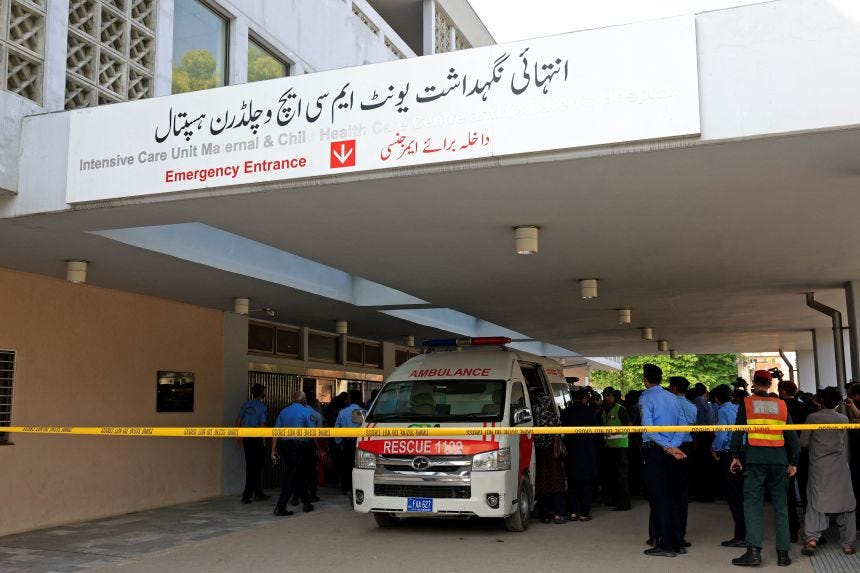
At 6:45 on the morning of August 26, 2026, there were fifteen newborn babies inside the nursery on the third floor of the Mother and Child Health Centre at the Pakistan Institute of Medical Sciences. An air-conditioning unit or overloaded electrical point sparked, oxygen ignited, smoke entered the lines that were keeping premature babies alive, and fourteen children died before their parents could reach them. Only one baby survived. Associated Press reported rescue workers breaking third-floor windows and raising ladders against the building while families gathered below, but the most damning detail came from the Capital Development Authority’s preliminary account: the emergency exits were permanently locked from the outside and obstructed. Aaj News reported that the CDA judged the ward’s fire and life-safety arrangements inadequate and below the prescribed standard.
The official explanation will stop at the air conditioner, as though an appliance locked the exits and neglected the alarm. You already know why that explanation feels insulting. An electrical fault supplied the first flame, but an institution supplied the conditions: twenty-four oxygen cylinders in a nursery, exits locked from outside, an alarm system that staff and witnesses say did not activate in time, no recent record of a fire drill, and a public hospital that had already received billions of rupees from Islamabad and more than a hundred million dollars in Japanese assistance. The money arrived and the buildings rose and officials posed beside plaques, and yet fourteen families left the federal capital’s largest hospital carrying coffins small enough to hold in their arms.
The first obligation is to name the dead when their families permit it. The second is to follow the money. PIMS officials produced an initial explanation within hours. According to Geo News, the hospital’s preliminary report said a nebuliser indicating oxygen quantity beside an incubator exploded, oxygen caught fire, and smoke travelled through pipes into the infants’ breathing systems. The same report cited video of flame coming from an air conditioner. Federal Health Minister Mustafa Kamal said the hospital’s firefighting equipment was operational. PIMS Executive Director Rana Imran Sikandar described the safety system as satisfactory and said rescuers faced no obstruction.
PIMS is led operationally by Professor Dr Rana Imran Sikander, who held acting charge from April 2023 and became permanent executive director in July 2025, but the political authority above him is Federal Health Minister Mustafa Kamal. Kamal oversees the ministry responsible for PIMS, defended the hospital’s firefighting equipment as operational after fourteen newborns died, and remains in office, while Prime Minister Shehbaz Sharif suspended Health Secretary Aslam Ghauri before the inquiry had established responsibility. You can see how accountability is being arranged: the minister keeps his portfolio, the executive director keeps the hospital, and the secretary between them is removed for the cameras. The inquiry must establish what Kamal and Sikander knew about repeated fire-safety warnings, locked exits, absent drills and the maintenance of donor-financed alarm and firefighting systems, because responsibility cannot stop with the official easiest to sacrifice.
The CDA’s account contradicts him. Its fire department found inadequate safety arrangements, locked and obstructed emergency exits, and barriers to evacuation. Rescue sources reported that no water was available at the fire point and couplings were missing from the hose. Dunya News reported that drills had not been held for years, staff lacked practical evacuation training, exits were closed and the alarm did not activate promptly. Parents told Geo News that the nursery door was locked and staff were absent. The aunt of the only surviving child said she entered the ward herself and carried the baby out. You are being asked to believe the system was satisfactory when a relative, rather than a trained rescue team, brought out the sole survivor.
Official and parental accounts dispute the rescue time. The CDA says its alert arrived at 6:54 a.m. and the first vehicle reached PIMS six minutes later. Parents told reporters that meaningful rescue came much later. Both accounts can be true if the alarm was late, staff failed to act, the door was locked and firefighters reached the compound before they could reach the children. The inquiry must publish the emergency-call audio, control-room log, appliance GPS records, corridor footage and door-access record. Without those records, every official time stamp is public relations.
The locked exit is a major breach that the phrase “short circuit” cannot bury. Someone ordered that door locked, someone continued working while it remained locked, someone inspected the ward or failed to inspect it, and every official in that chain drew a public salary. Follow that chain and the fire changes shape: electricity supplied the spark and oxygen carried it, but a human decision trapped the children.
PIMS had been warned by fire before. On January 4, 2018, a blaze in Surgical Ward 5 forced the evacuation of about forty-five patients. The hospital announced a six-member inquiry with CDA fire officers and promised recommendations to prevent another incident. The Express Tribune recorded the promise. ARY News now cites fire-department sources saying PIMS received repeated notices about safety defects from 2018 onward. Eight years later, another committee must answer a basic question: where are the first inquiry report and subsequent notices, which recommendations were implemented, who certified compliance, and why did a third-floor nursery still have locked exits?
The world has financed PIMS for more than four decades, so let us begin with the receipts. Japan has supported the institution since 1982. An official Japanese assistance summary places the cumulative grant total at approximately $125 million, covering the Children’s Hospital, the original Mother and Child Health Centre, medical equipment and later expansion. PIMS itself says the 125-bed Mother and Child Health Centre was built on a turnkey basis through Japanese grant assistance. The building existed because another country paid to help Pakistan reduce maternal and infant mortality.
Japan returned with more money. In April 2019, Tokyo committed about $32 million, then 3.62 billion yen, for an intensive-care expansion at the Mother and Child Health Centre and Children’s Hospital. The stated purpose was exact: increase treatment capacity for high-risk mothers and newborns. JICA said the project would accommodate 300 maternal and foetal intensive-care patients and 1,100 neonatal intensive-care patients each year. PIMS’s 2022-23 yearbook says the Japanese contractor completed the building, installed medical equipment and handed it to the hospital on September 9, 2023. Dawn reported that the 156-bed extension cost Rs4.3 billion, with JICA funding Rs3.9 billion and Pakistan responsible for Rs400 million.
The mechanical and electrical subcontractor describes what the project included: an addressable fire-alarm system, a public-address system, a nurse-call system, a 500-gallon-per-minute Naffco firefighting pump and piping network, electrical distribution boards, medical earthing, a backup generator and lightning protection. PECT valued its part of the work at Rs529.3 million. Those systems were installed to prevent an electrical spark from becoming a ward full of dead children.
The available record does not establish whether the nursery that burned was inside the 2023 extension, connected to its alarm and pump, or housed in an older section under repair. A relative told reporters that renovation was taking place in the affected building. The distinction must be settled with drawings and asset registers, not ministerial assurances. If the nursery was connected to the donor-financed system, the inquiry must explain why the alarm, water point, hose and exits failed. If it was outside that system, PIMS must explain why critically ill newborns were placed in a ward without equivalent protection while a new intensive-care facility stood elsewhere in the same complex.
Put those documents beside one another. The Japanese government can show the grant agreement. JICA can show the project scope. The yearbook records a handover date. The contractor lists the alarm, pump and electrical protections. Pakistan has yet to show you the commissioning certificate for each system, the coverage map identifying every protected ward, the preventive-maintenance contract, monthly alarm tests, pump-pressure tests, fire-door inspections, oxygen-risk assessment, staff drill register and the name of the officer who signed each document.
Foreign assistance builds an asset. The receiving state must operate it, maintain it, inspect it and publish the record. Pakistan’s ruling class has perfected the first half because inaugurations produce photographs and contracts produce influence, but the quiet work after handover has no ribbon to cut. Equipment ages, batteries expire, pumps lose pressure, exits acquire padlocks, maintenance budgets pass through offices and the public discovers the condition of the system only when a nursery burns.
Federal money continued during the years surrounding the Japanese project. The Nation reported after the fire that PIMS received approximately Rs22 billion over the last three fiscal years. In the last completed year, it was allocated Rs6.84 billion and spent Rs7.51 billion, an overrun of about Rs670 million that the government later regularised with an additional Rs660 million. The current allocation is Rs7.63 billion. You can follow every aggregate until the money reaches the ward, and there the record disappears: billions passed through PIMS, but the state cannot yet show what that money bought in safety.
The Mother and Child Health Centre has Rs1.069 billion for 2026-27. Geo News reported Rs356.9 million for salaries, Rs332.7 million for allowances and Rs270 million for operating expenses. The explicit allocations fall to Rs11 million for repair and maintenance, Rs7 million for machinery and equipment, and Rs4 million for buildings and structures. Salaries and allowances consume about 64.5 percent of the centre’s budget. The three visible maintenance, equipment and building lines receive about 2.1 percent.
Payroll keeps a hospital open, and clinicians cannot treat patients without it. The corruption lies in treating the aggregate budget as proof of service while refusing to expose the ledger beneath it. “Operating expenses” must be broken down. Every rupee spent on HVAC servicing, oxygen systems, fire doors, alarms, extinguishers, pumps and drills must be listed by invoice, vendor, ward and date. PIMS spent beyond its approved allocation and later received regularisation, and yet parents found a locked nursery door while rescuers reported a dry fire point and missing hose couplings. More money entered the system than Parliament first approved. Safety still failed.
The contrast is even uglier because the federal development programme continues to advertise expansion. The 2026-27 PSDP includes money for critical care, cardiac facilities and other PIMS construction. New blocks attract politicians because a government can announce a tower, award a contract and unveil a plaque, while a monthly pump test offers no ceremony and yet keeps a child alive when oxygen catches fire.
Calling every unexplained rupee theft would outrun the evidence. Calling PIMS’s financial record clean would defy it.
The Auditor-General of Pakistan identified Rs172.697 million in irregularities in the hospital’s 2011-12 accounts. The Express Tribune reported that PIMS spent Rs23.391 million on repair and maintenance for a liver-transplant unit without open bidding and split the work into fifty-three parts. Auditors also found that the hospital had paid Rs86.201 million to a contractor when only 25 percent of work on the Quaid-i-Azam Medical College had been completed. Six official vehicles assigned to the general pool were being used by individuals. Read the list again and notice what is already familiar: repairs without open bids, payment running ahead of construction and public property becoming private convenience.
An Auditor-General report covering 2016-17 and 2017-18 found procurement and control failures across PIMS. It recorded more than Rs1.08 billion in medicine purchases without quantities being determined in the tender documents, and it questioned Rs4.662 million in hospital receipts collected through a patient-welfare society and deposited outside the authorised hospital account. A later federal audit found that PIMS bought Rs134.078 million in medicines for Pakistan Bait-ul-Mal beneficiaries from suppliers outside the approved process. The audits document weak procurement, unauthorised handling of receipts and spending that broke the rules, although they do not establish theft from a fire-safety allocation.
The culture did not end with old audit files. In December 2025, ProPakistani reported that PIMS extended a cleaning contract without a fresh tender after the contractor had received fifteen warning notices, more than Rs6 million in fines and an adverse performance assessment. The hospital’s procurement department, with approval from the executive director, renewed the arrangement anyway. In November 2025, a Wafaqi Mohtasib inspection team described conditions in PIMS wards as appalling and unhygienic. The News reported that the team ordered urgent corrective action.
Corruption reaches a nursery without leaving an envelope marked “fire safety.” It appears in split contracts, incomplete work paid as completed, receipts held outside the proper account, purchases made outside approved channels, bad vendors retained after warnings and internal committees formed after each scandal. Money loses purpose as it moves through the institution. Responsibility is divided until nobody owns the locked door.
Social media supplied the testimony that official paperwork did not. A person identifying themselves as a PIMS worker wrote that the hospital had “0 safety, 0 maintenance, 0 concern,” while parents and local residents posted accounts of missing alarms, absent staff and locked access. These posts are leads, not audited evidence. They matter because the claims align with the CDA’s finding of inadequate safety and with years of official warnings about PIMS administration, but they must now be tested against payroll rosters, CCTV, duty logs, inspection certificates and procurement files.
You repay Pakistan’s borrowing through taxes, electricity bills, fuel prices and a currency weakened by the conditions attached to each rescue programme, which is why “where does the foreign money go?” deserves a documented answer. Grants such as Japan’s PIMS assistance are different from IMF balance-of-payments support and World Bank programme lending, but every inflow enters the same political order: donors finance new assets or fiscal space, Islamabad assumes responsibility, and the public is left without an accessible ledger connecting the money to a working service.
Pakistan is operating under a $7 billion IMF programme. The federal budget for 2026-27 totals Rs18.771 trillion. The Finance Division places interest payments at Rs8.054 trillion, while defence services receive Rs3 trillion. The National Assembly approved Rs37.22 billion for the National Health Services, Regulations and Coordination Division, of which the federal PSDP allocation was Rs16.064 billion. Associated Press reported that defence spending rose 18 percent while development funding was cut.
Debt interest and defence together take Rs11.054 trillion, almost 59 percent of the entire federal outlay. PIMS’s Mother and Child Health Centre receives Rs11 million for repair and maintenance. The state will insist that these figures sit in different categories, and technically they do, but budgets are the most honest description of power Pakistan publishes. Creditors are paid. The military allocation is protected. A nursery with premature babies and concentrated oxygen receives what remains, and when its door is found locked, the prime minister removes a secretary before sunset and calls another inquiry.
Pakistan’s crisis is the absence of public control over money. You can see the entire architecture now: Japan financed the building and equipment, the federal treasury supplied Rs22 billion to PIMS over three years, Parliament approved salaries, allowances, operations and development projects, auditors documented procurement failures, inspectors documented degrading conditions and an earlier ward fire produced an earlier committee. Every institution touched the hospital, and yet none can show the parents a complete chain of custody from grant agreement to alarm test, from budget release to maintenance invoice, from inspection visit to unlocked exit.
If this were only poverty, the records would show honest scarcity: requests denied, tenders unfunded, repairs deferred by named officials because cash was unavailable. The record instead shows money, irregular procurement, unexplained maintenance choices, repeat warnings and absent accountability. That is public corruption even before a court identifies personal enrichment, because public power and public funds were used without delivering the safety for which they existed.
Prime Minister Shehbaz Sharif removed Federal Health Secretary Aslam Ghauri and appointed a high-level inquiry headed by former interior secretary Shahid Khan. The Islamabad administration formed an eight-member fact-finding committee containing officials from the district administration, police, CDA, the power utility and PIMS itself. Associated Press of Pakistan reported that the panel has twenty-four hours to determine the cause, assess fire-safety measures and evaluate the emergency response.
PIMS is represented on a committee investigating PIMS. CDA officials will help assess a response delivered by CDA services. Bureaucrats will examine budgets and inspections administered by the same bureaucracy. The composition does not guarantee a false report, but it cannot provide public confidence without full disclosure and independent technical scrutiny. A twenty-four-hour deadline may identify an ignition point. It cannot audit three years of expenditure, four decades of donor-financed assets, maintenance contracts, inspection failures and the implementation of recommendations made after the 2018 fire.
The government must publish the complete report and its annexes, not a press-release summary. It must preserve and disclose the burned ward’s electrical layout, oxygen design, fire-system coverage, exit plan, CCTV and duty roster. It must publish all JICA handover and commissioning documents, Pakistan’s Rs400 million counterpart expenditure, the Rs22 billion PIMS budget releases, vendor contracts, bid evaluations, payment vouchers, maintenance logs and every fire-safety inspection since 2018. The Auditor-General should conduct a special forensic audit, and an independent fire engineer with hospital oxygen expertise should determine why the protection systems failed or did not cover the nursery.
Officials must also answer for the human chain. Who locked the exits? Who held the keys? Which nurse, doctor, ward attendant, security officer and administrator was assigned to the nursery at 6:45 a.m.? When was the last drill? Who checked the alarm? Who inspected the hose? Who counted the oxygen cylinders and approved their placement? Which officer accepted the ward for patient use while renovation continued? Names matter because “the system” becomes an alibi when a signature should exist.
Fourteen newborns died inside a hospital built and expanded with foreign assistance, funded with billions from the federal treasury and administered by officials who had already been warned through fires, audits, fines and inspections. You are asked to repay the debt, endure the taxes and salute each new project, and yet the state will not show you a working alarm until parents have buried their children.