
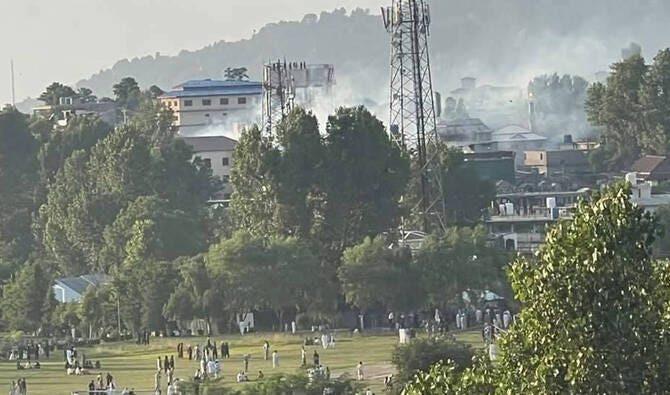
A special report on the constitutional machinery that keeps a self-governing promise permanently subordinate, and the charter of demands the state met with a proscription order, an internet blackout, and live ammunition.
Eleven people are dead in Rawalakot. Seven were protesters. Four were security personnel, three from the AJK police and one from the Frontier Constabulary. More than seventy were wounded, the mobile internet across the entire Poonch sector has been switched off, and seventy-two organizers, among them traders, lawyers, and student leaders, sit in custody under a law that now classifies the coalition they belonged to as a threat to national security. None of this happened because the coalition asked for something extraordinary. It happened because a sixteen-point charter, narrow enough to be costed in a single budget cycle, asked the government seated in Muzaffarabad to behave as though the people living under it were its constituents. That government could not say yes, because it was never built to answer to them in the first place.
This is the question this report is built to answer with documents rather than adjectives: not whether the state used too much force in Rawalakot, which is no longer in dispute, but what kind of government structure produces a year-long unanswered charter, a collapsed agreement, a Supreme Court ruling that closes its own loophole, and a proscription order delivered five days before a march the organizers had announced more than a year in advance. The record shows a system engineered, amendment by amendment, since 1974, to ensure that whoever governs Azad Jammu and Kashmir answers first to Islamabad and only second, if at all, to Rawalakot, Mirpur, and Muzaffarabad. Rawalakot did not break that system. It simply forced it into view.
The Numbers Islamabad Will Not Let Anyone Verify
The eleven dead that the AJK administration has confirmed are not the only count in circulation. Shaukat Nawaz Mir, the JAAC leader who presented the charter at the Muzaffarabad rally a year earlier, posted a video statement on X on June 8 declaring that “the state has begun a massacre of our people in Rawalakot.” The committee’s own account, posted on the same platform, described the scene at the Combined Military Hospital as a place that “resembled Gaza,” and said security forces had opened fire on what had been, until that moment, a peaceful sit-in. The Indian wire service IANS ran the same week with the headline “Concerns raised over Rawalakot ‘massacre’, grim situation in PoK,” placing the word in quotation marks while putting it in front of readers regardless. None of these claims has been independently verified, and in the territory’s current condition, none of them can be: the mobile internet across the Poonch sector has been off since June 7, the highways out of Rawalakot are lined with checkpoints, and any journalist attempting to reach the town from Muzaffarabad or Islamabad has to pass through the same barricades that stopped the white sedan at Barmang Bridge two days earlier.
This is not the first time the gap between the official count and the movement’s count has opened this wide, and the precedent is itself documented. When the JKJAAC’s predecessor campaign mobilized the territory for weeks beginning September 29, 2025, the region’s own Press Information Department eventually confirmed nine dead, six protesters and three policemen, according to Arab News. The JKJAAC’s figure for the same stretch of unrest was twelve of its supporters killed and more than two hundred injured, a third higher than the government’s number on deaths and roughly double on injuries. Those two counts were never reconciled before the two sides signed the agreement that ended that round of protest. The state did not commission an independent inquiry to settle which number was closer to the ground. It signed a settlement that made the dispute stop mattering politically, and moved on. Nine months later, with a fresh round of killings and a fresh blackout in place, the same disagreement has reopened in the same district, and the state has once again made certain that no outside party can weigh either side’s figure against the facts.
That is the part of this story that requires taking neither JAAC’s word over the government’s nor the government’s word over JAAC’s. It requires only noting what the state has chosen, twice in nine months, to make impossible: an independent count, arrived at while the evidence was still fresh enough to check. A government confident that its own figure, eleven this time, nine the last time, is the true one does not need to switch off the one network its critics could use to publish a competing number. It switches the network off because it learned, the first time, that an unresolved dispute over the dead costs a government less than a verified one would.
The Charter
The Joint Awami Action Committee did not arrive at this confrontation waving a separatist banner. It arrived with a document. At a core committee meeting in Dhirkot on May 21, 2025, the alliance, under the leadership of Shaukat Nawaz Mir, adopted a sixteen-point Charter of Demands and presented it five days later at a rally in Muzaffarabad, according to reporting in Dawn. The list reads like the standard inventory of a functioning provincial government anywhere in Pakistan: universal access to education and healthcare, employment programs and interest-free loans for young people, an international airport for AJK, the Taobat-Bhimber Expressway, clean water provision, regulation of the cellular companies operating in the territory, disability quotas and assistance, tax exemptions on basic goods, transparent judicial appointments, and an end to the diversion of public funds.
At the top of the list sits the demand that produced the bodies in Rawalakot: the abolition of the twelve seats in the Legislative Assembly reserved for Kashmiri refugees who settled in Pakistan after 1947 and 1965. The committee describes those seats as the mechanism through which decisions about AJK’s budget, taxation, and administrative appointments are made by people who do not live there and cannot be voted out by the people who do. Fifteen of the sixteen points are fiscal and administrative, the kind of demands a government resolves through a budget line and a delivery schedule. The sixteenth is constitutional, and it is the one the state has spent fifty years making sure no charter could ever reach.
A population does not spend a year assembling a sixteen-point negotiating document, electing a core committee, and organizing a long march if it intends to burn down the system it is petitioning. It does this when it has concluded, after years of unanswered requests routed through ordinary channels, that organized pressure is the only channel left open to it.
The state has negotiated with this movement before, and the result is the clearest evidence available that talks work when the federal center allows them to hold. In October 2025, the AJK government signed the Muzaffarabad Agreement with the Joint Awami Action Committee, promising subsidized wheat at Gilgit-Baltistan pricing and reduced electricity tariffs for residential consumers, ending months of civil disobedience during which residents had stopped paying their utility bills. For a window of weeks, it held. The agreement proved the committee was a negotiating partner capable of standing a protest down in exchange for commitments honored on schedule.
The commitments did not survive contact with the structural adjustment program Islamabad operates under with the International Monetary Fund. The federal government, bound to eliminate subsidies and raise energy tariffs to meet fiscal benchmarks, could not let Muzaffarabad keep the relief it had promised, because the AJK budget runs on federal transfers that arrive with conditions attached. By early 2026, wheat prices had risen forty percent and electricity bills had doubled, according to State Bank of Pakistan and Pakistan Bureau of Statistics fiscal and energy data cited in regional reporting. The settlement did not collapse because Muzaffarabad broke its word in spirit. It collapsed because the government that controls Muzaffarabad’s purse strings made the word impossible to keep. The lesson the protest movement drew from that sequence was not that negotiation fails. It was that negotiating with Muzaffarabad alone cannot succeed, because Muzaffarabad does not hold the authority to deliver on what it signs. That is precisely why the twelve seats moved from a symbolic grievance to the central demand: a locally accountable assembly would at least answer to the people whose wheat and power bills it sets.
The Architecture Built in 1974, and Reinforced in 2018
To understand why Muzaffarabad cannot deliver on its own signature, the structure has to be read at the level where it was actually built: the Azad Jammu and Kashmir Interim Constitution Act of 1974, Act VIII of that year, which remains the governing document of the territory more than half a century later. The act did not create a single government for AJK. It created two: the AJK government in Muzaffarabad, and the AJK Council, headquartered in Islamabad and chaired, by design, by the Prime Minister of Pakistan. The Council was handed jurisdiction over fifty-two subjects, a list that ran from electricity, oil and gas, banking, and insurance to census, railways, and the press, according to the text of the Interim Constitution Act and the Human Rights Watch analysis of the territory’s constitutional structure published in 2006. A Kashmiri elected to the Muzaffarabad assembly could not legislate on the subjects that governed daily life in his own constituency. The body that could sat in Islamabad, under a chairman who was never on an AJK ballot.
The act built its own permanence into its text. Article 56 of the 1974 constitution cannot be amended without the prior approval of the Government of Pakistan, a clause that places the document’s most consequential protections beyond the reach of the assembly elected to operate under it. Whatever AJK’s own legislature might one day conclude about its structure, the structure itself reserved the final word for the government across the Line of Control between Muzaffarabad and Rawalpindi, not the one inside it.
In 2018, Islamabad passed what it called a reform: the Thirteenth Amendment to the Interim Constitution Act, a forty-one page document touching more than forty sections, which formally abolished the Kashmir Council’s legislative powers and transferred them to the AJK Assembly and government, leaving the Council as an advisory body. The preamble was rewritten to declare that autonomy is the right of the people of Azad Kashmir and that devolving power to them serves better governance, language drawn directly from the United Nations’ own framework on local authority, according to coverage in The News and analysis published by the Research Society of International Law. Read only as a headline, it looked like the dismantling of the very lever this report is built around.
Read as a ledger, it reads differently. Of the fifty-four legislative subjects the amendment redistributed, thirty-two remain under the exclusive jurisdiction of the federal government in Islamabad. The remaining twenty-two can be legislated upon only with Islamabad’s prior concurrence, according to analysis published in the Sunday Guardian and the Kashmir Times. Activists in the territory, at the time, called the amendment a rebranding of the same arrangement under a different name, warning that it brought AJK structurally closer to a Pakistani province while leaving the underlying Kashmir dispute, and Islamabad’s leverage over it, untouched. Fifty-two subjects became fifty-four, one Islamabad-chaired council became an assembly still answerable to Islamabad on three out of every five subjects it can touch, and the word “autonomy” entered the preamble of a document that left the actual distribution of power essentially where it had been since 1974.
The Lever of Twelve Seats, and What It Has Delivered Since 1975
The twelve refugee seats did not arrive with the 1974 constitution. Their lineage runs back to electoral arrangements introduced in 1960 and reinforced through constitutional reforms in 1964 and 1970, before being locked into Article 22 of the 1974 act, according to the Supreme Court of Azad Jammu and Kashmir’s own account of the seats’ history, issued in its June 2026 advisory opinion. Six of the twelve are reserved for refugees from the Jammu division, a population the court itself estimated at roughly 434,000. The other six are reserved for refugees from the Kashmir Valley, a population the court placed at approximately 30,000, according to reporting in the Express Tribune and on Geo News covering the ruling. A bloc of refugees fourteen times smaller than its counterpart commands an identical six seats, and every one of the twelve is elected from a polling station inside Pakistan proper, in Karachi, Lahore, Rawalpindi, and Peshawar, run by provincial election commissions that answer to the federal government, not to any authority in Muzaffarabad.
The documented record of what that arrangement produces is not a matter of inference. Anadolu Agency, reporting ahead of recent AJK elections, noted that the party ruling in Islamabad has won the government of Azad Kashmir in essentially every election cycle since 1975, a sequence analysts expected to continue and one that has continued. In the 2021 AJK election, the Pakistan Tehreek-e-Insaf, then in power in Islamabad under Imran Khan, took a clear majority of twenty-five assembly seats, exactly as expected given who held the federal cabinet. When Khan’s government fell in April 2022, the PTI government he had installed in Muzaffarabad under Sardar Tanveer Ilyas did not survive the year either: it was removed roughly twelve months later, and Chaudhry Anwarul Haq, aligned with the new federal arrangement, ascended to the AJK premiership by 2023, a sequence The Diplomat described in November 2025 as proof that “Pakistan’s power dynamics dictate governments in Pakistan-administered Kashmir.” A change of government in Islamabad has, for half a century, produced a change of government in Muzaffarabad on a predictable lag, fifteen times in a row, which stops being coincidence and starts being a mechanism operating exactly as it was built to operate.
The Economic Ledger Beneath the Constitutional One
The political lever sits on top of an economic one, and residents of the Poonch and Muzaffarabad districts describe it in a single, specific number. AJK generates hydroelectric power from its own rivers, chiefly through the Mangla Dam and the Neelum-Jhelum project, at a production cost of roughly three rupees per unit. That power is fed into Pakistan’s national grid and then sold back to the people who generated it at more than forty rupees per unit, the difference accounted for by national circular debt surcharges and transmission costs that originate hundreds of kilometers from the dams that produced the electricity in the first place. A region produces its own power at one-thirteenth the price it is then charged to consume it, and the difference is collected to service a debt the region did not create.
Layered on top of that arrangement is the Special Investment Facilitation Council, the federal body that has placed serving and retired military officers in decision-making roles over land allocation and infrastructure projects in AJK, bypassing the territory’s own ministries in the process. Revenue from Chinese-funded CPEC projects and mineral concessions in the territory flows back toward the federal treasury or toward debt servicing, while the ecological cost of extraction, the silted rivers, the displaced communities, the strained water tables, remains where it was generated. The state’s answer to objections on this front has tracked its answer to the constitutional ones: treat the grievance as a security file, and let the Frontier Constabulary do what policy negotiation has been designed to avoid doing.
The Judicial Loop That Closes Itself
On June 7, as the clashes in Rawalakot were still underway, the Supreme Court of Azad Jammu and Kashmir issued an advisory opinion on a presidential reference filed under Article 46-A of the Interim Constitution Act, asking whether the executive could suspend or modify the refugee electoral rolls in response to the unrest. Chief Justice Raja Saeed Akram Khan, writing for the bench, ruled that the twelve seats are protected under Article 22 and cannot be altered by executive decree, adding that constitutional changes cannot be made under the pressure of street protest or public mobilization. Any change, the court held, would require a formal amendment carrying a two-thirds majority in the Legislative Assembly.
Read in isolation, that looks like ordinary judicial caution about amending a constitution under duress. Read against the composition of the assembly the ruling refers the question to, it is a door that locks itself from the inside. To pass such an amendment, the assembly needs a two-thirds majority. The assembly is composed, in part, of the twelve members whose seats are the subject of the amendment, plus the federal-aligned members the seats reliably help install. Neither bloc has ever shown the slightest inclination to vote itself out of the only mechanism that guarantees it a foothold in Muzaffarabad regardless of how the resident population votes. The court did not invent this trap. It described the trap accurately, and in describing it accurately, confirmed that the only legal channel for reform runs through the people who benefit most from there being no reform.
Five days before the announced long march, and at the precise moment its charter was most legible and its leadership most organized, the government proscribed the Joint Awami Action Committee under the Anti-Terrorism Act of 2014, designating a coalition of traders, lawyers, students, and shopkeepers a threat to national security. Seventy-two of them were arrested in pre-emptive raids across Muzaffarabad and Mirpur. AJK Prime Minister Raja Faisal Mumtaz Rathore has said publicly that his government would not use force against protesters and that “the solution is dialogue, not violence.” Minister for Parliamentary Affairs Dr. Tariq Fazal Chaudhry made the identical case in the days after the Rawalakot deaths, according to Dawn and the Express Tribune. Neither statement is in dispute, and neither statement explains why the instrument the state actually deployed, in the same week those words were spoken, was a proscription order that stripped the charter’s authors of the legal standing to negotiate at all. A government that actually preferred dialogue does not place the people who wrote the agenda in the First Schedule of an anti-terrorism law five days before the meeting where that agenda was due to be read aloud.
What the Record Asks, and What Islamabad Has Not Answered
Set the pieces next to each other and the question stops being about Rawalakot specifically. A constitution written in 1974 split AJK’s government in two and placed the more powerful half in Islamabad, under a Pakistani prime minister. A 2018 amendment, marketed as devolution, left thirty-two of fifty-four subjects under exclusive federal control and twenty-two more requiring federal sign-off. A bloc of twelve seats, elected from inside Pakistan and weighted nearly fifteen-to-one in favor of the smaller refugee population, has delivered the federal ruling party’s preferred government in Muzaffarabad in essentially every cycle since 1975. A 2025 agreement, negotiated in good faith by a government that actually wanted to keep its word, collapsed the moment Islamabad’s fiscal program required it to. A court ruling closed the only legal path to changing any of this. And when a coalition that has never raised a separatist slogan, never questioned AJK’s place inside Pakistan, and built its entire platform around schools, water, tax relief, and an expressway tried to walk that closed path anyway, the state’s response was a proscription order, an internet blackout, a curfew advisory, and live fire at a hospital gate.
None of this is the record of a state managing an unruly province. It is the record of a state that built a structure designed, from its first article, to make sure the people of Azad Kashmir could never govern Azad Kashmir, has spent fifty years refining that structure under the language of autonomy and reform, and has now met the first coherent, costed, entirely loyalist challenge to that structure with the full machinery of counterinsurgency. The protesters in Rawalakot waved Pakistani flags while soldiers and police, answering to a government those same protesters had no real part in choosing, fired on them. The federal apparatus calls the seats a symbolic link to the wider Kashmir dispute and a guarantee of Kashmiri representation in the Pakistani system. The documented record shows what the seats actually guarantee: that Islamabad’s chosen government in Muzaffarabad never has to win an honest argument with the people it governs, because it was never built to need their votes in the first place.
The charter is still on the table. The seats are still in place. The question the record now poses, and that no statement from Islamabad or Muzaffarabad has yet addressed, is the simplest one available: if the twelve seats exist to protect Kashmiris, why has protecting them required killing seven of them in a hospital parking lot.
References
Reports on the proscription of the Joint Awami Action Committee, the Rawalakot casualty figures, and the sixteen-point Charter of Demands adopted at the May 21, 2025 Dhirkot core committee meeting under Shaukat Nawaz Mir, Dawn Newspaper.
Official casualty reporting from the June 7, 2026 Combined Military Hospital clashes in Rawalakot (three AJK police, one Frontier Constabulary, seven protesters dead; over seventy wounded), Arab News Pakistan.
Advisory opinion of the Supreme Court of Azad Jammu and Kashmir on Article 22 of the Interim Constitution Act, 1974, and the historical account of the twelve refugee seats (six Jammu-division seats for an estimated 434,000 refugees, six Kashmir Valley seats for an estimated 30,000), issued June 7, 2026, under Chief Justice Raja Saeed Akram Khan; reported in the Express Tribune and Geo News.
The Azad Jammu and Kashmir Interim Constitution Act, 1974 (Act VIII of 1974), establishing the AJK Council chaired by the Prime Minister of Pakistan with jurisdiction over fifty-two subjects, and Article 56’s requirement of prior approval from the Government of Pakistan for constitutional amendment; text published by the AJK Legislative Assembly and analyzed in Human Rights Watch’s 2006 report “With Friends Like These... Human Rights Violations in Azad Kashmir.”
The Thirteenth Amendment to the AJK Interim Constitution Act, 2018, transferring the Kashmir Council’s legislative powers to the AJK Assembly and government while leaving thirty-two of fifty-four subjects under exclusive federal jurisdiction and twenty-two requiring Islamabad’s concurrence; reported in The News, the Sunday Guardian Live, and the Kashmir Times.
The recurrence of the federally ruling party winning AJK government in every election cycle since 1975, including the PTI’s 2021 majority and the removal of Sardar Tanveer Ilyas’s government within a year of Imran Khan’s April 2022 ouster and the subsequent rise of Chaudhry Anwarul Haq; Anadolu Agency and The Diplomat (November 2025).
The October 2025 Muzaffarabad Agreement on subsidized wheat and electricity tariffs and its collapse under International Monetary Fund structural adjustment benchmarks, with subsequent forty percent wheat price increases and doubled electricity bills by early 2026; State Bank of Pakistan and Pakistan Bureau of Statistics fiscal and energy data.
Public statements of AJK Prime Minister Raja Faisal Mumtaz Rathore and Minister for Parliamentary Affairs Dr. Tariq Fazal Chaudhry on dialogue versus the use of force following the Rawalakot deaths; Dawn and the Express Tribune.


