
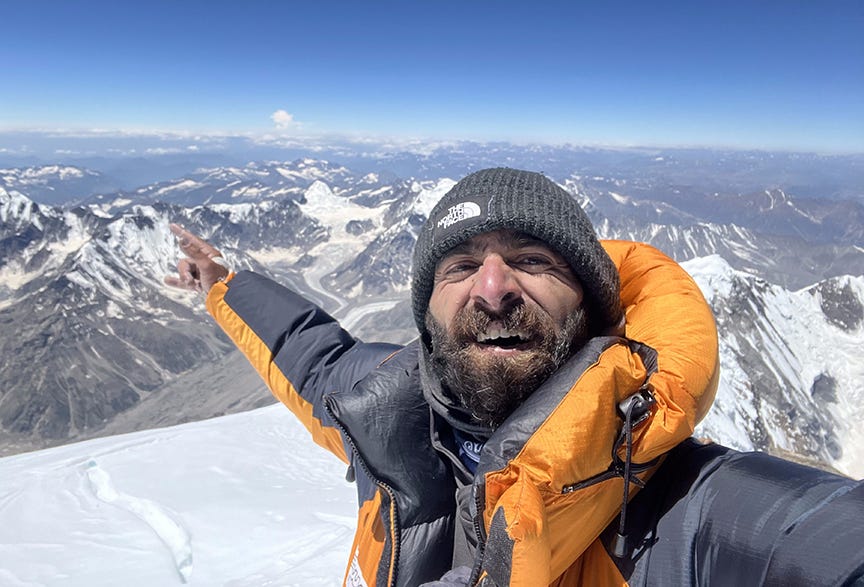
Sohail Sakhi Wanted Pakistanis to Own Their Mountains
The mountaineer from Hunza climbed K2 without bottled oxygen, trained children and built a local expedition company before an avalanche killed him on Broad Peak.
On August 15, 2020, Sohail Sakhi stood alone at Darkot Pass, 4,703 meters above sea level. The crossing joins the Broghil Valley in Chitral to the Yasin Valley in Gilgit-Baltistan. Sakhi had walked there because of something that happened when he was a child, although the memory belonged partly to other people. In 1996, his father fell some 200 meters into a crevasse at the pass. When one member of the party wanted to leave him, a student from Yasin refused, descended into the darkness with a torch and found his teacher alive.
Sakhi’s father had badly injured his face and both arms. The party pulled him out, and the boy remembered his face afterward. “I remember his face with all those injuries,” Sakhi wrote years later in an account of the accident. The man who went down with the torch had made the decision on which every later memory depended. He could have accepted that the injured man was gone, and yet he went looking.
Twenty-four years after the fall, Sakhi crossed Darkot Pass by himself. At the top, he remembered his heart beating hard and felt how small one person could be against the mountains. He had gone there carrying a child’s memory of his father’s damaged face, but he left with the adult knowledge of the ground that had nearly taken him. In the years that followed, Sakhi kept entering places where survival depended on whether another person considered you worth going back for.
In July 2025, when Sakhi’s friend Iftikhar Hussain was killed by a snow and rock avalanche on K2, Sakhi helped bring his body down. During the same season, he helped an injured guide descend. He later described assisting an independent Western climber who had contributed nothing to the rope-fixing system but still expected commercial teams to supply information and help when he was in trouble. Sakhi objected to the absence of payment or thanks, and yet he did not argue that the next person should be abandoned. He proposed a common rescue fund so the decision to save someone would no longer depend on gratitude.
On July 30, 2026, the person others went looking for was Sakhi. He was climbing Broad Peak with Mallory Geis, a 39-year-old American client, when an avalanche struck between Camps 2 and 3 at about 9:20 in the morning. Tracker data showed the climbers being thrown hundreds of meters down the mountain. Searchers found Sakhi’s rucksack and broken Garmin device in the debris. By the afternoon of August 2, recovery teams had located eight of the ten people caught in the avalanche, but the Associated Press reported that Sakhi’s body remained missing.
The object recovered from the snow was the same kind of small record that follows any traveler: a bag chosen for the body, packed by hand, filled with the things its owner believed he would need. The Garmin had been made to tell people where he was, and it had done so until it broke. His family and friends had a location on Broad Peak, an avalanche field and a bag, but they did not have Sohail.
Most international headlines placed Nirmal Purja first. Purja was one of the world’s most famous mountaineers, the Nepal-born former British special-forces soldier whose 2019 ascent of all fourteen 8,000-meter peaks became a Netflix film. Sakhi appeared farther down as “the Pakistani guide.” The description was accurate in the narrow way that an employment form can be accurate. It told the reader what Sakhi had been doing for Geis and almost nothing about the man who was doing it.
Eleven months before his death, Sakhi had supplied the missing explanation himself. “The Pakistani climbing community has mostly been left behind,” he told ExplorersWeb in August 2025. He was talking about money, equipment, training and ownership, but he might as well have been describing the order of the obituaries. A famous climber became the story, paying clients became people with hometowns and ambitions, and Sakhi became the local function that had carried someone else toward a summit.
He came from Aliabad in Hunza. A 2022 profile described his father as a man who loved remote places and credited him with inspiring his son. Sakhi studied pure mathematics at university before leaving to travel and guide. He thought mathematics and mountains shared an abstraction, a strange comparison until you consider the work of moving through either one. Both require a person to understand relationships that cannot always be seen, to hold several possibilities at once and to know that a small error made early can become decisive much later.
The mountains also gave him something mathematics could not. Sakhi said guiding kept him connected to his homeland. He traveled across Pakistan, learned technical ice and rock climbing and bought a camera after working long enough to afford one. He became a mountain photographer, then a drone pilot. In his pictures, the Karakoram was no longer the blank white backdrop against which a visiting climber discovered himself. It was closely observed terrain, photographed by a man who knew the people living below it and the workers moving across it.
Sakhi climbed Gasherbrum I and Gasherbrum II, completed an alpine-style ascent of the 7,027-meter Spantik and attempted Batura I in winter. He stood on K2 using bottled oxygen during an early assignment because the company employing him required it. When he later had the authority to choose for himself, he climbed without it. He described going without bottled oxygen as a way to test his limits and experience the mountain more directly, but the choice also marked the difference between executing someone else’s plan and becoming the author of his own.
That distinction mattered in 2025. Sakhi organized a Nanga Parbat expedition for six young climbers from Hunza so they could learn how a large commercial operation worked. They had little money and no large sponsor. “We were ready to eat noodles the whole time,” he told ExplorersWeb. Members of the community and some of Sakhi’s former clients contributed what they could. Two climbers reached the summit, including Sakhi, who arrived without bottled oxygen or porter support on July 4.
The others returned home after Nanga Parbat because the funds were exhausted. Sakhi continued to K2 alone. It took him three days to arrange the new expedition. An Askole porter helped carry his belongings to base camp, where Sakhi pitched a three-season tent, found food from better-supplied teams and relied on donated equipment. Around him were commercial camps built to keep wealthy clients fed, rested, informed and connected during a climb that could cost tens of thousands of dollars. Sakhi had borrowed food and a tent meant for three seasons, and yet on August 11 he reached the summit without bottled oxygen or a personal porter.
No other Pakistani climber matched his two no-oxygen ascents of Nanga Parbat and K2 that season. The first ascent had been designed partly as a classroom for younger climbers; the second had been assembled in three days after the classroom ran out of money. A culture that loves the photograph of a flag on a summit could celebrate the result without looking closely at the tent below it. Sakhi wanted people to look at the tent.
He told ExplorersWeb that a Pakistani high-altitude porter typically earned between $2,000 and $3,000 for an entire expedition. By his estimate, bringing a Nepali guide to Pakistan cost between $15,000 and $20,000, while a Western guide could receive between $20,000 and $30,000. The figures were his account of the industry, not an independently published wage survey, but his central comparison was brutally practical: a Pakistani worker’s seasonal pay could be lower than the price of the summit suit and boots required to work safely.
Commercial expeditions depend on people who move before the clients. They carry oxygen and tents, establish camps, inspect snow, fix ropes, repair routes and return upward when another climber has failed to descend. Sakhi fixed ropes on Nanga Parbat in 2024 and was part of the rope-fixing team that reached the summit of Kangchenjunga in Nepal at 12:12 a.m. on May 20, 2026. By then he had climbed K2, Nanga Parbat, Gasherbrum I and Gasherbrum II without supplemental oxygen. The person who fixes the line often disappears from the summit photograph, and yet everyone standing above him arrived by clipping into his work.
Pakistan’s five 8,000-meter mountains attract climbers, operators and money from around the world. The state issues permits and collects royalties; Pakistani drivers, cooks, porters and guides move expeditions from Islamabad toward the high camps; local communities absorb the accidents and join the recoveries. Foreign and Nepali companies have capital, international clients and reputations built over many seasons, while Pakistani workers often enter the same system at its lowest-paid and least visible point. The mountain is in Pakistan, the labor is Pakistani and the danger is shared, and yet ownership commonly begins somewhere else.
Sakhi founded Moving Mountains in 2025 because he wanted local people to stand at the front of the transaction. The company listed its office at Zero Point, near the Serena Hotel in Karimabad, and hired guides from the surrounding community. Sakhi wanted clients to arrive through a Pakistani operator, pay Pakistani expertise directly and understand that the person guiding them was sharing a homeland rather than performing a service in somebody else’s wilderness. His plans included a Great Karakoram Trail, but the larger project was a route into the industry for people who had previously entered it only as labor.
The part of that project most likely to outlive him was built far below the death zone. In 2025, Sakhi said his community had opened Hunza’s first proper climbing wall. Boys and girls trained there. The holds gave young people a place to learn movement and technique before their first exposure to ice, altitude or an employer’s equipment. Sakhi wanted certified guides who spoke English, owned suitable gear and could deal with clients as professionals, and the wall placed that ambition within a child’s reach.
He was trying to build the missing steps between a mountain village and a viable profession. The distinction matters because Pakistan already produces strong high-altitude workers. Strength was never the shortage. A young person needed safe equipment, technical instruction, certification, language training, sponsorship and a company willing to place a Pakistani name in front of the expedition. Without those things, talent became cheap labor and courage became the quality that allowed an unequal system to continue.
Rescue exposed the same arrangement at its hardest edge. Sakhi wanted every climber arriving at base camp to pay into a central fund for rope fixing and emergency response. He also wanted Pakistan to require prior experience before issuing permits for its highest mountains. An inexperienced client could buy access to danger, but the consequences did not remain personal once guides and other climbers had to attempt a rescue. The permit belonged to one person; the risk spread to everyone above him.
After Iftikhar Hussain’s death in 2025, the Gilgit-Baltistan Tourism Department said its revised policy required expedition companies to submit valid insurance certificates for every local porter and mountaineer before a climbing permit could be issued. Iftikhar had been covered for three million Pakistani rupees. A policy could compensate his family after death, but a person still had to leave a safe place, enter the slope and search for him.
Before Sakhi and Geis began their Broad Peak ascent, Pakistani mountaineer Mirza Ali saw them at base camp welcoming people who had returned from the summit. They applauded while Geis made coffee for everyone. It was an ordinary act in a place organized around extraordinary ambition: tired people came back, and the people waiting gave them something warm. Then Sakhi and Geis left for their own climb.
The avalanche struck an area that experienced local climbers had not considered especially dangerous. Heavy snow and strong winds had affected Broad Peak during the preceding week, and some teams had abandoned or delayed their attempts. The published record has not established what Sakhi knew, what he and Geis discussed or why they continued. His experience does not permit us to invent his final judgment, while his death does not turn every decision he made into recklessness.
When the trackers fell and the radios produced no reply, the international expedition became a Pakistani recovery operation. Army aviation prepared helicopters, Gilgit-Baltistan officials coordinated with the Alpine Club of Pakistan, local climbers moved toward Broad Peak and Nepali teams diverted from other mountains to help. Some of the same inequalities Sakhi had described remained in place, but none mattered to the snow. Rescuers were looking for ten people.
They were Nirmal Purja, Pur Bahadur Gurung, Kili Pemba Sherpa, Nima Sherpa, Nawang Thindu Sherpa and Gyalu Sherpa of Nepal; Nadhira Al Harthy of Oman; Wang Zhong of China; Mallory Geis of the United States; and Sohail Sakhi of Pakistan. Gurung had climbed more than twenty 8,000-meter peaks and built a foundation supporting children’s education in his home community. Kili Pemba had completed all fourteen 8,000-meter mountains less than a month earlier. Al Harthy had become the first Omani woman to summit Everest. Wang was nearing the end of his own fourteen-peak project. Geis had crossed the world for her first attempt on an 8,000-meter mountain in Pakistan.
They deserve more than a clause in another person’s obituary. Sakhi deserves particular attention because the structure that reduced the others to “Sherpas,” nationalities and clients also reduced him to “the Pakistani guide,” and he had spent his final years trying to dismantle his assigned place inside it. He climbed, photographed, taught, rescued, fixed ropes, built a company and opened a wall for children, and yet much of the world learned his name only when searchers found his bag.
What happens now to the children at that wall in Hunza? Moving Mountains can continue, the holds can remain fixed and another guide can repeat Sakhi’s demand for a rescue fund, but he had been building more than a business plan. He was building the expectation that a Pakistani child could look at the Karakoram and see ownership alongside danger, a profession alongside sacrifice and a future that did not require becoming anonymous in order to reach the mountain.


