


His speech asked the world to respect votes, protect civilians and reject coercion; the record of his own government tests every word.
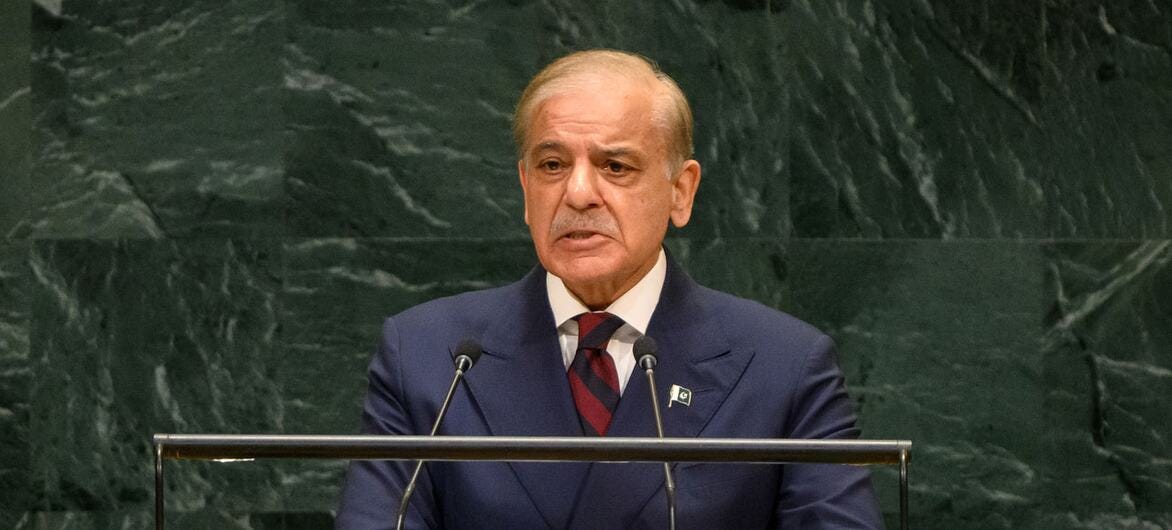
“Reform for all, privilege for none,” Shehbaz Sharif told the United Nations on 25 September. By the time he reached that line in his speech, he had praised Donald Trump, defended a new regional military pact, demanded self-determination for Kashmiris, mourned a Palestinian child and advertised Pakistan’s economic recovery. Each subject deserved the General Assembly’s attention, and yet the prime minister asked other governments to meet standards his own has refused to meet.
Sharif opened with Jinnah and the UN Charter, casting Pakistan’s conduct as the fulfilment of a founding commitment to international cooperation. He offered Pakistan’s mediation between Washington and Tehran as proof. The talks in Islamabad took place, and bringing adversaries together was useful. Sharif spoke proudly of that access while people in Pakistan who seek a meeting with their own government encounter detention orders, roadblocks and silence.
He ended by telling governments to choose dialogue over confrontation and cooperation over coercion. In the intervening 23 minutes, Washington and Tehran appeared as parties worth bringing to a table, and Kashmiris and Palestinians appeared as people entitled to be heard. Pakistanis disputing the 2024 election, searching for disappeared relatives or planning to march on Islamabad did not appear. Sharif had plenty to say about peace abroad and nothing to say about what happens when a citizen asks his government for it.
On Iran, Sharif described lost lives, damaged economies and pressure on the Strait of Hormuz, then credited Pakistan for bringing Washington and Tehran together. He thanked the current occupant of Pakistan’s military command for helping create space for diplomacy. He never named who began the war he was helping to end. The United States was a belligerent, and Sharif later praised its president’s “resolute and visionary leadership” for intervening in the India-Pakistan crisis. Three days earlier, Trump had defended his decision to start the war against Iran at the same rostrum. Sharif can thank him for a specific intervention without asking Pakistanis to forget that fact.
Sharif placed the talks, the Islamabad memorandum and his praise for the military command in one procession of achievement, even as he acknowledged that hostilities had resumed. Pakistanis can judge the diplomacy by what it secured: whether fighting stopped, ships could pass and the costs of war began to fall. Access to powerful men is easier to photograph than any of those results.
Sharif next presented the Makkah Joint Defence Agreement with Saudi Arabia and Türkiye as a commitment to “defence, stability, and peace” directed against no country. He had condemned Houthi attacks on Saudi Arabia, including an attempted drone attack on Makkah, and he was entitled to make clear that the holy cities must be protected. But a three-state defence agreement signed during a widening regional war demands more than a sentence of reassurance. Pakistanis have not been shown, in this speech, what assistance their state is committed to provide, who decides when the commitment is triggered, whether troops could be deployed, or what parliamentary control would apply. “Nothing more,” Sharif said after listing the agreement’s peaceful purposes. That is a poor substitute for the terms. A citizen asked to approve the agreement on the strength of its name cannot know where the duty to defend begins or ends. If the pact binds Pakistan to act, the public should see the obligation before an emergency is declared. If it binds Pakistan to nothing, the prime minister should explain what his government has gained by presenting it as historic.
Sharif’s account of India was the strongest part of the address. He defended Pakistan’s response to the 2025 confrontation, warned against a wider war between nuclear-armed neighbours and insisted that Kashmiris must have a say in their future. He described detention, disappearances and families waiting for sons and daughters who do not return. He said India’s decision to hold the Indus Waters Treaty in abeyance had no legal basis and warned that interference with Pakistan’s share of river water would be treated as an act of war. Pakistan has every reason to defend its water rights and the Kashmiri claim to self-determination. Sharif’s description of families waiting for the disappeared also describes a demand made of his government.
He spoke of Kashmiri parents searching for children who never come home. Baloch families have carried photographs of missing relatives through Pakistani streets and to Pakistani offices for years, asking where their people are. Dr Mahrang Baloch organised around that demand and is now serving a life sentence after a trial that Amnesty International says was held inside a jail and presented no direct evidence linking her to the killing for which she was convicted. A security officer died during the 2024 protest at issue, and his family deserves justice. The families who joined Mahrang’s movement are still owed answers about their missing relatives. Sharif described one set of parents to the world while his government has failed to answer the other.
Sharif named a child killed in Gaza and asked whether a child born there deserves the life and future of a child born anywhere else. He condemned Israeli violence in the West Bank and called for a sovereign Palestinian state. Those demands deserve support. He also asked the assembly to treat a child’s life as an equal claim wherever that child was born, and yet he said nothing about Pakistani children waiting for a detained or disappeared parent, or about the families of protesters killed after demanding a political answer from his government.
Sharif counted the civilians and security personnel Pakistan has lost to terrorism. Their deaths demand more than a number recited before diplomats. His speech then named armed groups based across the Afghan border, but left out 26 November 2024, when PTI protesters reached D-Chowk and security forces drove them from the capital. Amnesty International called it a lethal crackdown and demanded an independent inquiry into deaths, injuries and the use of force. The government said no protesters died. The Human Rights Commission of Pakistan interviewed families of seven reported victims, found that deaths had occurred and recorded accounts from families who said they had to sign undertakings before receiving bodies. Hospitals declined to speak to its investigators. Sharif had room for the state’s account of sacrifice and no words for these families.
Ahead of a planned September march on Islamabad, authorities detained Khan’s sisters and party workers. Amnesty described the pre-emptive arrests as arbitrary and a violation of the right to peaceful assembly. Rangers were deployed and routes towards the capital were obstructed. Sharif’s UN audience heard that Pakistan had chosen cooperation over coercion, and yet people at home who wanted to assemble were met first by detention orders and barriers. Whatever Sharif thinks of the marchers’ demands, their intention to travel is no grounds for detention.
Sharif announced that Pakistan’s economic recovery was close to his heart. He credited structural reform and fiscal discipline with restoring macroeconomic stability. Inflation has fallen from the crisis peak, and avoiding default matters to every household that would suffer from one. His speech did not say who has paid for the improvement, which taxes are collected without negotiation and which forms of wealth remain protected. The Pakistan Bureau of Statistics recorded annual inflation of 11.1 per cent in August 2026. A lower rate of increase does not return a family’s grocery bill to its old level. Nor does it explain why the salaried worker pays tax before the wage reaches the bank while politically connected land, property and business interests can bargain with the state. For the household paying more for power and food, fiscal discipline arrives as an expense that cannot be deferred. Sharif gave the assembly the result at the level of the national accounts and left out the people whose wages and bills make those accounts balance.
The IMF’s governance diagnostic described widespread corruption risks, weak oversight and constraints on the rule of law. Sharif asked for a stronger voice for developing countries in global financial institutions. Pakistan deserves that voice, but its citizens also deserve to know who speaks when the state negotiates a programme in their name and who is protected when the bill arrives. The speech listed agriculture, industry, minerals, digitisation and AI skills as the path ahead. It offered no account of how a household already paying more for electricity and food receives a share of that future. The economy entered the General Assembly as a list of national ambitions; it reaches most Pakistanis as a bill.
Near the end, Sharif said the Security Council must become “more representative, democratic, and accountable” and that reform should reflect the majority of states rather than the ambitions of a few. “Reform for all, privilege for none,” he declared. The permanent members of the Council deserve that challenge. Sharif’s government does too.
Pakistanis voted in February 2024 after Khan had been jailed, PTI had lost its electoral symbol and its candidates had to run as independents. Mobile service was cut on polling day. The European Union found no level playing field and called for investigation of reported irregularities. The Human Rights Commission of Pakistan found the election’s integrity compromised and demanded publication of the forms used to count and consolidate votes. Sharif obtained a parliamentary majority from that result. He cannot cite the formal vote that put him in office as an answer to the unresolved dispute over the vote that put those members in parliament.
The polling-station count is recorded on Form 45 before it becomes part of a constituency result. Publishing those forms would let voters compare the counts recorded where they voted with the totals announced in their name. Sharif asked the Security Council to become answerable to the states affected by its decisions, and yet his government has not given Pakistani voters the complete public record needed to test how their own representatives were chosen.
FAFEN reported that 128 election petitions remained undecided at the end of April 2026, more than two years after the election. A voter who challenges a count must wait while the returned member votes on budgets, laws and amendments. During that wait, Sharif’s government has exercised the power to change the constitutional structure itself. The right to challenge a result means little if the answer arrives after those elected on that result have finished changing the rules.
The 27th Amendment created a Federal Constitutional Court and moved major constitutional questions away from the Supreme Court. It also reorganised military command and conferred extraordinary protections on holders of the highest military ranks. The HRCP warned that the changes threatened judicial independence and democratic checks. Two senior Supreme Court judges resigned when the amendment passed, warning that the court’s authority had been diminished. This parliament was formed from an election whose integrity independent observers questioned, and yet it granted durable protections to powerful officeholders while disputes over its own composition were still pending. Sharif asked the UN to stop allowing a select few to write privilege into the rules. His government had already done it.
Sharif closed by saying that trust is earned through action. He asked the General Assembly to believe that Pakistan had chosen dialogue, then left the room without accounting for the voters still contesting the count that put him in office or the families still asking who killed their relatives at D-Chowk. The government could publish the election forms and order the independent inquiry HRCP demanded. It has had years to do the first and nearly two years to do the second, and yet Sharif stood before the world speaking of accountability as though the word carried no obligation back to Islamabad.