
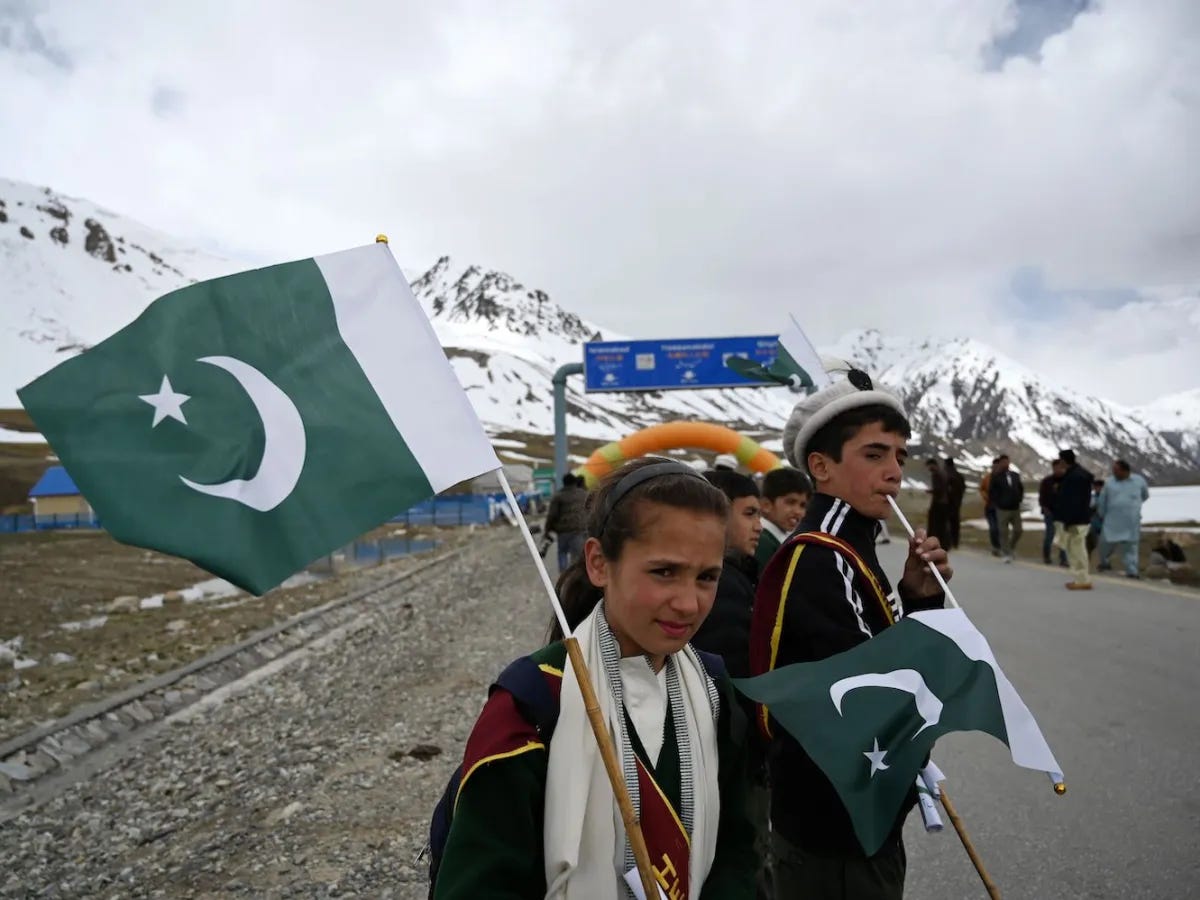
On 1 November 1947, the Gilgit Scouts arrested the Maharaja of Kashmir’s governor, Ghansara Singh, marched him out of the political agency, and ended Dogra rule in Gilgit without waiting for instruction from anyone. Within a fortnight, local leaders had acceded to Pakistan. The Pakistani flag went up because the people of Gilgit wanted it there, not because Pakistan had dispatched an army or written a directive. That distinction matters enormously, and the Pakistani state has spent nearly eight decades failing to reckon with it.
The accession was an act of political will by a population that had lived under the Dogra Maharaja’s administration as a leased strategic buffer for the British, governed from a distance, kept militarily useful and otherwise ignored. When the lease ended and the British returned control to the Maharaja in August 1947, the population did not wait to see what Jammu would do with them. They acted. Pro-Pakistan sentiment in the civilian population was intense, documented in contemporaneous accounts and confirmed in later historical scholarship. The Gilgit Scouts’ rebellion was a military event; the choice it expressed was a popular one.
New Delhi has never accepted this account and has constructed its own narrative in its place. India’s formal position is that Gilgit-Baltistan, as part of the former princely state of Jammu and Kashmir, is Indian territory under illegal occupation. In 2019, after revoking Article 370, India issued new official maps placing GB inside the Union Territory of Ladakh. Senior Indian ministers have called publicly for “taking back PoK and Gilgit-Baltistan,” Parliament has passed resolutions asserting ownership, and the Ministry of External Affairs has formally protested every Pakistani constitutional step in GB as illegal and unacceptable.
The candour of Indian strategic literature on the subject is instructive. GB is Pakistan’s only land corridor to China, the entry point of the China-Pakistan Economic Corridor, and a geographic fulcrum in the Himalayan competition with Beijing. Disrupting Pakistan’s control over this territory would weaken CPEC, complicate the Pakistan-China relationship, and alter the regional balance in India’s favour. The claim over GB is a contemporary strategic project directed at Pakistan’s territorial integrity, dressed in the language of partition-era legal succession. GB’s population has largely understood it as such and rejected it accordingly. What the people of Hunza, Skardu, Ghanche, and Diamer demand is not liberation from Pakistan. Their demand is directed at Islamabad, and it is quite different: stop governing us as though we are a problem to be managed and start governing us as though we are citizens.
The architecture of neglect
Pakistan’s failure in Gilgit-Baltistan is not a failure of intention alone, though intention has rarely been adequate. It is a structural failure, built into the constitutional and administrative arrangements that have governed the region since 1947 and sustained through eight decades of deliberate choice.
After the accession, Pakistan did not integrate GB as a province. It folded the region into the unresolved Kashmir dispute and administered it as the Northern Areas, a designation that carried neither provincial rights, nor constitutional protection, nor federal representation of any kind. For decades, GB’s residents had no seats in the National Assembly and no senators. They were not represented in the National Finance Commission, the body that distributes federal revenue among the provinces. They had no standing in the Council of Common Interests. They paid taxes into a federal treasury that voted on their behalf without their knowledge or consent.
The 2009 Gilgit-Baltistan Empowerment and Self-Governance Order created a legislative assembly and the formal structure of a provincial government. The 2018 GB Order revised and in some respects expanded those institutions. Neither reform granted GB full provincial status. Neither secured the region’s position inside the Constitution with the permanence that Pakistan’s four provinces possess. The legal status of Gilgit-Baltistan as of June 2026 remains what Pakistani legal scholars have consistently called a constitutional void: the entire governance framework rests on executive orders issued by the federal government, which means it can be revised, suspended, or replaced at Islamabad’s discretion, without recourse to a constitutional amendment, without parliamentary approval from representatives of GB, and without meaningful legal challenge from the people most affected.
This is not incidental to the problem of elections in GB. It is the problem. A territory without entrenched constitutional status cannot protect its own electoral process from federal interference, because the legal instruments that define that process are themselves controlled by the interfering party. The weakness is not a side effect of the constitutional arrangement. It is the constitutional arrangement’s purpose.
Pakistan’s own research institutions have documented what this structure produces on the ground. The Pakistan Institute of Development Economics described GB’s situation as one of historic neglect: a region abundant in water resources, mineral wealth, hydropower potential, and strategic geography, which has been systematically underinvested in, underrepresented, and under-governed relative to its enormous importance to the Pakistani state. The state extracts value from GB, in the form of its CPEC corridor, its rivers, its land, and its young men in uniform, while consistently failing to extend the equal citizenship that would require it to share power, revenue, and accountability in return.
Pro-Pakistan, anti-state, and why these are not the same thing:
Pakistani political commentary has rarely been comfortable with what Gilgit-Baltistan actually represents, because the territory refuses the neat categories on offer. It is not separatist. It is not pro-India. The majority of its population identifies firmly with Pakistan, celebrates its national days, and has served in the Pakistani armed forces and civil institutions for generations. The historical memory of ending Dogra rule and choosing Pakistan in 1947 remains a living part of political identity in the region, not a rhetorical device.
At the same time, GB is a territory of chronic protest and accumulated grievance. People have taken to the streets over wheat prices, over power cuts that last twenty-two hours a day, over internet blackouts imposed by a government that obtained a court stay order against restoring telecom services to its own citizens. Baba Jan, the political leader and climate activist from Hunza, stated it plainly when speaking to HRCP in 2024: successive GB chief ministers have been afraid to challenge the establishment on these basic questions, regardless of which party they nominally belonged to, because the structural dependence runs deeper than party affiliation.
These two facts, deep identification with Pakistan and intense anger at how the Pakistani state behaves in GB, do not contradict each other. They describe the same situation from opposite ends. One is addressed to the country the people claim as their own; the other is addressed to the apparatus that has never fully returned that claim. To hear anger in GB and conclude that the population is being influenced by foreign narratives is to confuse a demand for dignity with a demand for a different flag. The people know the difference. The state apparatus, it seems, finds that distinction inconvenient.
In April 2026, Genocide Watch classified Gilgit-Baltistan at multiple stages of concern, citing discrimination, political organisation against the population, polarisation, and persecution. The report documented the systematic marginalisation of GB’s Shia, Ismaili, and Noor Bakhshi majority within a state whose dominant institutional culture is Sunni and Punjabi-centred. The Human Rights Commission of Pakistan’s own 2024 findings from Gilgit recorded the same conditions with the same alarm: chronic power deprivation, restricted connectivity, and a political climate in which demanding a functioning electricity grid was treated by officials as evidence of foreign sympathy. These are not the findings of hostile foreign intelligence operations. They are documented by Pakistani institutions about Pakistani citizens, and they demand a Pakistani response.
How the election has already been managed:
The polling date for the Gilgit-Baltistan Assembly elections is 7 June 2026. The formal schedule was issued in April by Chief Election Commissioner Raja Shahbaz Khan, who confirmed that 24 constituencies would elect members to a 33-seat assembly. The schedule is orderly. The machinery is in motion. None of this is the same as saying the election is free.
The first and most structurally significant mechanism of interference in GB elections is administrative. The caretaker government overseeing this election was appointed from above, by the federal centre, without competitive process. Its composition was contested from the moment it was formed. In January 2026, the GB Youth Movement staged protests in Chinarbagh against the caretaker cabinet, with civil society groups joining demonstrations across Ghanche, Nagar, and Shigar districts to object to a government they described as unrepresentative and politically tilted. Those objections were formally lodged, reported in the press, and ignored. The cabinet that was protested in January is the cabinet overseeing the election in June.
The second mechanism is the deployment of federal resources in the campaign window. On 2 June 2026, five days before polling day, PML-N supremo Nawaz Sharif flew into Gilgit-Baltistan and announced a major airport development project for the region during a visit that was simultaneously a campaign event. GB’s fiscal dependence on the federal centre means that voters in a region with chronic underinvestment are presented, in the final days of a campaign, with an announcement of the infrastructure they have been requesting for years. The announcement is attributed to a specific party leader. The timing is not accidental, and no one involved has suggested that it was.
The third mechanism is procedural, and its effects compound over time. The Free and Fair Election Network’s observation of the 2020 GB election documented systematic failures at polling stations to provide Form 45, the mandatory Result of the Count, to polling agents. Form 45 is the only independent instrument by which a polling agent can verify that the announced result at a station matches the actual count. Without it, discrepancies between what was counted and what was certified become impossible to challenge with evidence. The 2020 election ended under a cloud of rigging allegations, street clashes, and unresolved complaints. No structural reform of the Form 45 provision process has been publicly documented in the five years since.
The fourth mechanism is selective non-enforcement. On 31 May 2026, Chief Election Commissioner Raja Shahbaz Khan publicly stated that all major political parties had violated the election code of conduct. He made this statement without announcing enforcement action against any specific party. This is a practised technique in the repertoire of managed elections: announce violations broadly, create a surface impression of evenhandedness, and then allow the party with greatest access to administrative machinery and state resources to continue operating without consequence. The announcement that everyone has broken the rules is functionally equivalent to announcing that the rules do not apply.
The sectarian provocation
The most dangerous development in this campaign has received the least proportionate coverage in the national press, and its implications extend well beyond the 7 June polling date.
Candidates affiliated with Tehreek-e-Labbaik Pakistan, a far-right Islamist party banned under Pakistan’s Anti-Terrorism Act following lethal confrontations with security forces, are reportedly contesting in the GB polls. TLP’s ideological programme is explicitly anti-Shia; its organisational history in Pakistan includes targeted violence against Shia communities and a documented record of using electoral presence to build sectarian infrastructure in areas where the state’s security footprint creates permissive conditions. Gilgit-Baltistan is a Shia, Ismaili, and Noor Bakhshi majority territory. Permitting TLP-affiliated candidates to contest an election in this region is not a procedural failure in the application of anti-terrorism law. It is a decision, and the people who made it understood the context in which they were making it.
The second and more explosive dimension of the sectarian story involves the Pakistan Markazi Muslim League, a party with documented links to the network of Lashkar-e-Taiba founder Hafiz Saeed. LeT is a proscribed organisation in Pakistan, designated by the United Nations, sanctioned by the United States, and responsible for attacks that have caused mass civilian casualties. As of 1 June 2026, opposition leaders and civil society groups in GB were formally alleging that Army Chief General Asim Munir had actively backed PMML candidates in the region. The allegation appeared in Pakistani and regional reporting and has not been denied with any specificity by military spokespeople. If the allegation is accurate, what is occurring in Gilgit-Baltistan is not ordinary administrative interference in an election. It is the military establishment deploying a proscribed organisation’s political network in a Shia-majority territory with a contested electoral history, five days before polling day, in a region that has already been classified by international human rights monitors as facing coordinated persecution.
The Ahle Sunnat Wal Jama’at, the rebranded successor to the banned Sipah-e-Sahaba Pakistan, has a well-documented record of electoral participation in GB. The 2026 election appears to be extending that record with a new and more explicit layer of alleged institutional facilitation. The question that the election commission’s measured public statements have not addressed is a simple one: under what interpretation of Pakistani law, Pakistani security interests, or Pakistani constitutional obligation does any of this serve the people of Gilgit-Baltistan.
What a genuine Pakistani answer looks like
The problems in Gilgit-Baltistan were built by choices made over eight decades, and they can be addressed by different choices. This is not optimism. It is a structural observation. The architecture of neglect was constructed; it can be dismantled.
The constitutional question cannot be indefinitely deferred. Full provincial status, with entrenched representation in the National Assembly, the Senate, the NFC, and the Council of Common Interests, is the minimum required to give GB’s residents equal standing before the law and equal voice in the decisions that govern their lives. As long as GB’s constitutional position rests on executive orders, it will remain subject to executive manipulation, and the elections held under that framework will carry the permanent suspicion that the result was calibrated before the campaign began. Pakistani legal scholars, development researchers, and constitutional analysts have made this argument consistently and at length. The government has received it, acknowledged it in various official forums, and declined to act.
The electoral process requires reforms that are specific and enforceable. A neutral caretaker arrangement requires that the federal government have no role in selecting its composition. Transparent delivery of Form 45 to polling agents at every station without exception is not an administrative aspiration; it is a legal requirement that has been systematically unmet. The selective enforcement of election code violations must be replaced by enforcement that applies equally regardless of which party holds federal office. The presence of proscribed organisations and their affiliates in GB’s elections is not a grey area requiring committee deliberation; it is a legal violation requiring prosecution.
The economic relationship between GB and the federal centre is a question of basic equity that the Pakistani state has consistently avoided. The China-Pakistan Economic Corridor passes through Gilgit-Baltistan. The hydropower potential of GB’s rivers is central to Pakistan’s energy future. The communities on whose land and through whose territory this infrastructure runs are entitled to a transparent, equitable, and constitutionally protected share of the returns. The alternative, in which GB contributes geography and resources while receiving in return chronic underinvestment, power cuts, and internet blackouts, is not a sustainable governance arrangement. It is extraction, and the people living under it have named it correctly.
Pakistan cannot keep claiming GB as its own while governing it as a managed frontier. The two positions have contradicted each other for seventy-nine years, and the contradiction now has an address: New Delhi, which watches every unresolved grievance in GB and calculates how to keep it from being resolved. The strongest possible response to India’s territorial ambitions is not a foreign ministry communiqué. It is a Gilgit-Baltistan that is so completely, so demonstrably, and so constitutionally Pakistani that India’s claims find no purchase anywhere in the region, because the people who live there have been given every reason to close that door permanently.
The flag went up in Gilgit on 2 November 1947 because people put it there. They did not ask for permission, and they did not wait to be integrated. They chose. The question that the 7 June election cannot answer, but that Pakistan’s political class will eventually have to face, is whether the state is capable of making a choice that is commensurate with the one the people of Gilgit-Baltistan made first, and whether it will make that choice before the cost of not making it becomes irreversible.


Edit request: No Islamabad in 1947*, the capital was Karachi.