
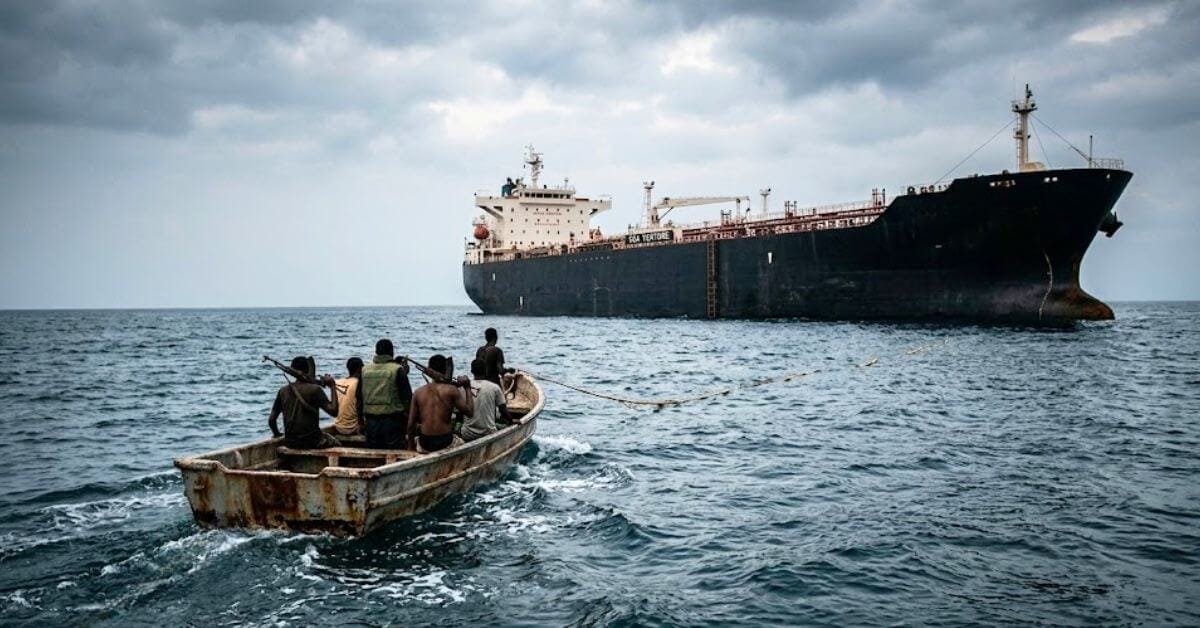
Pirates Have Taken Over
The last words Yasir Khan spoke to his wife before the line went quiet. Eight days later, no Pakistani government body has established contact with the Honour 25 or the ten men aboard it.
Mehwish was on the phone with her husband Yasir at 4:30 in the afternoon on April 21 when the line went strange. He said the words quickly, the way a person does when there is no time left: pirates have taken over the ship. Then the call ended.
The next time she heard his voice was three days later, on April 24, a five-minute call made from the captain’s phone. He told her each hostage was guarded by an armed pirate carrying heavy weapons. He could not say more than that. The five minutes ran out.
Yasir Khan has been a boiler operator in the merchant navy since 2009. After he and Mehwish married in 2010, he left the sea because he could not bear to be away from their children. For sixteen years he did not go back. Then, for reasons that families who need money understand without having to explain, he rejoined and boarded the Honour 25 on April 17. Four days later, at 4:30 in the afternoon, the phone went quiet.
Yasir’s elder son, Bashar, is seven years old. He is asking people to bring his father back to Pakistan as soon as possible. His younger brother, Umar, does not yet have the vocabulary for what has happened but has worked out one thing: pirates, he says, are robbers who have taken his father.
The Honour 25 sailed under a Somali flag and was carrying oil from Oman to Mogadishu when pirates seized it approximately thirty nautical miles off the Somali coast on April 21. Six gunmen boarded first, during the transit. Five more joined after the tanker was anchored, according to reporting by defense security monitors and Pakistani media. The vessel is now held near the towns of Xaafun and Bander Beyla in the semi-autonomous Puntland region of northeastern Somalia, 18,500 barrels of oil still in its tanks.
Of the seventeen crew members aboard, ten are Pakistani nationals. Eight of those ten are from Karachi. One is from Sahiwal in Punjab. One is from Swabi in Khyber Pakhtunkhwa. The rest of the crew is Indonesian, Indian, Myanmarese, and Sri Lankan, with an Indonesian national serving as captain.
Their names, as reported by the Express Tribune, Dawn, ARY News, and HUM News English:
Yasir Khan, a boiler operator from Karachi, who left the profession for sixteen years to raise his sons and boarded the ship on April 17. His wife is Mehwish. His older son is Bashar, seven years old. His younger son is Umar, who knows that pirates are robbers.
Amin Bin Shams, a fitter who joined the merchant navy recently, who traveled from Pakistan to Oman in early December 2025. His son was born in the last week of December. He has not yet seen the child. On April 21, he recorded an audio message from the tanker that has since circulated on social media across Pakistan. “Dad, we have been captured by pirates,” he says in the recording. “This is my last voice message. I don’t know if I will be able to speak to you again because they are taking us to be killed.” He asks his father to take care of his wife and two children. He asks for forgiveness for any mistake he ever made. His wife Ayesha told the Express Tribune she received the message that same afternoon.
Rafiullah, from Manora Cantt in Karachi. His brother, Sanaullah, said Rafiullah was able to make a five-minute call on April 24, in which he reported that each hostage was standing at armed gunpoint. He told his brother the ship, its cargo, and the pirates who took it are all Somali. Rafiullah’s parents are ill. Sanaullah has not yet told them their son is gone.
Kashif Umar, from Buffer Zone in Karachi, who has spent twenty-five years in the merchant navy. His son Izhar Umar said the last contact was on April 23, when his father reported that the food on the ship had run out. Since that call, nothing.
Second Engineer Syed Hussain, who left Karachi in January. His family told ARY News they have had no contact with him since April 21. They have appealed directly to Prime Minister Shehbaz Sharif and to Chief of the Naval Staff Admiral Naveed Ashraf for the safe return of their son.
On April 24, the pirates allowed each hostage to make a single five-minute call to their families. This is the most recent confirmed contact. What the families learned in those five minutes: the men are alive, they are guarded by armed pirates with heavy weapons, the food is gone, and nobody on the Pakistani government side had, at that point, made contact with the vessel or established any communication channel with the crew. That last detail did not come from the hostages. It came from Pakistan’s own Ministry of Maritime Affairs, which acknowledged it had not yet reached the crew, and from the shipping agency responsible for placing these men aboard the Honour 25, which has issued no statement of any kind.
Ansar Burney, a social worker and human rights lawyer who has worked on piracy and hostage cases involving Pakistani nationals before, told the Express Tribune on April 29 that no ransom demand has been made so far. He also said that no formal action has yet been initiated at the government level for the release of the Pakistani hostages. Not a formal negotiation. Not a formal mechanism. Nothing that constitutes an official process rather than a phone call from the Sindh Governor to the Maritime Affairs Minister.
Sindh Governor Nehal Hashmi met with the families on April 28 at the Governor’s House in Karachi. He stood at a press conference with them and said: “They are not abandoned. The government stands with them.” He confirmed he had spoken with Minister for Maritime Affairs Junaid Anwar Chaudhry and with the foreign secretary. Pakistan’s embassy, he said, was in full contact with the relevant parties. He did not name the relevant parties. He did not describe the contact. He did not explain why the ministry tasked with maritime affairs had still not established contact with the crew one week after the ship was taken. He did not address the manning agency’s silence.
The Honour 25 sailed under the Somali flag, which means it operated under Somali maritime registration, which in practice means it operated without the regulatory protections that vessels registered under major flag states carry. It was carrying oil from Oman to Mogadishu. The route brings a few things into proximity worth sitting with.
The US-Iran war began in late February 2026. Iran closed the Strait of Hormuz in response. The closure disrupted oil supply chains across the Indian Ocean rim in ways that have been documented in Pakistani media primarily through the lens of Pakistan’s own energy costs: Prime Minister Shehbaz Sharif said on April 29 that the war has pushed Pakistan’s weekly oil import bill to $800 million. For Mogadishu, already one of the most supply-constrained capitals in the world, the disruption has been more direct. Fuel costs in Somalia tripled in the weeks following the Hormuz closure, according to reporting on the tanker’s context. The Honour 25 was carrying oil to a city where people were already desperate for it.
The vessel circled near the UAE and the Strait of Hormuz before heading south toward Somalia, according to reporting by international maritime monitors. It was, in its final journey, a product of the war’s disruption: oil moving to fill a gap that the war had opened, carrying men from Karachi and Sahiwal and Swabi on a route made newly dangerous by the same conflict whose ceasefire Pakistan’s government was simultaneously working to preserve in Islamabad.
Six gunmen boarded thirty miles off the coast. Five more joined once the vessel anchored. The tanker did not resist. There was nothing aboard to resist with.
The agency that recruited, certified, and deployed these ten Pakistani men to the Honour 25 has not been identified in any official government communication. Its name has not appeared in any ministerial statement. No journalist reporting on the story has printed it. The families, when they went to the Sindh Governor’s office, the Ministry of Maritime Affairs, and the media, did not receive an explanation from the agency itself. The agency, in the language of maritime industry regulation, is the manning agent: the private company that holds the contract to supply labor to a vessel and is obligated, under Pakistani maritime law and International Labour Organization conventions, to maintain contact with the crew and support families during emergencies.
It has not done this. It has not contacted the families. It has not appeared before any press conference. It has not provided any information to any public official about the vessel’s ownership structure, the insurance arrangements, or the negotiations, if any, it may be conducting. The Directorate of Ports and Shipping, which sits inside the Ministry of Maritime Affairs and is empowered to suspend or revoke the licenses of non-compliant manning agents, has not publicly announced any action against the agency responsible for this crew.
Kashif Umar’s son Izhar, who has not heard from his father since April 23, has had no contact from the agency either. Neither has Sanaullah, whose parents are ill and who chose not to tell them that their son Rafiullah is in a pirate-controlled vessel in Puntland, guarded by a man with heavy weapons. Neither has the family of Syed Hussain, which has been compelled to go directly to the Chief of Naval Staff because no institutional intermediary below that level has given them anything to hold onto.
On April 25, 2026, Army Chief Field Marshal Asim Munir and Foreign Minister Mohammad Ishaq Dar stood on the tarmac at Nur Khan Airbase in Rawalpindi to receive Iranian Foreign Minister Abbas Araghchi. Araghchi was in Pakistan for a second round of visits, part of an ongoing process through which Pakistan has been attempting to broker talks between Iran and the United States. US envoys Steve Witkoff and Jared Kushner were also in Islamabad that week. The diplomatic operation Pakistan is running is genuinely significant: it involves the most senior military and foreign policy leadership in the country, and it carries real consequences for regional stability.
Four days before that tarmac moment, at 4:30 in the afternoon, Yasir Khan told his wife on the phone that pirates had taken the ship, and the call ended.
These two facts require no commentary. They are in proximity. The reader can measure the distance.
What the state chose to put its resources into in the week beginning April 21 is a matter of public record: mediation at the highest level, involving the army chief and the foreign minister, for a geopolitical conflict between two foreign powers. What it did not put formal resources into, as documented by the Ministry of Maritime Affairs’ own admission of failed contact and confirmed by Ansar Burney’s statement about the absence of formal government action: the release of ten of its citizens, most of them from Karachi, who were taken at gunpoint from a tanker in the Gulf of Aden.
Pakistani actor Mahira Khan wrote on Instagram: “Why isn’t this being reported and what exactly are we doing to save so many of our own.” Rapper Talha Anjum, who said one of the sailors was like a brother to him, posted the ship’s image and wrote: “As a Pakistani citizen, I am ashamed at the non-seriousness and under-the-rug policy of the government and the powerful offices.” Political activist Reham Khan wrote on X: “We need confirmation, not reassurance, on the safe recovery of abducted hostages from Karachi by Somali pirates.”
Bilawal Bhutto Zardari received a briefing on the situation from MNA Qadir Patel. The briefing produced no public commitment of action.
Pakistan’s overseas remittances reached approximately $33 billion in the financial year 2024-25, according to State Bank of Pakistan data. The government cites this figure regularly in macroeconomic briefings as evidence of economic resilience. Maritime workers are a specific category within that labor export: men with technical training from port cities, credentialed through private manning agencies, assigned to vessels flagged under various registries, doing skilled physical work on ships carrying cargo through waters the rest of the world’s trade depends on.
They are not counted among the constituencies that bilateral labor agreements protect. Pakistan has negotiated formal labor protection frameworks with Gulf states that cover domestic and construction workers in specific categories. Maritime workers move through a different channel, the manning agency system, which connects to a global industry in which the Pakistani state has modest leverage. When a vessel is under pirate control in Puntland, the leverage is essentially zero, and what determines whether these men come home is the combination of diplomatic pressure, private negotiation, and the agency’s willingness to commit resources to a resolution.
The manning agency responsible for the Honour 25 crew has shown no willingness to commit anything. Its silence is not ambiguous. It has been a week.
On April 26, five days after the Honour 25 was taken, a cargo ship called the Sward was seized six nautical miles northeast of Garacad on the Somali coast and forced into territorial waters. Two commercial vessel hijackings in the same waters within one week. No Pakistani official has spoken publicly about what this acceleration in piracy activity means for the several hundred Pakistani maritime workers employed on vessels transiting the Gulf of Aden and the waters around the Horn of Africa.
Somali piracy, which international naval coalitions suppressed through coordinated patrolling in the earlier part of this decade, has surged again. Security analysts attribute the resurgence to the redeployment of international naval assets toward the Red Sea following the expansion of Houthi attacks on commercial shipping. The Bab-el-Mandeb Strait, through which the Honour 25 was transiting, is now one of the most dangerous commercial shipping corridors in the world. It is also, because of the wages it pays to men from inland Pakistan and from the coastal neighborhoods of Karachi, one of the few employment options available to people with the right maritime certifications and not enough money to do anything else.
The government has been asked, at press conferences, whether contact has been established with the crew. The answer, as of the date of this report, is no. It has been asked whether a formal negotiation mechanism has been initiated. The answer, per Ansar Burney’s statement, is no. It has not been asked, in any public forum, why the manning agency has been permitted to remain silent for a week without any regulatory action from the Directorate of Ports and Shipping. It has not been asked who owns the Honour 25 or what flag registry obligations attach to that ownership. It has not been asked what the Pakistan Navy’s specific role or tasking in this situation is. It has not been asked whether the decision to prioritize the Islamabad mediation at the highest levels of military and foreign policy leadership, while leaving the maritime crew response at the level of a Sindh governor’s press conference, was a deliberate allocation of resources or simply an oversight.
Amin Bin Shams traveled from Pakistan to Oman in early December. His son was born in the last week of December. He boarded the Honour 25 and was taken by pirates on April 21, before he had seen his child. He asked his father for forgiveness. He asked his family to stay strong. His voice, in the audio that circulated on social media before any official in the Ministry of Maritime Affairs knew where the ship was, is the document this story leaves with its reader.


