


On the Monday after the federal government took over Khyber Pakhtunkhwa, Mohsin Naqvi, the interior minister, flew to Peshawar and sat down beside Governor Faisal Karim Kundi at Governor’s House. The province, Naqvi told reporters, had been “largely peaceful” for the past twenty-four hours. Kundi said that people had handed out sweets to mark a “day of liberation.” Shipping containers blocked the roads to the provincial assembly that morning, and mobile data had been switched off across much of the province. Sohail Afridi, the chief minister whom the assembly had elected a year earlier, was in police custody under the Maintenance of Public Order ordinance, along with the speaker. Two police officials told AFP that 278 members of his party had been picked up since Sunday.
A few miles away, the Minerals Development Department was still processing paperwork. The department keeps its titles in Landfolio, licensing software first developed in Cape Town and sold to mining ministries from Mozambique to Myanmar, and anyone can open the map it publishes online. The register behind that map holds 24,390 entries. It records that on Monday, October 12, the department granted a minor-mineral lease in Nowshera. On Tuesday it granted another in Dera Ismail Khan. Over Tuesday and Wednesday the regional office in Dir issued ten leases and quarry permits, and on Wednesday it approved a copper prospecting licence in Upper Dir that had sat in its files since December 2023. On Friday a new application arrived for a copper lease in North Waziristan. The government in whose name these titles were issued no longer existed. Its ministers had been removed from office by presidential proclamation five days earlier.
Yesterday Kundi, speaking to reporters after a medical convocation, said that “minerals are meant to be extracted,” and invited foreign and Pakistani companies to come to the province and form joint ventures with it. The federal cabinet had justified the emergency by pointing to the provincial government’s “deliberate disengagement” from the fight against terrorism. In the week since, the man running the province on its behalf has spent a good deal of his public time talking about copper, gold, oil and gas. On November 12, Islamabad will open the doors of the Jinnah Convention Centre to the Pakistan Minerals Investment Forum, an event that drew five thousand delegates from more than fifty countries last year.
A province of small quarries
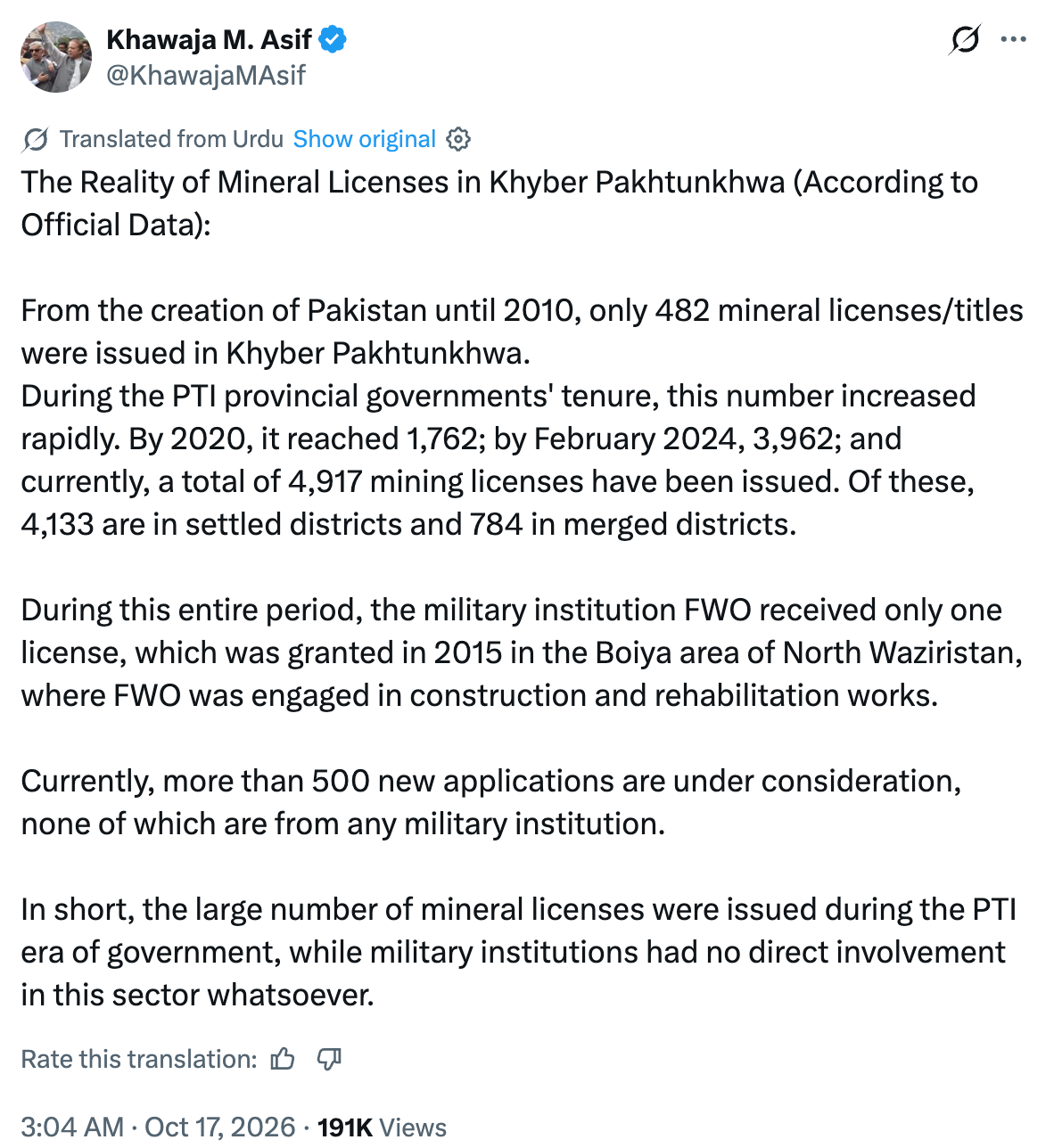
Most of the 4,917 titles that Khawaja Asif, the defence minister, cited on X yesterday are small. A typical granted mining lease in the register covers about three-quarters of a square kilometre, roughly 185 acres, and a prospecting licence is about the same. They belong to marble quarries in Buner and Mohmand, granite cutters in Mansehra, soapstone diggers in Kurram and the emerald and nephrite men of Swat and Chitral. Nisar Baz Khan, an Awami National Party legislator who sits on the assembly’s standing committee on minerals, put their number this week at more than four thousand, with combined earnings of about fourteen billion rupees a year. Asif’s purpose in quoting the total was to show that the Pakistan Tehreek-e-Insaf, not the Army, had handed out the province’s ground, since the count rose from 482 in 2010 to nearly five thousand under PTI governments. He is right about who signed the leases. Some of them went to cabinet members’ friends, and the department’s own auditors have spent years chasing unpaid rents.
The register also lists what the department has not handed out. It holds 1,866 blocks marked “Reserved for Auction” or “Proposed Auction Area,” covering about twenty thousand nine hundred square kilometres, more than four times the area of every title the province has ever granted. Nearly all of that reserve is metal. Blocks for base and precious metals in Chitral and Kohistan cover more than thirteen thousand square kilometres, some of them single parcels of five hundred to seven hundred square kilometres, drawn in 2007 and held back ever since. A lithium block in Chitral, entered last October, covers 2,060 square kilometres. In Dera Ismail Khan, where Kundi has contested elections for two decades, the department has laid out 104 placer gold blocks covering 931 square kilometres, most of them about fifty square kilometres each. A quarry owner in Buner would have no use for any of this ground, which is sized for the kind of company that brings its own drilling rigs, and for the joint venture partners Kundi invited yesterday.
The lease in Boya
Only one large-scale mining lease in the province carries the status “Granted.” Its file number is FS/MCC/NWA/ML-Copper/2013, the initials a relic of the old FATA Secretariat, and it belongs to Degan Exploration Works, a subsidiary of the Frontier Works Organisation. FWO is the Army’s engineering company, best known for building roads through the border districts. The lease was granted on July 15, 2016, runs until July 2036, and covers 30.1 square kilometres near Boya, about thirty-five kilometres from Miranshah in North Waziristan, forty times the size of a typical local lease. Baz Khan, who had seen the department’s file, put it the same way: thirty-seven ordinary leases, in a district where local applicants are given fifty to five hundred acres. Next to it, the company holds an exploration licence over 101.28 square kilometres, granted in June 2022. The province has granted exactly three exploration licences in its history, and FWO holds sixty-one per cent of that ground. When Asif wrote that the Army’s company had received only one mining licence, he was describing the only working industrial mine in Khyber Pakhtunkhwa.
The company did not come to Boya through an auction. In June 2014, the Army launched Operation Zarb-e-Azb in North Waziristan, and close to a million people left the agency for camps and rented rooms in Bannu and beyond. In March 2017, with FWO crews already digging near the Afghan border, Major General Hassan Azhar Hayat, a senior Army commander in the area, told Geo News that before the operation the agency’s minerals had been smuggled out or had gone “to a select few individuals.” Locals, he said, would now receive about eighteen per cent.
The Economic Coordination Committee in Islamabad later wrote that arrangement into an export processing zone covering the lease and the exploration block, which lifts them out of the ordinary customs and tax regime. Under the profit split it approved, Degan Exploration Works keeps half. A Quoam Commission of local elders gets eighteen per cent, a corporate social responsibility fund twenty-two, and the provincial Minerals Development Department ten. FWO told Germany’s trade promotion agency in February that the mine has been producing since 2019, crushing fifteen hundred tonnes of ore a day into about fifteen tonnes of concentrate at twenty-five per cent copper.
Baz Khan said this week that the department’s books show a hundred and sixty-nine million rupees paid in royalty on the lease. He also offered a valuation of the mine’s output, about six hundred and ninety billion rupees, which treats a million tonnes of crushed ore as though it were refined metal and cannot be right. FWO’s own production figure gives a simpler measure. Fifteen tonnes of concentrate a day yields roughly 1,370 tonnes of copper a year, worth about thirteen million dollars at recent prices, or something like ninety million dollars since 2019. The province’s 2017 Minerals Act sets royalty at five per cent. On that output it would come to about 4.5 million dollars, or roughly 1.25 billion rupees. If Baz Khan has read the books correctly, the province has collected about an eighth of what the mine owed it.
The department’s register shows that it can bargain harder when the other party is a private company. In 2022, under a PTI government, it signed thirteen joint ventures, for copper in Upper Dir, iron ore, base metals and gemstones in Chitral, chromite in Bajaur and soapstone in Kurram. Where the register records the shares, the private partner holds about eighty per cent and the province about twenty, twice what the province collects from Boya. This is the model behind Kundi’s invitation to foreign companies, although he did not mention that a PTI cabinet drew it up four years ago.
The Americans
On September 8, 2025, at a ceremony in Islamabad, FWO signed two memorandums with US Strategic Metals, a company based in Missouri, covering the processing and shipment of critical minerals and a planned polymetallic refinery. The Prime Minister’s Office said that exports of antimony, copper, gold, tungsten and rare earths would begin at once, and it noted that FWO was “already operating mines in Waziristan.” The first consignment left on October 2. In December, the U.S. Export-Import Bank approved $1.25 billion for Reko Diq, the copper and gold project in Balochistan. Washington wants supplies of these metals that do not run through China, and since Donald Trump’s first meetings with Field Marshal Asim Munir last year, Pakistan has been offering itself as one.
Private miners have taken the same road. Himalayan Earth Exploration, a Pakistani firm that formed a partnership this summer with Nova Minerals, a company listed in the United States, says American buyers now come to it for antimony it used to sell to Chinese middlemen. Christopher Gerteisen, Nova’s chief executive, called Pakistan “a virgin country for mineral exploration.” The register shows Himalayan Earth holding one of four large-scale placer-gold leases granted in November 2024, along the river in Nowshera.
On Friday, Asif told an interviewer that Pakistan had not awarded “any mineral mine or mining contract” to the United States, and that talks were at an early stage. FWO’s agreement with US Strategic Metals is a memorandum rather than a contract, and Barrick, which runs Reko Diq, is Canadian, so the statement is accurate on its terms. In the same interview, Asif listed the United States, China, Canada and Australia as countries interested in Pakistan’s minerals. The investment forum was originally scheduled for April. In March, its organisers moved it to November, citing “evolving regional developments.” The emergency in Khyber Pakhtunkhwa was declared a month before the new date.
Afridi’s year
Sohail Afridi was thirty-six when the assembly elected him chief minister, in October 2025, five weeks after FWO’s ceremony with the Americans. He came from Khyber district, had risen through PTI’s student wing, and replaced Ali Amin Gandapur. Within weeks he had said publicly that the province would not accept another military operation.
In January, the Army began moving families out of the Tirah Valley, in Khyber district, as snow fell. The federal government said the residents were leaving voluntarily, and the defence minister described the movement as seasonal. Afridi released a video calling the operation a decision taken “behind closed doors” and recalled that “22 major military operations and more than 14,000 intelligence-based operations” had not ended militancy in the province. A grand jirga convened under the provincial assembly had already adopted, unanimously, a fifteen-point position rejecting military operations as the answer. His government released four billion rupees for the displaced, which he said Islamabad resented, and he reminded the federal government that families in the Bakakhel camp in Bannu were still waiting for stipends promised to them after Zarb-e-Azb, ten years earlier.
The assembly was also sitting on a law that Islamabad wanted. The Khyber Pakhtunkhwa Mines and Minerals Bill, tabled in April 2025 as Bill No. 52, runs to a hundred and thirty-nine pages. It would establish a Minerals Investment Facilitation Authority required to follow federal advice on royalties and auction reserve prices. Clause 2(jjjj) allows the federal government to decide which minerals count as “strategic,” and Section 65(c) requires mineral agreements to follow a model drafted by the Federal Mineral Wing in Islamabad. The ANP called a conference against the bill in Mardan and drew in the JUI-F, Jamaat-e-Islami, the Pashtunkhwa Milli Awami Party and representatives of the PML-N. Imran Khan’s sister Aleema asked for it to be withdrawn. Gandapur refused to bring it to a vote without Khan’s approval from prison, and the assembly’s website still lists its status as “Introduced.” Last July, the standing committee on minerals went further, ordering a review of every lease in the province after members complained that titles had been issued to people who were not the recorded owners of the land.
Balochistan passed a near-identical law in March 2025. The Balochistan Mines and Minerals Act went through the provincial assembly in a few days, with almost no debate and very little press, and became law on March 14. It places the facilitation authority under the Special Investment Facilitation Council, the civil-military body through which the Army has shaped economic policy since 2023, and gives the Federal Mineral Wing oversight of licensing, bidding, rents and royalties. In his remarks yesterday, Kundi held up Balochistan as a province whose government works with state institutions.
The machinery of the emergency
The proclamation of October 11 rests on two articles of the Constitution. Under Article 234, the powers of the provincial assembly pass to Parliament. Under Article 232, Parliament may also legislate for the province on subjects outside the federal list, and its laws prevail over provincial ones for as long as they stand. Minerals, apart from oil and gas, have been a provincial subject since the Eighteenth Amendment of 2010. When the two houses met jointly on October 15 to endorse the emergency, the government carried its procedural motion by two hundred and fourteen votes to fifty-six. No one has yet tabled the Khyber Pakhtunkhwa minerals bill in Islamabad, though the coalition now has the votes to pass it there without a single legislator from the province.
The same proclamation came with an order creating an Area Development Secretariat for twelve districts: Dera Ismail Khan, Tank, Lakki Marwat, Bannu, Bajaur, Mohmand, Khyber, Kurram, Orakzai, North Waziristan and both halves of South Waziristan. Its administrator, an additional chief secretary, may direct civilian, police and military officials, reorganise departments and move funds, and his orders carry the force of the provincial government’s. Article 175(3), which separates the judiciary from the executive, does not apply in those districts. Rida Hosain, a constitutional lawyer in Lahore, told Al Jazeera that the arrangement allows executive officers to perform judicial functions, and that the emergency itself has no fixed end.
The twelve districts hold 1,600 of the province’s active mineral titles, including FWO’s copper mine, Mohmand’s 541 marble and quarry titles, the coal and soapstone seams of Orakzai and Kurram, and the gold blocks of Dera Ismail Khan. Yesterday Kundi brought up mineral development in Lakki Marwat, Tank and Bannu by name.
In 2019, when the PTI government extended the provincial minerals law to the former tribal agencies, its ministers promised that communities owning the land would have first claim on mineral titles, settled at an open public meeting, a jalsa-e-aam. The department’s register lists a hundred and twenty-two applications with the status “Pending Jalsa-e-Aam.” All of them are in merged districts: forty in Mohmand, twenty-six each in Orakzai and Khyber, twelve in Bajaur, seven in Kurram, four in South Waziristan and three in North Waziristan. The 2019 law limited those protections to ten years, which means they expire in 2029. The meetings that would decide those hundred and twenty-two applications now fall under an administrator appointed by Islamabad, in districts where the courts no longer stand apart from the officials who run them.
Quiet on the screens
The violence the federal government cited is real. PICSS, a security research group in Islamabad, counted 225 militant attacks across Pakistan in September, the highest monthly figure in twelve years, with 259 people killed. The intelligence briefing presented to the federal cabinet on the day it decided on the emergency recorded a hundred-and-ninety-five-per-cent rise in terrorist incidents in Khyber Pakhtunkhwa since March 2024, a hundred and seventy drone attacks on police and soldiers this year, and more than nine thousand police posts standing empty.
Naqvi’s announcement of a largely peaceful day came on the emergency’s first morning. On October 13, the Pakistan Electronic Media Regulatory Authority wrote to every news channel, reminding them of a 2023 prohibition order and directing them once more not to air or carry live coverage of “any unfortunate/unpleasant incident such as explosion, blast, firing, terrorist attack etc.” Channels may now report only what the relevant department or the police have verified. Waliullah Rahmani, who covers Afghanistan and Pakistan for the Committee to Protect Journalists, said the rules turn safety measures into official control of information. The information portfolio on Kundi’s advisory council went to Samar Haroon Bilour, a PML-N member of the National Assembly. When PTI supporters fought police in Bara that same day, the provincial administration’s fact-check unit described reports of a serious clash as baseless, and PTI said that one man had been killed. Kundi has given himself three months to undo what he calls thirteen years of mismanagement.
People in the province have heard such announcements before. Operation Rah-e-Nijat, in South Waziristan in 2009, was presented as the end of the Taliban there. Zarb-e-Azb, five years later, was said to have broken the militants’ back, and Radd-ul-Fasaad, in 2017, was meant to finish the work nationwide. Each operation ended in a declaration of victory, and each left the Army in charge of who returned to the cleared areas and on what terms. The copper concentrate trucked out of Boya is one of the things that came after Zarb-e-Azb. With the channels now forbidden to show the next attack, there will be little on air to contradict the next declaration.
Islamabad has removed elected governments in these two provinces before. In February 1973, Zulfikar Ali Bhutto dismissed the National Awami Party government in Balochistan after weapons were found at the Iraqi embassy, and the NAP-JUI government in the North-West Frontier Province resigned in protest. Governor’s rule came to the Frontier in February 1975, after the assassination of Hayat Sherpao, and the NAP was banned. The reason given each time was security.
PTI’s record
Kundi and Asif have spent the week reminding the country that the PTI handed out most of Khyber Pakhtunkhwa’s mining titles, and the register supports them. In the last weeks before Mahmood Khan dissolved the assembly, in January 2023, the department logged a hundred and seventy-one “unsolicited” joint-venture and profit-share proposals, eighty-eight of them in Chitral and thirty-seven in Swat. In August 2024, under Gandapur, consortiums of little-known companies cleared the provincial titles committee with proposals covering eighty-five and a hundred and eighteen square kilometres of placer gold. Last week, the Auditor General flagged 16.94 billion rupees in irregularities in the minerals department, including eight billion lost to illegal mining and 4.31 billion never recovered from defaulting contractors. PTI’s rediscovered concern for Pashtun resources sits awkwardly beside those files.
The same files, though, were what the assembly’s minerals committee had started to examine in July. That committee no longer meets, and with it went the only body in the province in a position to audit both the PTI’s leases and the Army’s lease next door. The province’s mines employed about thirty-two thousand five hundred people when licensing reopened in 2016, by the department’s own count. In September, the Minerals Association, which speaks for leaseholders and their crews, asked the government to lift its restrictions on mining explosives and to spend royalty money in mining communities. Neither request appeared in Kundi’s remarks yesterday about jobs.
What happens next
The governor’s rule can run for six months under the Constitution, with Parliament’s approval every two months, and the emergency behind it can run indefinitely. The investment forum opens in less than four weeks. The families who left Tirah in the snow have not been told when they can return, and the stipends promised at Bakakhel remain unpaid. In Mohmand and Orakzai, a hundred and twenty-two consent hearings wait on an administrator in Peshawar, while a single army company holds thirty square kilometres of copper in a district where local miners are given a few hundred acres. The province’s voters gave PTI ninety-three of the assembly’s hundred and forty-five seats, and the assembly is shut.