
Pakistan's War, Whether It Wants One or Not
For the media, the country that brokered a ceasefire between two powers it cannot influence is about to discover what happens when it gets caught in the middle.
Pakistan did not broker the April ceasefire between the United States and Iran because it carries genuine diplomatic weight in either capital. It brokered it because Washington needed a Muslim interlocutor with open lines to Tehran, and China, which has its own reasons to prevent a prolonged Gulf conflagration, was comfortable with Islamabad filling that role. Pakistan was useful. That is a different thing from being powerful, and the distinction matters enormously, because when the ceasefire collapses, the consequences will not spare the messenger.
What Pakistan actually is, stripped of the diplomatic theater of the past several weeks, is a country in a condition of advanced institutional fragility being pulled by forces it has no capacity to resist. Its economy is broken. Its military command is concentrated in a single general with no institutional check on his decisions. Its Shia population of somewhere between 35 and 50 million people watched the killing of Khamenei in February with the kind of grief that does not stay private. It shares a long border with Iran. It has 23,000 soldiers in Saudi Arabia under a mutual defense clause that has already been triggered. It is simultaneously conducting what its own officials call an open war against the Afghan Taliban on its western flank. None of these are positions Pakistan chose in the last few months. They are the accumulated products of seventy-seven years of decisions, most of them made by a military establishment that mistook dependency for strategy and called the result statecraft. The result is a state that looks, from the outside, like it is managing a crisis, and is, from the inside, being managed by one.
The Saudi financial relationship that now exposes Pakistan to this conflict goes back to the 1960s, when Pakistani troops were first sent to the kingdom to guard against Egyptian adventurism in Yemen. It deepened after the 1979 Iranian revolution, when Riyadh found itself sharing a region with a militant Shia theocracy actively trying to export itself. Throughout the 1980s, up to 15,000 Pakistani troops were stationed in Saudi Arabia at any given time. When the Saudi government asked Islamabad in 1984 to remove Shia soldiers from Pakistani units stationed in the kingdom, General Zia ul-Haq complied. That compliance was not merely logistical. It was a declaration about which side of Islam’s internal fault line Pakistan was prepared to stand on, and who was paying for the choice.
The sectarian infrastructure Zia built in that same period never left. His Islamization program encoded Sunni Hanafi jurisprudence into state law, systematically marginalizing Shia religious practice. The creation of Sipah-e-Sahaba in 1985, a Deobandi anti-Shia organization seeded and protected by the state, was not a product of popular sentiment. It was a policy instrument designed to generate ideological coherence for the Afghan jihad and satisfy Saudi sponsors simultaneously. The killing that organization and its more violent offspring Lashkar-e-Jhangvi conducted across the 1990s, targeted assassinations of Shia professionals, doctors, and intellectuals across Punjab, was the blowback the state never accounted for. No subsequent government reversed those decisions because the military establishment that benefited from the Saudi relationship that produced them retained effective control of the relevant levers. The Kurram district, where more than 130 people died in sectarian clashes in the final months of 2024, is the living residue of that inheritance. It did not become what it is because of this war. The war simply activated what was already there.
The constitutional consolidation that produced Asim Munir’s current position followed a similar pattern. The 27th Amendment of November 2025, passed in the political panic following the India-Pakistan conflict, created the post of Chief of Defense Forces and vested it in Munir alongside his existing role as Army Chief. He now commands all three services and the Strategic Plans Division, under a five-year tenure and presidential-level immunity from prosecution. He is Pakistan’s first Field Marshal since Ayub Khan, who awarded himself the same rank in 1959, the year after his coup. The comparison is not biographical decoration. It describes a structural condition. When a single officer commands every branch of the armed forces, controls all senior appointments, and operates under constitutional protections that insulate him from political consequence, the military’s internal corrective mechanisms stop working. Pakistan’s army has historically managed its internal politics through the rotation of ambition. Promotions have stalled across the officer class because the man above them is not rotating out. That rotation has stopped, and in a period of compounding external crisis, what accumulates in its place is institutional pressure with no sanctioned outlet.
In April 2015, Pakistan’s parliament voted unanimously to reject Saudi Arabia’s request for troops in the Yemen intervention. It was a remarkable moment of civilian assertion, reflecting genuine public discomfort with being conscripted into someone else’s war. That check no longer exists. The April 2026 deployment of 13,000 additional troops and between ten and eighteen fighter jets to King Abdulaziz Air Base happened without a parliamentary vote, without public debate, and without any announcement from the Pakistani government at all. Saudi Arabia announced it. Islamabad confirmed it when journalists pressed. The 27th Amendment had already removed military deployments from the architecture of civilian oversight that made the 2015 vote meaningful.
Pakistan did not sign the Strategic Mutual Defense Agreement with Riyadh in September 2025 because it wanted a war with Iran. It signed it because Saudi Arabia offered a financial package and Islamabad, with its IMF program perpetually on the edge of suspension, could not refuse. The mutual defense clause was written as a formality that everyone involved understood would never actually be triggered. It has been triggered. Iranian missiles struck the Jubail petrochemicals complex in April. Pakistani mechanized forces with T-80 tanks and self-propelled artillery are on the Saudi-Yemen border. Pakistani jets are at King Abdulaziz. The gap between formality and reality has closed, and Islamabad is standing in it with no exit strategy and no political mechanism to build one.
The economic consequences of that position are the most measurable part of what is happening. Petrol has reached PKR 458 per litre, a rise of more than 40 percent in a single month, driven directly by the Hormuz disruption. The 2.5 million Pakistani workers in Saudi Arabia whose remittances represent one of the only genuine sources of foreign exchange in an economy that has been unable to generate its own are now sitting inside a country that Iranian missiles have already struck and that Pakistan is formally obligated to defend. What happens to those workers, and to the remittance flows sustaining millions of Pakistani families, if the war resumes at scale, has not been answered publicly by anyone in Islamabad because the answer is too damaging to say out loud.
When Gilgit-Baltistan went under curfew for three days in March, when at least ten people were killed and more than sixty wounded when Marine guards opened fire on protesters outside the US Consulate in Karachi, when 23 Pakistanis died in clashes across the country within the first weeks of the war, the Pakistani state’s response was to summon Shia clerics to Rawalpindi. Munir warned them against domestic violence and, by several accounts, told those who sympathized with Iran that they were welcome to leave.
That response reflects a fundamental misreading of what the state is dealing with. Pakistan’s Shia community is not a foreign-controlled fifth column manageable through intimidation. It is a domestic population of tens of millions whose alienation from state institutions has been constructed, deliberately, through four decades of policy. The Zainabiyoun Brigade, which recruits heavily in Kurram and maintains ties to Iranian Revolutionary Guard networks, did not appear in 2026. It was incubated by the same policy environment that produced Sipah-e-Sahaba, on the opposite side of the same divide, and left to develop because the state found it occasionally useful as a check on that divide and never found it convenient to dismantle.
If the war resumes at full scale, the pressure on Pakistan’s Shia population to understand itself as being on the opposite side of its own state will become very difficult to resist. The state will respond with force because that is what it knows. Force will produce more alienation. The Balochistan border with Iran, already a corridor for separatist activity and cross-border intelligence operations, will become an active fault line. Pakistan will be fighting the Afghan Taliban in the northwest, managing a Baloch insurgency in the southwest, attempting to contain sectarian violence in Punjab and Gilgit-Baltistan, and formally obligated to treat Iranian military action as an act of war against itself. It will be doing all of this simultaneously, under a command structure too centralized to course correct and an economy too fragile to absorb further shocks.
There is a settlement available in theory. It has been available since approximately the third week of the war. What makes it unreachable is not the absence of terms but the absence of a political architecture that lets both sides survive signing them.
Iran’s position is internally coherent and externally impossible. The killing of Khamenei did not weaken the Islamic Republic’s resistance logic. It calcified it. A state that has just lost its supreme leader to a foreign airstrike cannot negotiate from a posture of accommodation without the new leadership appearing to have capitulated on behalf of a martyred predecessor. Whatever successor consolidates authority in Tehran will need the outcome of this war to justify the losses, which means Iran must be able to claim, credibly, that it forced a negotiation, extracted concessions, and was not broken. The five-point counter-proposal Tehran submitted, demanding security guarantees, war reparations, and international recognition of its losses, is not a maximalist opening bid designed to be bargained down. It is the minimum domestic political requirement for any Iranian leader who wants to survive the signing ceremony.
Washington’s position is structurally incompatible with that requirement. Trump has stated publicly that he will accept nothing short of unconditional surrender. He has described Iran’s military as destroyed. He has framed the naval blockade not as pressure toward negotiation but as the natural condition of a defeated adversary. The political cost of signing a deal that Iran can subsequently present to its own population as a negotiated settlement rather than a capitulation is one that no figure in the current administration has shown any willingness to absorb.
The historical precedents for bridging this kind of gap exist but they are instructive about how much political architecture they required. Khomeini accepted UN Security Council Resolution 598 to end the Iran-Iraq war in 1988 after eight years of devastating conflict, describing it as drinking poison, a formulation that acknowledged the bitterness of the act while framing it as a sovereign choice rather than a defeat. The JCPOA in 2015 was sold domestically in Iran as a technical agreement preserving the right to civilian nuclear activity, even as its substantive effect was to dismantle the weaponization infrastructure the United States had spent years trying to eliminate. In each case, the deal required someone to build a rhetorical and structural framework that let Iran claim it had not lost.
The difference now is that Khamenei is gone and the institution he embodied is in succession crisis. In 1988, Khomeini’s personal authority was sufficient to absorb the political cost of the ceasefire. Iran’s new leadership does not yet have that authority. A deal that requires a new supreme leader to drink poison in his first months in office is a deal that may produce the domestic collapse of the very leadership any agreement would need to hold. Washington has either not thought this through or has concluded that Iranian domestic collapse is an acceptable outcome, which is a considerably more dangerous strategic calculation than it appears.
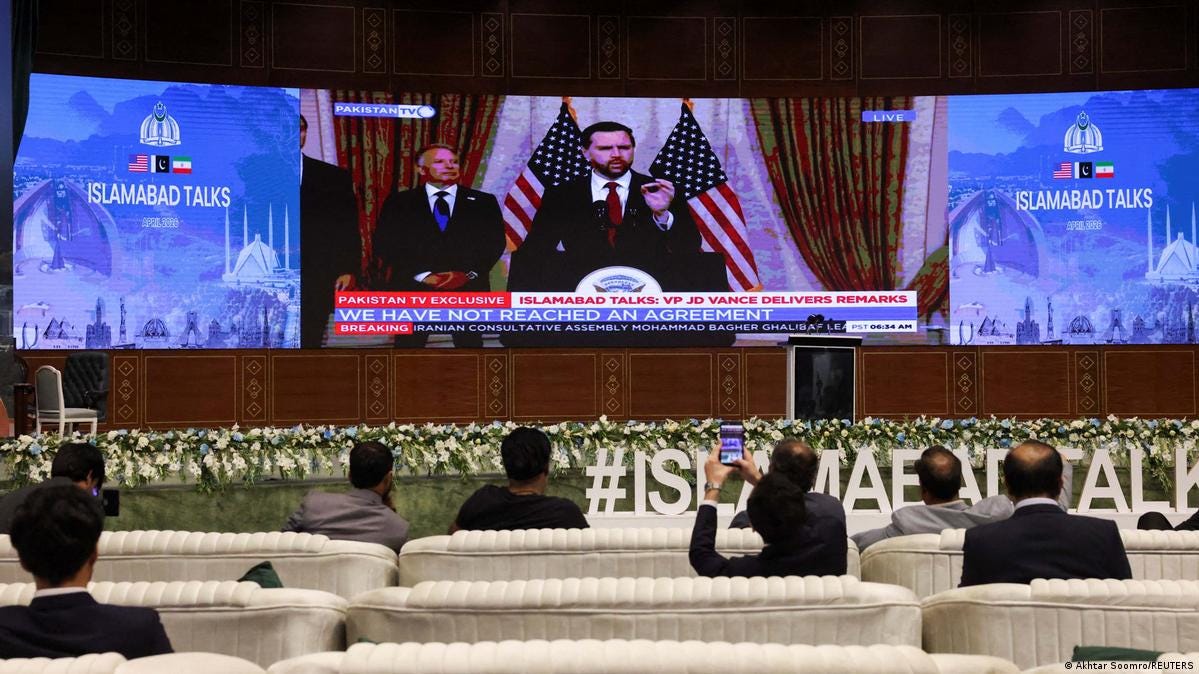
The Islamabad talks assigned Pakistan the role of constructing the face-saving framework that makes a deal possible: delivering American terms to Tehran in language that does not read as an ultimatum, carrying Iranian counter-positions back to Washington in terms that do not read as defiance, finding the formulation that lets both sides announce victory on the same day. It is a role that requires genuine diplomatic standing in both capitals and the kind of institutional credibility that comes from being perceived as an actor with independent interests.
Pakistan has none of those things in sufficient quantity. Its line to Tehran runs through Shia clerical networks and historical bilateral ties that predate the current Iranian leadership and may not be honored by it. Its line to Washington runs through an administration that views Islamabad primarily as a delivery mechanism. Its line to Riyadh runs through a defense pact that has already compromised its neutrality beyond recovery. The moment Saudi Arabia announced that deployment on the day of the Islamabad talks, Pakistan’s standing as a neutral host evaporated. What Pakistan can do in this diplomatic space is carry messages. What it cannot do is change the structural logic that makes those messages insufficient.
The settlement, when it comes, will not come through Pakistan. It will come when one side’s cost calculus shifts enough that a diplomatic fiction becomes preferable to continued attrition. Iran is closer to that threshold than it presents itself to be. A blockaded economy, a destroyed air defense architecture, a dead supreme leader, and the near-total dismantlement of the proxy network that gave it regional leverage before the war represent a level of strategic damage that no state absorbs indefinitely. The Revolutionary Guards know this. The question is whether the political structure replacing Khamenei can acknowledge it without being destroyed by the acknowledgment.
That is the deal that ends this war: not a negotiation between equals but an arrangement in which Iran concedes the substance while retaining enough of the language to survive domestically. Someone has to build that architecture quietly enough that the fiction holds. Pakistan has been asked to be that someone, partly because Washington had no better candidate, and partly because Beijing, which has strong interests in ending a conflict that has driven oil prices through the roof and disrupted its Gulf infrastructure investments, has quietly endorsed the role.
The problem is what happens if the fiction cannot be built in time, or if it collapses before it is signed. Pakistan does not return to the position it occupied before the Islamabad talks. It returns to the position it actually occupies: a formal belligerent under its Saudi pact, an economic casualty of the Hormuz crisis, a country with a sectarian fault line this war has pressed open, and a military command too centralized and too constitutionally protected to course correct at the speed the situation will require. Pakistan has survived worse crises than this, its defenders will argue. What they tend not to add is that surviving those crises required exactly the kind of institutional flexibility, civilian input, and distributed military authority that the current arrangements have systematically removed.
The ceasefire bought time. Pakistan used that time to deepen its exposure. The messenger is standing in the blast radius. The message has not been delivered.


