


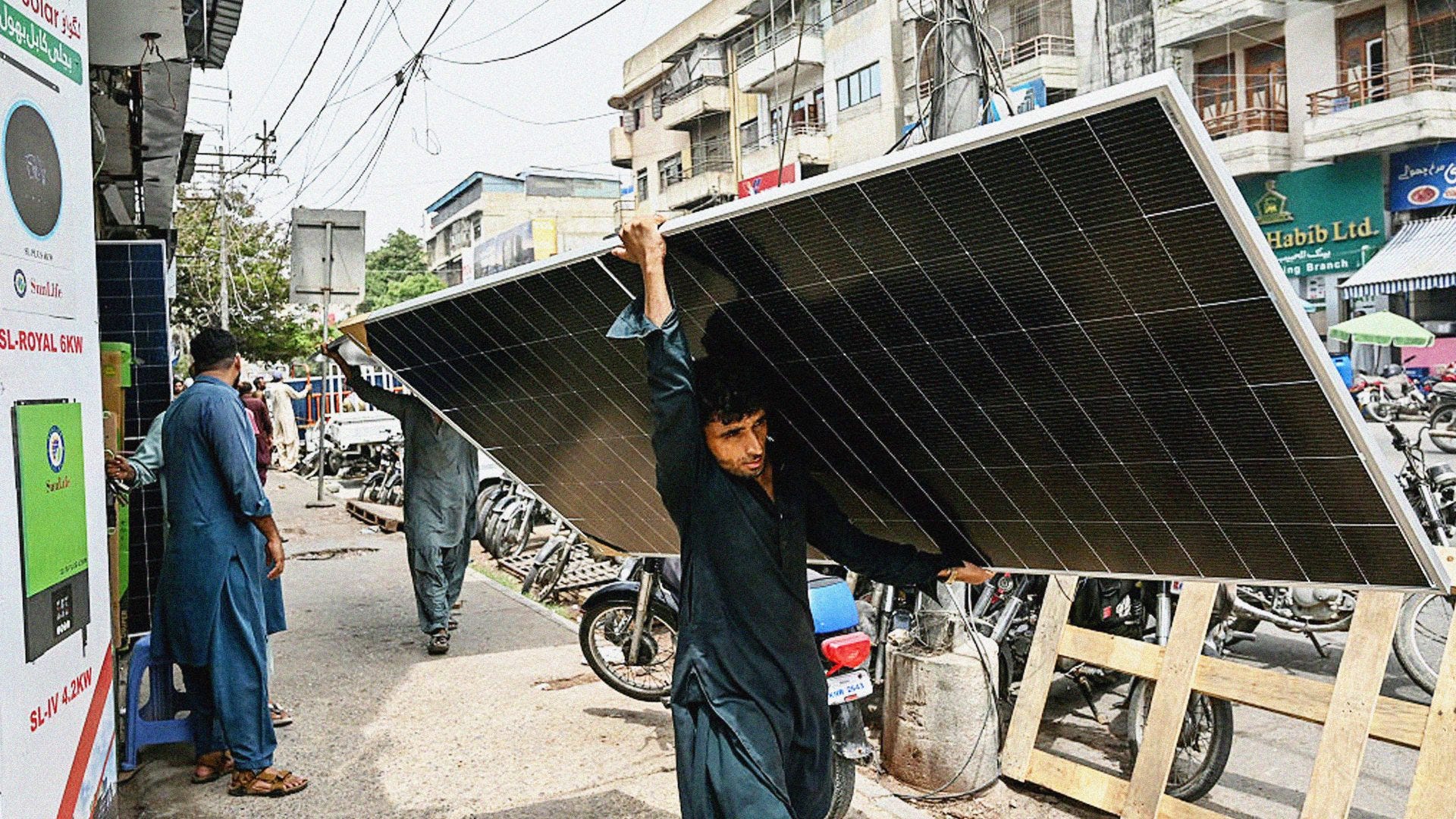
Millions have bought panels to escape expensive electricity. Those still on the grid must pay for the power plants the state promised to support.
Muhammad Nazam learned to connect his solar panels by watching YouTube. He uses them to run a tubewell in Qila Mian Singh, Punjab, where diesel and grid electricity had made pumping water increasingly expensive. Zainaab Basil and Adeel Malik reported his story in October. Their journey through eight Punjab districts found panels propped on bamboo, laid out near wheatfields, and connected by farmers who had learned from neighbours and videos on their phones. Some had gone hungry to save money for electricity.
In a rented Karachi flat, Muhammad Ali shares one air-conditioned room at night with his parents and two sisters. He is a dental resident trying to study; his father watches videos on his phone in the same room. Ali checked the shared roof, spoke to installers, and won the other residents’ consent to put up panels. Then the rules changed. Selling excess power to the utility became less profitable, making a battery more useful, but his family had little room for one. As he told Dawn in September, he had priced a system without storage at around one million rupees. Even that calculation depended on access to a roof he did not own.
Nazam can now run his tubewell, and yet Ali is still working out whether he can afford to use the roof above his family’s flat. A homeowner with money can buy storage and cut a large electricity bill, while a tenant stays on the grid despite having the same sunlight overhead. The state encouraged people to generate their own power, failed to make its grid affordable, and now says those who managed to leave have made electricity more expensive for everyone else.
In March 2025, the federal Economic Coordination Committee estimated that customers who sell solar power to the grid had shifted Rs159 billion in costs onto other consumers by December 2024. The estimate deserves an answer. So does the history it leaves out: Pakistan committed itself to expensive payments for power plants long before most families could buy a panel, and yet the household that responds to those payments by buying its own electricity has become the easiest part of the system to blame.
Who gets the savings
Ember estimates that roughly seven million Pakistani households own panels and that 73 percent of them are rural. Its study found that solar-powered tubewells rose from almost none of the country’s tubewells in 2022 to 61 percent in 2025. A cheaper way to pump water changes what a farmer can grow and how much diesel a family must buy. Rural Pakistan has been solving an energy problem the state left in the fields.
On a tenant farm in Muzaffargarh, Ghulam Fareed told Basil and Malik that his landowners bought him eight panels to power a tubewell. His rent stayed the same, and at night he sleeps in a straw shed beside the panels to guard them from thieves.
Basil and Malik found that some landlords brought solar from their urban houses to their farms, where tenants and neighbours could see it working before they bought panels of their own. Fareed’s landowners gave him equipment without raising his rent. The help is real. So is the difference between owning a pump and depending on the owner of one. A World Bank survey of 10,000 Punjab farmers in 2022 found that only 27 percent of farmers with holdings of up to two and a half acres owned a tubewell, though 78 percent used groundwater. For many small farmers, water already came through somebody else’s machine and terms.
Solar makes that machine cheaper to run, which is a considerable gain for a farmer who once paid for diesel. It can also make it easier to pump from an aquifer that belongs to no single landowner. The UN Food and Agriculture Organization warned in November 2026 that Punjab’s groundwater had been depleted by roughly 5.5 billion cubic metres a year over a recent five-year period. That estimate measures a long-running water crisis, not the effect of solar panels alone. But solar reduces the operating cost of drawing water, and Ember itself warns that pumping can accelerate depletion without water-use rules. A large owner can pay to deepen a well or install more panels. A tenant who depends on the same groundwater cannot make the aquifer replenish itself. The question of who owns the pump will matter long after the electricity bill falls.
A small system can run a fan during the day. A larger one can run appliances, charge a battery for the night, and lower the amount bought from the grid. A registered customer with the right meter can sell surplus power back. A tenant needs permission to use a roof, and a family in a crowded apartment block may have too little roof to share. Ali’s difficulty in Karachi had less to do with sunshine than with the building in which he lived.
Under NEPRA’s February 2026 rules, new customers buy grid electricity at the retail tariff while the utility buys their surplus solar power at a lower price. The old arrangement gave earlier customers a more generous credit; existing agreements have separate transitional treatment. Selling power to the grid also requires an eligible connection and three-phase supply. Before a low-income household can argue about the buyback price, it must have the right roof, the right meter, and enough money to install the equipment.
In Karachi, the shift left Ali weighing the price of a battery he had not planned to buy. Across the same city, Dawn reported, Ahsan Haider had installed a seven-kilowatt system with storage on the roof of his apartment block after obtaining his landlord’s permission. His family cut its electricity bill by 70 percent. Haider had a roof he could use and enough money for a battery. Ali was still looking at quotations. Both lived in apartments; only one had reached the point at which sunlight became a dependable household asset.
Ember estimates that power generated by distributed solar supplied 28 percent of Pakistan’s total electricity in fiscal 2024–25, including electricity used in homes, farms, and businesses without passing through the grid. The Pakistan Economic Survey gives a much smaller share for renewables recorded on the formal grid because it measures electricity that enters that system. Distributed solar generation grew from 15 terawatt-hours in fiscal 2022–23 to 51 terawatt-hours two years later. Total electricity use rose even as power taken from the grid fell. Families and farmers could finally afford some of the electricity they had long needed, and yet in the tariff debate their purchase is entered as a loss to grid revenue.
The 200-unit line
Under the protected-customer system in force in October 2026, a household using up to 200 grid units in a month qualified for a lower tariff. The power minister told the Senate that one unit above the threshold could send the price as high as Rs33 per unit and remove the subsidy for six months. A rich household with enough panels could keep its recorded grid use below 200 while still running appliances on its own electricity. A poorer household without panels could cross the line during a hot month simply by using more power from the grid. The meter records purchases from the utility; it does not record income.
The minister said the number of protected customers had grown from roughly ten million to between twenty million and twenty-five million over two years. He cited households that used 700 or 800 units in all but bought fewer than 200 from the grid after installing solar. That is a real flaw in a subsidy based on grid use. It does not mean every household below the threshold is affluent, or that every household above it can afford the higher rate. The government said it would replace the cliff with aid aimed at poorer customers. As of the October announcement, that was a plan, and families still had to live with the bill in front of them.
The World Bank examined that bill in 2024. Between fiscal 2020 and fiscal 2024, its table shows residential electricity subsidies rising from Rs239 billion to Rs378 billion, while its analysis found that average tariffs for non-protected domestic meters rose by 225 percent and electricity’s share of the household budget tripled for poor, vulnerable, and lower-middle-income customers. Spending more public money on subsidy had not protected those households from a rising claim on their wages. The bank calculated that the subsidy system spent 90 percent more than a targeted bill rebate would need to reach the poorest families. The state kept using a meter reading as a stand-in for a family’s means, even after household solar made the stand-in less reliable.
A cabinet-backed tariff filing in February 2026 proposed new fixed monthly charges for residential users to help lower the price paid by industry; contemporary reporting put the expected household collection at about Rs125 billion. The industrial tariff cut of Rs4.04 per unit was later notified, along with domestic fixed charges. Cheaper power may help factories keep workers and compete for orders. The question is why a protected household’s fixed charge should finance that policy, and why the trade-off was buried in a tariff schedule rather than argued openly as a transfer from homes to industry.
The power plants behind the bill
A household’s electricity bill helps pay for power even when the household does not use it. Under capacity-payment arrangements, the public purchaser owes generators for making plants available. The payment is separate from the fuel and other costs of producing a unit of electricity. These contracts vary, and a country needs reserve power for nights, cloudy days, and sudden demand. But when grid sales fall, many fixed obligations remain. Fewer purchased units must carry costs already promised to generators. NEPRA’s State of the Industry Report 2025 puts capacity payments at about Rs614 billion in fiscal 2020–21 and Rs1.8 trillion in fiscal 2024–25. The amounts rose steeply before the latest wave of household solar took hold. NEPRA’s evaluation of power plants for 2024–25 found that thermal plants used 42.5 percent of their reference capacity. That number alone cannot tell us which plant should have been built or retired. It tells us that Pakistan was paying to keep a large amount of generation available while much of it was not running.
Imported fuel became dearer, the rupee lost value, distribution companies lost power to theft and weak collection, and governments postponed hard decisions about tariffs and subsidies. Some plants brought needed electricity to a country starved of it. Their owners, lenders, contract terms, and actual output belong in the same public accounting as the government’s Rs159 billion estimate for the solar cost shift.
A distribution company fails to collect enough to cover the electricity it receives; the central purchaser cannot pay every generator on time; generators and fuel suppliers carry unpaid bills; and the government guarantees, subsidises, refinances, or adds charges to keep the chain operating. The World Bank’s 2024 power-sector study found that these annual deficits averaged 2.8 percent of GDP from fiscal 2014 through fiscal 2024. Accumulated circular debt reached about Rs2.4 trillion by June 2024. The debt did not arise because a farmer learned to wire a tubewell in 2025, and neither removing his panels nor cutting a new customer’s export credit would settle it.
The State Bank’s 2025–26 annual report put registered capacity under net metering at about 7,319 megawatts in March 2026. Ember’s wider accounting estimated roughly 38,000 megawatts of distributed solar already installed by the end of fiscal 2024–25. These are estimates made on different dates and by different methods, but they show that the registered exporters debated in tariff hearings are only one part of Pakistan’s solar economy. A rural household using a panel for its own fan does not receive the same export credit as an urban household with the right connection. Blaming all solar owners for the costs of the older net-metering deal erases that distinction.
In a separate State Bank calculation, analysts estimated that solar generation in fiscal 2025–26 could have saved $4.5 billion to $5.5 billion in energy imports after accounting for imported panels, batteries, and inverters. The estimate depends on assumptions about how many panels were operating, how much power they produced, and which fuels they displaced; it is not a measured pile of dollars in the treasury. Households bore the upfront expense of the equipment, while the country gained some relief from fuel imports, and yet the public debate begins with the charge that those households have hurt the grid.
The change from net metering to net billing has a defensible principle: customers who use the grid as backup should contribute to its wires and services. Yet the state could alter what a new solar customer earns far more quickly than it could reduce what the public owes under old power contracts. A family buying panels after years of punishing bills receives a revised bargain; the agreements behind those bills remain difficult for that family to inspect. The people asked to absorb the change did not sign either set of contracts.
When relief becomes a contract
Sindh promised solar kits to low-income families. In September 2025, Transparency International Pakistan raised objections to the procurement of one such programme. Its complaint said the provincial cabinet had exempted a direct contract with NRTC Energies from normal competitive bidding, after which another subsidiary took its place without fresh cabinet approval. It also questioned Rs6 billion in advance payments and compared a contracted price of $219 per kit with an estimated market price of $135. Transparency International calculated that the price difference could cost the public about $21 million. That is its estimate, not a court finding. If the government can tell a poor household exactly how many units it consumed, it can tell the public which company supplied each kit, who owned that company, who approved the change of contractor, and what was paid.
The Sindh cabinet’s account of a separate, World Bank-funded solar project was damaging in its own terms. It reported improper contract changes, payments for incomplete or missing work, fake import documents from a main contractor, and spending on equipment that could not be clearly accounted for. The chief minister ordered audits and investigations. Those failures concern a different project from the home-kit complaint. They are two occasions on which money intended to bring electricity to households encountered the discretion of contractors and officials before it reached a roof.
At the border, the Auditor General’s review of the Federal Board of Revenue recorded Rs37.76 billion in alleged over-invoicing across 2,178 solar-panel import declarations. It described Rs73.83 billion transferred abroad in the transactions examined, with payments sent to Dubai and Hong Kong for panels imported from China. Auditors said customs offices had failed to assess values properly and that some used panels were declared new. They recommended an anti-money-laundering investigation. These are audit findings, not convictions, but they place the corruption question at both ends of the same trade: the price paid to bring panels into Pakistan and the price paid when a government buys them for the poor.
Chief Minister Maryam Nawaz launched Punjab’s free solar programme for 100,000 consumers. In 2022, before she became chief minister and before this scheme existed, a political opponent alleged that her cousin Suleman Shehbaz owned a solar business that would benefit from government policy. Suleman denied owning such a company and sent a defamation notice. The allegation does not establish that a Sharif relative sold panels to Punjab. Publish the scheme’s contract awards, the names of its suppliers, their owners, and the payments they received. If a family member is among them, the record will show it. Until then, a political charge cannot do the work of a company filing.
The family pays again
The electricity bill arrives alongside school fees and medicines. A family with money can send a child to a private school, see a doctor in a private hospital, and store electricity in a battery. A family without it still pays tax, school costs, medicine bills, and the utility, often in the same month. Pakistan’s governments treat these as separate policy problems. They meet in the same household.
The Pakistan Economic Survey 2025–26 puts public education spending in fiscal 2024–25 at about Rs962 billion, or 0.8 percent of GDP. A World Bank analysis published in 2026counts roughly 25 million children aged five to sixteen outside school. For those who attend, a place in a classroom is no guarantee that they learn to read. The World Bank’s education data record severe learning poverty among ten-year-olds. Parents who can afford tuition and private lessons pay to escape those odds; poorer parents may pay fees anyway and still find their child has learned little.
The Economic Survey’s health figures show Rs942 billion spent by federal and provincial governments in fiscal 2024–25, also 0.8 percent of GDP. An older household survey, cited by the World Health Organization, found that patients paid 51.7 percent of health spending themselves in 2017–18. The survey is old, but the expense it measured remains familiar at the pharmacy counter: a household can be counted as served by the health economy while treatment empties its savings.
The World Bank’s October 2026 poverty brief estimates that the share of Pakistanis living below the national poverty line rose from 22 percent in 2018–19 to 29 percent in 2024–25. Its country data show real wages falling by an average of 3.4 percent a year across that period. A battery bought outright saves money over time; a worker whose pay buys less each year cannot always make the first payment, and yet that worker is among those least able to absorb the grid’s next bill.
The government’s Tax Expenditure Report 2026 estimates Rs2.353 trillion in tax concessions and exemptions for fiscal 2024–25. Some concessions have public purposes or help lower-income consumers; that total cannot be assigned wholesale to wealthy beneficiaries. Each still has a beneficiary, a cost, and a reason it was granted. The IMF’s November 2025 governance review describes openings for powerful interests to influence tax policy, procurement, and enforcement. A salaried worker pays tax before receiving a wage, a customer pays at the counter, and organised interests have the means to argue for exceptions in rooms those taxpayers cannot enter.
A World Bank study published in 2025 reconstructed what taxes, cash aid, and subsidies did to Pakistani households in fiscal 2018–19. After those payments and benefits were counted, only the poorest tenth of households received more cash from the state than they paid into it; households in the other nine tenths paid more than they received. The bank estimated that the cash effects of fiscal policy raised the national poverty rate by 2.3 percentage points, while the overall tax and spending system reduced measured inequality only slightly. The study is based on an older survey and cannot be passed off as a 2026 count. Its finding is still a warning against calling every subsidy progressive. A poor family just above the bottom tenth can pay more in tax than it gets back in cash, even while needing public help with its power bill. The same study found BISP to be among the most effective tools for reducing poverty; the failure lies in how little the rest of the fiscal system does for families around its edge.
State Bank figures put remittances at $41.6 billion in fiscal 2025–26, up from $38.3 billion the year before. That money pays for food, rent, school, and treatment in homes across Pakistan; it also supplies foreign currency the country needs. The government celebrates the record inflow. The driver, nurse, or construction worker sending it has paid for that record with years away from family, while those at home remain responsible for stretching each transfer through the next set of bills.
The 2026–27 budget allocates Rs844.78 billion to the Benazir Income Support Programme. Cash support can prevent hunger and it should reach the families who need it. Its recipients must still return to the same school, clinic, and power company after the payment has been spent. A government that relies on their relatives’ remittances and their private spending to hold daily life together has little cause to congratulate itself for keeping those services open.
Moving electricity help from the 200-unit meter rule to a household registry could correct the subsidy captured by well-off solar users. It could also miss families who are poor but absent from the register. A World Bank review published in 2025 estimated that about 2.2 million households in the bottom 40 percent were missing from the National Socio-Economic Registry, even though the registry covered most of the country. The government’s October 2026 electricity plan sets a December deadline to define new eligibility criteria and a January 2027 target to begin reducing subsidies for unregistered consumers. A tenant whose meter is in a landlord’s name or a family that has moved for work may have to prove need to a system designed around paperwork it does not control. The government has not yet shown how its proposed reform will find every such household. A better test of poverty than monthly grid units will help only if poor people can actually pass it.
Ali had his neighbours’ permission to use the roof and quotations from installers before the tariff changed. The new price for selling electricity made a battery more important, and his rented flat had no room for one. The roof belongs to someone else.