
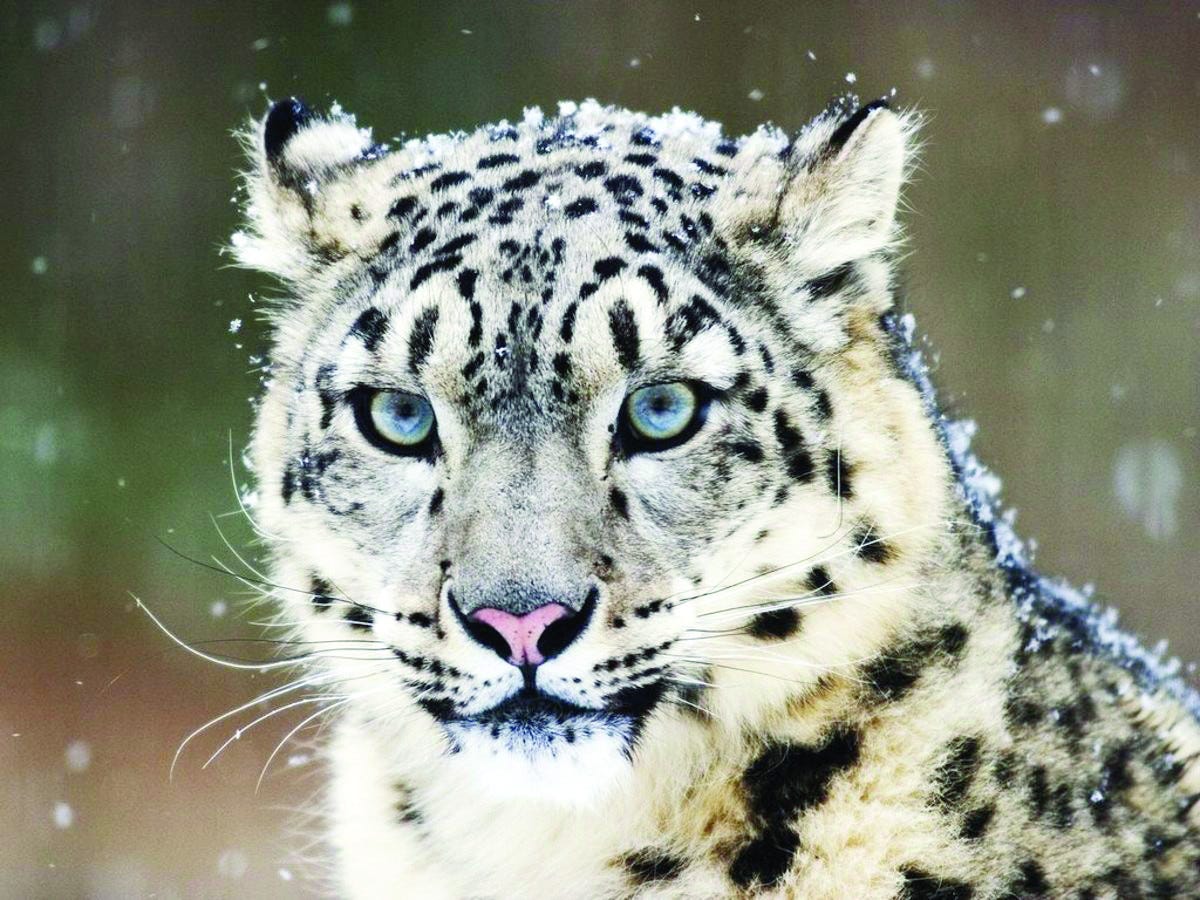
Pakistan's Snow Leapords
For a century, Pakistan knew its ghost cat was out there. This year, someone finally put a number to it.
Muhammad Ali Nawaz has spent the better part of two decades trying to count an animal that does not want to be counted. He is a wildlife biologist and the founder of the Snow Leopard Foundation Pakistan, based in Islamabad, and his work has taken him to ridgelines above Khunjerab, into the side valleys of Chitral, across the boulder fields of the Central Karakoram and the high pastures of the Hindu Raj, the four mountain ranges that together hold almost the entire snow leopard range in Pakistan. He has deployed cameras in terrain so steep that reaching the camera station is itself a day’s work. He has hiked into valleys where the nearest paved road is two days behind you. He has spent years sifting through photographs of empty rock and grey sky and wind-bent grass, waiting for the frame that contains what he came for: a pair of eyes, a spotted flank, the long tail that snow leopards drape over their faces in cold like a scarf.
He has been doing this, systematically and without interruption, since 2010.
In January 2026, the journal Ecography published what that patience produced. The paper is titled “From Shadows to Data: First Robust Population Assessment of Snow Leopards in Pakistan.” After nine years of fieldwork, 828 deployed cameras, 26,540 trap days, and 4,712 photographs of snow leopards taken at 65 separate locations across 39 percent of the species’ range in Pakistan, the number the study arrives at is 155 animals. The confidence interval runs from 100 to 239. The mean density is 0.16 animals per 100 square kilometres.
One hundred and fifty-five snow leopards. That is what the mountains are holding.
Before this study, no one could say that number with any scientific authority. Previous estimates for Pakistan’s snow leopard population had ranged from fewer than two hundred animals to more than four hundred, depending on the year, the methodology, and who was doing the projecting. The variance was not negligence. It was the honest result of trying to measure something that occupies territory the size of a small country, moves almost entirely at night, avoids human presence as a matter of evolutionary habit, and wears a coat of pale grey and black rosettes that renders it, at any distance, indistinguishable from the rock it walks across. Earlier figures were extrapolations: density estimates from small, well-studied areas extended outward across assumed habitat. They were the best available tool at the time. They were also, as Nawaz and his co-authors state plainly in the paper, insufficiently empirical to serve as a foundation for serious conservation planning.
A baseline is what you measure everything else against. Without one, you cannot say whether a population is recovering or collapsing. You cannot evaluate whether an intervention worked. You cannot make a credible argument to a government ministry or an international funding body that the situation is stable or that it is not. The 2026 study does not only produce a number. It produces the point from which every future number becomes meaningful.
This distinction matters more than it might appear. Pakistan’s northern mountains have hosted snow leopard populations for as long as there have been snow leopards and northern mountains. But hosting an animal and knowing how many of them you are hosting are two different things, and a government that cannot quantify what it is protecting will eventually, under enough competing pressure from mining concessions and road-building contracts and international creditors, stop protecting it. The number is not academic. It is a claim on the future.


The fieldwork ran from 2010 to 2019. That span is not incidental. Snow leopard survey work of this kind resists compression. A single camera trap deployment at one location tells you something about presence and density at that location during that season. To build an estimate that holds across four mountain ranges covering 39 percent of a species’ national range, you need years of overlapping data, surveys in different seasons, cameras placed not where access is easy but where the animal actually moves.
Nawaz’s team used spatial capture-recapture methodology, a statistical framework that identifies individual animals by their unique rosette markings across multiple camera detections, then models their movement and territory to estimate how many animals occupy both surveyed and unsurveyed areas. Snow leopard rosettes are as individual as fingerprints: the specific arrangement of spots along the flank, the diameter and spacing of the rings, the configuration at the shoulder where the spots begin to cluster. An animal photographed at a site in the Karakoram in March 2013 can be matched, through that rosette geometry, to the same animal photographed at a different camera 30 kilometres away in November 2015. The statistical model then uses those detections to estimate not only how many individuals are present but how large their territories are and how far they range, which in turn allows the researchers to project density across areas the cameras did not cover.
The cameras were not placed at random. They went at sites with documented sign: scrape marks where a leopard had dragged its claws across a rock to mark territory, spray points, pugmarks preserved in the soil of a game trail. Some of that sign was identified by field teams from the Snow Leopard Foundation. Some of it was read by men from the villages at the base of the survey zones, men who had spent their lives in these mountains and who knew, from habit and inheritance, what to look for and where to find it.
This is worth saying plainly because it tends not to be said: the scientific output of nine years of camera trap data from the Karakoram and Hindu Kush rests substantially on the knowledge of people whose names do not appear in the author list of a paper published in Ecography. The Balti herder who has been reading snow leopard pugmarks since he was twelve years old and who can tell, from the depth of an impression in mountain soil, how recently the animal passed: he is not a footnote. He is a method. The entire enterprise of putting a precise number on Pakistan’s ghost cat depends on knowledge systems that predate wildlife biology by several centuries and that no university has conferred a degree for.
The snow leopard’s formal conservation status sits at Vulnerable on the IUCN Red List, a classification that replaced the previous Endangered listing in 2017 and produced significant dissent among field researchers who considered it premature. Vulnerable does not mean safe. It means that at the time of assessment the population did not meet the numerical threshold for Endangered, which requires either fewer than 2,500 mature individuals globally or a documented generational decline of at least 30 percent. The global snow leopard population is estimated at between 4,000 and 8,500 animals across thirteen countries.
Pakistan holds the third-largest national population in the world, after China and India.
That position is rarely stated in terms of what it actually means. The Karakoram, Hindu Kush, Hindu Raj, and Pamir ranges of northern Pakistan contain some of the least commercially developed high-altitude terrain remaining in the snow leopard’s global range. The road-building, hydropower projects, and intensified pastoral activity that have compressed leopard habitat elsewhere across Central and South Asia have touched these ranges more lightly. This is partly geography. The passes are higher here, the approaches more brutal, the infrastructure investment slower to arrive. And it is partly because the communities that have lived in these valleys for centuries had already worked out, over generations, an accommodation with the animal that shares their altitude.
The Karakoram Highway has been extended. New mining concessions are active in Gilgit-Baltistan. The high-pasture grazing season is lengthening as a warming climate pushes the snowline upward, driving livestock and their herders deeper into what was previously leopard territory for more months of the year. The 155-animal baseline is not a reassurance. It is a reference point against which the coming decades will be measured, and having a reference point is how you detect a decline before it is too late to reverse.
The primary threat to snow leopards in northern Pakistan is not the fur trade, though that threat is real and the illegal market for snow leopard pelts and bones extends from the Karakoram passes into Central Asian trafficking networks. The primary threat is a dead goat.
When a snow leopard kills livestock, it creates a direct financial loss for a household that may have no other income. In documented surveys of predation hotspots across the Karakoram, snow leopards were found responsible for roughly 46 percent of all livestock predation incidents, taking sheep, goats, and cattle, with sheep making up the single largest share of kills. In the high-pasture communities of Gilgit-Baltistan, where a household’s animals are simultaneously its food supply, its seasonal income source, and its capital reserve, losing four or five animals in a single night to a predator is not a conservation statistic. It is a crisis. The response has historically been immediate: the leopard is tracked, found, and killed. The logic is not malice. It is that the leopard has just consumed a significant portion of a family’s annual income and no one has offered to replace it.
This is the specific problem that the Snow Leopard Foundation has spent fifteen years trying to solve, not by persuading herding families to absorb losses they cannot afford, but by changing the economics so that they no longer have to.
Predator-proof livestock corrals, built to dimensions that prevent a snow leopard from forcing entry at night, have been constructed across the foundation’s program areas in Gilgit-Baltistan, Khyber Pakhtunkhwa, and Azad Jammu and Kashmir. The construction is in partnership with village communities: the design is tested against the actual anatomy and behaviour of the animal, the materials are locally sourced where possible, and the maintenance knowledge stays in the village. Livestock insurance schemes verify predation losses through field inspection and compensate the affected family from a community-managed fund, removing the financial rationale for retaliatory killing. Community wildlife guardians, recruited from the same villages whose livestock are at risk, monitor leopard movement, report sightings, and serve as the living human connection between the scientific monitoring programme and the mountain communities that ultimately determine whether the animal survives. The foundation has also worked, more slowly and with more difficulty, on the longer calculation: making the living leopard worth more to the valley than the dead one through wildlife tourism, trained eco-guides, and the economic case that a snow leopard repeatedly photographed by visitors over its lifetime generates more income for the valley than its pelt fetches at any border.
None of this is simple and none of it is finished. The corrals require maintenance. The insurance funds require consistent contributions and careful management to remain solvent when multiple predation events occur in a short season. The guardian network requires payment, training, and institutional continuity. The 2026 population count was produced by a team that has been doing this long enough to know that the number is only useful if the conservation infrastructure around it holds. A population of 155 animals with a functioning community protection network and a reliable baseline is in a meaningfully different position from a population of 155 animals counted once and then left to the arithmetic of the mountains.
The data in the Nawaz study makes this visible in a specific way. The density predictions from the spatial capture-recapture model were not uniform across Pakistan’s northern ranges. Higher leopard densities clustered around protected areas and zones with higher prey biomass: Khunjerab National Park, the buffer zones of the Central Karakoram National Park, the community-managed conservation areas in Chitral and upper Gilgit-Baltistan. Where protection existed, even imperfectly, the animal was more present. Where it did not, the numbers were thinner. The 155 is not evenly distributed across Pakistan’s mountains. It concentrates in the places where people decided, at some earlier point, to let it live.
The prey base matters as much as direct protection of the leopard itself. Snow leopards in northern Pakistan feed primarily on blue sheep, also called bharal, along with ibex, markhor, and urial. A leopard requires roughly 20 to 30 large prey animals per year to survive and rear young. Where those prey populations are healthy, the leopard population can sustain itself. Where they have been depleted by unregulated hunting, the leopard either follows domestic livestock into conflict or starves. This is why the Zoo New England program announced in early 2026, which targets not only snow leopards but the full high-altitude ecological web, has a logic that goes beyond charismatic megafauna. The markhor, Pakistan’s national animal and the world’s largest wild mountain goat, is in these ranges. The woolly flying squirrel, the largest squirrel on earth, endemic to this region, is in these ranges. The urial, under sustained poaching pressure from trophy hunters, is in these ranges. The conifer forests at lower elevations, the last significant stands of their kind in the area, shelter species across the entire elevation gradient. Protecting the leopard without protecting what the leopard eats is a calculation that fails at the third step.
The Zoo New England programme commits four years of support to more than 10,000 square kilometres of northern Pakistan, backing more than 50 local resource organisations and over 20 community wildlife conservancies. Its structure is deliberately not Islamabad-facing. The organisations it supports are village-level bodies, community wildlife associations, local conservation councils that have been operating in these valleys with inconsistent external support for years. It does not create new institutions. It funds the ones that already exist and already carry the trust of the people whose land the leopard crosses. The programme’s target, by the time those four years are complete, is that each of the 20-plus community conservancies it supports will be formally gazetted as protected areas under Pakistani law, turning community-managed territory into legally defined conservation land.
There is one number from the Nawaz study worth holding separately from the rest. Nine years. 828 cameras. 26,540 trap days. 65 locations across four mountain ranges. And the total yield of all that patience, logistics, cold, and altitude is 4,712 photographs in which a snow leopard appears. Roughly ten frames per week, averaged across a survey area spanning hundreds of thousands of square kilometres of the most demanding terrain on earth.
Ten frames a week.
The animal is here. It is present, reproducing, holding territory, moving through the Karakoram and the Hindu Kush on routes that have been in use for longer than any human record. And across nine years of systematic effort, it appeared in a camera ten times a week.
That near-invisibility is not incidental to what the snow leopard is. It is the central fact of it. The animal evolved in a landscape where visibility meant death, and it refined its solution so completely that it has spent most of its existence outside human records, outside any record, moving through the rocks at night on paws evolved to be silent on stone. The Baltis and the Wakhis and the Chitralis who have lived below its range for centuries knew it from tracks and kills and the occasional sighting treated as something worth describing to others, something to remember. The idea that there is a precise number of them, a figure that can be cited and interrogated and revised, is genuinely new.
Muhammad Ali Nawaz and his co-authors did not discover the snow leopard. They found a number. That is a different and in some ways harder thing, requiring not a single moment of encounter but nine years of cameras sitting in the cold. Nine years of early mornings at altitude carrying equipment up boulder fields to reach a camera that may or may not have triggered in the weeks since the last visit. Nine years of downloading hundreds of frames of empty rock before the one frame that contains the spotted shoulder, the amber eye, the proof that what you were looking for is still out there.
The number they found is 155. The confidence interval is wide enough to be honest about what a mountain keeps to itself. And the question of what is built on it now, whether the insurance schemes hold, whether the community conservancies receive their legal status, whether the camera trap surveys continue on a cycle short enough to detect decline before it becomes irreversible, is not a question the paper can answer. It is the question the paper makes it possible, for the first time, to ask properly.
Pakistan has the third-largest snow leopard population on earth. The animal has survived here because the people who share its altitude decided, generation after generation, that it was worth the cost. The science has finally caught up with what they already knew.


Haven’t read it yet; but the title reminded me how it was included as the one of the main stories in the cool independent film ‘The Secret Life of Walter Mitty’