Pakistan’s Ponzi State
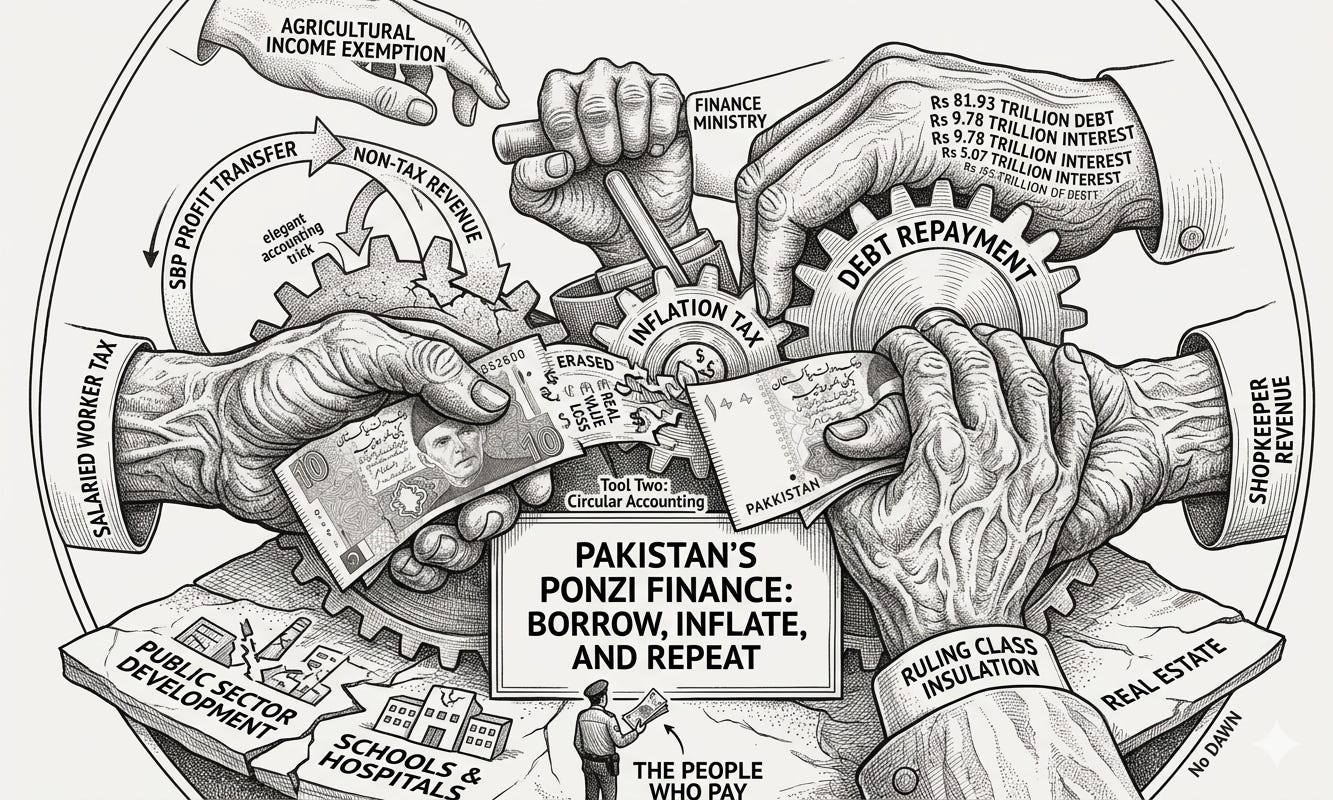
For 25 years the government borrowed to pay its debt, used inflation to quietly erase it, and called the accounting trick revenue. The salaried worker, the shopkeeper, and anyone paid in cash took the loss.
Asadullah Khan sits outside a washed-out building in Saddar for twelve hours every day in the punishing Karachi heat. He is a security guard. He lives near Ziauddin Hospital in Clifton and walks the ten kilometres to work each morning, two hours on foot each way, to save the bus fare. By noon, the humidity off the Arabian Sea forces him to take off his sweat-drenched uniform shirt and dry it in front of the guard room’s shabby fan. He earns Rs 25,000 a month. He does not know the government’s minimum wage is Rs 37,000. He has never been told. When his employer gives him a raise, he is grateful. He does not know the raise is returning a fraction of what was owed to him from the first day. Dawn reported his story last year.
While Asadullah dried his shirt in Saddar, Pakistan’s finance ministry told parliament it had achieved a primary surplus. Both things are true. That is where the story lives.
The Architecture
Pakistan’s fiscal structure has operated, for the better part of three decades, on a simple mechanism: spend more than you earn, borrow the difference, and borrow again to pay the interest on the first borrowing. Economists describe this as Ponzi finance, after the fraudster whose scheme collapsed the moment new money stopped coming in. Pakistan’s version has not collapsed. The reason it has not is that a sovereign state possesses tools a private borrower does not, and Pakistan has used all of them. An analysis by Dr. Ali Hasanain, published through PRISM, Dawn’s data journalism vertical, documented the mechanics precisely.
The numbers are not disputed. Total public debt reached Rs 80.52 trillion at the close of the last fiscal year, up from Rs 71.25 trillion just twelve months before. The Ministry of Finance told parliament the reason: the debt rose “mainly due to an increase in interest payments.” The State Bank’s own data now puts the figure at Rs 81.93 trillion. Per capita debt stands at Rs 333,041, money owed on behalf of every Pakistani on decisions made before most of them were old enough to vote on any of them.
At the peak of the cycle, sixty-one paisas out of every rupee the government collected in revenue went directly to interest payments. Not to schools, or hospitals, or the public development programme that was announced that year and then underfunded. To interest. To the banks that lent the government money, to the external creditors that lent it dollars, and to the compounding arithmetic of a system that was never designed to stop growing. In the budget presented the following year, debt servicing consumed Rs 9.78 trillion. The current budget still allocates Rs 7.824 trillion of its Rs 17.573 trillion total outlay to the same purpose.
That peak is now falling. Interest payments have come down to 49 paisas per revenue rupee, and the Pakistan Economic Survey 2025–26 projects further decline toward 35. Finance Minister Muhammad Aurangzeb has called this “restrictive fiscal discipline” and pointed to the trajectory as evidence of structural improvement. The IMF, in its most recent country report, confirmed that performance criteria had been met. Neither document explains the mechanism by which the improvement was achieved.
Tool One: The Inflation Tax
The first tool was inflation, and it worked most efficiently on the poor.
When Pakistan’s consumer price index crossed 30 percent and kept climbing, something happened to the government’s debt that did not happen to Asadullah Khan’s savings. The debt shrank, in real terms, because the currency it was denominated in was worth less. A billion rupees three years ago and a billion rupees today are not the same billion rupees. The government’s liability eroded. The security guard’s wage did not keep pace.
Inflation averaged above 29 percent in one fiscal year and 23 percent in the next. Nominal wages rose across the economy, the Labour Force Survey found, but the Consumer Price Index had already consumed most of that gain. In construction, manufacturing, and retail, real wages by last year were substantially below where they had been when the inflation began. The current budget’s 7 percent salary increase for government employees arrived against an inflation rate still running above 10 percent.
The inflation tool has a name in economic literature: the inflation tax. It levies on anyone who holds savings in cash, anyone whose wages are not indexed to prices, and anyone whose transactions are not hedged against currency depreciation. It does not levy on the landowner whose asset appreciates with inflation, the dollar-account holder whose savings are denominated in a stable currency, or the real estate investor whose holdings track the consumer price index upward. Pakistan’s ruling class, understood as a composite of large landowners, senior military and civil officers with dollar-linked benefits, and the financial sector, sat largely outside the inflation tax’s effective reach. The government’s fiscal metrics improved while the rupee in circulation did its quiet work on wages, savings, and the purchasing power of anyone who got paid in cash.
Tool Two: The Circular Accounting
The second tool is more elegant and almost never discussed in plain language.
The government borrows money from commercial banks. It pays those banks interest. The State Bank of Pakistan, as the central bank and regulator, holds a portion of government securities and earns interest on them. At the end of each fiscal year, the State Bank transfers its profit to the federal government. That transfer is recorded as non-tax revenue. This year, the transfer reached Rs 2.4 trillion. According to a Topline Securities analysis quoted by Business Recorder, it played a decisive role in achieving what the government described as a 21-year low fiscal deficit. The government spent money, a portion of it flowed through the banking system, the central bank captured part of that flow as profit, and then transferred it back. The government counted the return as income.
This accounting structure is not illegal. The parties are both the government, so no fraud statute applies. What it produces is a fiscal presentation that allows the state to claim a lower deficit than the underlying position warrants. The IMF, operating on agreed programme metrics that include the SBP dividend, has continued to approve tranches. The programme is on track, and the structural conditions that created the need for one have not changed.
Who Paid
The third element of the structure is the tax base, and here the picture is the most unambiguous.
Salaried workers paid Rs 605 billion in income tax in the last full fiscal year, according to Express Tribune data. In just the first eight months of that year, they paid Rs 331 billion. Retailers, in the same eight-month window, contributed approximately Rs 24.5 billion. The disparity, 1,350 percent in the salaried workers’ direction, is not marginal. A World Bank policy note identified Pakistan’s fiscal regime as structurally inequitable: a narrow, compliant segment carries a disproportionate share of the burden while large portions of the economy remain outside the net.
Agricultural income remains exempt from federal income tax under the Income Tax Ordinance 2001. In Pakistan, where major landholding is concentrated among a small and politically powerful class that has historically included senior politicians and retired military officers, this exemption is not incidental. It is architecture. The provinces nominally hold the power to tax agricultural income and have largely chosen not to exercise it. Real estate income and capital gains have been systematically undertaxed for decades, producing the circular condition in which the class that benefits most from the state’s expenditure pays the least toward its financing.
The Management Association of Pakistan, in a budget submission this year, put it without bureaucratic softening: forcing legitimate businesses to repeatedly bridge the revenue gap while the massive informal economy escapes the net is a recipe for economic stagnation. The response in budget after budget, across successive governments, has been to raise withholding taxes on the documented economy: salary deductions, bank transactions, utility bills, all of them easiest to extract from people already in the system, none of them capable of reaching the land, the property, or the informal commerce that constitutes the actual wealth of Pakistan’s ruling class.
The Recovery and What It Actually Means
Pakistan’s fiscal position today is measurably better than it was three years ago. The primary surplus is real. The debt-to-GDP ratio has declined from its peak of around 74 percent to approximately 70 percent. Gross reserves have recovered to $16 billion, according to the IMF’s most recent country report. These improvements are documented.
The interpretation is the point.
The improvement did not happen because the structural conditions that produced the deficit were reformed. Agricultural income remains exempt. The real estate sector remains lightly taxed. The formal documentation of the economy has proceeded slowly and against resistance from the political class that controls the legislature. The Federal Board of Revenue’s shortfall of approximately Rs 1 trillion in the current fiscal year demonstrates that the revenue base has not broadened in proportion to what was required, in the same year the government is claiming its best fiscal performance in two decades.
The improvement happened because the IMF is watching. Programme conditionality imposed fiscal discipline that the political economy of Pakistan, left to itself, has never voluntarily chosen. Interest rates came down from their peak. The inflation tax, having done its destructive work on wages and savings, has eased. The current government is spending less on development than its predecessors, which is the only form of expenditure that might have benefited the people who absorbed the crisis.
Fitch, in its most recent assessment, noted that progress in reducing the fiscal gap has largely come from curtailing development and capital outlays. It cautioned that continued low investment could weaken medium-term growth prospects and complicate debt sustainability. Dawn’s budget analysts described this year’s budget as Nero playing the fiddle while Rome was burning: relief for salaried people and exporters alongside higher indirect taxes on manufacturers, distributors, and wholesalers, with no structural change in who pays and who does not.
The Debt Per Capita
There is a figure in the Ministry of Finance’s statement to the National Assembly that did not appear in any government press release.
Per capita debt rose from Rs 294,098 to Rs 333,041 in one year: an increase of Rs 38,943. The ministry presented this figure in the same statement in which it acknowledged “perpetual breach” of the Fiscal Responsibility and Debt Limitation Act. The Act sets a ceiling on debt. The government has been in breach of it continuously. The admission was not reported on the front page of any English-language daily.
A teacher in government service earning Rs 39,042 a month, the national average wage from the Labour Force Survey, earns Rs 468,504 a year before deductions. Her share of the national debt, allocated per capita, increased by Rs 38,943 in one year. In absolute rupee terms, roughly one month of her salary, added to what the country owes on her behalf, without her knowledge, in the year the government posted its best fiscal metrics in two decades.
The current budget allocates Rs 7.824 trillion to debt servicing. The corresponding allocation for the Public Sector Development Programme, the infrastructure, schools, and hospitals that would change the material conditions of that teacher’s life, has not been reported as a separate headline figure with equivalent prominence in any government communication.
The Structural Question
Pakistan is not the first country to operate a fiscal structure that extracts from the bottom of the distribution while insulating the top from the cost of state failure. What makes Pakistan’s version distinctive is the longevity, the documented nature of the mechanism, and the consensus silence around it.
The landowner whose income is untaxed survives both fiscal crisis and fiscal consolidation: the crisis allows him to delay structural reform, while the consolidation is paid for by the salaried worker. The bank that lends to the government profits through the cycle in either direction, whether through high interest rates during the borrowing peak or through the SBP profit-transfer mechanism when rates come down. The government official whose salary is indexed to foreign exchange adjusts minimally in any scenario.
When the IMF programme ends, what will remain is the political economy: untaxed land, lightly taxed real estate, a formally employed minority carrying the income tax burden of 240 million people, and a central bank profit-transfer mechanism that makes the deficit smaller on paper without changing who bears the cost. The revenue target for next year is Rs 15.264 trillion, nearly Rs 2 trillion above the revised estimate that the FBR still could not reach this year. The tax will be extracted, as it has been extracted for twenty-five years, from the people already in the system.


