Pakistan's Petrol Bomb Had a Long Fuse
The Rs55 Hike Was Not the War. The War Was the Excuse.
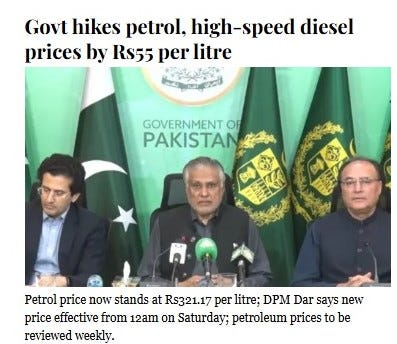
On the night of March 6, Deputy Prime Minister Ishaq Dar walked to a podium and opened with Iran. He described the strikes, the closure of the Strait of Hormuz, the extraordinary circumstances confronting the region. Finance Minister Muhammad Aurangzeb called it an exceptional global situation. Petroleum Minister Ali Pervaiz Malik said the government had been safeguarding reserves for weeks.
Then they announced Rs55 per litre on petrol and diesel.
None of them mentioned that the Federal Board of Revenue had missed its eight-month revenue target by Rs429 billion.
None of them mentioned that the petroleum levy on petrol had already been raised to Rs82 per litre before the war began, specifically to compensate for that shortfall.
None of them mentioned that the IMF had been pressing Pakistan to raise fuel prices immediately since before the first strike hit Iranian soil.
None of them mentioned the Rs400 billion emergency reserve the IMF asked Pakistan to set aside last June for exactly this kind of shock, and which the government did not deploy.
The war in the Gulf is real. The pressure from the Hormuz closure is real. The Rs55, however, is not a war number. It is the sum of years of structural fiscal failure, a standing IMF demand, a petroleum levy already raised for domestic fiscal reasons, and a government that found in the killing of Khamenei the most useful cover it could have hoped for.
On January 16, petrol in Pakistan was priced at Rs253.17 per litre. Diesel at Rs257.08. Those prices held into late February.
On February 28, Operation Epic Fury began. On March 1, the first post-war price revision came through. Petrol rose by Rs8 per litre. Diesel by Rs5.16. On March 6, the government announced Rs55 on both products. Effective midnight.
The sequence looks like war pricing. The numbers say otherwise.
Industry analysts had projected a petrol increase of Rs4.50 to Rs7 per litre for the March 1 cycle before the war started. The March 1 hike of Rs8 was barely above a routine adjustment. What changed at the March 6 announcement was not the market alone. What changed was the political window.
Petrol went from Rs253.17 in January to Rs321.17 on March 7. That is a Rs68 total increase in seven weeks. The war-driven import cost surge, traced through the petrol import premium jump from $5 per barrel to $17, accounts for Rs15 to Rs20 per litre on future cargoes. The rest was already in the pipeline before the first bomb fell on Tehran.
The Federal Board of Revenue missed its eight-month revenue target by Rs429 billion. Between July and February of fiscal year 2025-26, the FBR collected Rs8.121 trillion against a target of Rs8.550 trillion. The IMF has already revised down Pakistan’s annual FBR collection target by Rs150 billion. The FBR missed its target in the previous fiscal year as well.
This is the structural context in which the Rs82 petroleum levy on petrol must be read.
The Express Tribune, citing sources present at Friday’s ministerial huddle, confirmed the following: the petroleum levy rate on petrol had already been raised to Rs82 per litre to compensate for the FBR’s revenue shortfall. That decision predates the Iran war. It is a domestic fiscal decision taken in response to a domestic fiscal failure. The war did not create that levy. The war did not raise it. The war arrived to find it already sitting at Rs82 and provided the government a justification for avoiding further questions about how it got there.
Pakistan collected Rs822 billion through the petroleum development levy between July and December 2025. That is more than 60 percent of the full-year target achieved in the first six months. To hit the Rs1.468 trillion PDL target by June 30, the government needed to sustain heavy per-litre levy collection through the back half of the fiscal year. A fuel price hike was not a contingency. It was a budget line.
Before Operation Epic Fury, the IMF had already instructed Pakistan to raise petroleum product prices in line with international market rates and to avoid providing subsidies on petrol or diesel. Officials familiar with the discussions confirmed the Fund stressed that the PDL target of Rs1.468 trillion must not be compromised. Reports from February 28, the day war started, already projected the ex-refinery price of petrol rising by Rs32 per litre by March 15 under pre-war market conditions alone, as international Platts averages had been trending upward through February.
A price hike was scheduled before anyone in Washington gave the order to strike.
The IMF had also specifically requested, in June 2025, that Pakistan set aside Rs400 billion in contingency reserves to cushion against unforeseen shocks. Pakistan set that money aside. When the largest energy shock in years arrived, the government chose not to deploy it. It raised prices instead. The Rs400 billion contingency fund, built at IMF direction for exactly this scenario, remains unspent while motorcycle commuters across Karachi and Lahore absorb the difference at the pump.
Here is what neither Dar, Aurangzeb nor Malik addressed at the podium: Pakistan’s existing fuel stocks were purchased approximately 24 days before the price announcement, at pre-war prices.
Industry sources confirmed to Profit Pakistan Today that stocks reportedly purchased at lower rates may now be sold at the revised higher price. The Express Tribune reported that Dar held two consecutive meetings Friday specifically to find a way to apply the increase without generating excessive windfall profits for oil marketing companies on their existing inventory. He did not find that way. Or did not try hard enough.
The Rs55 hike applies to every litre in the system, including the 25 to 26 days of existing stock sitting at depots and filling stations across the country, acquired at costs that reflect a world before any war started. The government announced a war surcharge on fuel that cost no war price to purchase.
The Rs55 is not even a single number applied on a single logic.
The Express Tribune documented the following: the increase in petrol prices exceeded the actual surge in international market costs because the government chose to extract more than the required amount from petrol users in order to subsidise diesel, primarily consumed by public transport and agriculture.
Petrol in Pakistan is used overwhelmingly by low-income motorcycle commuters. Diesel runs long-haul freight, agriculture machinery and intercity buses. The government decided, on the night of March 6, to charge the motorcycle commuter above the war-adjusted cost in order to hold diesel prices down for another constituency entirely. That cross-subsidy structure is not a war decision. It is a political pricing decision with distributional consequences, dressed in crisis language so that neither the arithmetic nor the logic would be interrogated in the days following.
The government stated the hike was driven by the Iran war and the Hormuz closure.
The IMF was demanding a price increase before the war began. Officials had already projected a Rs32 per litre rise by March 15 on pre-war market trajectories. The PDL on petrol had already been raised to Rs82 to compensate for the FBR’s Rs429 billion shortfall. The Rs400 billion contingency reserve built for exactly this emergency was not deployed. Existing stocks purchased at pre-war prices are being sold at the full Rs55 war surcharge. The petrol increase exceeds the war-driven international cost movement because it is cross-subsidising diesel.
Of the Rs55, the portion attributable to the actual Hormuz-driven import cost surge on future cargoes is Rs15 to Rs20. The rest is structural mismanagement with new packaging.
Pakistan is at its highest poverty level in eleven years and its highest unemployment level in twenty-one years. This is not an opposition estimate. It is embedded in the Express Tribune’s own analysis of Friday’s announcement, drawn from sources inside the government’s own ministerial huddle.
The people filling their motorcycles on Shahrah-e-Faisal tonight are paying for a war they didn’t start, a tax deficit they didn’t create, and a contingency fund the government saved for someone else.